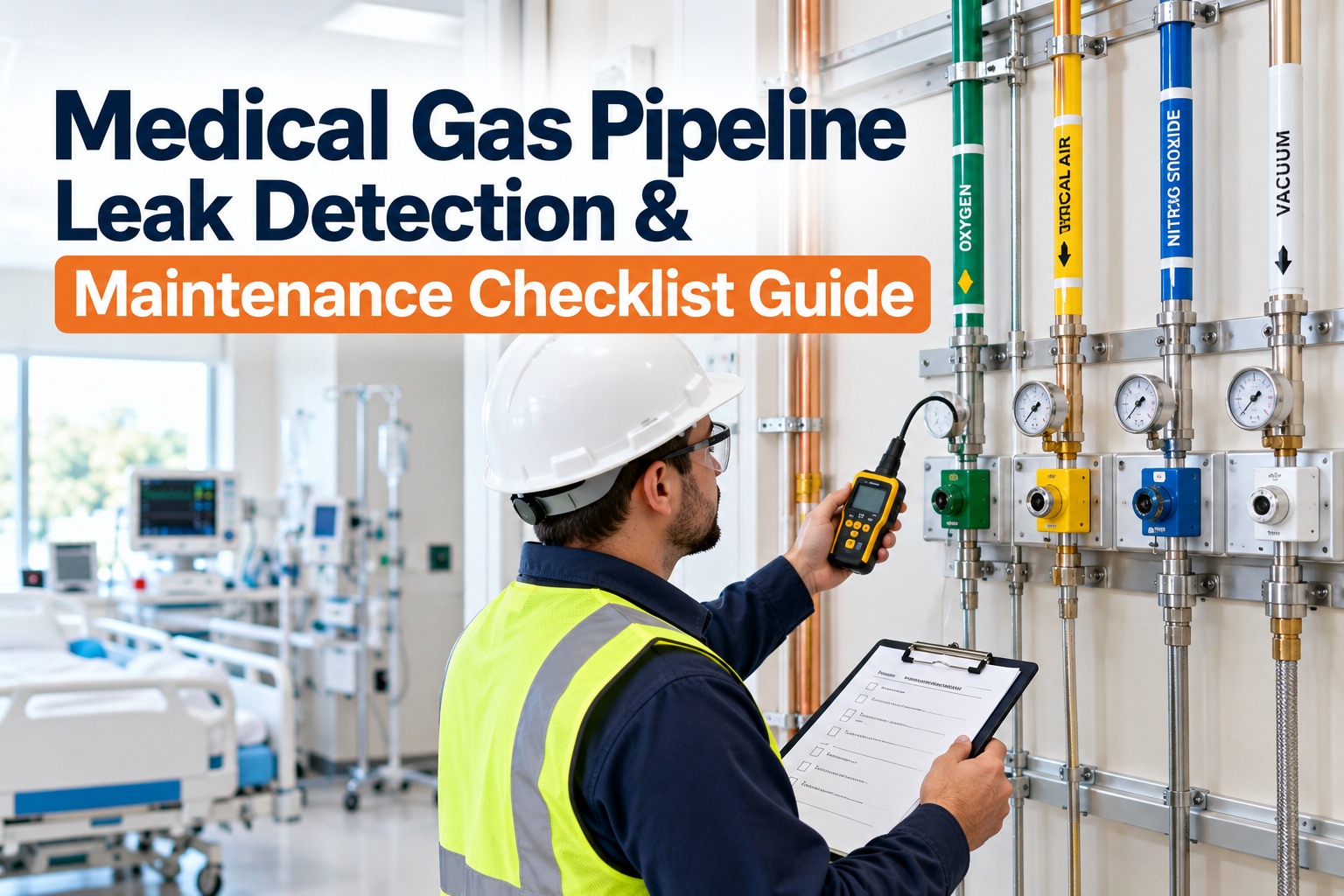
Medical gas systems are the invisible lifeline of every hospital. Oxygen flowing to ICU beds, nitrous oxide powering anesthesia in surgical suites, nitrogen preserving tissue samples in laboratories — these gases are classified by the FDA as pharmaceuticals, and they travel through miles of hidden piping above ceilings, behind walls, and under floors. Yet most hospitals still rely on outdated methods like spray-and-bubble testing to find leaks in these critical pipelines. The result is staggering: compressed gas leaks can silently drain thousands of dollars every single month while creating fire hazards, exposing healthcare workers to toxic gases, and jeopardizing patient treatments in emergency and surgical situations. Artificial intelligence is now rewriting the rules of medical gas safety, and hospitals that adopt AI-powered predictive maintenance are catching dangerous leaks weeks before traditional methods ever could.
These numbers tell a clear story — the healthcare industry is rapidly moving away from reactive, calendar-based maintenance toward intelligent systems that predict failures before they happen. Facilities that continue relying on manual inspections risk falling behind in both safety performance and regulatory compliance. If your hospital is still catching leaks after they become problems, it is time to explore a smarter approach. Sign up with OxMaint and put AI-powered leak detection to work for your facility today.
The Hidden Danger Beneath Hospital Ceilings
Medical gases are among the most frequently administered drugs in the United States. Oxygen, nitrogen, nitrous oxide, carbon dioxide, helium, and medical air each serve critical clinical functions — from life support ventilation and surgical anesthesia to tissue preservation and respiratory therapy. These gases must be transported, stored, and dispensed under strict federal standards, and the delivery infrastructure extends from bulk storage tanks or compressors through complex piping networks to individual patient room outlets, operating room ceiling systems, and laboratory connections.
The challenge is that leaks develop silently in this vast infrastructure. The Joint Commission has documented that hospital employees in operating rooms and laboratories face heightened risk of injury from medical gas exposure. Waste anesthetic gases escape through deteriorating connectors, tubing joints, and valves. Oxygen leaks push room concentrations above the 22.5% threshold, creating conditions where materials that would not normally burn can ignite violently. Pressure drops from compressed air leaks compromise surgical instrument performance during critical procedures. And because hospitals often oversize compressors to compensate for unknown leaks, the energy waste compounds month after month.
OSHA recommends using approved leak detection liquids sprayed around suspected areas to watch for bubbles — a method that is slow, imprecise, and often unsuccessful in the complex piping environments found in modern hospitals. Even ultrasonic acoustic detectors require technicians to conduct point-by-point inspections, making comprehensive coverage of an entire facility nearly impossible within practical time constraints. These limitations create a dangerous gap between when leaks begin and when they are discovered. Book a demo to see how OxMaint closes this detection gap with artificial intelligence.
How AI Detects What Manual Inspections Miss
The fundamental limitation of traditional leak detection is that it depends on a human being physically present at the exact location of a leak at the exact time an inspection is scheduled. Artificial intelligence eliminates this dependency entirely. AI-powered predictive maintenance uses networks of IoT sensors installed throughout the medical gas delivery infrastructure to continuously capture real-time data on pressure, flow rates, temperature, and gas concentrations — 24 hours a day, 7 days a week, across every pipeline segment, manifold, regulator, and outlet in the facility.
Machine learning algorithms trained on historical maintenance data and live sensor readings establish baselines for what normal system behavior looks like. When subtle deviations appear — a gradual pressure decline in a specific zone, an unusual flow pattern suggesting a developing micro-fracture, or a temperature anomaly around a valve seal — the system identifies these patterns as early indicators of a developing leak. Published research in the journal Medical Gas Research confirms that deep learning algorithms can now facilitate real-time monitoring and leak detection in compressed medical gas systems, analyzing data streams to immediately identify anomalies and reduce the risk of hazardous situations.
What makes this approach transformative is not just the speed of detection — it is the ability to predict failures that have not yet occurred. A traditional inspection might find a leak that has already been wasting gas for weeks. An AI system identifies the conditions that lead to leaks and triggers maintenance before the first molecule of gas escapes. For facilities managing complex pipeline networks across multiple buildings and floors, this shift from reactive to truly predictive maintenance represents a fundamental upgrade in both safety and operational efficiency. Sign up for OxMaint and experience predictive intelligence for your medical gas infrastructure.
Detect Leaks Before They Cost You
OxMaint's intelligent CMMS monitors your entire medical gas network in real time, predicts component failures, automates work orders, and keeps your facility compliant with NFPA 99 and Joint Commission standards — all from one unified platform.
NFPA 99 Compliance: Why Documentation Matters More Than Ever
Medical gas systems in U.S. hospitals are governed by NFPA 99 (Health Care Facilities Code), which establishes risk-based criteria for system design, installation, and ongoing maintenance. The Centers for Medicare and Medicaid Services adopted the 2012 edition of NFPA 99 in July 2016, and Joint Commission standard EC.02.05.09 requires hospitals to inspect, test, and maintain their piped medical gas and vacuum systems in compliance with these provisions. Facilities must perform documented risk assessments, classify systems into risk categories (1 through 4) based on patient impact, and maintain comprehensive maintenance records that demonstrate ongoing compliance.
The compliance challenge for most hospitals is not a lack of good intentions — it is the difficulty of maintaining thorough documentation across dozens or hundreds of system components when maintenance is managed through paper-based processes or disconnected spreadsheets. A survey found that 50% of hospitals have errors in basic zone valve labeling alone. When Joint Commission surveyors arrive, they expect to see that regular maintenance and testing has been performed on every critical component and that any identified issues have been promptly addressed with documented evidence.
Health Care Facilities Code
Risk-based criteria for medical gas system design, installation, maintenance, and testing. Requires documented risk assessments, permit-to-work systems, and qualified Responsible Facility Authority personnel.
EC.02.05.09 Standard
Mandates inspection, testing, and maintenance of piped medical gas and vacuum systems. Incorporates NFPA 99-2012 provisions and requires documented evidence of ongoing compliance activities.
Pharmaceutical Regulation
Medical gases are regulated as pharmaceuticals requiring prescriptions for use. Strict standards govern transportation, storage, dispensing, and delivery infrastructure including tanks, regulators, and tubing.
Workplace Safety Standards
Occupational exposure limits for anesthetic gases and compressed gas handling requirements. Mandates leak detection procedures and protective measures for healthcare workers in high-risk areas.
This is where a modern CMMS becomes indispensable. Every inspection, repair, test, and maintenance activity logged through the platform is automatically timestamped, attributed to specific technicians with digital signatures, and organized into audit-ready reports. When it is time for a Joint Commission survey or CMS review, the documentation is already complete — no last-minute scrambling, no missing records, no compliance gaps. Book a demo to see how OxMaint automates compliance documentation for your medical gas systems.
What a Smart CMMS Actually Does for Medical Gas Management
A Computerized Maintenance Management System designed for healthcare goes far beyond simple work order tracking. When integrated with AI analytics and IoT sensor networks, it becomes the command center for your entire medical gas infrastructure — connecting real-time condition data with maintenance workflows, compliance documentation, and team coordination in a single platform. Here is what that looks like in practice for hospitals managing complex gas delivery systems.
Hospitals that implement comprehensive CMMS platforms with AI capabilities typically report 20-40% reductions in overall maintenance expenses and 15-30% savings in energy costs. For medical gas systems specifically, the elimination of undetected leaks, reduced emergency repairs, and optimized compressor sizing create measurable financial returns within the first year of deployment. Sign up for OxMaint to bring this level of intelligence to your maintenance operations.
Reactive vs. Preventive vs. Predictive: Understanding the Difference
Not all maintenance strategies deliver the same results, and understanding the distinction is essential for healthcare facility managers evaluating their options. The differences between reactive, preventive, and predictive approaches determine not just costs — but patient safety outcomes, staff exposure risks, and regulatory compliance posture.
The trajectory of the healthcare industry is unmistakably toward predictive intelligence. About 65% of U.S. hospitals already report using predictive analytics or AI-driven models in their operations, and AI integration in gas leak detection systems specifically has grown by 30% in recent product launches. Facilities that delay adoption are not just missing efficiency gains — they are accepting higher safety risk that could be prevented with technology already available and proven. Book a demo to see where your facility stands and how quickly you can transition to predictive maintenance.
Frequently Asked Questions
What types of medical gas leaks can AI-powered systems detect
AI-driven CMMS platforms integrated with IoT sensors can detect leaks across all common medical gases including oxygen, nitrous oxide, nitrogen, carbon dioxide, compressed medical air, and helium. The system monitors pressure differentials, flow rate anomalies, temperature variations, and gas concentration changes across the entire pipeline network — from bulk storage and manifold systems to individual terminal outlets in patient rooms, operating suites, ICUs, and laboratories. The AI models are trained to distinguish between normal operational variations and genuine anomalies indicating developing leaks.
How quickly can AI detect a medical gas leak compared to manual inspection
Traditional manual inspection methods like spray-and-bubble testing or handheld ultrasonic detectors can only find leaks during the specific time a technician is physically present at the leak location. This means leaks can persist for days, weeks, or even months between scheduled inspections. AI-powered monitoring operates continuously, analyzing sensor data in real time around the clock. Anomalies are typically flagged within minutes of deviation from established baselines, and predictive algorithms can identify conditions likely to produce leaks days or weeks before they actually develop.
Does OxMaint help with NFPA 99 and Joint Commission compliance
Yes. OxMaint automatically generates compliance documentation aligned with NFPA 99 (Health Care Facilities Code), Joint Commission standard EC.02.05.09, FDA pharmaceutical handling requirements, and OSHA workplace safety standards. Every maintenance activity, inspection, test, and repair is logged with digital timestamps and technician attribution. Risk assessment records, maintenance histories, and audit reports are organized and accessible at any time, eliminating the manual documentation burden that causes compliance gaps during surveys.
What is the return on investment for AI-powered medical gas monitoring
Healthcare facilities implementing AI-driven predictive maintenance typically see 20-40% reductions in maintenance expenses and 15-30% decreases in energy costs. For medical gas systems specifically, eliminating undetected leaks stops the ongoing waste of expensive pharmaceutical gases, reduces emergency repair costs, and removes the need for oversized compressors used to compensate for unknown pressure losses. Most hospitals begin seeing measurable returns within 6-12 months, with full ROI commonly achieved within 18 to 24 months depending on facility size.
Can OxMaint integrate with our existing hospital building management systems
OxMaint is designed to integrate with existing hospital IT infrastructure including building management systems, fire alarm panels, centralized monitoring dashboards, and electronic health record platforms. The system uses standard APIs and interoperability protocols to exchange data seamlessly with your current technology stack. This means you add AI-powered predictive maintenance capabilities on top of the infrastructure already in place — no full system replacement required.
Is AI-powered medical gas monitoring only beneficial for large hospital systems
While large multi-building hospital campuses with extensive pipeline networks see the most dramatic improvements due to scale, facilities of all sizes benefit from predictive monitoring. Smaller surgical centers, dental practices using nitrous oxide, outpatient facilities with oxygen delivery, and specialty clinics all have medical gas infrastructure that requires monitoring and maintenance. The automated nature of AI-driven systems is particularly valuable for smaller facilities that may not have dedicated maintenance engineering teams.
How does predictive maintenance reduce environmental impact from medical gas leaks
Leaked medical gases — particularly nitrous oxide, which is approximately 300 times more potent as a greenhouse gas than carbon dioxide — contribute significantly to healthcare's environmental footprint. By detecting and preventing leaks before they occur, predictive maintenance reduces the volume of medical gases released into the atmosphere. It also decreases the frequency of gas deliveries and the energy consumed by oversized compressors, further lowering the facility's carbon emissions and supporting sustainability objectives.
Your Patients Depend on Gas Systems You Cannot See — Make Sure AI Can
Join forward-thinking healthcare facilities using OxMaint to predict medical gas failures, automate compliance, and protect what matters most. Set up takes minutes, and the impact is immediate.