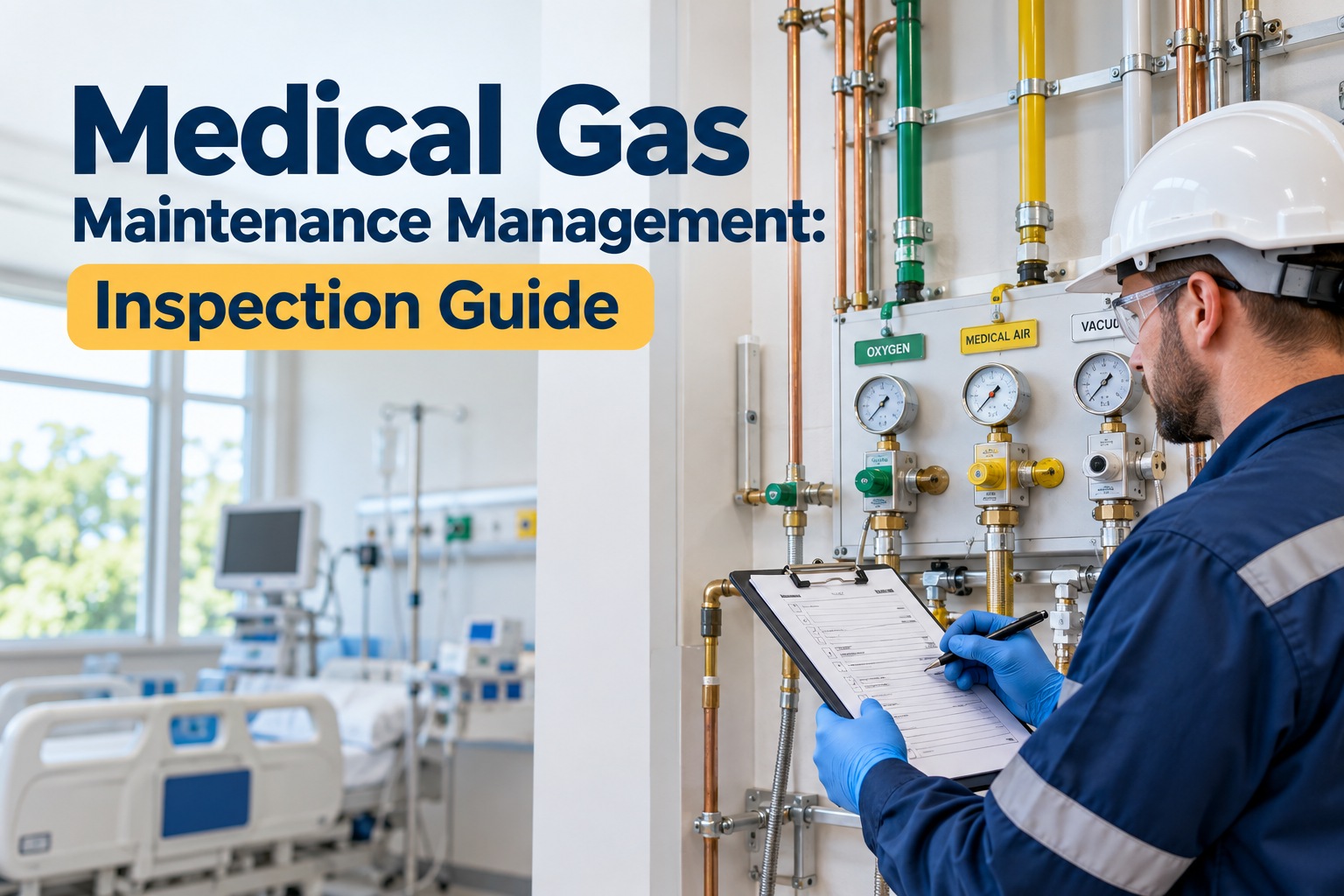
Medical Gas Maintenance Management: Inspection Guide

By William Jerry on September 26, 2026

medical-gas-maintenance-management-inspection-guide

Of every system in a hospital, medical gas is the one where a maintenance lapse can reach a patient directly. A contaminated air line, a mislabeled zone valve, a source alarm nobody heard — these aren't equipment problems that inconvenience operations; they're life-safety failures that show up on the ward. Which is exactly why medical gas sits under NFPA 99 with prescribed inspections, witnessed alarm tests, and documentation a surveyor will ask to see. This guide covers what medical gas maintenance requires and how OXMAINT AI, the AI-powered CMMS, keeps every inspection scheduled, every finding tracked to a fix, and every record audit-ready.

Hospitals & Health Systems · Medical Gas · NFPA 99 Maintenance

Medical Gas Maintenance Management: Inspection Guide

Medical gas compliance isn't just doing the inspection — it's proving you did it, on schedule, with every finding closed out. When a surveyor asks for the last zone-valve test or alarm verification, "we did it" isn't an answer; the dated, signed record is. OXMAINT AI schedules each inspection, routes every finding into a corrective work order, and keeps the whole trail on the asset — so the evidence is ready before anyone asks.

Scheduled inspection → Finding logged → Corrective work order → Audit-ready record
Inspections scheduled, never missed Findings tracked to corrective action Records ready for the surveyor

The Four Systems You're Maintaining

"Medical gas" is really four distinct systems, each with its own components, failure modes, and inspection points. A maintenance program has to cover all four — a gap in any one is a gap in patient safety. Start free and track all four on one system.

O₂
Oxygen
Bulk liquid storage, pressure regulation, manifolds, zone valves, and area alarm panels — the most critical line to keep flowing and clean.
AIR
Medical Air
Compressors, desiccant dryers, receivers, and intake filters — with high-temp, high-pressure, and carbon-monoxide monitoring on the alarms.
VAC
Medical Vacuum
Pumps, inlet and bacterial filters, receivers, zone valves, and waste anesthetic gas disposal — the suction side that's easy to under-maintain.
N₂O
Nitrous Oxide
Manifolds, cylinder storage, regulators, zone valves, and scavenging systems — with leak and exposure control front of mind.

The Inspection Cadence

NFPA 99 frames medical gas upkeep as a rhythm of checks — some daily, some annual, each with its own record. The frequencies below are typical; your AHJ, equipment, and facility policy set the specifics. Book a demo to build this cadence for your facility.

Daily Check source pressures and gauges; confirm no active master or area alarms and that supply levels are within range
Monthly Inspect the source equipment — compressors, dryers, vacuum pumps — for condition, drain moisture, and service filters per manufacturer intervals
Quarterly Walk the distribution — zone valves labeled and accessible, outlets and inlets sound, alarm panels reading correctly
Annual Full witnessed testing — zone-valve pressure verification, master alarm checks, medical-air CO testing — typically by an ASSE-certified inspector

The Inspection Isn't Done Until the Record Is.

A perfectly executed zone-valve test with no dated, signed record is, to a surveyor, a test that didn't happen. OXMAINT AI captures each inspection against the asset with who, when, and what was found — so compliance is built as the work is done, not reconstructed the week before a survey.

From Finding to Fix — The Compliance Loop

An inspection that flags a problem is only half the job. NFPA 99 compliance means the finding is corrected and the correction is documented — a closed loop, not a note in a binder. Start free and close every finding to a fix.

01
Inspect on Schedule
The recurring inspection fires and is completed against the specific gas asset, with its checklist attached.
▼
02
Log the Finding
A deficiency — a sticking zone valve, a drifting alarm, a CO reading — is recorded as a defect on the record, not a mental note.
▼
03
Raise Corrective Action
The finding converts to an assigned, prioritized corrective work order — the fix is owned and tracked, not left open.
▼
04
Close & Document
The correction is completed, signed off, and stored on the asset — a complete inspection-to-resolution trail ready for any survey.

What a Surveyor Will Ask to See

Joint Commission and CMS surveys probe whether the paper matches the practice. Each item below is a question you want a dated record ready for — not a scramble to assemble. Book a demo to keep these on hand.

EvidenceThe question behind it
Inspection records Were the required inspections done, on schedule, and signed?
Zone-valve test Are shut-off valves verified, labeled, and accessible?
Alarm verification Were master and area alarms witnessed and confirmed working?
Medical-air quality Is the CO/air-quality testing current and within limits?
Corrective actions Was every finding closed, and how long did it take?
Filter / service log Are source-equipment filters and service on their intervals?

How OXMAINT AI Manages Medical Gas

Compliance holds when scheduling, findings, and records live in one place tied to the equipment. Here's what OXMAINT AI keeps together. Start free and put it all on one system.

Inspections that schedule themselves
Daily, monthly, quarterly, and annual checks generate and assign automatically per asset, so no required inspection quietly slips past due.
Findings into corrective work orders
A deficiency becomes an assigned, prioritized job in one step, so every flagged issue is owned and closed instead of noted and forgotten.
Records on the asset, audit-ready
Who inspected, when, what was found, and how it was resolved all sit on the equipment record — exportable the moment a surveyor asks.
All four systems in one view
Oxygen, air, vacuum, and nitrous are tracked together, so no system is the one that gets overlooked between the others.

Binder-and-Memory vs. OXMAINT AI

What mattersPaper binder & memoryOXMAINT AI
Inspection scheduling Remembered, easy to miss Auto-generated per asset
Findings Noted, sometimes lost Routed to corrective action
Corrective tracking Open with no owner Assigned and closed out
Survey records Assembled under pressure Ready on the asset record
Four-system coverage One can be overlooked All tracked together
Audit trail Gaps hard to explain Complete and timestamped

Frequently Asked Questions

What standard governs medical gas maintenance?
NFPA 99 (Health Care Facilities Code) sets the inspection, testing, and documentation requirements, and Joint Commission and CMS surveys check compliance against it. Your authority having jurisdiction and facility policy determine the exact specifics. Start free and align to your requirements.
Which inspections need a certified inspector?
Annual verification testing — zone valves, alarms, and gas quality — is typically performed by an ASSE-certified medical gas inspector, while routine daily and monthly checks are handled by facility staff. Keeping both on record is what compliance requires. Book a demo to track both.
Why does documentation matter as much as the work?
Because in a survey, an undocumented inspection is treated as one that didn't happen. The dated, signed record — plus proof each finding was corrected — is the evidence of compliance, so capturing it as the work is done is essential. Start free and document as you go.
What happens when an inspection finds a problem?
It has to be corrected and the correction documented — that's the compliance loop. Logging the finding, raising a corrective work order, and closing it with a record turns a deficiency into demonstrable follow-through rather than an open risk. Book a demo to see the loop.
How does a CMMS help with medical gas specifically?
By keeping the scheduling, findings, corrective actions, and records for all four gas systems tied to the equipment in one place — so inspections never slip, findings never get lost, and survey evidence is ready without a last-minute reconstruction. Start free and manage it in one place.

Keep Patients Safe — and the Records Ready.

Schedule every medical gas inspection, route every finding into a tracked corrective action, and keep the complete trail on the asset — so all four systems stay compliant and survey-ready every day, not just before a survey.


Share This Story, Choose Your Platform!