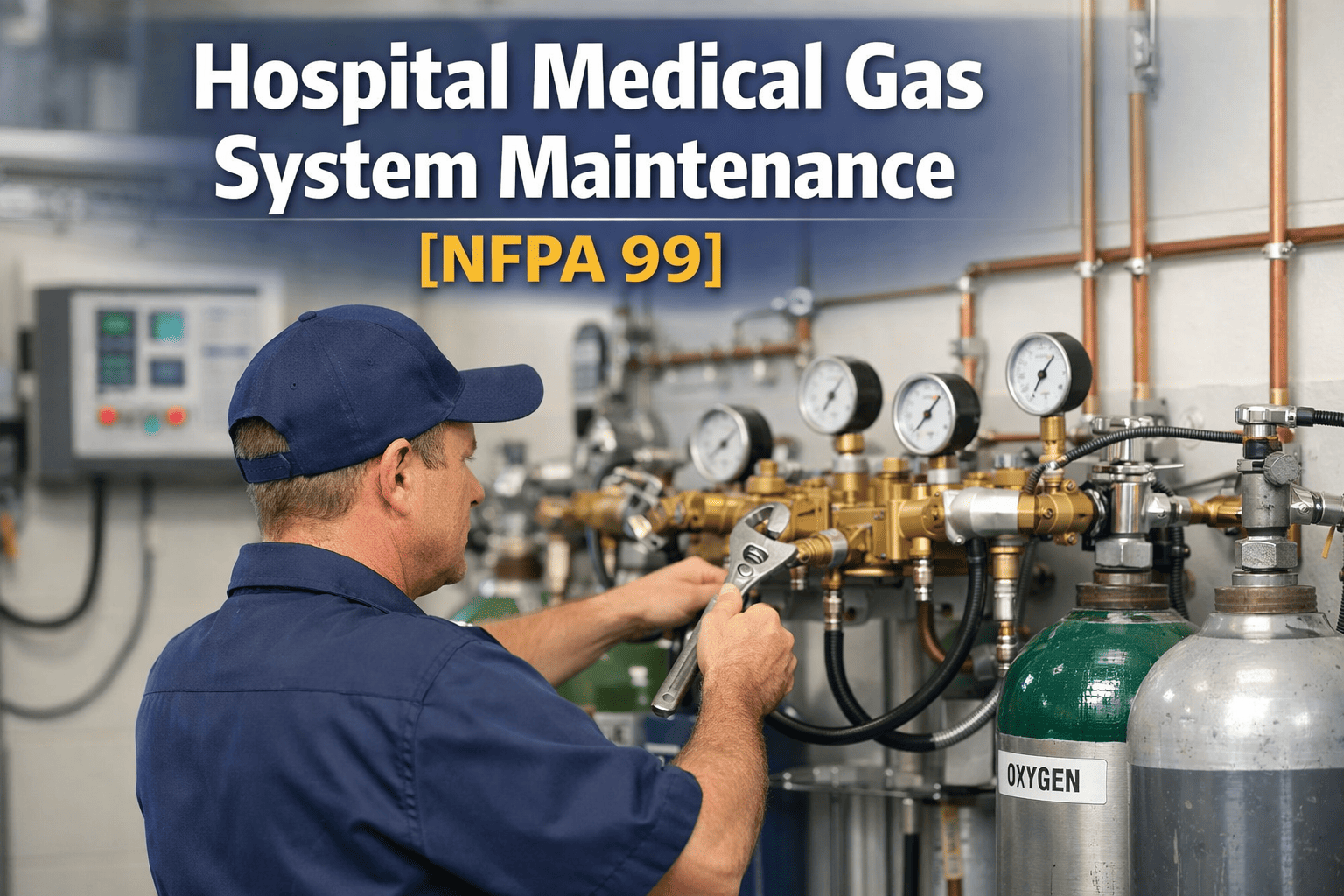
A medical gas system failure during active patient care is not a maintenance inconvenience — it is a sentinel event. NFPA 99 mandates documented inspection, alarm verification, and zone valve testing for every oxygen, medical air, vacuum, and nitrous oxide system serving patient care areas. Yet most hospital facilities teams manage these obligations through paper logs, shared spreadsheets, and verbal reminders — until a Joint Commission surveyor or an unplanned shutdown exposes the gap. OxMaint digitizes the entire medical gas inspection workflow, from scheduled PM triggers to alarm test evidence, so your team meets NFPA 99 and TJC requirements on every inspection cycle. Book a demo to see how it works for your facility.
Medical Gas — Downtime Prevention Guide
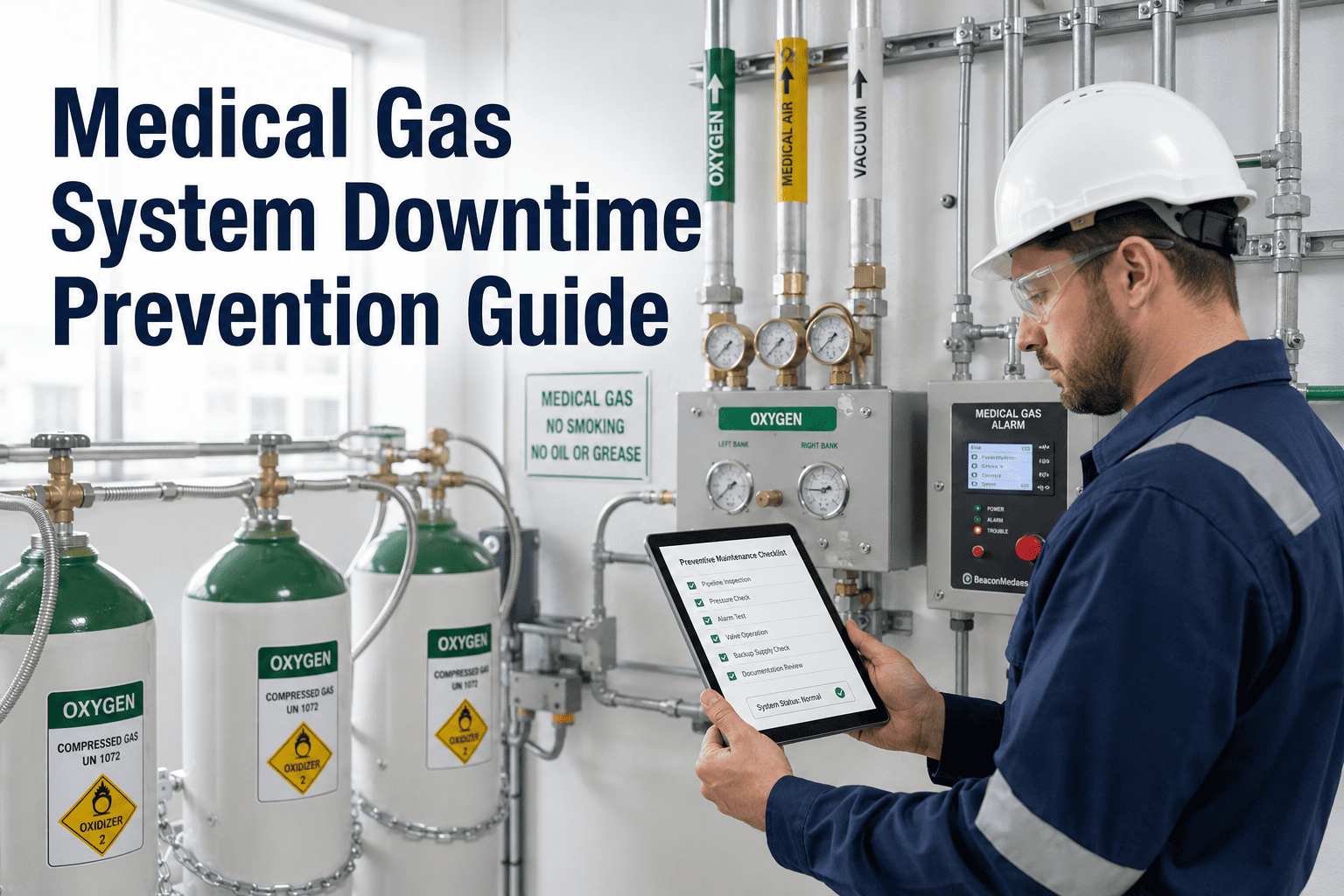
Medical Gas System Downtime Prevention Guide
How to protect oxygen, medical air, vacuum, and nitrous oxide systems from failure — and prove NFPA 99 compliance on demand.
Sentinel Event Risk
Oxygen System Failure
Total OR or ICU oxygen supply disruption — immediate threat-to-life designation by TJC surveyors
High Citation Risk
Alarm Test Gap
Master alarm panel and area alarm verification records missing or outdated beyond required intervals
Compliance Risk
Zone Valve Documentation
Zone valve inspection records absent or not linked to specific system and patient care area served
The 4 Medical Gas Systems That Require Scheduled Maintenance
O2
Oxygen (Level 1)
QuarterlyCentral supply pressure checks, bulk storage inspection, manifold switchover test
AnnualFull pipeline pressure verification, bulk storage capacity review, CO monitor calibration
Per EventArea alarm test after any zone valve work or system modification
AIR
Medical Air (Level 1)
QuarterlyCompressor intake filter, desiccant dryer performance, receiver tank inspection
QuarterlyHigh-temperature, high-pressure, and carbon monoxide alarm verification and documentation
AnnualDew point measurement, oil content verification, full pipeline pressure test
VAC
Medical Vacuum (Level 1)
QuarterlyVacuum pump inspection, receiver tank check, reserve pump activation test
QuarterlyArea alarm panel test — high vacuum pressure alarm at each patient care area
AnnualFull pipeline vacuum level verification, seal inspection, exhaust discharge check
N2O
Nitrous Oxide (Level 2)
QuarterlyManifold pressure check, cylinder connection inspection, supply/reserve switchover
AnnualFull pipeline verification, operating room terminal unit function test
Per UseLeak check at terminal units, nitrous oxide ambient level monitoring in occupied ORs
Under FDA 21 CFR Part 213 (effective December 2025), medical gases are classified as drugs. This means facilities must now maintain cGMP-level documentation for equipment cleaning, maintenance, and container integrity — not just NFPA 99 compliance. Facilities without a digital maintenance record trail face both TJC and FDA citation exposure.
How OxMaint Prevents Medical Gas Downtime
From Inspection Schedule to Audit Evidence — Automatically
1
Schedule by System & Interval
Configure quarterly, annual, and event-based PM tasks for each gas system. OxMaint triggers work orders automatically — no manual calendar tracking, no missed inspection windows.
2
Technician Executes with Guided Checklist
The mobile app presents the NFPA 99-aligned inspection checklist for each system type. Technicians complete fields, record pressure readings, capture photos of alarm panel results, and sign off from the plant room.
3
Escalate Alarms and Failures Instantly
Any failed alarm test or abnormal pressure reading triggers a work order escalation to the maintenance supervisor with priority classification. Critical gas system issues cannot sit in a queue unnoticed.
4
Export NFPA 99 Compliance Evidence
All inspection records, alarm test results, and corrective work orders export as a timestamped NFPA 99 compliance package — organized by system type and inspection interval. Survey-ready in one click.
See the Medical Gas Workflow
30-Minute Demo Built for Facilities Teams
We walk you through NFPA 99 PM scheduling, alarm test capture, escalation rules, and compliance export — applied to your specific gas systems and patient care areas.
NFPA 99 Medical Gas Inspection Intervals at a Glance
| System | Component | Inspection Interval | Documentation Required | Citation Risk if Missed |
|---|---|---|---|---|
| Oxygen | Bulk storage & central supply | Quarterly + Annual | Pressure readings, capacity review, CO monitor calibration | Immediate threat-to-life possible |
| Medical Air | Compressor, dryer, alarms | Quarterly | Alarm test results, dew point, oil content, CO alarm verification | High — EC.02.05.01 finding |
| Medical Vacuum | Pump, receiver, area alarms | Quarterly + Annual | Area alarm panel tests, vacuum level verification, seal inspection | Medium — EC documentation gap |
| Nitrous Oxide | Manifold, terminal units | Quarterly + Per Use | Pressure checks, leak test records, ambient monitoring in ORs | Medium — OR shutdown risk |
| Zone Valves | All systems — all patient care areas | After any service event | Area alarm test record linked to zone and care area | High — post-modification requirement |
| Master Alarm Panels | All systems | Per manufacturer + periodic | Panel function test, all indicator verification, technician ID, date | High — TJC commonly cited |
Expert Review
Medical gas systems fail quietly. Zone valves are mislabeled. Alarm panels have dead indicators nobody noticed. These aren't high-drama failures — they're the kind of drift that only a structured, documented PM program catches before a patient event. Facilities running paper-based gas system records are operating on faith, not evidence. The transition to a digital CMMS for medical gas compliance is not a luxury — it is the difference between a finding and a sentinel event report.
DP
David Pratt
Medical Gas Compliance Engineer, ASSE 6040 Certified, 20 years in hospital piped gas systems maintenance and inspection
Frequently Asked Questions
What NFPA 99 certification is required for hospital medical gas maintenance technicians?
NFPA 99 Section 5.1.14.2.2.5 specifies that maintenance personnel must hold ASSE 6040 certification, and verifiers must hold ASSE 6030 certification, or have completed a documented training program acceptable to the healthcare facility. Under the 2024 edition, reference to ASSE/IAPMO/ANSI 6060 was added for medical gas systems designers. Facilities should maintain training records and certification documents for every technician assigned to medical gas work in their CMMS asset and personnel records. OxMaint stores technician certifications linked to work order assignments.
How does FDA 21 CFR Part 213 (December 2025) affect hospital medical gas maintenance records?
The December 2025 effective date of 21 CFR Part 213 brings hospital medical gas maintenance documentation under cGMP requirements — previously applied primarily to gas manufacturers. Hospitals must now maintain records covering equipment cleaning procedures, maintenance schedules, container integrity checks, and supplier verification documentation at a pharmaceutical compliance standard. This is a significant expansion of documentation obligations beyond NFPA 99 alone, and facilities using paper-based systems will struggle to demonstrate cGMP compliance during FDA facility inspections. Book a demo to see how OxMaint structures cGMP-level records.
What should a medical gas alarm test record include to satisfy Joint Commission review?
A compliant alarm test record must include the specific alarm panel location and patient care area served, the gas type and alarm type tested (high pressure, low pressure, high temperature, carbon monoxide), the test result (pass/fail), the technician's name or ID, and the date and time of the test. Records linked only to a general "medical gas inspection" without identifying the specific panel location and alarm function tested are routinely rejected by TJC surveyors as insufficient evidence. OxMaint's medical gas inspection templates enforce all required fields before a work order can close. See the inspection template in a free trial.
How quickly does OxMaint escalate a failed medical gas alarm test to the maintenance supervisor?
Escalation is immediate upon work order submission. When a technician marks an alarm test as failed or records an out-of-range pressure reading in OxMaint, the system creates a priority corrective work order and sends a notification to the designated supervisor within the same session. Escalation rules can be configured by system type, patient care area criticality, and time of day — ensuring OR and ICU gas system failures receive the highest priority routing regardless of which shift discovers the issue. See escalation configuration in a demo.
Medical Gas Compliance Built Into Every Inspection
Stop Relying on Memory to Protect Your Gas Systems
OxMaint schedules every NFPA 99 inspection interval, guides technicians through gas-type-specific checklists, escalates failures immediately, and exports survey-ready compliance evidence in one click.
4
Gas systems tracked
1-click
NFPA 99 export
Instant
Alarm failure escalation
100%
Technician-signed records