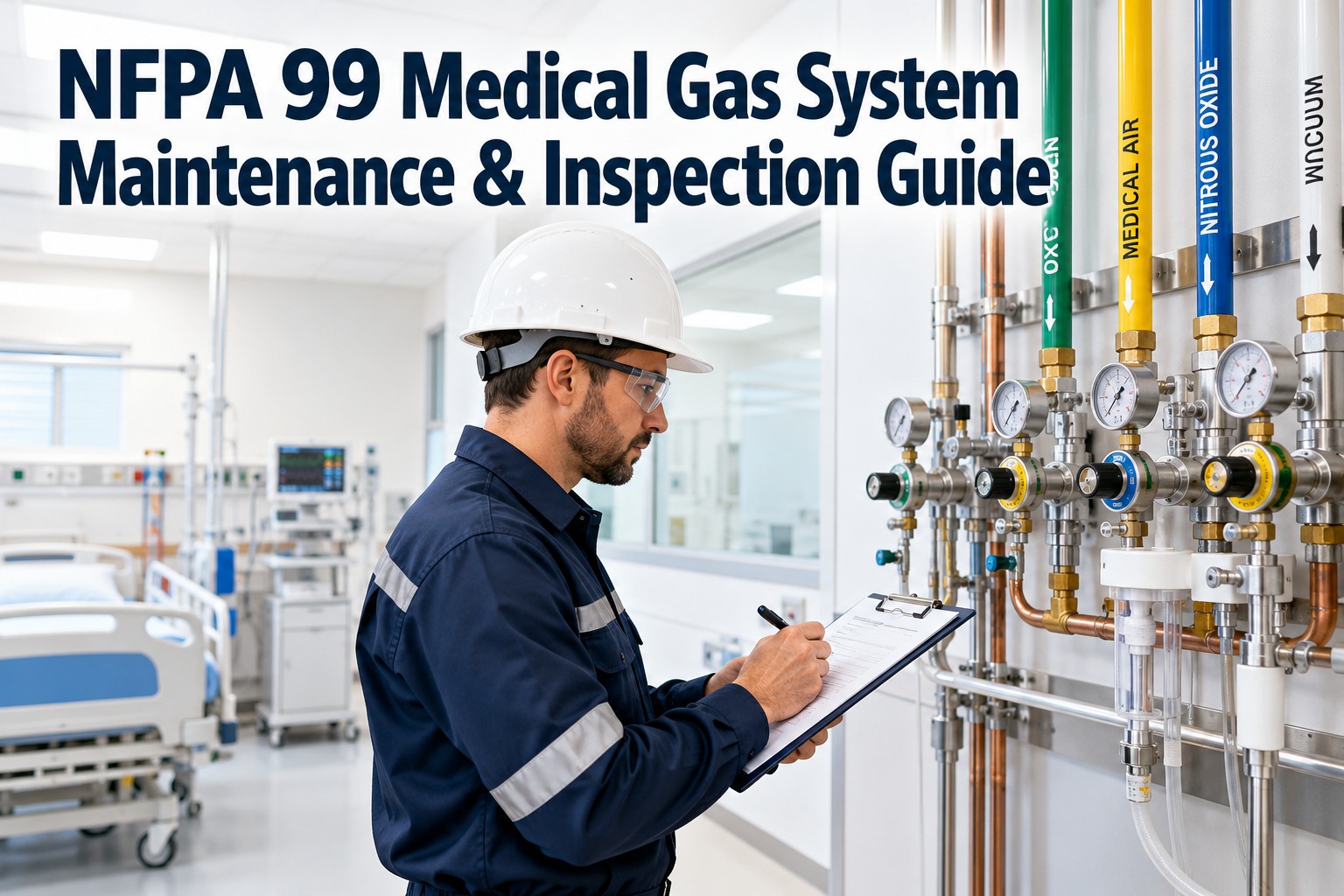
NFPA 99 Medical Gas System Maintenance & Inspection Guide
By Willam Jerry on October 12, 2026
A zone valve nobody can find. A master alarm last tested "sometime last year." A repair closed without a cross-connection test. Medical gas rarely fails loudly — it fails on paper first. OXMAINT AI is the AI-powered maintenance management software that schedules every NFPA 99 check, captures the proof, and turns every failed test into a tracked work order.
NFPA 99 · Medical Gas & Vacuum · Hospital Compliance Guide
NFPA 99 Medical Gas System Maintenance & Inspection Guide
Oxygen, medical air, vacuum and nitrous oxide run behind every wall of your hospital — and surveyors judge them on records, not on how quiet the alarms are. OXMAINT AI turns each inspection into a logged issue, each issue into a ranked work order, and each source, zone valve and outlet into an automated PM schedule. The result: a program you can run every day and prove in minutes.
NFPA 99CMS · 42 CFR 482.41TJC EC.02.05.09ASSE 6000 Series
2012
NFPA 99 edition CMS surveyors cite against in hospitals today
10 ppm
carbon monoxide level that must trip the medical air alarm
$7.1B
global medical gas pipeline system market in 2025
4.6%
annual growth to a projected $11.2B by 2035
Four Rulebooks Read the Same Medical Gas Record
Medical gas is the one hospital utility where a single log entry answers to several authorities at once — and North America, the largest pipeline market, keeps adding outlets, zones and ambulatory sites to prove. Instead of four binders, the OXMAINT AI maintenance management software keeps one record and shapes it for every reader. Start free and build one record that satisfies all four in OXMAINT AI.
CMS
The Law You're Surveyed To
CMS adopts NFPA 99-2012 through 42 CFR 482.41(c), excluding chapters 7, 8, 12 and 13. Chapter 5 gas and vacuum findings land under the K900-series tags.
OXMAINT AI: inspection templates aligned to the edition you're surveyed on
TJC
Your Own Written Policy
EC.02.05.09 requires you to inspect, test and maintain critical components. TJC doesn't fix intervals — the surveyor grades you against the frequencies you set.
OXMAINT AI: your written intervals run as recurring PMs
NFPA 99
The Technical Playbook
Chapter 5 defines inventories, schedules, procedures and qualified people. The 2021 and 2024 editions add a responsible facility authority and permit-to-work.
OXMAINT AI: full inventory by gas, zone and component
ASSE 6000
Who May Touch the System
Maintenance, verification, inspection and installation each carry their own certification — and the record should show which one did the work.
OXMAINT AI: certifications stored on every technician profile
Follow the Gas: Where Every Inspection Happens
The easiest way to build a complete inspection program is to walk the gas from the tank to the patient. OXMAINT AI builds your asset register along this same path, so every stop below becomes an asset, a scheduled checkpoint and a record — and no node is left out of the chain. Book a demo to map your own source-to-outlet path in OXMAINT AI.
Source
Bulk oxygen, manifolds, air compressors, vacuum pumps
Contents, pressure, lead/lag
Daily readings logged on mobile
→
Monitors
Medical air CO and dew point sensors
Readings + annual calibration
Calibration PM scheduled automatically
→
Mains & Risers
Source, main and riser shutoff valves
Labeled, reachable, leak-free
Each valve its own asset record
→
Zone Valve Box
Isolation for each care area
Area served, gauge, access
Rooms served attached to the valve
→
Alarms
Master, area and local panels
Every signal tested
Signal-by-signal test form
→
Outlets & Inlets
The point of patient use
Leak, flow, gas identity
Pass/fail history per outlet
The Inspection Rhythm, Component by Component
NFPA 99 requires a written inventory, inspection schedule and procedure for every system — and it requires medical air dew point and CO monitors to be calibrated at least annually or as the manufacturer specifies. The intervals below reflect a typical hospital program; your own policy, risk assessment and manufacturer guidance set the final numbers — and OXMAINT AI turns whatever you decide into recurring PMs that land on the right technician's phone on time. Start free and load this rhythm as recurring PMs in OXMAINT AI.
Component
Daily
Quarterly
Annual
After Any Work
Bulk oxygen & manifolds
Contents and line pressure logged
Enclosure and signage walk
Leak check of valves, pigtails, regulators
Gas identity + purity
Medical air plant
CO and dew point readings
Lead/lag rotation, intake check
CO + dew point monitors calibrated
Purity re-test
Vacuum & WAGD
Pump status and run hours
Filters, receiver drain
Inlet flow verified
Level re-verified
Master & area alarms
Panels read normal
Lamp and horn check
Every signal tested, witnessed
Alarm function confirmed
Zone valves
—
Labeled and unobstructed
External leak + gauge accuracy
Isolation + labeling
Outlets & inlets
—
High-use area spot checks
Leak and flow, each one
Cross-connection test
The amber column is the one most programs forget. In OXMAINT AI, a repair on an opened zone carries its re-verification tests inside the same work order — so it can't close without them.
Your Med Gas Program Is Only as Strong as Its Last Missing Signature.
OXMAINT AI schedules every daily, quarterly and annual check, forces the reading and the sign-off before a task can close, and escalates anything overdue — so the record is complete before the surveyor asks.
A medical gas system is at its safest right after verification — and at its most dangerous the moment someone breaks into the pipe. The Joint Commission expects any opened system to be tested for correct gas, purity and pressure before patients use it again, and newer NFPA 99 editions formalize this with a permit-to-work. OXMAINT AI runs every repair as a six-stage digital permit, where each stage needs its sign-off before the next one opens. Book a demo to see a digital permit-to-work in OXMAINT AI.
PERMIT-TO-WORKMedical Gas · Opened System
01
Permit Raised
Scope, gases and zones approved by the responsible facility authority.
02
Isolate & Notify
Zone shut, clinical areas warned, backup supply confirmed.
03
Qualified Work
Performed by ASSE 6010 or 6040 certified personnel.
04
Test
Pressure, cross-connection, purity and gas identity.
05
Verify
Results reviewed — by an ASSE 6030 verifier where required.
06
Restore & File
Zone reopened; permit, readings and names saved together.
Who Is Qualified to Do What
NFPA 99 points to the ASSE 6000 series for medical gas personnel, and the 2024 revision of that series now runs from installers to design instructors. Most hospital work falls to the first two roles below — and OXMAINT AI assigns medical gas tasks only to technicians whose certification is on file and current. Start free and attach certifications to every technician profile in OXMAINT AI.
6040
Maintenance Personnel
Your in-house team for routine maintenance of gas and vacuum systems.
6030
Verifier
Tests and verifies system operation — typically after installation or major work.
6020
Inspector
Inspects new installations of the distribution pipeline.
6010
Installer
Installs and brazes medical gas and vacuum piping.
Annual Medical Gas Inspection Checklist
Use this as a quick self-check before your annual verification or survey window. Tick each line as you confirm it. Run the same checklist inside OXMAINT AI and any line you can't tick becomes a work order automatically, with the asset and location attached. Book a demo to run this checklist on any mobile device in OXMAINT AI.
Sources & Alarms
Distribution & Outlets
What the Surveyor Asks to See
Surveyors rarely start at the pipe. They start with your binder — and a missing document can become a finding even when the system itself is healthy. These six records carry most medical gas surveys, and OXMAINT AI keeps every one of them linked to the asset it belongs to — ready to pull up by system, zone or date. Start free and keep all six in one searchable place in OXMAINT AI.
01
System Inventory
Every source, valve, alarm and outlet by gas and zone.
02
Risk Category
The documented assessment behind each system's category.
03
Written Frequencies
Your policy — the yardstick TJC grades you against.
04
Test Results
Readings, dates and names — not just "pass."
05
Closed Corrections
Every deficiency traced to a finished work order.
06
Permits & Certs
Who opened the system, who tested it, and their credentials.
How OXMAINT AI Maintenance Management Software Runs Your Medical Gas Program
Everything on this page — the inventory, the rhythm, the permit, the qualified people and the surveyor's six records — lives in one place in OXMAINT AI. The software connects the inspection, the fix and the proof, so nothing found on rounds is left sitting in a notebook. Book a demo to walk your medical gas program end to end.
1
Guided Inspections
Mobile checklists per source, zone and alarm, with required readings and photos.
2
Issue Logging
An out-of-range reading or failed test is captured as an issue on the spot.
3
Ranked Work Orders
Life-critical gases jump the queue; overdue tasks escalate to a supervisor.
4
PM & Re-Verification
Recurring PMs on every asset, plus a required re-test before any opened zone closes.
5
Qualified Assignment
Tasks go to technicians with the right ASSE certification on their profile.
6
Survey-Ready Reports
Inspection history filtered by system, zone or date for your next survey.
Frequently Asked Questions
Which edition of NFPA 99 applies to my hospital?
CMS enforces the 2012 edition for hospitals, and surveyors cite against that text. Your state or local authority may adopt a newer edition for construction — when two apply, follow the stricter one.
How often must medical gas systems be tested?
The Joint Commission sets no fixed interval — you define frequencies in a written policy based on manufacturer guidance or a risk-based strategy, and NFPA 99-2012 Annex B can guide it. CO and dew point monitors must be calibrated at least annually. Start free and set your intervals in OXMAINT AI.
Who is allowed to maintain medical gas systems?
Routine maintenance is done by ASSE 6040 certified personnel. Verification testing is typically performed by an ASSE 6030 verifier, and new piping by ASSE 6010 installers.
What has to happen after a medical gas repair?
Any time the system is opened, it must be tested for correct gas, purity and pressure to rule out a cross-connection — and the results recorded before the zone returns to patient use.
How does OXMAINT AI help with NFPA 99 medical gas compliance?
The maintenance management software holds your full inventory, runs your written intervals as recurring PMs, turns failed checks into ranked work orders and keeps every reading, permit and certification ready for survey.
What changed in the 2021 and 2024 editions?
The 2021 edition defined the responsible facility authority, a permit-to-work and an emergency medical gas plan. The 2024 edition moved dental gas and vacuum systems into a dedicated Chapter 15.
One Program · Every Gas · Every Zone
Run It Daily. Prove It in Minutes.
Put your oxygen, medical air, vacuum and nitrous oxide systems on one schedule with OXMAINT AI — guided inspections, ranked work orders, permit-to-work and a timestamped record ready for your next CMS or Joint Commission survey.