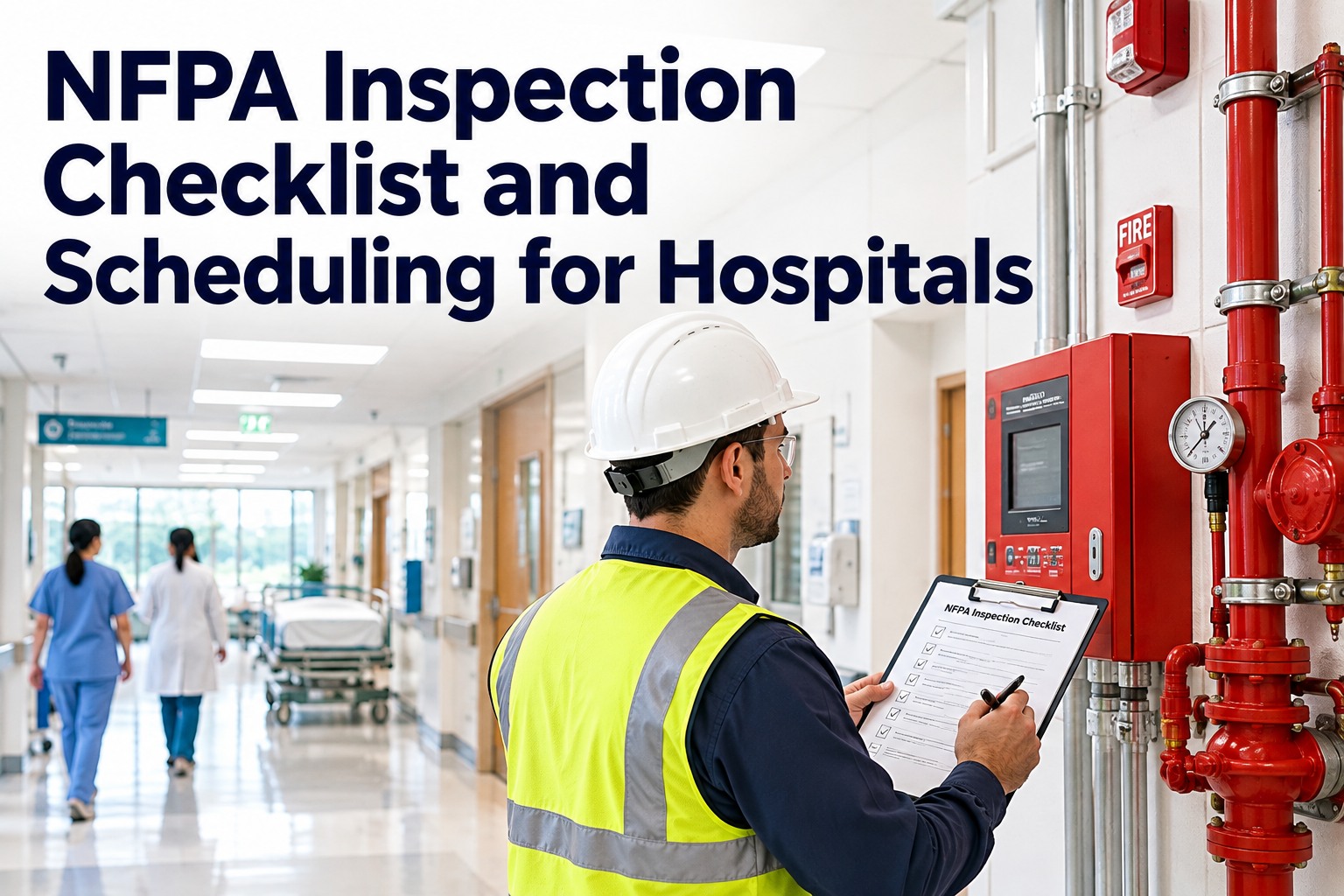
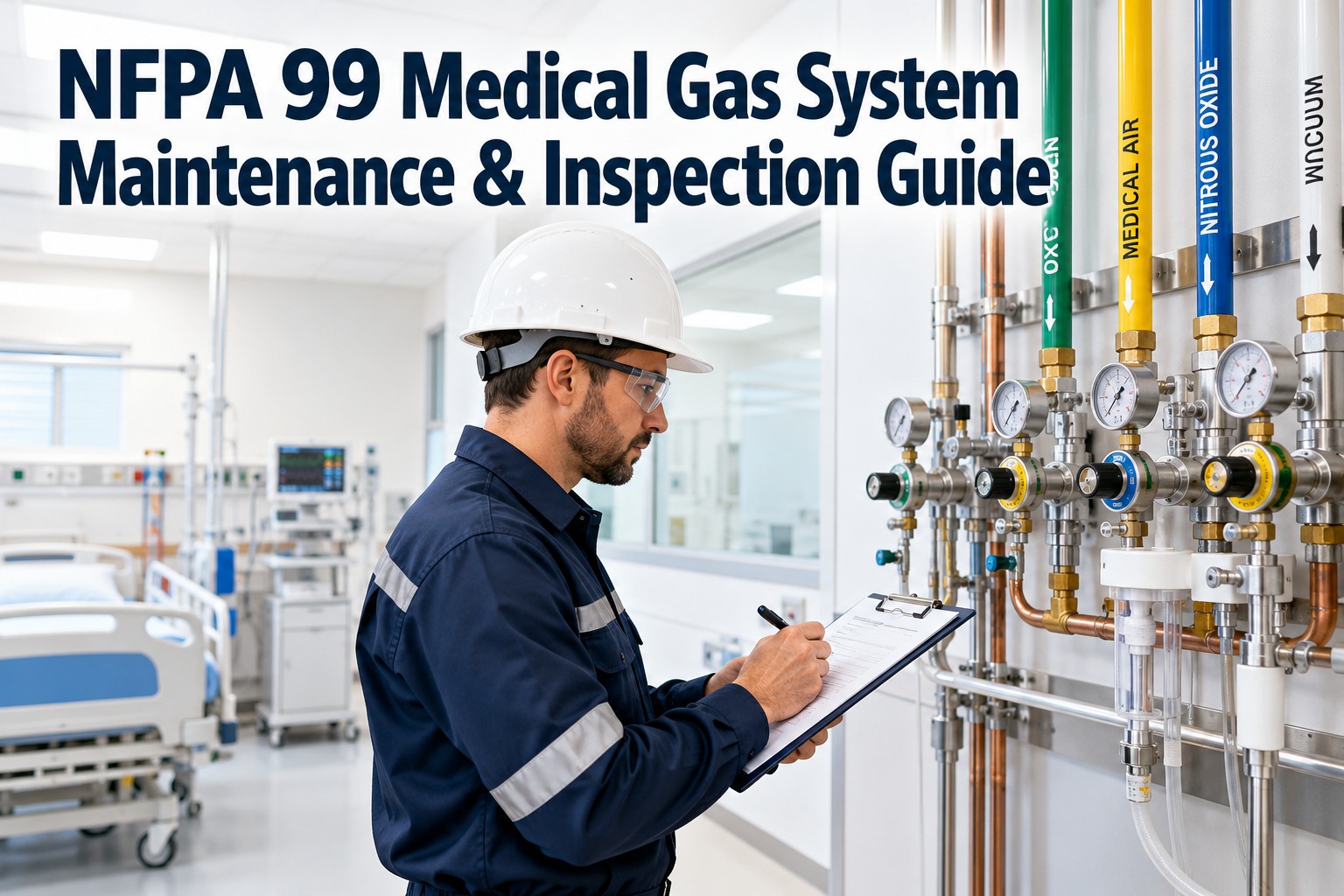
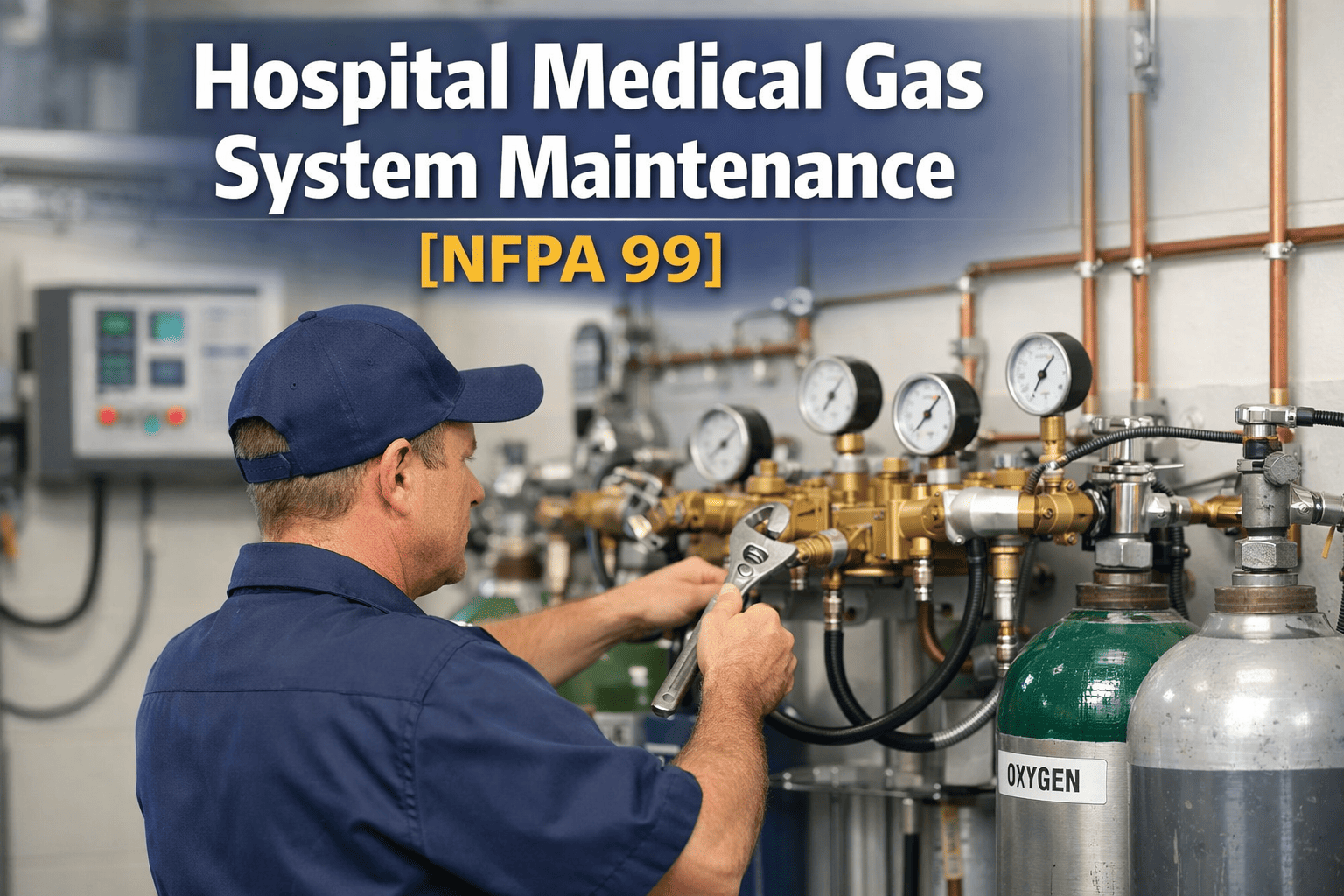
Medical gas infrastructure is one of the few hospital systems where a single maintenance failure can affect every patient in a clinical zone simultaneously. Unlike a malfunctioning infusion pump or a defective surgical light — where the impact is confined to one bedside — a bulk oxygen system failure, a contaminated medical air supply, or a mislabelled zone valve can compromise care across an entire ward or floor within minutes. NFPA 99, CMS Conditions of Participation, and Joint Commission EC.02.05.09 collectively require that piped medical gas systems operate under a defined, traceable maintenance programme with documented results — not an annual inspection event, but a layered programme of daily logs, quarterly functional tests, and annual performance qualifications. Sign in to OxMaint to bring every gas system PM under one audit-ready digital programme — or book a demo to see healthcare compliance tracking configured for your facility.
Four Compliance Facts Every Hospital Facilities Team Must Know
What NFPA 99 Chapter 14 Requires — and What Auditors Actually Check
NFPA 99 Chapter 14 consolidates inspection, testing, and maintenance requirements for medical gas and vacuum systems into a single regulatory reference. The code uses a risk-based framework — Category 1 systems (whose failure could cause major injury or death) require maximum inspection frequency and documentation rigour, Category 2 and 3 systems proportionally less. For hospital facilities teams, the practical implication is that ICU oxygen systems, operating room medical air, and anaesthesia vacuum are all Category 1 — and the maintenance programme for these systems must reflect that. Sign in to OxMaint to configure risk category assignments and inspection frequencies per system across your gas infrastructure.
Every Gas System Inspection Documented. Every Finding Linked. Every Test Result Filed.
OxMaint converts medical gas PM schedules into mandatory-field digital work orders — with technician sign-off, automatic deficiency escalation, and NFPA 99-aligned documentation for every system and test type.
Critical Monitoring Parameters by Gas System
Effective medical gas maintenance requires systematic monitoring of the parameters most likely to generate patient safety events or regulatory findings. Each monitoring area below maps to a specific inspection task in OxMaint — with mandatory completion fields and automatic escalation for out-of-tolerance findings. Sign in to OxMaint to configure monitoring templates for each gas system at your facility.
Bulk cryogenic liquid oxygen systems are Category 1 for any application where failure would be immediately life-threatening. Source pressure, liquid level, vaporiser function, and primary/secondary supply changeover must be verified daily. Pipeline purity testing — oxygen concentration, moisture, and oil content — is required annually and after any system modification.
Medical air is manufactured on-site — unlike bulk oxygen, purity is entirely dependent on the condition and maintenance of the compressor plant. NFPA 99 Grade D specification requires carbon monoxide below 10 ppm, controlled dew point, and zero oil contamination. CO monitoring must be continuous or performed at a frequency that ensures exceedances are detected before patient exposure.
Medical vacuum serves suction in ORs, ICUs, and general wards. Vacuum level must be maintained within the design specification at all outlet points — insufficient vacuum during surgery or airway suction is immediately life-threatening. Pump alternation, exhaust function, and collection vessel drain must be verified on every service visit.
Nitrous oxide manifold systems serve anaesthesia in ORs and procedure rooms. Manifold systems must alternate between primary and secondary banks automatically — a failed changeover during a procedure can result in immediate gas supply interruption. WAGD (Waste Anaesthetic Gas Disposal) systems must be inspected concurrently for airflow adequacy.
Alarm panels are the primary detection system for gas system abnormalities. NFPA 99 requires master alarm panels to be in a 24-hour staffed location. Area alarm panels must be present at each clinical zone and tested for both high and low pressure activation. A functional alarm panel that is not monitored provides zero patient protection.
Zone valves are the primary isolation tool for emergency gas shut-off by floor or clinical area. Incorrect labelling, hidden access, or a valve that fails to seal are the most common Joint Commission findings. TJC surveyors regularly identify shutoff valves that are unlabelled, covered by ceiling tiles, or labelled with the wrong gas or zone. Book a demo to see zone valve inspection records in OxMaint.
Preventive Maintenance Schedule by Frequency
Medical gas PM must be structured around frequency bands that match the patient risk profile of each system. A single monthly template for all gas systems overserves low-risk distribution components and underserves Category 1 life-critical supply equipment. OxMaint generates separate inspection work orders per system at the correct frequency with system-specific task lists and mandatory completion fields.
NFPA 99 and Joint Commission — Key Requirements by System
| System | NFPA 99 Requirement | TJC / CMS Implication | Common Finding | OxMaint |
|---|---|---|---|---|
| Bulk oxygen | Daily pressure and level log; annual pipeline purity test | Missing daily logs are immediate EC.02.05.09 findings | Gaps in daily log continuity during survey period | Auto-scheduled daily WO — cannot close without all fields complete |
| Medical air | CO monitoring ≤10 ppm; dew point control; annual purity test | CO exceedance triggers CMS patient safety event investigation | No continuous CO monitoring; unverified dew point readings | CO reading field mandatory; auto-alert on threshold approach |
| Medical vacuum | Pump alternation; exhaust location check; vacuum level verification | Insufficient vacuum in OR is sentinel event category | Single pump running; no alternation evidence documented | Alternation log field required; single-pump running flagged |
| Nitrous oxide | Changeover test; manifold pressure; WAGD airflow verification | WAGD inadequacy creates staff occupational exposure liability | WAGD not tested; no changeover test documentation | WAGD airflow field included; changeover test date tracked |
| Zone valves | Annual inspection and exercise; labelling accuracy | Mislabelling is most frequent TJC EC.02.05.09 finding | Incorrect gas/zone labels; access obstructed by ceiling tiles | Per-valve inspection record; label verification field required |
| Alarm panels | Master panel in 24-hr staffed area; area panel functional test | Untested panels treated as non-functional by surveyors | Area alarm test results undocumented; panel location non-compliant | Per-panel test record with zone ID, result, and technician signature |
Compliance requirements apply to existing and new construction per NFPA 99 2012 edition as adopted by CMS under QSO-17-30. Individual AHJs may have adopted subsequent editions. Verify applicable edition with your accrediting body and state authority. Book a demo to configure your facility's specific compliance framework in OxMaint.
What Healthcare Facilities Engineers Say
We had a Joint Commission survey where our medical gas programme was cited for three findings — all documentation, none operational. The systems were functioning within specification. Every alarm was working. The zone valves were correctly labelled. But we had six weeks of daily oxygen logs with gaps, two area alarm panels where the test results were in a technician's notebook rather than a system record, and one nitrous oxide changeover test that we could not produce documentation for because it was on a paper form that had been archived in the wrong folder. OxMaint eliminated all three failure modes in the first month. The daily log cannot close without every field completed. Every alarm test generates a timestamped record linked to the panel and zone. The changeover test result is stored against the nitrous oxide asset. Our next survey resulted in zero medical gas findings for the first time in seven years.