Medical gas is the one utility in a hospital a patient is directly connected to. When oxygen pressure drops in an ICU, a compressor pushes contaminated air to a ventilator, or OR suction fails mid-procedure, it is not a facilities inconvenience — it is a patient-safety event. OXMAINT AI is the AI-powered maintenance management software that keeps every source, line, valve and alarm on a documented preventive schedule and turns an alarm into a tracked work order the moment it sounds.
Medical Gas & Vacuum · NFPA 99 · Hospital Safety · 2026
Medical Gas System Maintenance: Hospital Safety Guide
A clear walk-through of the piped medical gas and vacuum systems a hospital depends on — the services, the equipment, and the preventive maintenance that keeps them safe under NFPA 99. Then how OXMAINT AI, a healthcare maintenance management platform, schedules that PM, logs every inspection, and routes alarms into work orders — so compliance is continuous, not a once-a-year scramble.
Source
→
Pipeline
→
Alarms
→
Outlet
MEDICAL GAS SOURCE · LIVE
Oxygen · Primary bank52 psi OK
Medical Air · Compressor 1/2Dew pt OK
Med-Surg Vacuum · Pump 2/219 inHg
Nitrous Oxide · ManifoldReserve low
Master Alarm Panel1 active
Safety scope: This guide explains medical gas maintenance in general terms. Under NFPA 99, work on medical gas and vacuum systems must be performed by qualified, certified personnel — typically ASSE 6040 maintenance technicians, with verification by an ASSE 6030 verifier. Follow the current NFPA 99 edition, your Authority Having Jurisdiction, and your written policies. This page is not a substitute for that program.
NFPA 99
the Health Care Facilities Code governing medical gas & vacuum
≤10 ppm
carbon monoxide limit for medical air quality
ASSE 6040
certification required for medical gas maintenance personnel
100%
documented maintenance expected on survey day
What You're Actually Maintaining: Source to Outlet
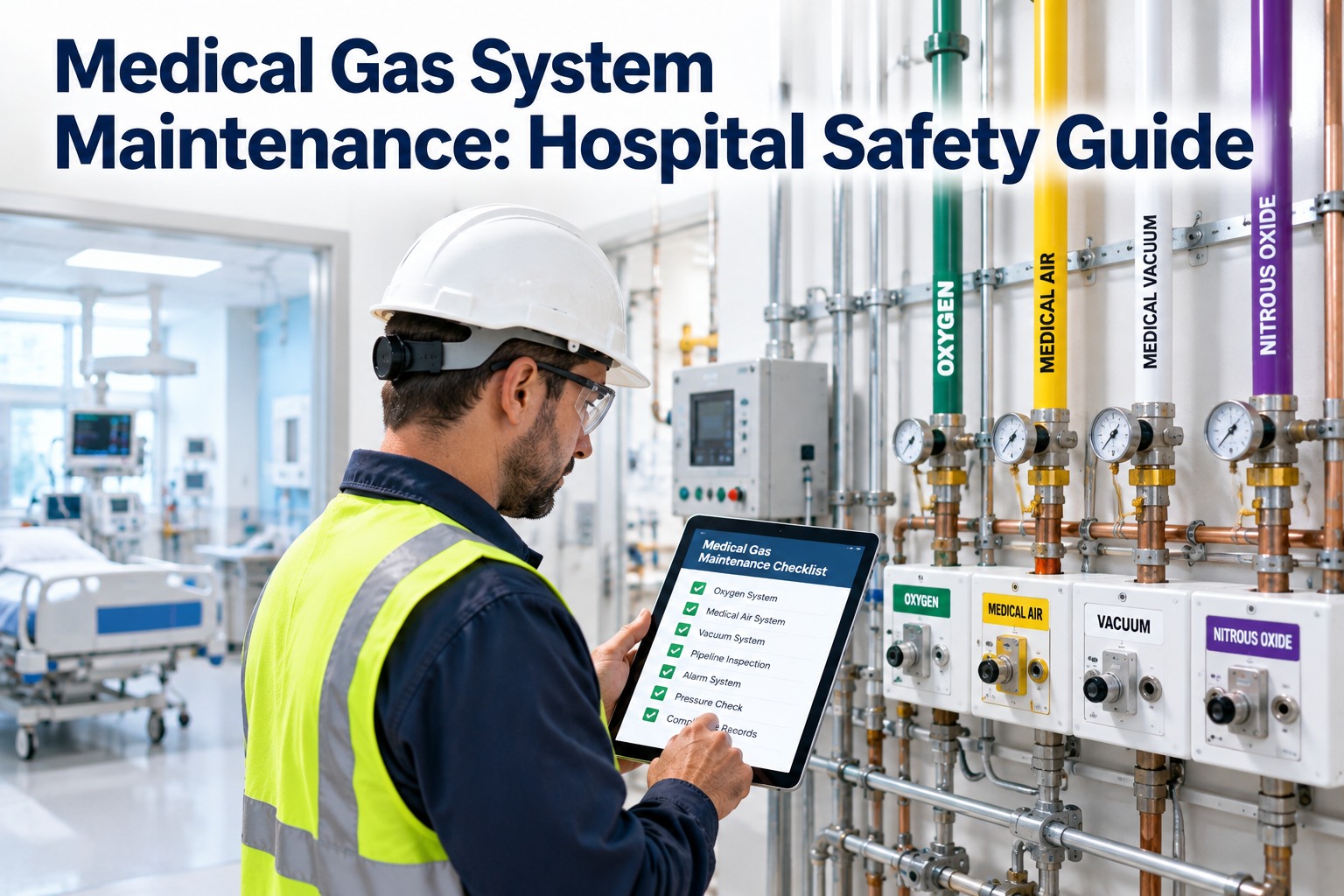
A medical gas system is a chain, and every link has to hold. Gas leaves a source, travels the pipeline, passes a zone valve, is watched by an alarm, and reaches the patient at an outlet. Maintenance means proving each stage is sound — here is the path.
1
Source & Supply
Bulk oxygen, cylinder manifolds, medical air compressors and vacuum pumps — with primary, secondary and reserve.
→
2
Pipeline
Brazed copper mains carry each gas through the building at regulated pressure, kept leak-free and labeled.
→
3
Zone Valves
Shutoff valves isolate each zone for service or emergency — they must be labeled, accessible and operable.
→
4
Alarms
Master, area and local alarms watch source status and line pressure, warning before a shortfall reaches a patient.
→
5
Station Outlet
The gas-specific outlet or vacuum inlet at the bedside — tested for correct gas, flow and no leakage.
A weak link anywhere in that chain is invisible until the moment it is needed, which is exactly why it gets a schedule. Start free and put every stage on a PM schedule in OxMaint.
The Six Piped Services
Hospitals run several gas and vacuum services, each with its own source, risk and maintenance focus. They share standardized identification, but they are not interchangeable — a cross-connection is one of the most dangerous faults in the system.
Oxygen (O₂)
Source: bulk cryogenic + reserve
Life support across the whole facility. Watch source levels, changeover to reserve, and line pressure continuously.
Medical Air
Source: medical air compressors
Breathing air for ventilators. Quality is everything — dew point, carbon monoxide and oil must stay within limits.
Medical-Surgical Vacuum
Source: vacuum pumps
Suction for procedures and airway clearance. Maintain vacuum level, pump alternation and fluid separation.
WAGD
Source: dedicated producer
Waste anesthetic gas disposal scavenges gases from the OR, protecting staff. Keep it separate from med-surg vacuum.
Nitrous Oxide (N₂O)
Source: cylinder manifold
Anesthetic gas. Monitor manifold and reserve levels and guard against leaks in the OR and delivery lines.
Nitrogen / Instrument Air
Source: manifold / compressor
Drives surgical tools. Maintain supply pressure and the regulators that step it down for instrument use.
Each service earns its own line on the maintenance plan, because a failure in any one of them stops a different kind of care. Book a demo to map all six services into OxMaint.
The Maintenance Checklist, by Subsystem
Use this as a working checklist across the five subsystems that carry the most risk. Intervals vary by equipment and by your AHJ — set the exact cadence in your program and let qualified personnel sign each item off.
The checklist is only as good as the record it leaves behind — a check nobody can prove on survey day may as well not have happened. Start free and run this checklist with a dated record in OxMaint.
Why the Alarm Has to Become a Work Order
A medical gas alarm is a warning with a short fuse. Master and area alarms exist to flag a problem before it reaches a patient — but an alarm that lights a panel and nothing more has done only half its job. The response is what protects the patient.
Alarm sounds
A source or line pressure crosses its threshold on a master or area panel.
→
Work order raised
A priority work order opens with the source, zone and reading attached — no manual logging.
→
Resolved & recorded
Qualified personnel respond, the fix is verified, and the whole event is kept for the record.
That closed loop is the difference between an alarm that warned you and an alarm that saved someone. Book a demo to see alarm-to-work-order routing in OxMaint.
In a Hospital, "We Think It's Fine" Is Not a Maintenance Record.
Medical gas is life-safety infrastructure, and NFPA 99 expects the proof. OxMaint keeps every source, valve, outlet and alarm on a documented schedule, routes alarms to the right team, and builds the survey-ready record as the work is done.
How OxMaint Runs the Program
Qualified personnel do the hands-on work. OxMaint runs the program around them — the scheduling, the records, the alarm response and the audit trail that turn good maintenance into provable compliance.
Scheduled PM by Interval
Every source, line, valve and alarm on its own daily-to-annual cadence, so nothing slips past due.
Mobile Inspection Records
Run the subsystem checklist on a phone, with readings, photos and a dated sign-off against each asset.
Alarm-to-Work-Order
A master or area alarm opens a priority work order with the source and reading attached, routed at once.
Per-Asset History
Each compressor, pump, manifold and zone valve carries its own service log, readings and parts history.
NFPA 99 & Survey Records
Timestamped, retained documentation that stands up on a Joint Commission or AHJ survey — pulled in seconds.
Compliance Dashboard
A live view of PM completion, open alarms and overdue items — so the facilities lead always knows where things stand.
The hands-on work stays with your certified team; the program, the records and the proof live in one place. Sign up free and build your medical gas program in OxMaint.
Reviewed by OxMaint Healthcare Facilities Operations
Content was checked against NFPA 99 Health Care Facilities Code practice and the ASSE 6000 series for medical gas personnel. Requirements, limits and intervals vary by edition, equipment and jurisdiction — confirm against the current code and your AHJ, and use certified personnel for all work.
Frequently Asked Questions
Who is allowed to maintain a medical gas system?
Under NFPA 99, work is performed by qualified, certified personnel — typically ASSE 6040 certified maintenance technicians, with system verification by an ASSE 6030 verifier. A CMMS manages the program; it does not replace certified labor.
What standard governs medical gas maintenance?
NFPA 99, the Health Care Facilities Code, governs medical gas and vacuum systems, alongside Joint Commission and CMS expectations for documented maintenance. Always work to the edition your facility is held to.
What are the key medical air quality limits?
How often should medical gas systems be checked?
Intervals run from daily source and alarm checks to annual full inspections, set by equipment type and your AHJ. The point is a defined, documented cadence — not a once-a-year look before a survey.
Does OxMaint handle the NFPA 99 documentation?
Yes. Every scheduled PM, inspection, reading and alarm response is timestamped and retained against the asset, so the record an auditor asks for is already built and searchable.
Keep the One Utility Patients Breathe Running Safely.
Put every medical gas source, pipeline, valve, outlet and alarm on one platform with OXMAINT AI — scheduled preventive maintenance, mobile inspections with dated sign-offs, alarms routed straight to work orders, and NFPA 99 records ready for any survey. Protect the system before a patient ever feels the gap.