An operating room that is not fully ready before the first case is not a safe operating room. Anesthesia machine failures, unverified suction, non-functional electrosurgical units, and incorrect OR air pressure have all contributed to surgical adverse events that were entirely preventable with a systematic pre-case readiness check. This daily OR readiness checklist covers every critical system — anesthesia, electrosurgery, surgical lights, suction, OR table, smoke evacuator, and air pressure verification — with role assignments for surgical technologists, circulating nurses, and biomedical staff. Every completed check should generate a timestamped record in OxMaint so your OR leadership has real-time readiness status across every suite before the day's first incision. Book a demo to see OR readiness tracking in action.
Healthcare · Perioperative · OR Safety
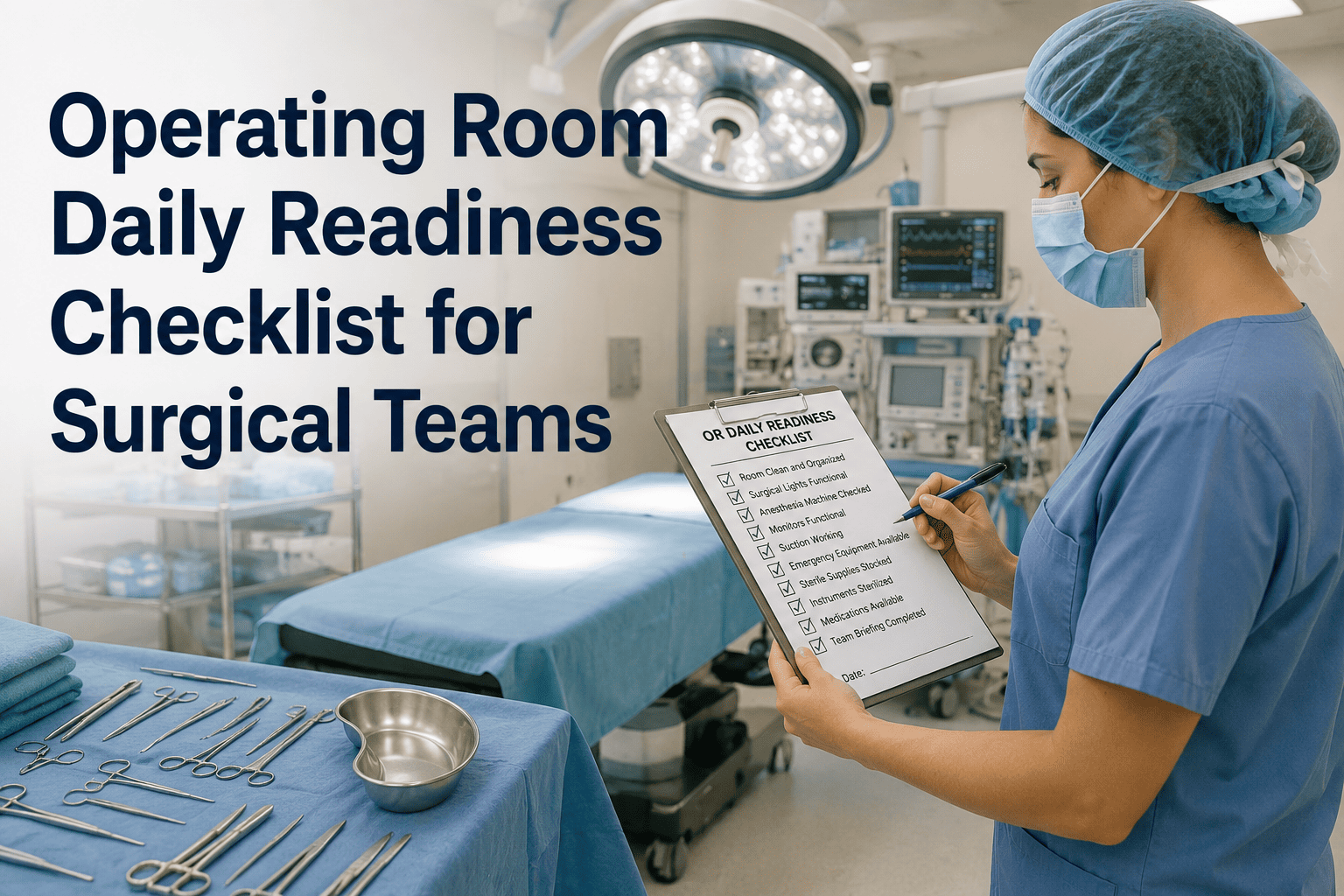
Operating Room Daily Readiness Checklist for Surgical Teams
A pre-case verification framework for anesthesia, electrosurgery, lighting, suction, OR table, smoke evacuation, and environmental controls — designed for surgical teams who perform first-case starts on time and without surprises.
7System Zones
40+Verification Points
DailyBefore First Case
P1Critical Priority
FCFirst Case (Daily)
TOTurnover
WWeekly
MMonthly
QQuarterly / Annual
Pipeline gas pressures confirmed — O2, N2O, and medical air at 50–55 psi on wall supply gauges; cylinder backup valves opened and cylinder pressure adequate
FCAnesthesiologist / CRNA · Anesthesia checkout log
Breathing circuit leak test completed — circuit holds positive pressure with no detectable flow leak; fresh gas flow valve, APL valve, and pop-off valve all functional
FCAnesthesiologist / CRNA · Anesthesia machine log
Ventilator function confirmed — mandatory ventilation mode tested with test lung; tidal volume, rate, and pressure limit alarms verified at appropriate thresholds
FCAnesthesiologist / CRNA · Ventilator checkout record
Vaporizer agent level checked and filler cap secured — agent confirmed matching scheduled anesthetic; no cross-fill risk between vaporizers on same machine
FCAnesthesia Tech · Vaporizer check log
Emergency airway equipment staged and verified — laryngoscopes light-tested, ETT sizes confirmed, LMA sizes stocked, video laryngoscope charged and functional
FCAnesthesia Tech · Airway cart check
CO2 absorbent canister color check — absorbent within service life and no purple/violet color indicating exhaustion; canister replaced at change interval regardless of color
WAnesthesia Tech · Absorbent replacement log
ESU self-test completed and pass confirmed — unit powered on, self-diagnostic cycle run, and no fault codes or alarm indicators displayed before case setup begins
FCSurgical Tech · ESU setup record
Active electrode (Bovie pencil) and cable inspected — insulation intact along full cable length, no exposed wire, connector pins clean and fully seated in ESU port
FCSurgical Tech · ESU setup record
Return electrode (grounding pad) package sealed and expiry confirmed — pad within expiry, gel intact on inspection, pad size appropriate for patient weight range scheduled
FCCirculating Nurse · Grounding pad check
Ultrasonic energy device (if scheduled) — generator powered on, handpiece connected and tested, generator self-test passed and output confirmed at start setting
FCSurgical Tech · Energy device log
Primary surgical light powered on and full intensity range verified — light confirms full-bright output, no flicker, and focus function moves through full range without resistance
FCSurgical Tech · OR light check log
Secondary / satellite light confirmed functional — all lights in suite operational and positioned to allow access without conflict with anesthesia equipment or surgeon positioning
FCSurgical Tech · OR light check log
Sterile light handle covers in correct size available and stocked on back table — handle covers confirmed compatible with light model in suite before sterile setup begins
FCSurgical Tech · Back table setup checklist
Battery backup or emergency lighting tested — emergency lighting activates within 10 seconds of simulated power interruption test; battery backup on surgical lights holds position and illumination
WBiomedical Tech · Emergency lighting test record
OxMaint assigns daily OR readiness checks to the right staff before every first case, captures photo-confirmed findings in real time, and gives OR leadership a live suite-by-suite readiness dashboard before the day's first patient enters the building.
Wall suction functional at required vacuum level — suction tubing connected to anesthesia circuit, Yankauer connected, and suction pressure confirmed at minimum 300 mmHg negative pressure
FCAnesthesia Tech · Suction check log
Surgical suction canister new and correctly connected — canister lid sealed, suction tubing not kinked, and overflow float functional before case setup
FCSurgical Tech · Suction setup check
Portable emergency suction unit present in suite — battery charged and confirmed, suction functional on battery power, and device accessible without clearing equipment
FCCirculating Nurse · Emergency equipment check
Irrigation fluid warmer set at correct temperature — fluid confirmed at ordered temperature range; unwarmed irrigation in high-volume cases is a hypothermia risk
FCCirculating Nurse · Fluid management log
OR table powered on and all articulation functions tested — Trendelenburg, reverse Trendelenburg, lateral tilt, head/foot elevation, and overall height confirmed through full range
FCSurgical Tech · OR table setup log
Table locking mechanism confirmed secure — table does not move when lateral force applied in locked position; wheel brakes engaged and tested before patient transfer
FCSurgical Tech · OR table setup log
Positioning aids confirmed for scheduled procedure — gel pads, arm boards, beach chair attachment, stirrups, or specialty positioning devices present and inspected for damage
FCCirculating Nurse · Positioning checklist
Safety straps and arm restraints present and functional — straps not frayed, buckles and velcro intact, and sufficient quantity for procedure positioning requirements
FCCirculating Nurse · Positioning checklist
Smoke evacuator powered on and filter within service life — filter hours or particle count within manufacturer replacement threshold; replacement filter staged in suite for high-volume cases
FCSurgical Tech · Smoke evacuator log
Smoke evacuation tubing and pencil adapter connected and suction confirmed functional — audible airflow and capture confirmed at intended evacuation distance before case setup
FCSurgical Tech · Smoke evacuator log
OR fire risk assessment completed for scheduled cases — open oxygen source, alcohol-based prep, and energy device combinations documented; fire extinguisher location confirmed known to all staff in suite
FCCirculating Nurse · Fire risk assessment form
CO2 fire extinguisher in suite — extinguisher charge indicator in green zone, safety pin present, and no physical damage to cylinder or nozzle
MBiomedical / Safety Officer · Fire equipment log
OR positive pressure differential confirmed — visual pressure gauge at suite entry showing positive reading (typically +2.5 Pa minimum); any loss of positive pressure triggers facilities notification before case start
FCCirculating Nurse · Environmental log
OR temperature between 68°F and 75°F (20–24°C) confirmed — temperature outside range documented and facilities notified; hypothermia risk for pediatric and neonatal cases requires tighter control at 72–75°F
FCCirculating Nurse · Environmental log
OR humidity between 30–60% confirmed — low humidity increases static risk and OR fire risk; high humidity compromises sterile field integrity and increases condensation on equipment
FCCirculating Nurse · Environmental log
HVAC air exchange rate verified operational — suite air handling unit confirmed running at required air changes per hour by facilities before day's first case; any HVAC fault escalated to biomedical and infection control
WFacilities Engineer · HVAC monitoring log
Key Performance Indicators
Metrics That Confirm Your OR Readiness Program Is Working
| Metric |
How to Measure |
Target |
Review Cadence |
| First Case On-Time Start Rate |
Cases starting within 5 min of scheduled time |
Above 90% |
Daily |
| Readiness Check Completion Rate |
Completed pre-case checks / Total cases |
100% |
Daily |
| Intraoperative Equipment Failure Rate |
Equipment failures per 1,000 cases |
Below 0.5 |
Monthly |
| OR Air Pressure Compliance |
Days positive pressure maintained / Total OR days |
100% |
Monthly |
| Smoke Evacuator Use Rate |
Energy cases with smoke evacuation documented |
100% |
Monthly |
| Corrective WO Closure Time |
Avg hours from equipment finding to resolution |
Under 4 hrs |
Monthly |
Expert Review
The operating room is the highest-risk clinical environment for equipment-related patient harm, and the pre-case readiness check is the primary defense. What separates high-performing surgical programs from those with persistent near-miss events is not the content of their checklists — it is the consistency of execution and documentation. A digital, role-assigned readiness workflow eliminates the ambiguity of who checked what and when, and gives OR leadership the real-time visibility to intercept a readiness failure before a patient is ever transferred to the suite. Programs that digitize this process consistently reduce intraoperative equipment-related events by 40–60% within the first year.
Perioperative Safety Director, Academic Medical Center
Based on OR readiness program assessments at 25+ surgical centers, 2021–2024. Aligned with AORN Perioperative Standards and ECRI OR safety guidelines.
FAQs
Frequently Asked Questions
Who is responsible for completing the OR daily readiness checklist?
Responsibility is shared across roles and is procedure-specific. Anesthesiologists or CRNAs are responsible for the anesthesia machine checkout — this cannot be delegated to non-anesthesia staff. Surgical technologists manage ESU, table, and back table verification. Circulating nurses own environmental controls, fire safety assessment, and suction verification. Anesthesia technicians support the equipment checks but do not substitute for licensed practitioner oversight on machine checkout.
OxMaint assigns each checklist item to the correct role so accountability is built into the workflow rather than assumed.
What should a surgical team do if a readiness check reveals a failed item before first case?
The case should not start until the failed item is resolved, replaced, or a documented clinical decision is made by the attending surgeon and anesthesiologist that the case can safely proceed with an alternative. The failure must be logged as a corrective work order with biomedical engineering notified if the equipment requires repair or replacement. No equipment failure should be verbally reported and then proceed without a written record — survey findings and litigation consistently arise from undocumented workarounds.
Book a demo to see how OxMaint manages the failed-item escalation and case hold workflow.
How many air exchanges per hour does an operating room require?
ASHRAE Standard 170 and the Facility Guidelines Institute require a minimum of 20 total air changes per hour in an operating room, with at least 4 of those being outside air. Positive pressure differential relative to adjacent corridors must be maintained at all times during surgical activity. Any HVAC fault reducing air exchange rate below minimum, or causing a loss of positive pressure differential, is an infection control event requiring facilities notification and case hold pending restoration of compliant conditions. Regular HVAC monitoring is documented in OxMaint against the suite asset record.
Does the anesthesia machine checkout need to be documented for every case or just first case?
The full FDA-recommended checkout must be documented at minimum for the first case of the day on each machine. For subsequent cases, a shortened between-case verification is clinically appropriate — checking breathing circuit integrity, gas supply, and vaporizer level — but must still be documented with the provider name and time. Full checkout documentation must also be completed any time the machine has been serviced, moved, or left unattended overnight.
OxMaint differentiates first-case and between-case checkout templates, ensuring each provider completes the correct verification scope for each clinical context.
Ready to Digitize Your OR Readiness Program?
Every Suite Verified. Every Case Ready. Every First-Case Start on Time.
OxMaint converts this checklist into role-assigned, mobile-first pre-case verification rounds with real-time OR leadership dashboards — so you know every suite is ready before the first patient leaves pre-op. Start free or speak with a perioperative specialist today.