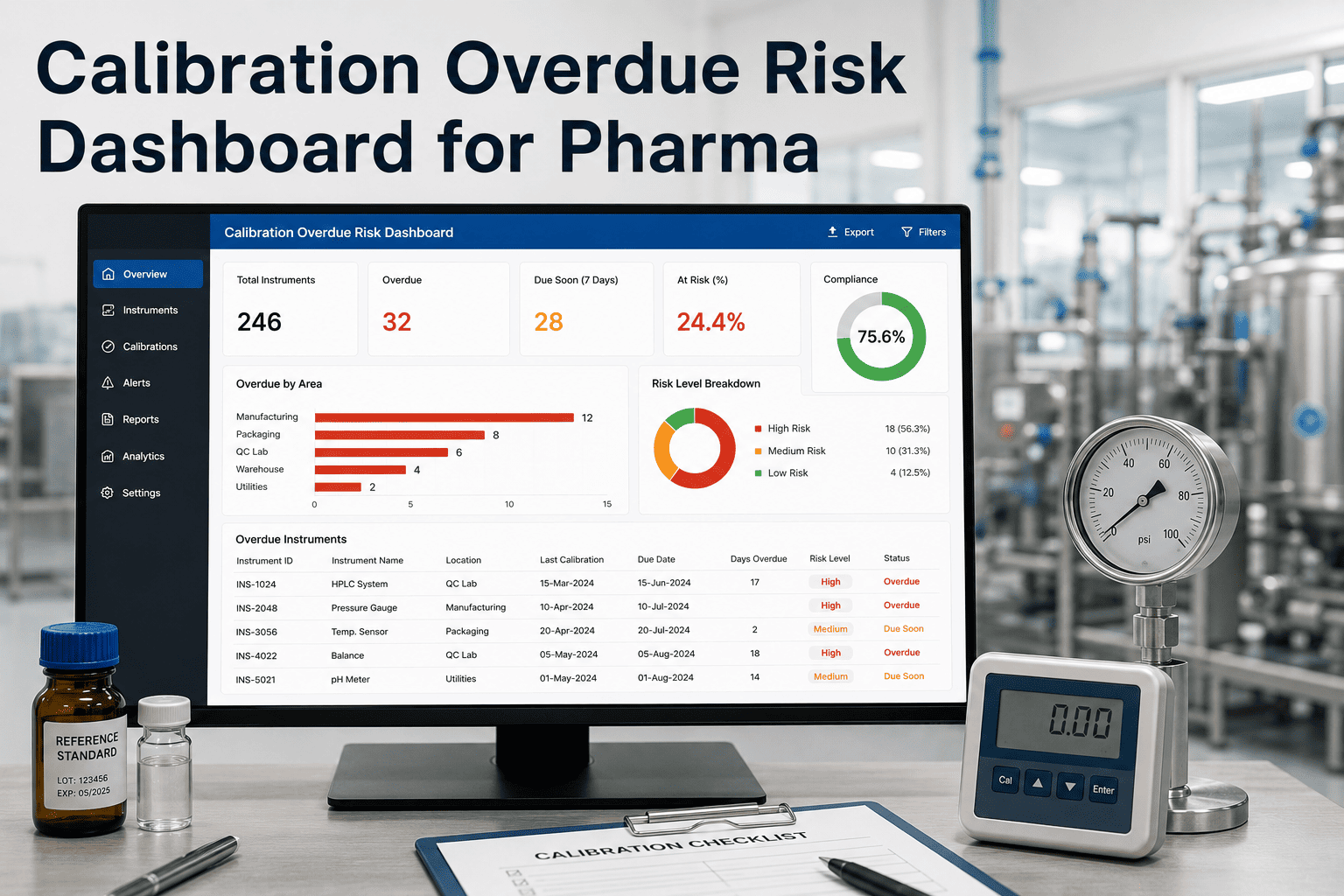
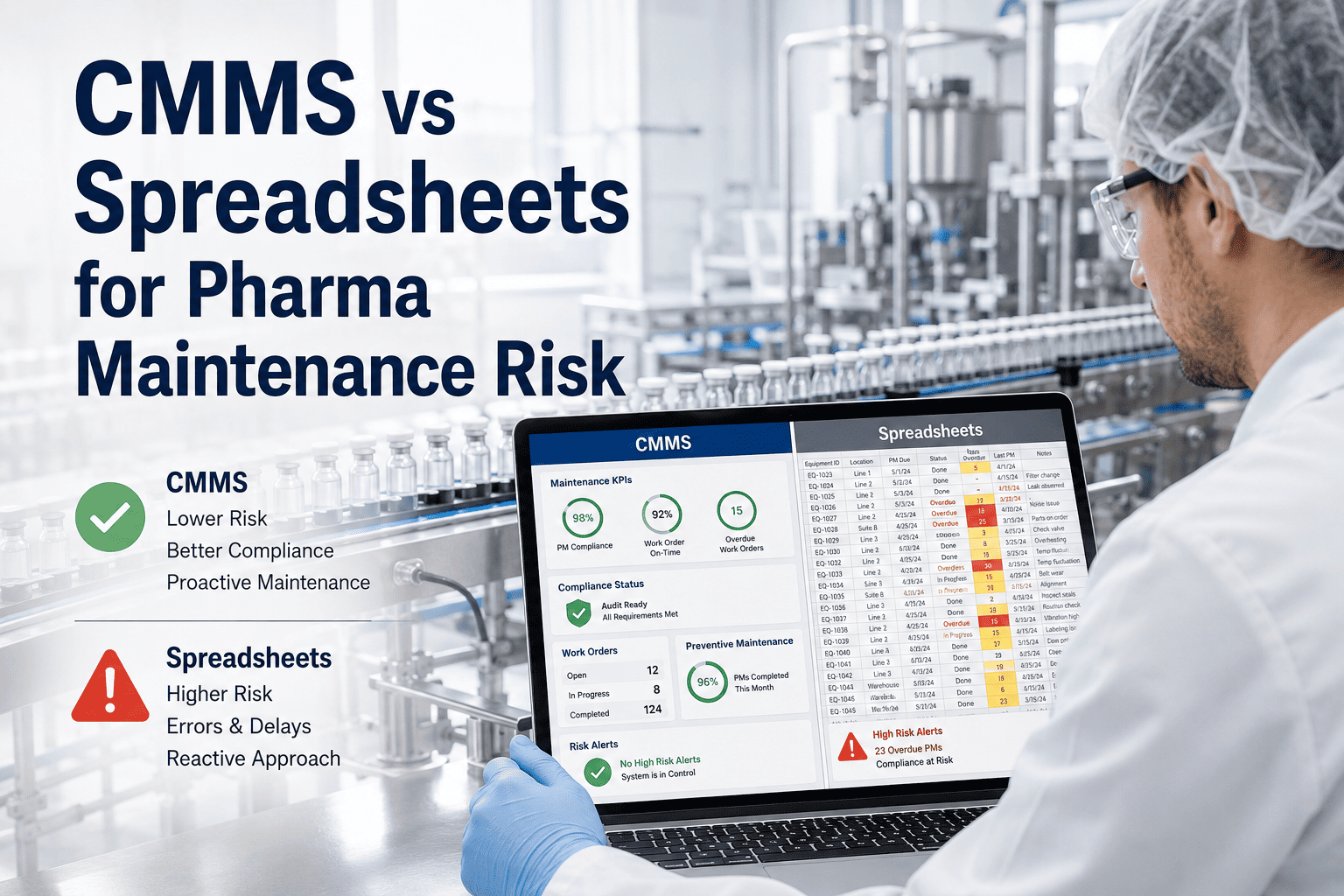
When a calibration result falls outside its defined tolerance band, the clock starts. Regulatory bodies expect a documented, time-bound response — quarantine, batch risk review, root cause investigation, and CAPA closure — not just a note that the instrument was recalibrated. Facilities that treat out-of-tolerance (OOT) findings as maintenance tasks rather than compliance events routinely face FDA 483 observations and ISO audit findings that could have been prevented. Book a demo with OxMaint to see an automated OOT CAPA workflow in action, or start a free trial and configure your own tolerance thresholds today.
Blog · GMP Workflow · Calibration CAPA · Pharma Metrology
Out-of-Tolerance Calibration CAPA Workflow
A step-by-step guide to handling OOT calibration results — from instrument quarantine and batch risk review to CAPA initiation, QA approval, and instrument re-release — in a pharma-compliant CMMS.
48 hrs
Maximum time FDA expects batch impact assessment to begin after OOT finding
83%
of OOT CAPA failures cited in FDA 483s relate to missing or delayed documentation
Stage 1
OOT Detection and Flagging
Within: 0 hours
The calibration technician records as-found readings. The CMMS compares readings against defined tolerance limits automatically. If the reading exceeds the tolerance band, the system flags the event as OOT and prevents normal work order closure until the deviation workflow is completed. This automated gate is the critical difference between a CMMS and a spreadsheet.
As-found reading recorded in measurement data fields
Tolerance band exceeded — system generates OOT event
Notification sent to QA supervisor and maintenance manager
Stage 2
Instrument Quarantine
Within: 2 hours
The affected instrument must be immediately removed from service or restricted pending investigation. In the CMMS, asset status changes to Quarantine, preventing new work orders from being assigned to the instrument. Physical tagging of the instrument should correspond to the CMMS status change, with the date, time, and authorizing person recorded in the asset record.
Asset status set to Quarantine in CMMS
Production team notified to stop using instrument
Physical quarantine tag applied — matches CMMS timestamp
Stage 3
Batch Impact Assessment
Within: 24–48 hours
QA must identify every product batch manufactured using the instrument during the period it was out of tolerance — from the last known good calibration date to the OOT finding date. This drift period review is the most time-sensitive and legally consequential step. A CMMS that links work orders to production batch records shortens this review from days to hours. The assessment outcome — no impact, quarantine batch, or batch release with documentation — must be recorded and approved in the CMMS.
Drift period identified: last good calibration to OOT date
Batch list pulled from CMMS for the drift period
QA assessment completed and linked to OOT record
Stage 4
CAPA Initiation and Root Cause
Within: 72 hours
A Corrective and Preventive Action record is initiated in the CMMS, linked directly to the OOT event. Root cause categories for OOT findings typically include calibration drift (instrument aging), improper handling or environmental exposure, reference standard error, or technician procedure deviation. Each root cause category requires a different corrective action. Preventive actions — such as increasing calibration frequency or adjusting tolerance tiers — must also be documented with target completion dates and responsible persons.
CAPA record created and linked to OOT event in CMMS
Root cause identified and categorized
Corrective and preventive actions documented with target dates
Stage 5
Recalibration, QA Closure, and Re-release
Within: CAPA target date
After recalibration is completed successfully and the CAPA corrective actions are verified, QA performs a digital sign-off that closes both the OOT record and the CAPA record simultaneously. The instrument status changes from Quarantine to Active in the CMMS. The full event timeline — from OOT detection through CAPA closure — is preserved as a single linked record that can be retrieved and printed for any subsequent inspection.
Recalibration completed — as-left reading within tolerance
CAPA actions verified and closed by responsible person
QA digital sign-off — instrument status restored to Active
OxMaint automates every stage of this workflow — from OOT detection and quarantine flagging to CAPA creation, batch impact linkage, and QA closure — with timestamps at every step.
Manual vs CMMS-Managed OOT Response
| OOT Response Activity |
Manual / Paper |
OxMaint CMMS |
| OOT detection and QA notification |
Technician reports verbally — no audit timestamp |
Automatic on tolerance breach — timestamped notification |
| Instrument quarantine documentation |
Paper tag only — no system record or date link |
Asset status change in CMMS with authorizing user and time |
| Batch impact assessment scope |
Manual batch log review — typically 2–5 days |
Linked work order history — typically 2–4 hours |
| CAPA record creation |
Separate paper form — not linked to OOT event record |
Auto-created and linked to OOT work order in one action |
| QA approval audit trail |
Handwritten signature — date/time often illegible |
Digital signature with UTC timestamp per 21 CFR Part 11 |
| Inspector document retrieval |
Binder search — average 4–8 hours during inspection |
Single export — complete OOT package in under 10 minutes |
| OOT trend analysis |
Not feasible without manual data compilation |
Automated trend report by asset, frequency, and root cause |
Common OOT Root Causes and Required CAPA Actions
01
Calibration Drift
Reduce calibration frequency. Review instrument age and service history. Consider replacement if drift is progressive across three consecutive calibrations.
02
Environmental Exposure
Document temperature, humidity, or vibration conditions at time of calibration. Relocate instrument or add environmental controls. Re-evaluate storage procedure.
03
Reference Standard Error
Check reference standard calibration status immediately. Initiate a parallel OOT review for all instruments calibrated with the same standard during the affected period.
04
Technician Procedure Deviation
Review calibration SOP compliance. Issue retraining record for the technician. Consider adding a second-person verification requirement for this instrument class.
SB
Dr. Sanjana Bhat
Regulatory Affairs Director · 16 Years in GMP Calibration and CAPA Management
The batch impact assessment window is where I see the most regulatory exposure. Facilities that manage this manually take two to five days to reconstruct which batches used a drifted instrument. That delay itself becomes a 483 observation — FDA expects you to know which product was at risk within 48 hours. A CMMS that links calibration events to production work orders makes this a two-hour task. The second observation I see repeatedly is CAPA records that exist in a separate system from the OOT record. When they are not linked, you cannot demonstrate to an investigator that the CAPA actually addressed the specific OOT event — and that looks like paper compliance, not real compliance.
Frequently Asked Questions
What is the difference between an out-of-tolerance and an out-of-specification result?
An out-of-tolerance (OOT) finding means a calibration instrument's measurement deviates beyond its defined accuracy band — it is a metrology finding about the instrument itself. An out-of-specification (OOS) finding means a product test result falls outside established product quality specifications — it is a manufacturing quality finding about the product. However, an OOT calibration instrument can cause an OOS product result if the instrument was used during the drift period, which is why batch impact assessment is mandatory after every OOT finding.
Book a demo to see how OxMaint links OOT and OOS workflows.
Does every OOT finding require a full CAPA, or only significant deviations?
Under 21 CFR Part 211 and ICH Q10, all OOT findings require documented investigation and a corrective action record. The depth of CAPA scales with the severity and frequency of the deviation — a first-time minor OOT may require only a documented recalibration and monitoring increase, while a repeated OOT on a critical instrument requires full root cause analysis and preventive action. The regulatory risk is not in the depth of CAPA but in having no CAPA at all. OxMaint's OOT workflow creates a CAPA record automatically for every OOT event.
Start a free trial to configure severity-based CAPA templates.
How far back does the batch impact assessment need to go after an OOT finding?
The review period begins at the last confirmed in-tolerance calibration date and ends at the OOT detection date. All product batches manufactured using the instrument during that drift period are in scope for the impact assessment. The length of this period depends on your calibration frequency — an instrument calibrated monthly may have a short drift window, while one calibrated annually may expose a year of production. This is why calibration frequency should be set based on instrument criticality, not just convenience. A CMMS maintains the full calibration history needed to determine the drift window accurately.
Can OxMaint track OOT trends to predict future failures before they occur?
Yes. OxMaint generates OOT trend reports by asset, asset class, location, and root cause category. Instruments with increasing drift frequency are flagged before they reach a failure state, allowing maintenance teams to increase calibration frequency or schedule replacement proactively. ISO 17025 and GMP guidance both recommend trend analysis of calibration results as part of a preventive maintenance culture.
Book a demo to see OxMaint's OOT trend reporting dashboard.
Stop Treating OOT Findings as Maintenance Tasks
OxMaint turns every out-of-tolerance calibration event into a structured compliance workflow — quarantine, batch assessment, CAPA, and QA closure — with timestamps that satisfy FDA and ISO auditors.