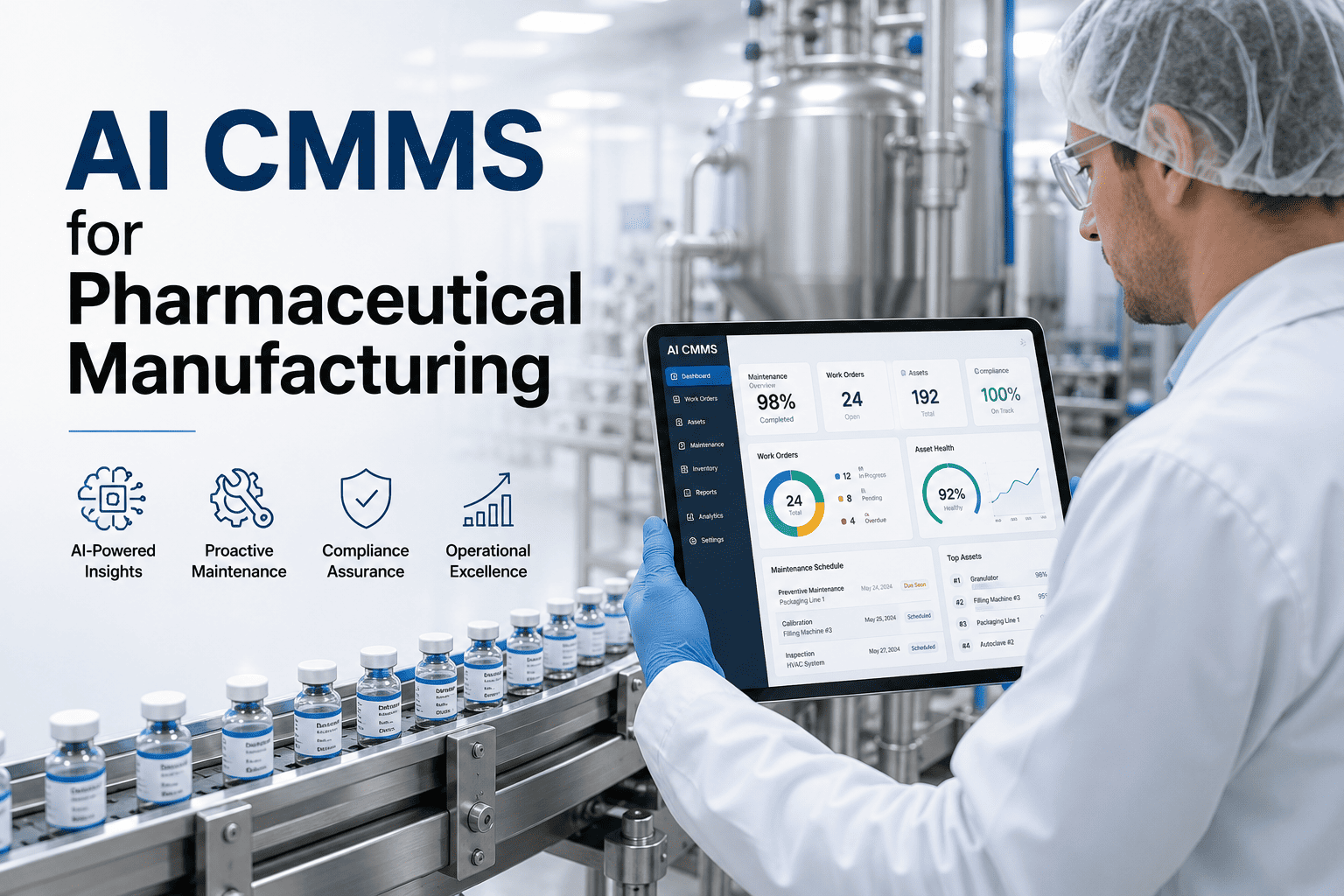
Pharmaceutical manufacturing sits at the intersection of the most demanding regulatory environment in any industry and the fastest pace of technology disruption since the introduction of automated filling lines. Maintenance leaders who treat CMMS as a work order system — rather than a compliance infrastructure — are one FDA 483 observation away from a consent decree that costs more than three years of digital transformation investment. Book a demo to see how Oxmaint positions your pharma maintenance program for 2026 regulatory and operational requirements.
Five trends are reshaping pharmaceutical maintenance in 2026: AI-powered predictive maintenance replacing time-based PM schedules, IoT condition monitoring on critical process equipment, digital GMP documentation closing FDA audit gaps, equipment digital twins accelerating qualification cycles, and integrated CMMS-ERP-MES platforms replacing fragmented maintenance data silos. Oxmaint delivers all five capabilities — configured for 21 CFR Part 11 compliance, GMP documentation requirements, and pharmaceutical-specific equipment hierarchies — deployable in weeks without IT projects.
Five Trends Reshaping Pharmaceutical Maintenance in 2026
Each trend carries a direct operational and regulatory implication. VP-level decisions made now on maintenance technology will determine audit exposure, batch release velocity, and OEE performance for the next five years. Book a demo to see how Oxmaint maps to each of these capability requirements.
Fixed-interval preventive maintenance schedules — inherited from paper-era maintenance planning — result in two documented failure modes: over-maintenance that consumes technician capacity without eliminating failure risk, and under-maintenance that allows degradation to progress between scheduled intervals. AI-driven predictive maintenance uses vibration, temperature, and process parameter data to trigger work orders based on actual equipment condition rather than calendar intervals. For lyophilizers, tablet compression equipment, and HVAC clean room systems, this reduces unplanned downtime by 35 to 55 percent and extends mean time between failures by eliminating unnecessary interventions. Oxmaint integrates condition monitoring sensor feeds directly into work order generation — no manual data transfer, no engineering review bottleneck.
IIoT sensor deployment costs have declined by over 60 percent since 2020, making continuous condition monitoring economically viable across entire pharmaceutical facility equipment bases — not just high-value assets. Clean room HVAC, compressed air systems, purified water generation, and filling line drives are now routinely monitored for vibration signature deviation, thermal anomaly, and flow parameter drift. The regulatory implication is equally significant: real-time monitoring data creates a continuous equipment health record that supplements scheduled qualification and validation documentation with actual performance evidence between formal review periods. Oxmaint's IoT integration layer connects to leading sensor platforms and routes alert data directly into maintenance work orders with full asset history linkage.
The majority of FDA 483 observations related to maintenance cite a documentation gap — not a procedural failure. The maintenance activity was performed correctly. The record was incomplete, unsigned, or not retrievable in the format required for inspection. 21 CFR Part 11 requires electronic records to meet specific integrity standards: unique user identification, audit trail, and tamper-evident record architecture. Oxmaint's electronic signature and audit trail module is designed specifically for 21 CFR Part 11 requirements — every maintenance record carries a timestamped, identity-verified signature chain that is retrievable by asset, date range, or equipment tag within minutes of an inspector's request. Paper cannot meet this standard. Partially implemented CMMS deployments without proper electronic signature infrastructure cannot meet this standard.
Equipment digital twins — virtual models of physical assets maintained with real operational data — are moving from aerospace and automotive into pharmaceutical manufacturing as qualification documentation requirements grow more complex. A digital twin fed by continuous maintenance history, calibration records, and condition monitoring data provides a real-time validated state model that accelerates IQ/OQ/PQ re-qualification after maintenance events. For multi-product facilities managing dozens of validation protocols across bioreactors, filling equipment, and clean utility systems, the ability to demonstrate continuous equipment state through integrated maintenance records reduces qualification timeline by 30 to 45 percent per event. Oxmaint's asset history architecture provides the structured maintenance data foundation that digital twin implementations require.
Pharmaceutical manufacturing VPs operating with disconnected CMMS, ERP, and MES platforms carry a structural data problem: maintenance events that affect batch quality cannot be linked to batch records automatically, spare parts consumption cannot be reconciled against production runs, and OEE calculations cannot reflect actual equipment availability from maintenance records. Integrated platforms that connect work order completion data to MES batch records and ERP financial flows eliminate this structural gap — enabling batch release teams to access complete maintenance history for equipment used in a specific lot without manual record assembly. Oxmaint's bi-directional integration with SAP, Oracle, and leading MES platforms delivers this connection without custom development.
Five Trends. One Platform. Deployable in Six Weeks.
Oxmaint delivers predictive maintenance, IoT integration, 21 CFR Part 11 documentation, and CMMS-ERP-MES connectivity — configured for pharmaceutical GMP requirements without a 12-month IT implementation. Book a strategic briefing to evaluate Oxmaint against your current maintenance technology roadmap.
Pharma Maintenance KPI Benchmarks — Where the Industry Stands in 2026
Regulatory Compliance Mapping — Pharma Maintenance Requirements
| Framework | Key Maintenance Obligations | Common Documentation Failure | Oxmaint Coverage |
|---|---|---|---|
| FDA 21 CFR Part 211 / Part 11 | Written maintenance procedures, equipment logs, preventive maintenance schedules, electronic record integrity with audit trail and e-signature | Unsigned maintenance records, missing PM completion evidence, non-retrievable equipment logs under inspection | 21 CFR Part 11-compliant e-signature, tamper-evident audit trail, PM schedule enforcement with completion verification, sub-60-minute record retrieval |
| EU GMP Annex 11 / EudraLex Vol. 4 | Computerized system validation for CMMS, audit trail for all maintenance record modifications, access control with role-based authorization | CMMS not validated per Annex 11, audit trails disabled or incomplete, user access controls not aligned with GMP roles | Annex 11-aligned CMMS validation package available, full audit trail on all record modifications, role-based access with GMP authorization levels |
| ICH Q10 Pharmaceutical Quality System | Maintenance as a manufacturing control — equipment performance trending, CAPA for equipment failures, continual improvement documentation | Equipment failure patterns not analyzed systematically, CAPA not linked to maintenance root cause, no equipment performance trending program | Equipment failure trend analysis dashboard, CAPA module linked to work order root cause, performance KPI trending per asset over configurable periods |
| ISO 15378 / GMP for Primary Packaging | Preventive maintenance for packaging line equipment, calibration records for measurement equipment, validated cleaning verification procedures | Calibration certificates not linked to equipment records, packaging line PM compliance gaps, cleaning validation records not retrievable per batch | Calibration schedule with certificate attachment, packaging line PM compliance tracking, cleaning validation record linkage to batch and equipment records |
| WHO GMP / PIC/S Guidelines | Equipment qualification documentation, maintenance history records per equipment, spare parts specification control for GMP-critical components | Qualification documentation not current after maintenance events, spare parts substitution without specification verification, equipment history gaps | Post-maintenance qualification workflow triggers, spare parts specification management with GMP-critical flagging, complete equipment history per asset tag |
Oxmaint vs Competing CMMS — Pharmaceutical Capability
| Capability | Oxmaint | MaintainX | UpKeep | Fiix | Limble | IBM Maximo | Hippo | Infor EAM |
|---|---|---|---|---|---|---|---|---|
| 21 CFR Part 11 e-signature & audit trail | Yes | No | No | Partial | No | Yes | No | Custom |
| IoT condition monitoring integration | Yes | Generic | Partial | Partial | Generic | Yes | No | Yes |
| Predictive maintenance work order triggers | Yes | No | No | Partial | No | Yes | No | Yes |
| SAP/Oracle ERP bi-directional integration | Yes | No | No | Partial | No | Yes | No | Yes |
| Calibration schedule with certificate management | Yes | Generic | Generic | Yes | Generic | Yes | Generic | Yes |
| CAPA module linked to equipment failures | Yes | No | No | Partial | No | Yes | No | Custom |
| Deployment without IT project — weeks not months | Yes | Yes | Yes | Varies | Yes | No | Yes | No |
Operational Outcomes — Pharma Facilities Using Oxmaint
From 67% to 97% PM Compliance — in 60 Days
Pharmaceutical facilities that deploy Oxmaint close their GMP documentation gap before the next FDA inspection cycle — not after the observation is written. Schedule a strategic briefing to map Oxmaint capabilities to your current maintenance technology gaps.
Frequently Asked Questions
Position Your Pharma Maintenance Program for 2026 and Beyond
AI-driven predictive maintenance, IoT condition monitoring, 21 CFR Part 11 documentation, and CMMS-ERP-MES integration — all live in Oxmaint within six weeks, no IT project required. Schedule a strategic briefing with your VP of Operations and Maintenance and see the full capability mapped to your current gap assessment.