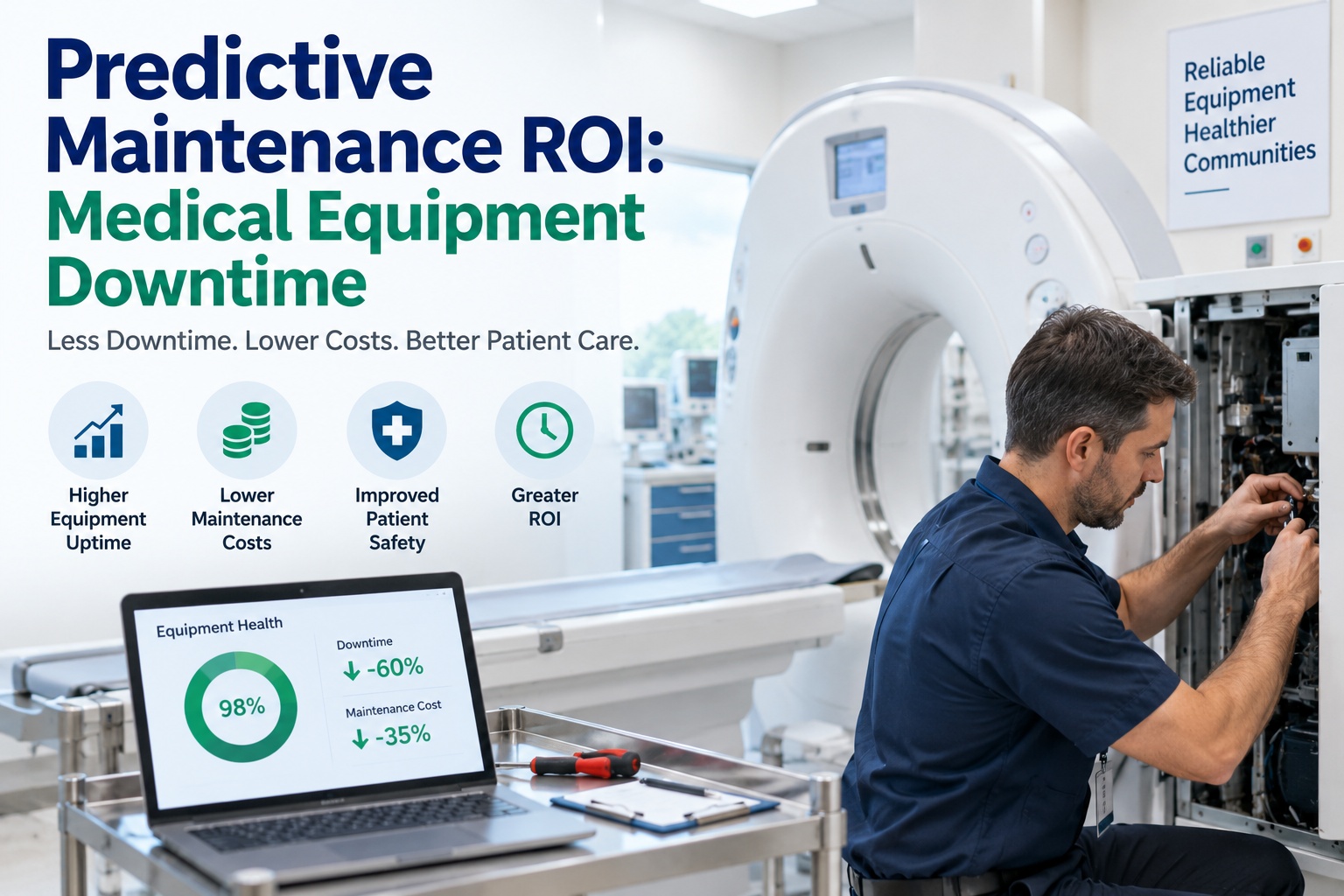
Hospitals run on equipment. Every MRI scanner, ventilator, infusion pump, and surgical robot is a link in a chain of patient care — and when one link breaks unexpectedly, the consequences ripple far beyond a maintenance ticket. Unplanned equipment downtime in healthcare costs an average of $8,662 per minute in a surgical environment, and the human cost is harder to measure but equally real. The old model — waiting for something to fail, then fixing it — is no longer acceptable when the stakes involve patient outcomes. Predictive maintenance powered by IoT sensors and machine learning is rewriting that model entirely. Instead of reacting to failure, hospitals are now anticipating it, often days or weeks before a technician would ever notice a problem. Want to put predictive intelligence to work at your facility? start a free trial for 30 days or book a demo to see how OxMaint helps healthcare teams stay ahead of every failure.
Stop Reacting. Start Predicting.
OxMaint CMMS gives your hospital the tools to connect IoT sensor data, automate work orders, and stay ahead of equipment failure — all on one platform.
What Is Predictive Maintenance in Healthcare?
Predictive maintenance is a data-driven strategy that uses real-time sensor readings, machine learning models, and historical performance data to forecast when a piece of equipment is likely to fail — before it actually does. Unlike preventive maintenance, which operates on fixed schedules regardless of actual equipment condition, predictive maintenance intervenes only when the data says intervention is needed. In healthcare environments, this distinction is critical. Preventive maintenance schedules are blunt instruments: they may dispatch a technician to service a perfectly healthy ventilator while a degrading pump motor two rooms away goes unexamined. Predictive maintenance redirects effort with precision, prioritizing the equipment most at risk at any given moment. Instead of rigid service calendars, teams work from live risk scores generated by machine learning — meaning every technician hour is spent where it will deliver the greatest reduction in failure probability. Ready to make the shift? start a free trial and explore how predictive workflows integrate with your existing CMMS, or book a demo with the OxMaint team today.
Predictive vs. Preventive Maintenance
| Dimension | Preventive Maintenance | Predictive Maintenance |
|---|---|---|
| Trigger | Fixed time interval or usage threshold | Real-time sensor data and ML anomaly detection |
| Timing | Scheduled regardless of equipment condition | Condition-based — only when risk is detected |
| Downtime Risk | Moderate — failures can still occur between cycles | Low — failures anticipated days or weeks in advance |
| Resource Use | Often over-maintains healthy equipment | Targets effort precisely where needed |
| Data Required | Minimal — schedule-based | Continuous sensor streams and historical baselines |
| Implementation Cost | Lower upfront | Higher upfront; lower total cost over time |
How IoT Sensors Enable Predictive Maintenance
The foundation of any predictive maintenance program is a network of sensors continuously measuring the physical signals that precede equipment failure. In healthcare, these sensors are embedded in imaging systems, HVAC units, surgical robots, laboratory analyzers, and patient monitoring infrastructure. The data they generate is the raw material that machine learning models transform into actionable predictions.
Detect bearing wear, imbalance, and mechanical loosening in rotating equipment — including MRI cooling systems, centrifuges, and robotic drive motors — before failure propagates to adjacent components.
Monitor thermal signatures in electrical panels, motor windings, and cooling circuits. Abnormal heat buildup is a precursor to insulation failure, component burnout, and fire risk in high-voltage medical systems.
Track electrical draw anomalies in pumps, compressors, and imaging equipment. A motor drawing more current than its baseline is working harder than it should — a leading indicator of mechanical degradation.
Critical for medical gas systems, sterilization equipment, and pneumatic actuators. Pressure deviations outside defined thresholds indicate leaks, valve wear, or compressor degradation before patient safety is affected.
Capture high-frequency sound signatures from bearings, gears, and fluid systems. Ultrasonic analysis identifies cavitation in pumps and early-stage bearing defects invisible to vibration analysis alone.
Track actual usage hours and operational cycles rather than calendar time. Enables precise remaining-useful-life calculations for components with defined wear curves — critical for surgical robot joints and imaging tube assemblies.
Machine Learning Models That Power Failure Prediction
Raw sensor data is only as useful as the models interpreting it. Predictive maintenance software in healthcare environments deploys several categories of machine learning algorithms, each suited to different failure patterns and data characteristics.
Unsupervised Baseline Deviation
Models like Isolation Forest, Autoencoders, and One-Class SVM learn the normal operating signature of each piece of equipment and flag deviations from that baseline. Particularly valuable when labeled failure data is scarce — which is common for recently acquired or rarely-failing high-value assets like MRI systems.
Remaining Useful Life Prediction
Gradient Boosting, Random Forest, and LSTM neural networks trained on historical run-to-failure datasets produce time-to-failure estimates expressed as remaining operational hours. RUL prediction gives maintenance teams a planning horizon — scheduling parts and labor before the failure window, not after it.
Fault Type Identification
Once an anomaly is detected, classification models identify which specific failure mode is developing — bearing wear versus imbalance, for example. This determines not just that maintenance is needed, but exactly what repair will be required, enabling parts to be ordered before the technician arrives.
Temporal Pattern Recognition
LSTM and Transformer-based architectures capture degradation trajectories that unfold over days or weeks. Where simpler models see a single out-of-range reading, time-series models see a trend — distinguishing genuine degradation from transient noise that would otherwise generate false alarms.
High-Impact Applications in Hospital Environments
Predictive maintenance delivers its greatest value on equipment where failure is both costly and clinically consequential. In hospitals, several asset categories stand out as priority targets for IoT-enabled prediction programs. OxMaint helps facilities track all of these asset classes in a single unified platform. Want to see it in action? start a free trial and connect your first asset class in minutes, or book a demo to walk through the full hospital equipment portfolio.
MRI and CT Imaging Systems
Imaging equipment combines high mechanical complexity — cryogenic systems, gradient coils, rotating gantries — with failure costs exceeding $50,000 per unplanned downtime event when lost revenue and emergency repair premiums are included. Helium pressure monitoring, cryocooler vibration analysis, and gradient amplifier thermal tracking are all addressable with IoT sensors.
Surgical Robots
Robotic surgical systems accumulate wear in joint actuators, cable assemblies, and instrument drive mechanisms across thousands of procedures. Torque monitoring and encoder drift analysis detect mechanical degradation that could compromise surgical precision long before it would be caught during scheduled calibration.
HVAC and Critical Environment Systems
Operating room air handling units, pharmacy cleanrooms, and pathology cold storage depend on HVAC systems with zero tolerance for failure. Bearing analysis on AHU fans, refrigerant pressure monitoring, and filter differential pressure tracking prevent environmental failures that compromise sterility, medication integrity, and accreditation compliance.
Medical Gas Infrastructure
Oxygen, nitrogen, and nitrous oxide delivery systems serve every patient care area. Compressor performance monitoring, leak detection, and valve cycle counting enable proactive maintenance of infrastructure whose failure can have immediate life-safety consequences.
Sterilization Equipment
Autoclaves and washer-disinfectors underpin surgical instrument supply chains. Pressure vessel integrity, heating element performance, and door seal condition can all be tracked continuously — preventing the sterilization failures that result in surgical case delays and instrument loss.
Laboratory Analyzers
High-throughput chemistry and hematology analyzers process hundreds of patient samples daily. Pump wear, probe alignment drift, and temperature control degradation affect result accuracy before they cause outright failure — making continuous monitoring critical for diagnostic integrity.
The ROI Case: Quantifying Downtime Reduction
Healthcare organizations evaluating predictive maintenance investments need a clear financial model. The return on investment operates through four primary value streams that compound across a large equipment portfolio. Beyond direct maintenance savings, the indirect value of downtime prevention — preserved surgical revenue, avoided patient diversions, protected accreditation status, and reduced clinician frustration — typically exceeds the direct cost savings by a factor of two to three in high-acuity hospital environments.
Building a Predictive Maintenance Program: Key Components
Implementing predictive maintenance in a healthcare setting requires more than installing sensors. A durable program integrates hardware, software, process, and organizational change across four foundational layers. OxMaint is built to support every layer — from sensor data ingestion to automated work order creation and audit-ready documentation. See how OxMaint fits your facility by taking a free 30-day trial, or book a demo with our team to map a deployment plan to your portfolio.
Sensor Infrastructure and Connectivity
Select sensors appropriate to each failure mode — vibration, temperature, current, pressure, acoustic. Establish secure, dedicated IoT network paths that comply with hospital IT governance and do not traverse clinical systems networks. Define data sampling rates that capture relevant failure signatures without overwhelming storage and processing infrastructure.
Data Platform and ML Pipeline
Aggregate sensor streams into a time-series data platform capable of storing and querying billions of data points. Build or deploy machine learning models trained on historical data from your specific equipment population. Establish model retraining cadences to accommodate equipment aging and operational profile changes.
CMMS Integration and Work Order Automation
Predictions are only valuable if they generate action. Integrate your predictive maintenance platform with a CMMS that automatically converts risk alerts into prioritized work orders — with asset ID, predicted failure mode, recommended action, and required parts already populated. OxMaint closes this loop between data science and physical maintenance execution.
Technician Training and Change Management
Predictive maintenance requires technicians to trust and act on algorithmic recommendations — a cultural shift from experience-based intuition to data-guided decision-making. Invest in training that builds model literacy, establish clear escalation protocols for high-confidence alerts, and create feedback loops where technician findings improve model accuracy over time.
Regulatory and Compliance Considerations
Healthcare predictive maintenance programs operate within a regulatory framework that shapes both what data can be collected and how maintenance actions must be documented. Three bodies of regulation are most directly relevant.
Governs electronic records and signatures for regulated medical devices — including the maintenance logs and calibration records that predictive maintenance platforms generate. Any CMMS used in this context must support audit trails, access controls, and record integrity features that satisfy these requirements.
Environment of Care standards require documented preventive maintenance programs for all life-safety and patient care equipment. Predictive maintenance enhances this requirement — work orders generated from sensor alerts must be captured in the same audit-ready format as scheduled PM records.
HIPAA considerations arise wherever predictive maintenance systems interface with equipment that processes patient data — including imaging systems, patient monitors, and connected infusion pumps. The networks carrying sensor data must be governed with the same rigor as clinical systems.
The ISO 55000 series provides the international framework for asset management systems, defining how hospitals should plan, control, and improve the life cycle of their physical assets. OxMaint's condition-based tracking and CapEx forecasting align directly with ISO 55001 requirements for systematic asset decision-making.
OxMaint: Predictive Maintenance Meets Healthcare-Grade CMMS
OxMaint connects IoT sensor alerts to automated work orders, tracks asset health across your entire hospital equipment portfolio, and generates the audit-ready documentation your compliance program requires. One platform for predictive intelligence and maintenance execution.
Frequently Asked Questions
What is the difference between predictive and preventive maintenance in healthcare?
Preventive maintenance operates on fixed schedules — servicing equipment every 90 days regardless of its actual condition. Predictive maintenance uses real-time sensor data and machine learning to identify when equipment is actually at risk of failure, enabling targeted intervention only when the data indicates it is needed. Predictive approaches reduce unnecessary maintenance labor while dramatically lowering unplanned downtime rates. Most healthcare organizations see measurable downtime reductions within 6 to 12 months of deploying predictive programs on high-value assets.
What types of sensors are used for predictive maintenance in hospitals?
Common sensor types include vibration sensors for rotating equipment, temperature sensors for electrical and thermal systems, current and voltage monitors for motor health, pressure sensors for gas and fluid systems, acoustic and ultrasonic sensors for leak and bearing detection, and runtime counters for usage-based remaining-life calculations. Sensor selection depends on the specific failure modes relevant to each asset category — OxMaint supports ingestion from all major sensor protocols including MQTT, OPC-UA, and HL7 FHIR.
How long does it take to see ROI from a healthcare predictive maintenance program?
Most healthcare organizations report measurable downtime reduction within 6 to 12 months of deployment on high-value assets. Full program ROI — accounting for sensor hardware, software licensing, and implementation costs — is typically achieved within 18 to 24 months, with ongoing returns compounding as model accuracy improves with additional training data. The indirect value of preserved surgical revenue and avoided patient diversions typically exceeds direct savings by a factor of 2 to 3.
Is IoT predictive maintenance suitable for smaller community hospitals?
Yes, particularly for high-value imaging and life-safety assets where a single unplanned failure can displace dozens of procedures. Cloud-based predictive maintenance platforms have significantly reduced the infrastructure investment required, making the technology viable for facilities that cannot support on-premise data science infrastructure. Starting with two or four critical asset categories and expanding as ROI is demonstrated is a practical path for smaller organizations. Book a demo to find the right starting point for your facility, or start a free trial with no long onboarding required.