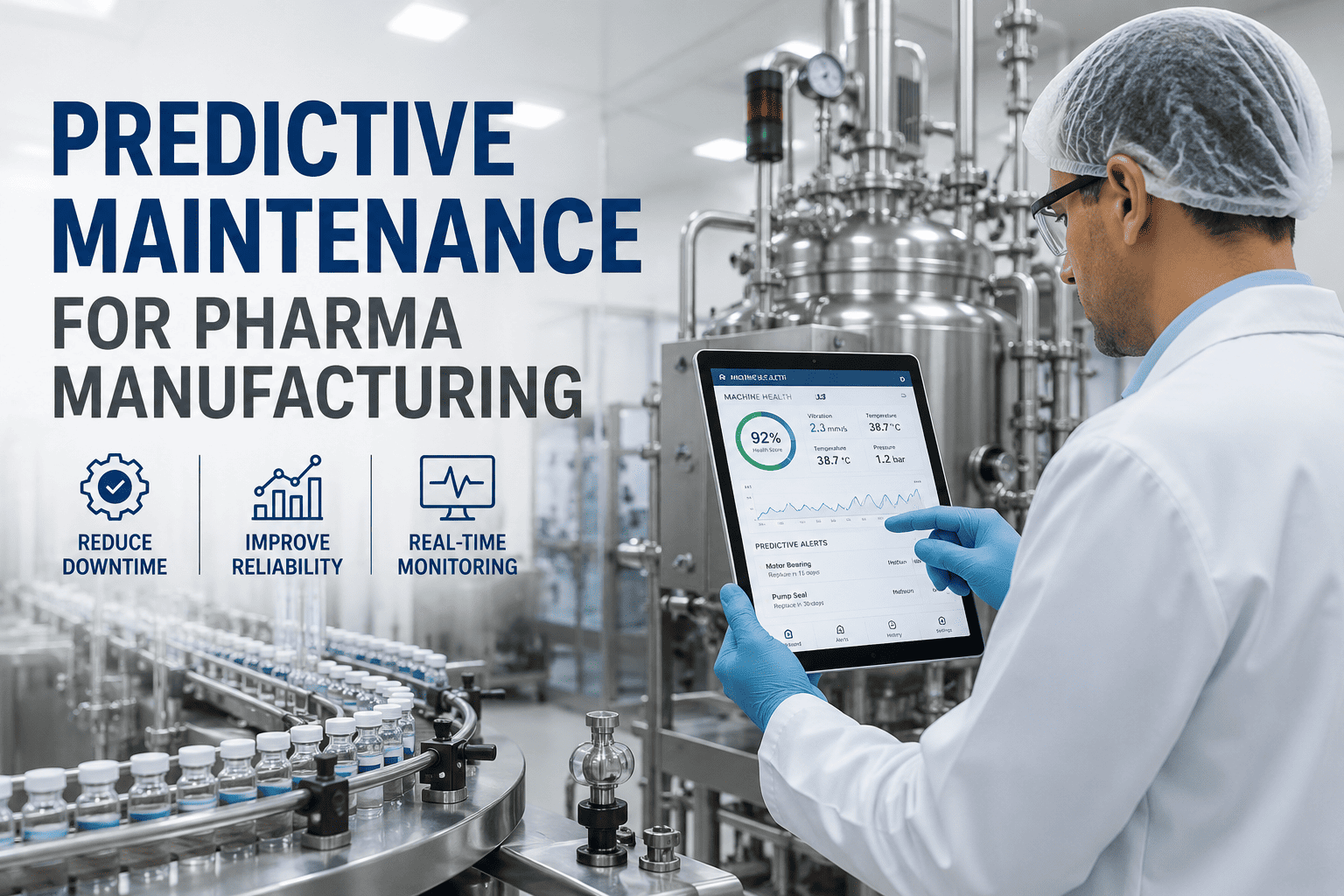
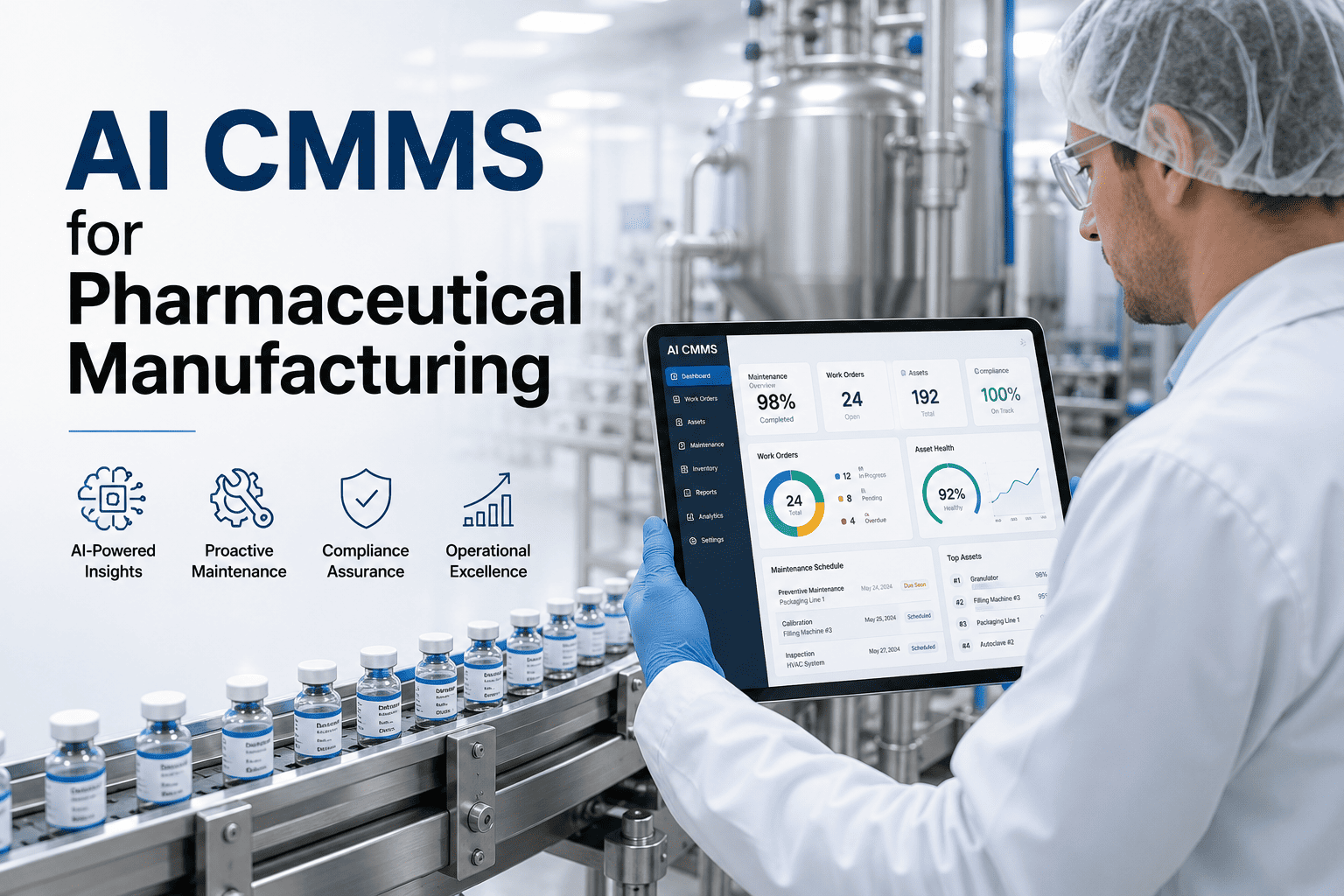
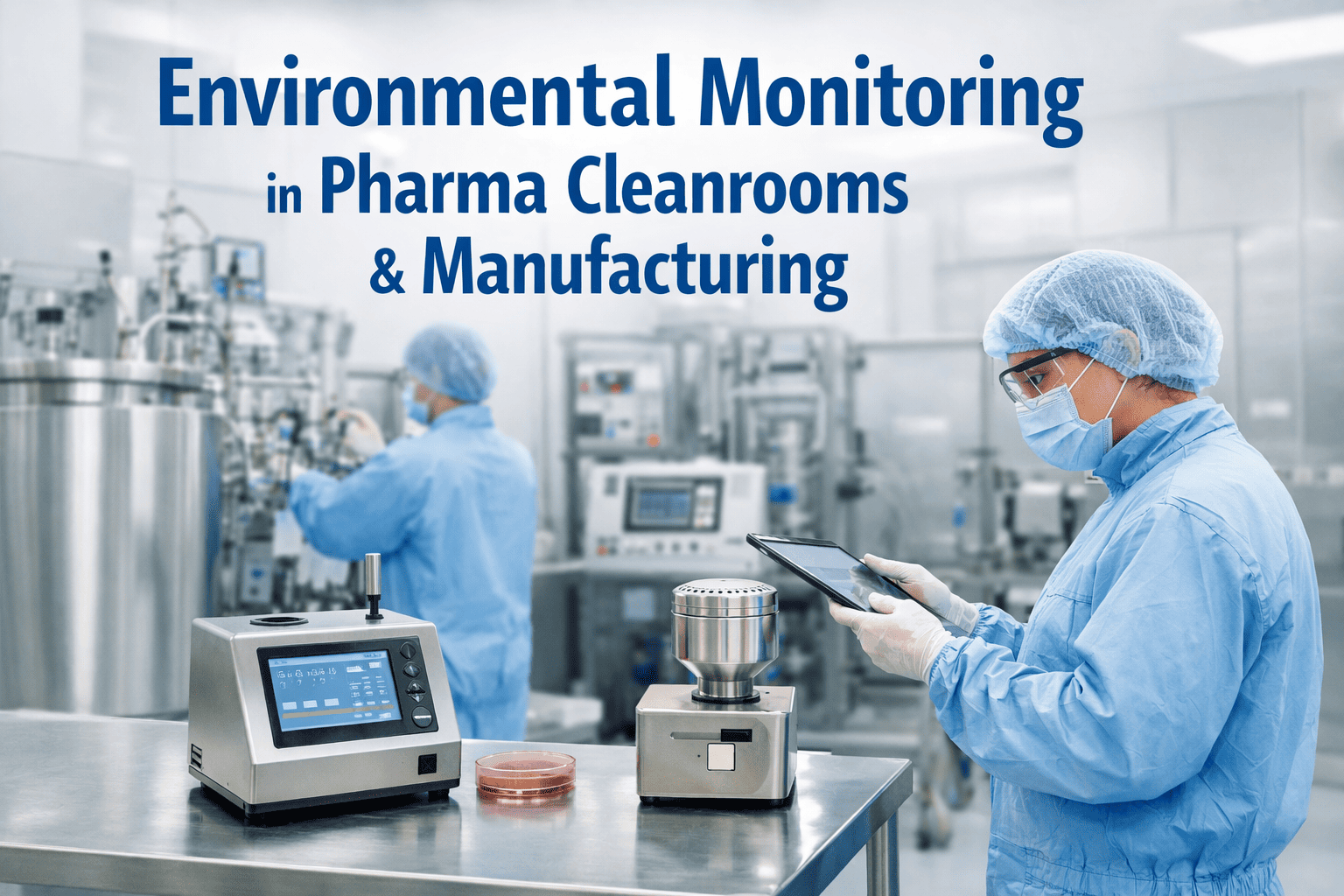
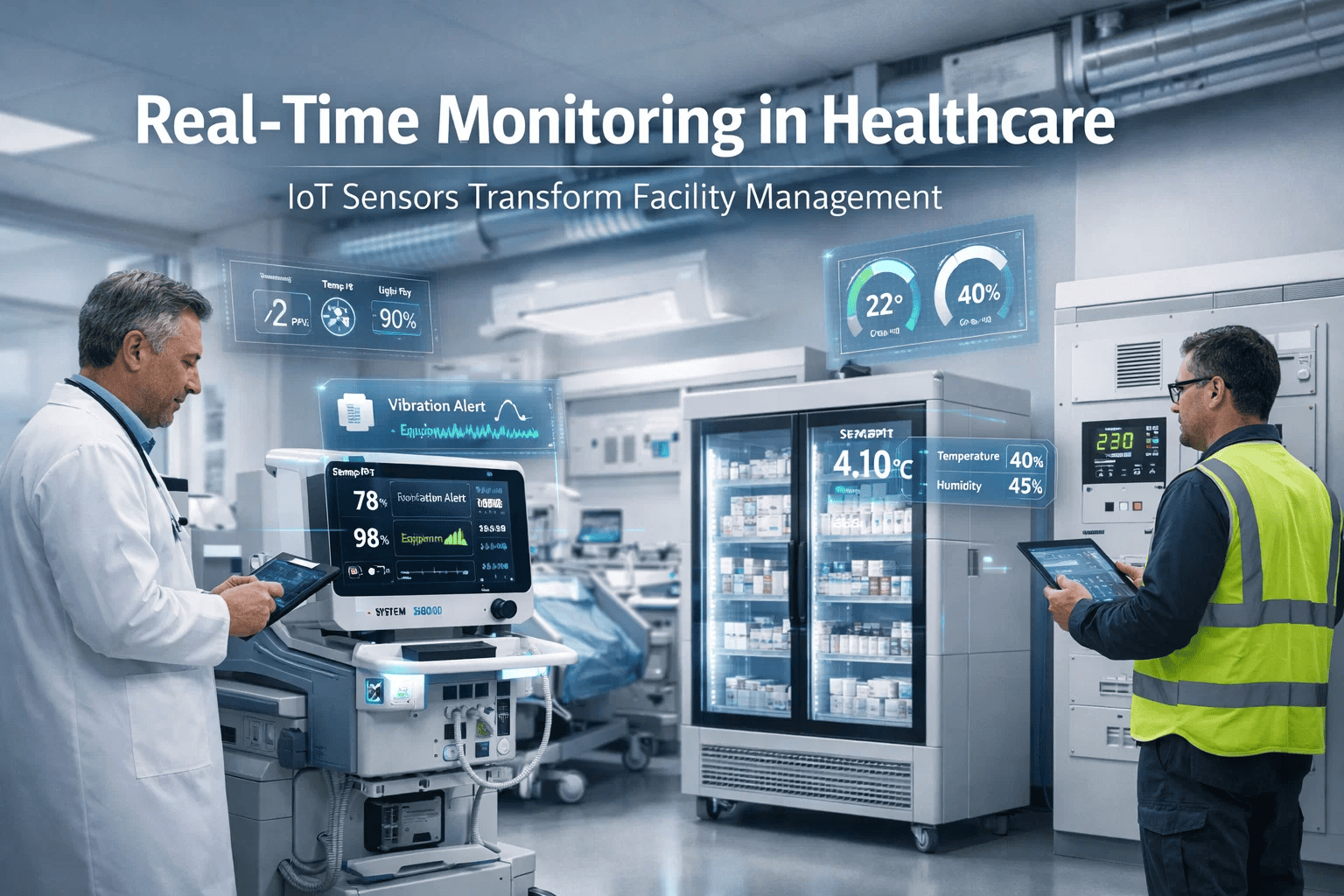
Pharmaceutical manufacturing runs on razor-thin tolerances. A tablet press running 2% out of spec does not just waste product — it triggers batch failures, regulatory holds, and investigations that shut lines for days. The difference between a plant that catches equipment drift before it becomes a deviation and one that discovers it during QC review is almost entirely about what sensors are installed, what data they feed, and whether your maintenance team acts on signals before failures happen. Want to see how predictive maintenance works in a GMP environment? start a free trial or book a demo with our pharmaceutical operations team today.
AI Predictive Maintenance for Pharmaceutical Manufacturing
Stop batch failures before they start. This guide shows pharma plant managers, maintenance engineers, and quality teams how IoT sensors, AI analytics, and GMP-compliant CMMS combine to predict equipment failure weeks before it costs you a batch.
Your Equipment Is Sending Signals. Is Anyone Listening?
Tablet presses, granulators, and filling lines generate thousands of data points per hour — vibration, temperature, torque, pressure, and speed variations that shift subtly weeks before a mechanical failure or quality deviation. Most pharma plants ignore this data until something breaks. Oxmaint's pharma PdM module captures it continuously, runs it through AI-trained fault models, and alerts your maintenance team when intervention is still cheap and scheduled — not after the batch is lost. Start a free trial and connect your first piece of critical equipment in under a day, or book a demo to see a live pharma equipment dashboard.
What Is Predictive Maintenance in Pharma — and Why Does It Matter More Here?
Predictive maintenance (PdM) uses real-time sensor data and machine learning to forecast when equipment will fail or drift out of specification — before it actually does. In most industries, the cost of a wrong prediction is a service call. In pharmaceutical manufacturing, it is a batch rejection, an FDA deviation record, a potential recall, and a quality investigation that can run for weeks.
The GMP dimension makes pharma PdM fundamentally different from standard industrial maintenance. Equipment condition directly affects product quality and patient safety. A tablet press with worn tooling produces tablets outside dissolution specs. A filling line with seal integrity drift creates contamination risk. Predictive maintenance in this environment is not just a cost-saving tool — it is a quality assurance function. Start a free trial to see GMP-compliant monitoring in action, or book a demo with our pharma implementation team.
6 Pharma Equipment Types Where PdM Pays the Most
These are the machines where equipment drift causes batch failures, regulatory deviations, and unplanned downtime with the highest financial and compliance impact.
What Changes When You Switch From Reactive to AI-Driven PdM
Ready to move from reactive to predictive? Start a free trial or book a demo to walk through a live pharma PdM deployment.
The Oxmaint Pharma PdM Stack — From Sensor to Scheduled Work Order
Oxmaint connects IoT sensor infrastructure to GMP-compliant work order management in a single platform — no third-party analytics middleware, no manual data export, no disconnected SCADA silo.
Every step is audit-ready. Oxmaint's pharma PdM module is designed for 21 CFR Part 11 and Annex 11 environments — electronic records, electronic signatures, and tamper-evident change logs across all maintenance activity. Start a free trial and run your first sensor-to-work-order loop in under a week, or book a demo to see the full compliance documentation layer.
PdM and Regulatory Compliance — What Inspectors Actually Look For
What Pharma Plants Achieve With AI Predictive Maintenance
Pharma PdM — Questions Maintenance and QA Teams Ask Most
01 How does AI predictive maintenance integrate with our existing SCADA and DCS systems? ▾
Oxmaint connects to existing SCADA and DCS infrastructure via OPC-UA, Modbus, and REST API protocols — the most common industrial communication standards in pharma facilities. Process parameters already being measured by your control system (temperatures, pressures, flow rates, speeds) are ingested directly into Oxmaint without additional sensors on those data points. For parameters not currently monitored — vibration, motor current draw, bearing temperature — Oxmaint provides retrofit IoT sensor kits that install without production line shutdown. Typical integration time for a solid dose manufacturing line is 3–5 days from first sensor installation to live analytics dashboard.
02 Does the system generate the documentation we need for FDA and EMA inspections? ▾
Yes — and this is the area where most of our pharma clients see the fastest value after implementation. Every maintenance record in Oxmaint is timestamped, linked to the specific equipment asset, and electronically signed by the responsible technician and approver. The audit trail is tamper-evident and searchable by equipment, date range, maintenance type, or technician. For FDA inspectors who request maintenance records for a specific piece of equipment during an inspection, Oxmaint generates a complete equipment history report in minutes — including calibration records, preventive maintenance completion, corrective actions, and any anomaly alerts that were raised and resolved. This documentation package directly supports responses to requests under 21 CFR Part 211 Subpart D (Equipment) and EU GMP Chapter 3.
03 How does the AI model learn our specific equipment — it must behave differently from generic industrial machines? ▾
Correct — pharmaceutical equipment has unique operating patterns tied to batch cycles, product changeovers, and CIP/SIP events that would look like anomalies on a generic industrial AI model. Oxmaint's pharma fault models are pre-trained on equipment behavior signatures from tablet presses, granulators, filling lines, and coating pans — then fine-tuned on your specific equipment's baseline during a calibration period of 2–4 weeks. During this period, the system learns normal operating envelopes for each product and batch type. After calibration, anomaly detection is specific to your equipment's actual behavior — not a generic threshold. This dramatically reduces false positive alerts, which are the primary reason maintenance teams stop trusting and acting on PdM systems.
04 What happens when a maintenance action is needed — how does the system communicate it to the right people? ▾
When the AI model detects an anomaly that meets the threshold for maintenance action, Oxmaint automatically creates a prioritized work order and routes it based on the equipment type, fault category, and your escalation rules. Notifications go to the responsible maintenance engineer, shift supervisor, and — if the anomaly has quality implications — the QA contact linked to that production line. The work order includes the sensor readings that triggered the alert, the AI's confidence score, the predicted remaining useful life, and suggested corrective actions based on the fault signature. Maintenance teams act on specific, contextualized information — not just a generic "check this machine" alert. All actions taken, parts used, and sign-offs are captured back in the work order, closing the audit loop automatically.
Start Monitoring. Stop Reacting. Protect Every Batch.
Oxmaint gives pharma maintenance and quality teams a single platform to monitor critical equipment in real time, detect failure signals weeks early, generate GMP-compliant work orders automatically, and produce inspection-ready audit records on demand. No lengthy validation projects. No disconnected monitoring silos. Live equipment health data from your first production line within days of go-live.