The same part costs two very different amounts depending on when you order it. Stocked ahead of a planned repair, it's list price and standard freight. Ordered at 2 a.m. because a critical device just failed, it's a sole-source OEM markup, an overnight-freight surcharge, and a machine down the whole time you wait. In hospitals, most maintenance spend is reactive — and reactive parts are the most expensive parts there are. Cutting emergency parts cost isn't about buying cheaper; it's about needing fewer emergencies. OXMAINT AI, the AI-powered hospital CMMS, shifts work from reactive to planned and keeps the critical spares on the shelf.
Healthcare · Emergency Parts Cost · Hospital Maintenance · 2026
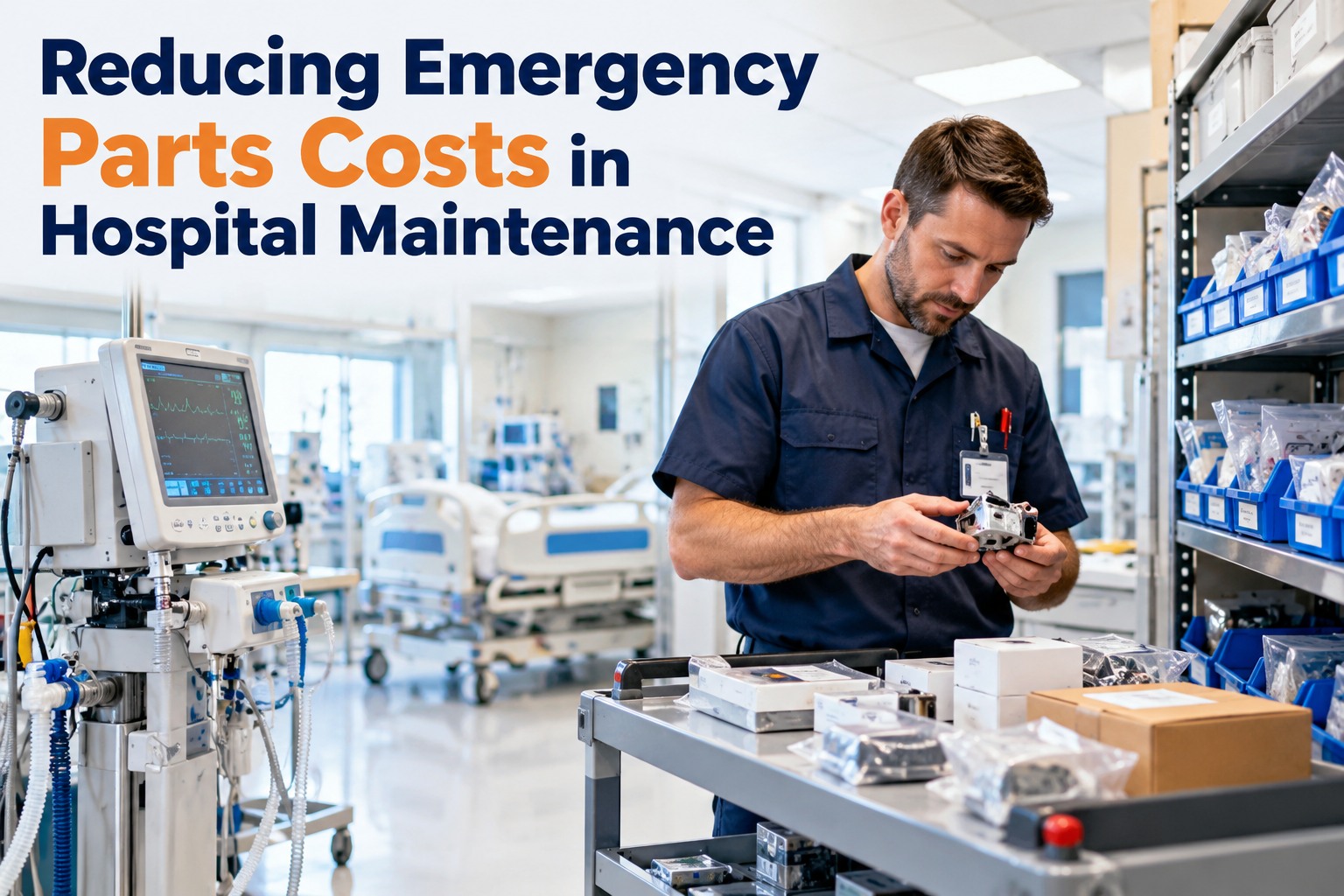
Reducing Emergency Parts Costs in Hospital Maintenance
A rush order at a premium. Overnight freight on a sole-source part. A device down while you wait. Emergency parts are the most expensive line in a biomed budget. OXMAINT AI, the AI-powered CMMS and maintenance management software, attacks the root cause: preventive and predictive work that heads off the failure, critical spares stocked to a reorder point, and consumption-based ordering — so the fix is a planned pick, not a panic purchase.
1Predict / Plan
→
2Stock Critical
→
3Auto-Reorder
→
4Avoid the Rush
SAME PART · TWO WAYS TO BUY
PLANNED
List price
Standard freight
No downtime
vs
EMERGENCY
Rush premium
Overnight freight
Device down
3–5×
cost of reactive work vs planned preventive maintenance
~54%
of hospital work orders are reactive on average
18–28%
cut in emergency repair spend at 85%+ PM compliance
<20%
reactive-work target a healthy program aims for
Anatomy of an Emergency Part
An emergency part doesn't cost more because the component changed — it costs more because of everything wrapped around a rush. Break the invoice apart and the premium is obvious, and every layer of it is avoidable with lead time. OXMAINT AI buys that lead time by catching the need before it's urgent. Start free and take the rush out of your parts in OXMAINT AI.
Why the Same Part Costs More in an Emergency
Rush / sole-source premium
Illustrative, not to scale — the point is that the part itself is often the smallest piece. Reactive repairs run 3–5× the cost of the same work planned, and much of that gap is the rush around the part, not the part.
Why the Emergencies Happen
Every rush order traces to one of a few root causes — and none of them is "bad luck." They're gaps in planning, stocking or visibility that a system closes. OXMAINT AI is built to close each one. Book a demo to find your emergency-order root causes in OXMAINT AI.
Failure Wasn’t Prevented
A missed PM or an ignored condition alert lets a device fail unplanned — turning a scheduled fix into a 2 a.m. rush.
Critical Spare Wasn’t Stocked
The part that takes a device offline wasn't on the shelf, so it has to be bought now, at whatever the vendor charges.
No Reorder Trigger
Stock quietly ran out because nothing watched the level — the shortage is discovered only when a job needs the part.
No Lead-Time Warning
A long-lead OEM part wasn't ordered ahead of a known PM, so the maintenance window arrives before the part does.
Five Levers That Cut Emergency Parts Cost
Reducing emergency parts spend isn't one move — it's five, working together, all off the same maintenance data. OXMAINT AI runs each on the platform your biomed team already uses. Start free and pull these levers in OXMAINT AI.
1
Prevent the Failure
Automated PM and condition alerts head off the breakdown — the cheapest emergency part is the one you never had to order. Hitting 85%+ PM compliance is where the emergency-spend reduction shows up.
2
Stock the Vital Few
Identify the parts whose absence takes a critical device offline and keep them on the shelf with safety stock — so the failure that does happen is a pick, not a purchase.
3
Reorder on Consumption
Consumption-based inventory tied to closed work orders auto-reorders at the minimum level — eliminating the stockouts that create emergency procurement premiums.
4
Forecast Long-Lead Parts
Read the PM schedule forward and order long-lead OEM parts before the window opens — standard freight instead of overnight, list price instead of rush.
5
Consolidate & Score Vendors
Use performance data to consolidate suppliers and negotiate — vendor consolidation backed by scorecards drives a 12–19% contract cost reduction at renewal.
The Cheapest Emergency Part Is the One You Didn’t Need.
You can't negotiate your way out of a 2 a.m. rush order — you can only avoid needing one. OXMAINT AI shifts work from reactive to planned, keeps the critical spares stocked, and orders long-lead parts ahead of the window, so the expensive emergency purchase stops happening.
Shifting From Reactive to Planned
Emergency parts cost is a symptom; a reactive maintenance program is the disease. The cure is a steady shift from firefighting to planned work — and that shift is measurable. OXMAINT AI runs the loop that moves the reactive percentage down month over month. Here's how. Book a demo to see the reactive-to-planned shift in OXMAINT AI.
01
Automate the PM Program
Every device on a preventive schedule with condition alerts — the failures that drive rush orders start getting caught early.
↓
02
Link Parts to the Work
Each spare is tied to the assets and PMs that consume it, so demand is known ahead instead of discovered at failure.
↓
03
Stock & Auto-Reorder
Critical spares held to a reorder point; consumption from closed work orders triggers replenishment before the shelf empties.
↓
04
Order Ahead of the Window
Upcoming PMs surface the long-lead parts they'll need, so procurement beats the maintenance window at standard cost.
↓
05
Measure the Reactive Ratio
Reactive percentage and emergency spend trend on the dashboard — the proof the shift is working, month over month.
What the CMMS Does to Parts Cost
Emergency parts spend is the visible symptom of gaps the CMMS is built to close — in prevention, stocking and visibility. OXMAINT AI runs all of it off the maintenance data you already collect. Start free and put your parts spend on one platform in OXMAINT AI.
PREVENT
Automated PM & Alerts
Asset-based preventive schedules and condition alerts head off the failures that create rush orders in the first place.
STOCK
Critical-Spare Management
The parts that take a device offline are flagged and held with safety stock, so the vital few are never a rush buy.
REORDER
Consumption-Based Replenishment
Stock tied to closed work orders auto-reorders at minimum — eliminating the stockouts behind emergency premiums.
FORECAST
PM-Driven Parts Planning
Upcoming PMs flag the long-lead parts they'll need, so they're ordered at standard cost before the window.
VENDOR
Vendor Scorecards
Response, invoice accuracy and repeat-repair rates tracked automatically, giving the data to consolidate and negotiate.
ANALYZE
Cost & Reactive Dashboard
Spend by asset, department and vendor, plus the reactive ratio — the numbers that show emergency cost falling.
“
Our parts budget was being eaten alive by rush orders — overnight freight and OEM premiums on components we should have had on the shelf. When we looked, more than half our work was reactive, so of course the parts were always emergencies. We put the PM program on the system, stocked the critical spares to a reorder point, and started ordering long-lead parts ahead of scheduled work. The reactive ratio came down, and with it the rush orders. The part prices didn't change — we just stopped paying the emergency tax on them.
Clinical Engineering Director · Regional Hospital
Frequently Asked Questions
Why do emergency parts cost so much more?
It's rarely the part itself — it's the rush around it: sole-source OEM premiums, overnight freight, and the device being down while you wait. Reactive work runs 3–5 times the cost of the same repair planned, and most of that gap is the emergency, not the component. OXMAINT AI removes the rush by catching the need early.
Start free and take the rush out.
What's the single biggest lever to reduce emergency parts spend?
Prevention. The cheapest emergency part is the one you never had to order, and facilities that reach 85%+ PM compliance report an 18–28% cut in emergency repair spend. OXMAINT AI automates the PM program that gets you there.
Book a demo to see PM automation.
How do we know which spares to stock?
Start with criticality — the parts whose absence takes a patient-critical device offline get safety stock and a reorder point; low-impact parts are ordered on demand. OXMAINT AI classifies parts and links them to the assets they serve.
Start free and stock the vital few.
How does consumption-based reordering help?
It ties stock levels to what closed work orders actually use and auto-reorders at the minimum, so critical spares never quietly run out — which is what forces the emergency premium in the first place. OXMAINT AI runs it off your work-order data.
Book a demo to see auto-reorder.
Can this reduce our vendor and contract costs too?
Yes — performance data (response time, invoice accuracy, repeat repairs) supports vendor consolidation, which drives a 12–19% contract cost reduction at the first renewal in multi-facility systems. OXMAINT AI tracks vendor scorecards automatically.
Start free and score your vendors.
Stop Paying the Emergency Tax on Every Part.
Cut emergency parts cost on the OXMAINT AI maintenance management software — automated PM that prevents the failure, critical spares stocked to a reorder point, consumption-based replenishment, PM-driven ordering of long-lead parts, and vendor scorecards. Turn panic purchases into planned picks.


.jpg)
