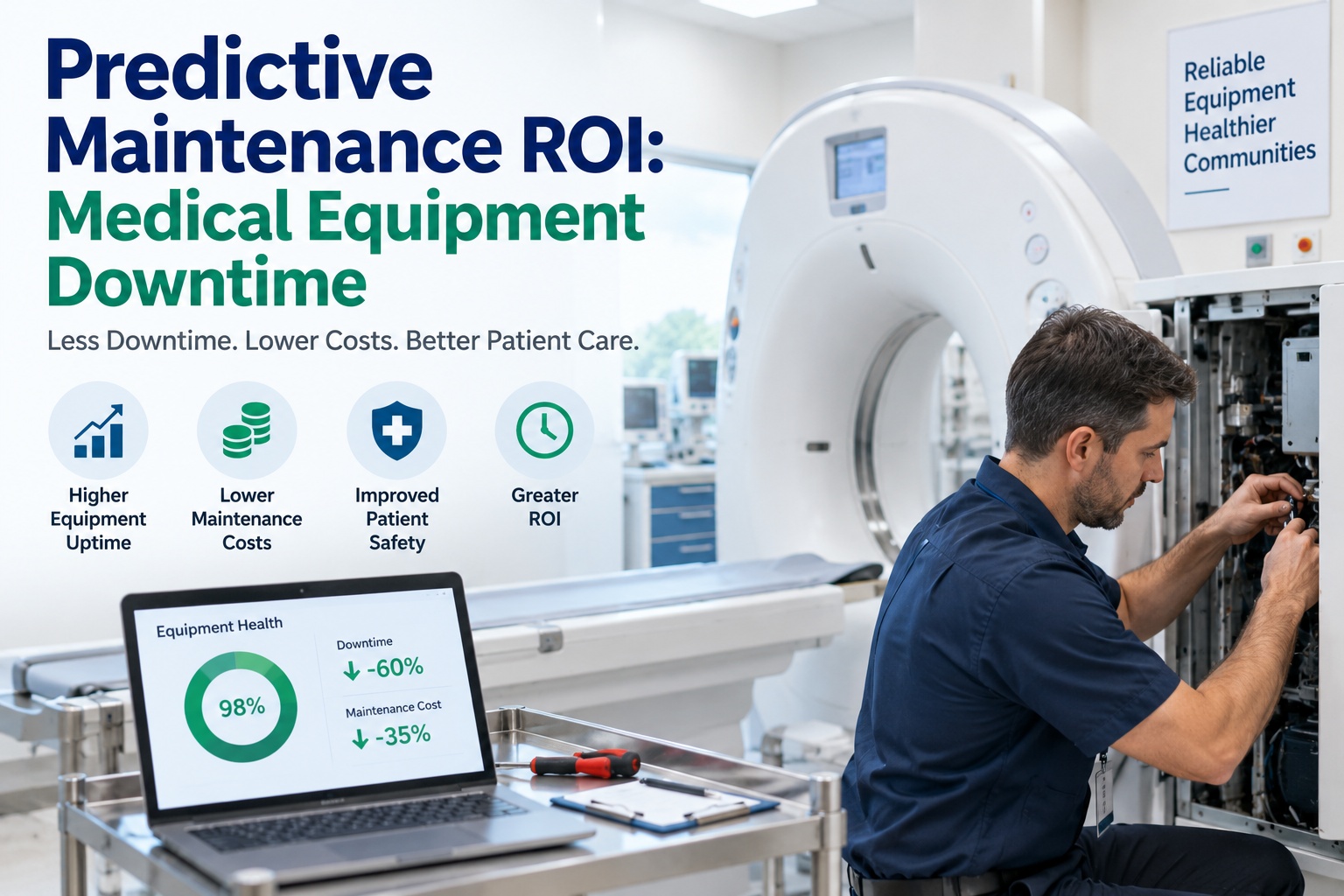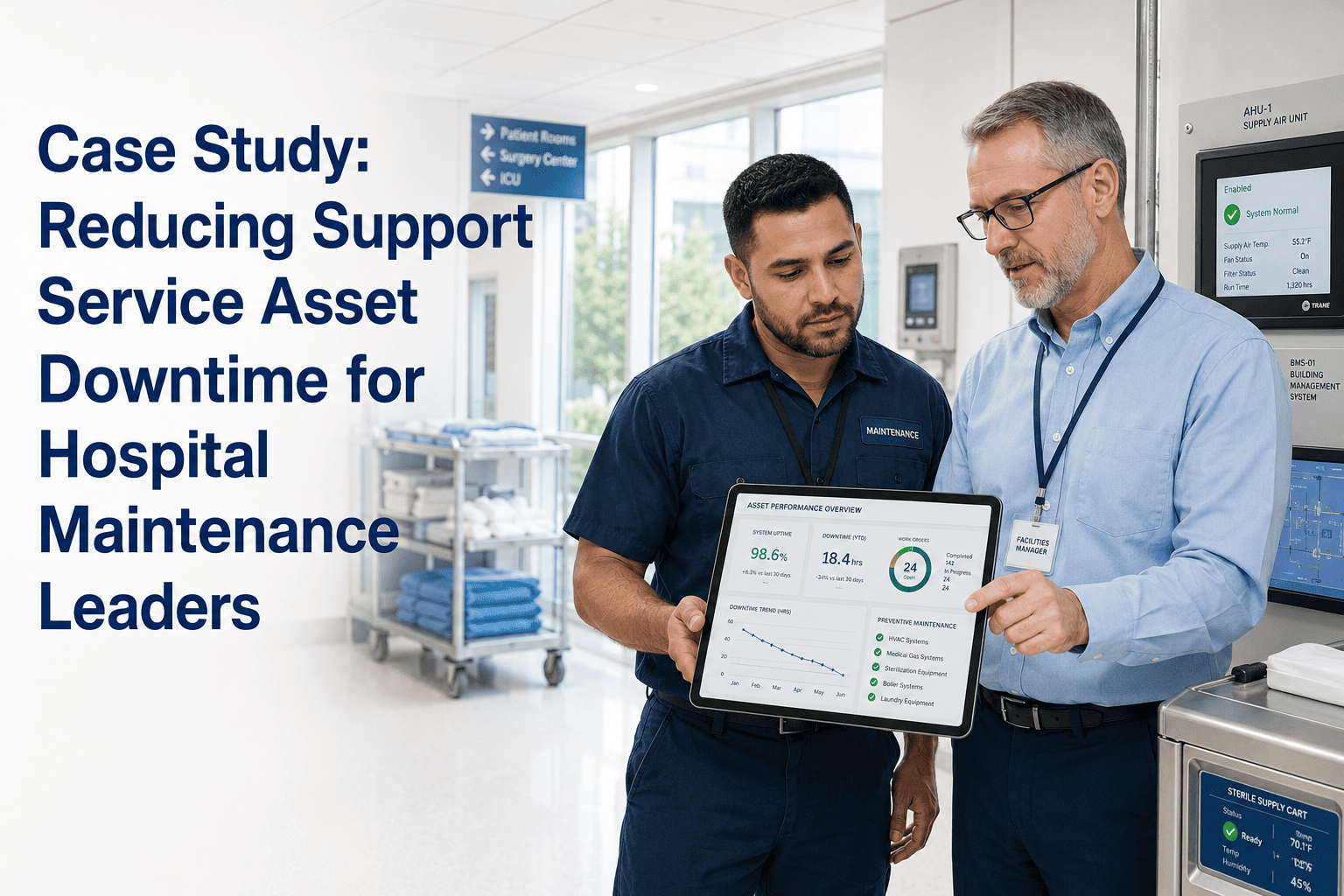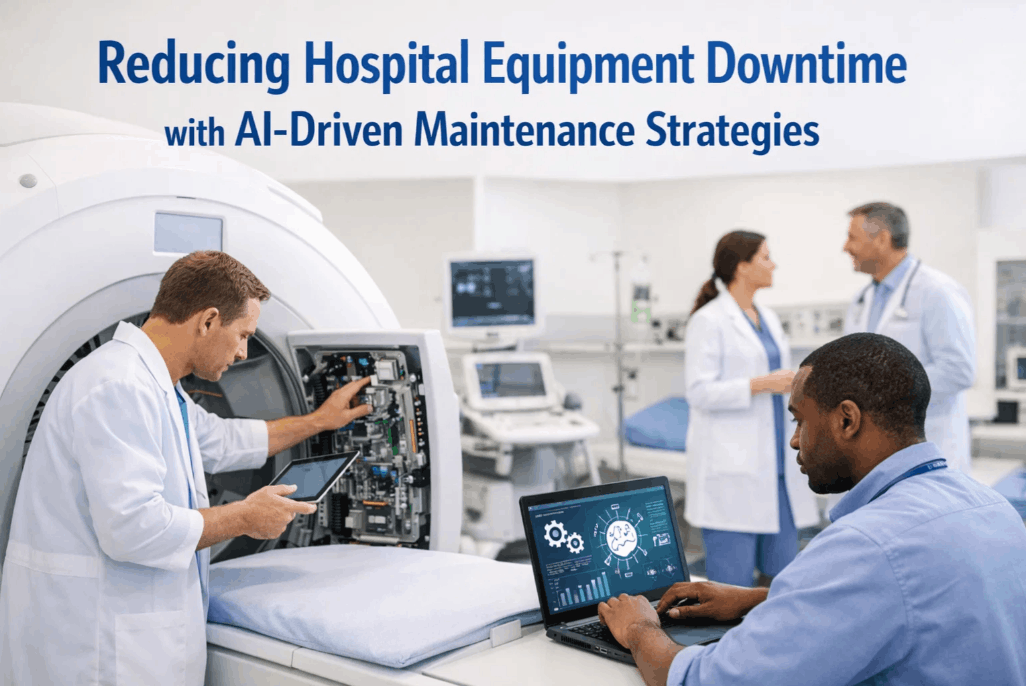
Unplanned equipment failure in a hospital is not simply an operational inconvenience — it is a patient safety event. When a ventilator goes offline unexpectedly, when a CT scanner requires emergency service in the middle of a trauma shift, or when infusion pumps cycle out of calibration without warning, the downstream consequences extend far beyond maintenance costs. Clinical workflows stall, procedures get rescheduled, staff productivity drops, and in the worst cases, patient outcomes are directly compromised. Reducing hospital equipment downtime is now one of the most measurable levers available to healthcare operations leaders seeking to improve both care quality and financial performance. The organizations achieving the lowest downtime rates today are not simply maintaining their assets more frequently — they are using AI-driven maintenance platforms — sign up to get started — to predict failures before they happen, prioritize work orders intelligently, and optimize asset lifecycles across entire facility portfolios.
Is your facility truly AI-maintenance ready?
Discover how OxMaint's AI-powered platform eliminates unplanned downtime and keeps your equipment audit-ready around the clock.
The Real Cost of Equipment Downtime in Healthcare
Most hospital finance teams track the direct cost of equipment repair — parts, labor, vendor dispatch fees. Far fewer have quantified the true total cost of downtime, which includes procedural delays, staff overtime, patient diversions, revenue loss from canceled billable procedures, regulatory compliance risk, and the reputational impact of service disruptions. Studies from leading health systems have placed the total cost of unplanned clinical equipment downtime at between $1.5 million and $2 million annually per mid-sized hospital, with imaging departments and critical care units accounting for the largest share of that impact.
The challenge is compounded by the aging state of biomedical inventories across many health systems. The average age of hospital medical equipment in the United States has climbed steadily over the past decade, driven by constrained capital budgets, supply chain disruptions affecting replacement timelines, and the sheer expansion of connected device ecosystems that biomedical engineering teams are now expected to manage. More devices, older devices, and more complex interdependencies — all managed by teams whose headcount has not kept pace with asset portfolio growth. The result is a reactive maintenance culture that treats failure as an inevitable operational condition rather than a preventable one.
Why Reactive Maintenance Is No Longer Viable
Traditional hospital equipment maintenance has operated on one of two models: reactive maintenance, which dispatches technicians after a failure has already occurred, or time-based preventive maintenance, which schedules service at fixed calendar intervals regardless of actual equipment condition. Both models carry significant inefficiencies that AI-driven approaches are now designed to eliminate.
Fix After Failure
- Equipment fails during active clinical use
- Emergency repair costs 3–5x planned maintenance
- No warning time to arrange alternatives
- Patient procedures delayed or canceled
- Clinical staff workflows disrupted immediately
- Failure data rarely captured for trend analysis
Fixed Schedule Service
- Service occurs regardless of equipment condition
- Resources wasted on unnecessary maintenance
- Critical failures still occur between intervals
- Scheduling conflicts with clinical operations
- No correlation between service cycles and failure risk
- High labor cost with incomplete risk coverage
Condition-Based Intelligence
- Failure risk identified weeks before failure occurs
- Maintenance scheduled at optimal cost and timing
- Clinical disruption minimized through advance planning
- Resources directed only where and when needed
- Continuous learning improves prediction accuracy
- Full audit trail for compliance and lifecycle analytics
How AI-Driven Maintenance Reduces Equipment Downtime
Artificial intelligence transforms equipment maintenance from a schedule-driven administrative function into a data-driven operational capability. The core mechanism is continuous condition monitoring: IoT sensors embedded in or connected to clinical equipment stream real-time performance data — vibration signatures, temperature readings, power consumption patterns, cycle counts, error logs — into a centralized analytics platform. Machine learning models trained on historical failure data analyze these streams continuously, identifying the subtle patterns that precede equipment degradation before any visible symptom appears at the device level. Want to see this in action for your facility? Book a demo to explore how AI condition monitoring works across clinical asset classes.
The result is a maintenance intervention window — typically ranging from days to several weeks in advance of projected failure — during which biomedical engineering teams can plan service at a time that minimizes clinical disruption, source parts proactively, and coordinate with clinical department heads to arrange backup coverage if needed. This shift from reactive response to proactive management is the fundamental value driver behind healthcare AI maintenance programs, and it is the primary mechanism through which leading health systems are achieving downtime reductions of 35–45% across their critical equipment portfolios.
IoT Sensor Integration and Real-Time Monitoring
AI maintenance platforms connect directly to biomedical devices through embedded sensors, gateway devices, or native equipment APIs to establish continuous condition visibility. Data streams are normalized, timestamped, and fed into anomaly detection models that establish baseline performance signatures for each individual asset — recognizing that two units of the same model may exhibit different normal operating patterns based on age, usage intensity, and environmental conditions.
Predictive Failure Analytics
Machine learning models — typically combining time-series anomaly detection with supervised classification trained on labeled failure event data — generate equipment-specific risk scores that update continuously as new sensor data arrives. These scores are surfaced to biomedical teams through prioritized work order queues that rank intervention urgency based on failure probability, clinical criticality of the asset, and time-to-projected-failure estimates.
Automated Work Order and Parts Management
When AI systems flag an elevated failure risk, the downstream workflow is equally important as the prediction itself. Leading CMMS platforms automatically generate draft work orders with pre-populated asset history, parts recommendations, and technician assignment suggestions based on skill matching and schedule availability. Integration with parts inventory systems enables automatic procurement triggers when replacement components fall below threshold stock levels for high-risk assets.
Asset Lifecycle Optimization
Beyond predicting individual failure events, AI analytics aggregate performance data across asset classes to identify systemic patterns — models with elevated failure rates, service history clusters associated with premature end-of-life, and department-level usage patterns that accelerate wear beyond manufacturer projections. These portfolio-level insights inform capital planning decisions, replacement cycle optimization, and vendor performance assessment with a data rigor that traditional paper-based maintenance programs cannot provide.
Critical Equipment Categories Where AI Delivers the Highest Impact
While AI-driven maintenance delivers measurable benefits across all biomedical and facilities assets, certain equipment categories present particularly high-value opportunities due to the combination of clinical criticality, failure frequency, and the availability of rich sensor data streams that support robust predictive modeling. Start tracking your critical assets with a platform built for healthcare operations teams managing complex, high-stakes device inventories.
Imaging Systems
MRI, CT, and PET scanners represent some of the highest-value and highest-complexity assets in any hospital. Unplanned downtime on a single CT scanner can result in $15,000–$25,000 in lost daily revenue while emergency service contracts for these systems carry significant premium costs. AI monitoring of chiller temperatures, helium pressure levels, tube usage cycles, and detector performance enables intervention planning weeks ahead of failure thresholds.
Ventilators and Life Support
For life-critical devices, downtime is not measured in dollars but in patient safety events. AI maintenance platforms monitoring compressor performance, valve cycling patterns, sensor calibration drift, and alarm activation frequencies can identify ventilators approaching failure well before they exhibit clinical warning signs, enabling proactive withdrawal from service for maintenance without emergency replacement pressure.
Infusion Pumps and IV Systems
High-volume, distributed devices like infusion pumps present a fleet management challenge that manual tracking cannot efficiently address. AI platforms tracking motor wear, battery performance degradation, software error frequencies, and programming keypad failure patterns across large pump inventories enable risk-stratified maintenance that prioritizes the highest-risk units while extending service intervals for pumps showing robust performance data.
Sterilization Equipment
Autoclave and sterilizer failures create cascading procedural delays across surgical departments. AI condition monitoring of chamber pressure cycles, temperature uniformity, seal integrity metrics, and cycle duration drift enables proactive maintenance that protects surgical instrument supply chains from the downstream effects of sterilization equipment failure.
HVAC and Critical Environment Systems
Operating room air handling systems, pharmacy clean rooms, and laboratory environmental controls directly affect infection control compliance and regulatory standing. AI monitoring of filter pressure differentials, air change rates, temperature and humidity stability, and compressor performance enables facilities teams to maintain critical environment specifications continuously rather than relying on periodic compliance checks.
Laboratory Analyzers
Clinical lab equipment downtime directly delays diagnostic turnaround times, affecting clinical decision-making across emergency, intensive care, and surgical departments. AI platforms monitoring reagent consumption patterns, quality control result trends, pump and rotor wear indicators, and optical system performance can identify analyzer degradation trajectories before test result accuracy is compromised.
CMMS and AI Integration: The Technology Architecture
The technical foundation of an AI-driven hospital equipment maintenance program sits at the intersection of three platform categories: the Computerized Maintenance Management System (CMMS), the IoT data ingestion and analytics layer, and the clinical asset management system that maintains the master device registry. Understanding how these layers integrate is essential for biomedical engineering and operations leaders evaluating implementation pathways.
| Platform Layer | Primary Function | AI Capability | Integration Point |
|---|---|---|---|
| CMMS Core | Work order management, PM scheduling, technician dispatch | AI-prioritized work queues, automated work order generation | EHR, ERP, asset registry |
| IoT Sensor Platform | Real-time device telemetry ingestion and normalization | Anomaly detection, baseline drift identification | CMMS, analytics platform |
| Predictive Analytics Engine | Failure risk scoring, RUL (remaining useful life) estimation | ML-based failure classification, ensemble modeling | CMMS, IoT platform, reporting |
| Asset Lifecycle Management | Capital planning, depreciation tracking, replacement forecasting | Portfolio-level trend analysis, replacement optimization | Finance systems, CMMS |
| Compliance Reporting Layer | Regulatory documentation, audit trail generation, certification tracking | Automated compliance gap detection, risk flagging | Accreditation systems, EHR |
Building a Data Foundation for Predictive Maintenance
The effectiveness of any AI predictive maintenance program is directly proportional to the quality, completeness, and historical depth of the data it trains on. Many hospital biomedical programs find that their first significant challenge is not selecting the right AI platform — it is assembling the data foundation that the platform requires to function reliably. The following domains represent the core data inputs that an AI maintenance system depends on.
Historical Maintenance Records
Accurate, structured records of every maintenance event — including work order type, failure mode description, parts replaced, labor time, and technician notes — form the labeled training data that AI failure prediction models require. Facilities with incomplete or paper-based maintenance histories may need to invest in data remediation efforts before predictive models can achieve reliable performance.
Real-Time Sensor Telemetry
IoT connectivity is the lifeblood of condition-based AI maintenance. For devices without native connectivity, retrofit sensor packages — vibration sensors, current clamps, temperature probes, and runtime meters — can establish monitoring coverage across legacy equipment. Defining sensor placement strategies based on failure mode criticality is essential for maximizing signal quality relative to deployment cost.
Manufacturer Performance Specifications
Integrating OEM specifications — normal operating parameter ranges, rated service intervals, component lifespan projections, and known failure mode profiles — into AI models significantly improves prediction accuracy, particularly for equipment classes with limited historical failure data in a given facility's maintenance records. Manufacturer service bulletins and field safety notice data provide additional signal for model refinement.
Utilization and Workflow Context
Equipment that operates at significantly higher utilization rates than its rated design assumptions degrades faster than OEM maintenance schedules anticipate. AI platforms that integrate utilization context — procedure volumes, daily cycle counts, patient census correlation — can adjust risk scores and maintenance interval recommendations dynamically based on actual usage patterns rather than fixed calendar schedules.
Environmental and Facility Data
Operating environment conditions — ambient temperature fluctuations, humidity levels, power quality metrics, and physical location factors — materially affect equipment degradation rates. Facilities with building management system integration can feed environmental telemetry into AI maintenance models to identify location-specific failure patterns that would be invisible to models operating without this contextual layer.
Implementation Roadmap: From Reactive to Predictive Maintenance
The transition from reactive maintenance operations to AI-driven predictive programs does not happen overnight, and it cannot be accomplished through technology deployment alone. Successful implementations follow a structured progression that addresses people, process, and data readiness alongside platform deployment — ensuring that the AI system has both the data quality and the operational context it requires to deliver reliable predictions in a clinical environment.
Asset Inventory Audit and Data Baseline
Conduct a comprehensive audit of all biomedical and facilities equipment assets — documenting device age, current maintenance status, service history completeness, existing sensor connectivity, and criticality classification. Identify the highest-value targets for initial AI monitoring deployment based on failure frequency, clinical impact, and data availability. Digitize paper-based maintenance records for high-priority asset classes to establish the historical data foundation that predictive models require.
CMMS Modernization and IoT Connectivity
Deploy or upgrade to a CMMS platform with native AI integration capability and open API architecture that supports IoT data ingestion. Establish sensor connectivity for priority asset classes — beginning with highest-criticality, highest-downtime-cost equipment where ROI justification is strongest. Validate data pipelines from sensor to analytics platform, ensuring data quality standards are met before predictive model training begins.
Predictive Model Deployment and Calibration
Deploy AI failure prediction models for instrumented asset classes, beginning with equipment categories where sufficient historical failure data exists to support robust model training. Operate predictive alerts in parallel with existing maintenance workflows initially — allowing biomedical teams to validate prediction accuracy against actual failure events before fully transitioning work order prioritization to AI-generated recommendations.
Workflow Integration and Team Enablement
Integrate AI-generated work order prioritization into biomedical engineering daily operations — replacing or augmenting static PM schedules with dynamic, risk-stratified maintenance queues. Train biomedical technicians and supervisors on interpreting AI risk scores, acting on predictive alerts, and providing feedback that improves model accuracy over time. Establish escalation protocols for high-confidence failure predictions on critical clinical assets.
Portfolio Expansion and Continuous Optimization
Expand AI monitoring coverage progressively across the full asset portfolio, leveraging model performance data and business case outcomes from initial deployments to secure capital for broader program investment. Establish continuous improvement cycles that incorporate new failure event data, utilization pattern shifts, and equipment fleet changes into model retraining pipelines. Develop executive-level reporting on downtime reduction outcomes, cost savings, and asset lifecycle optimization performance to demonstrate program value and guide ongoing investment decisions.
Ready to Build a Predictive Maintenance Program That Delivers Results?
OxMaint combines AI-driven failure prediction, automated work order management, and real-time asset condition monitoring in one platform designed for healthcare operations teams.
Measuring the ROI of AI-Driven Maintenance Programs
Demonstrating return on investment from predictive maintenance technology requires a measurement framework that captures the full spectrum of value delivery — not just maintenance labor savings, but the clinical and financial impact of downtime reduction, emergency repair cost avoidance, parts inventory optimization, and asset lifespan extension. The following framework represents the key performance indicators that leading health systems use to quantify AI maintenance program value.
Unplanned Downtime Rate
The primary metric for any downtime reduction program. Measured as the percentage of total available equipment operating hours lost to unplanned failures, tracked by asset class and department. Baseline measurement before AI deployment establishes the comparison point against which subsequent reductions are calculated. Top-performing programs report 35–45% reductions in unplanned downtime within 18 months of full program deployment.
Mean Time Between Failures (MTBF)
MTBF tracks the average operating interval between failure events for a given asset class, providing a longitudinal view of reliability improvement over time. AI maintenance programs that successfully shift from reactive to condition-based service consistently demonstrate MTBF improvements of 20–35% for high-priority asset classes within two to three years of program maturity.
Emergency vs. Planned Maintenance Ratio
The ratio of emergency repair work orders to planned preventive maintenance work orders is a direct indicator of program maturity. Reactive maintenance cultures typically show emergency-to-planned ratios of 40–60%. Best-in-class AI-driven programs drive this ratio below 15% — reflecting the fundamental shift from failure response to failure prevention that predictive maintenance enables.
Maintenance Cost Per Asset
Total maintenance spend divided by the active asset count provides a normalized cost efficiency metric that accounts for portfolio growth. AI programs that eliminate unnecessary preventive maintenance while reducing emergency repair frequency consistently demonstrate 20–30% reductions in cost per asset — even after accounting for platform licensing and sensor deployment costs.
Frequently Asked Questions
What is the difference between preventive and predictive maintenance in healthcare?
Preventive maintenance follows fixed time-based schedules — service occurs at set intervals regardless of actual equipment condition. Predictive maintenance uses real-time sensor data and AI analytics to identify the specific moment when an individual asset's condition indicates elevated failure risk, enabling maintenance to be scheduled based on actual need rather than calendar assumptions. Predictive maintenance consistently outperforms preventive programs in both downtime reduction and total maintenance cost efficiency.
How does a CMMS support hospital equipment downtime reduction?
A modern CMMS centralizes all maintenance workflow management — work order creation, technician assignment, parts tracking, maintenance history documentation, and compliance reporting. When integrated with AI predictive analytics, CMMS platforms can automatically generate work orders based on AI-identified failure risk signals, prioritize technician schedules to address highest-risk assets first, and build the historical maintenance record that continuously improves AI model accuracy over time.
Which hospital equipment types benefit most from predictive maintenance AI?
Equipment categories with the highest predictive maintenance ROI combine high clinical criticality, high failure cost, and rich IoT sensor data availability. Imaging systems, ventilators, sterilization equipment, infusion pump fleets, laboratory analyzers, and critical environment HVAC systems consistently deliver the strongest business cases. The availability of historical maintenance data and the feasibility of real-time sensor connectivity are the primary factors determining which asset classes are best suited for early AI program deployment.
How long does it take to see results from a hospital predictive maintenance program?
Initial predictive alerts typically begin appearing within 60–90 days of sensor deployment and AI model calibration for well-instrumented asset classes with sufficient historical data. Measurable reductions in unplanned downtime events become visible within the first six months of active program operation. Full ROI realization — including MTBF improvement, emergency repair cost reduction, and parts inventory optimization — typically materializes over an 18–24 month program horizon as model accuracy matures and technician workflows fully adapt to predictive work order prioritization.
Does AI maintenance require replacing existing CMMS systems?
Not necessarily. Many AI-driven maintenance platforms are designed to integrate with existing CMMS systems through open APIs, augmenting current platforms with predictive analytics and IoT data ingestion capabilities rather than replacing them outright. However, CMMS systems with limited integration architecture may constrain the depth of AI functionality available. A technology assessment of the existing CMMS platform's API capabilities and data model flexibility is an essential early step in any AI maintenance program planning process.