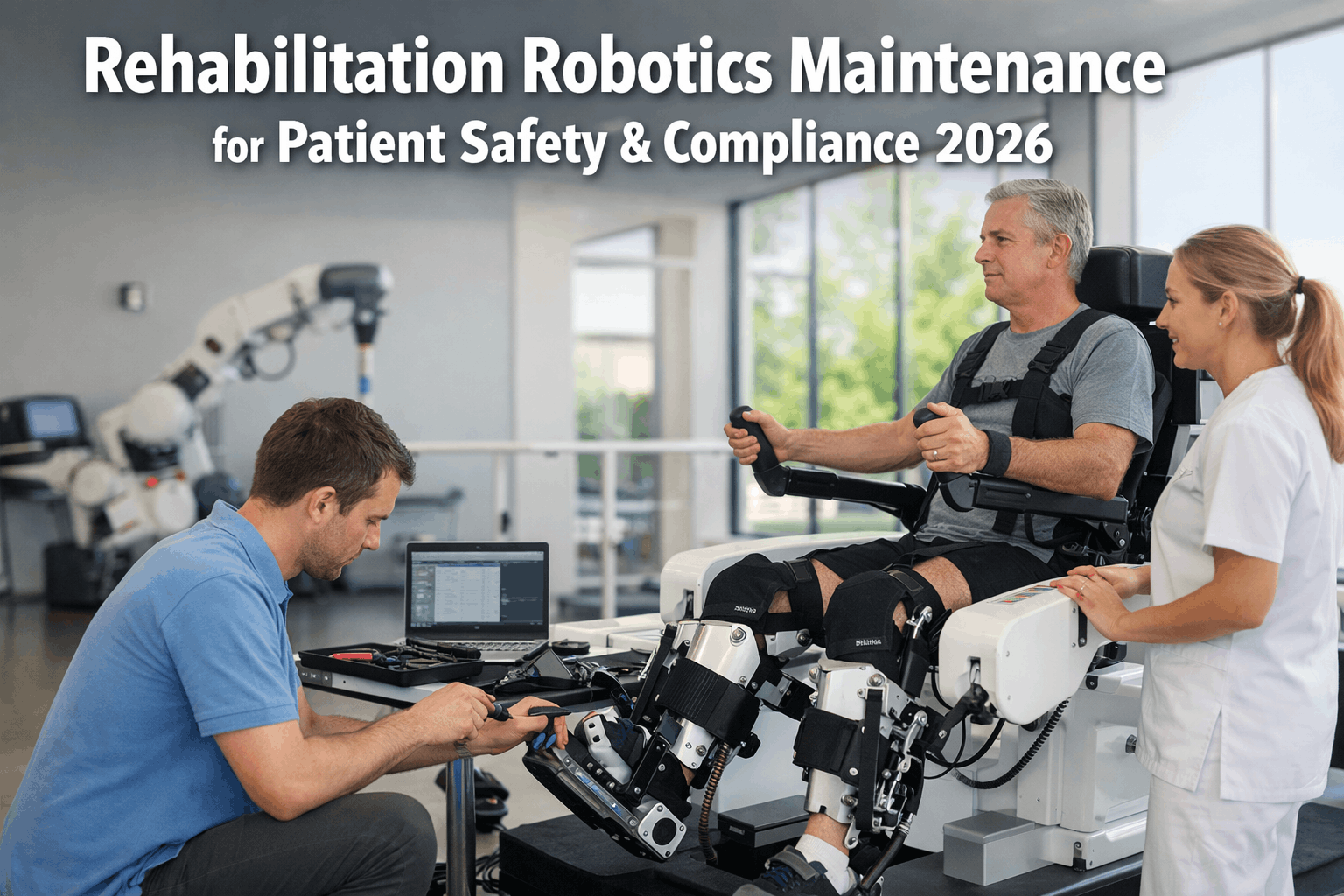
Robotic exoskeletons are transforming rehabilitation — enabling patients with spinal cord injuries, stroke, and neurological conditions to stand, walk, and regain independence. The global exoskeleton market reached $590 million in 2025 and is growing rapidly, with FDA-cleared devices like ReWalk, EksoNR, Indego, HAL, and Atalante now deployed across hospitals and rehab centers worldwide. These Class II medical devices contain motorized joints, servo motors, joint encoders, tilt sensors, rechargeable battery packs, and wearable harness systems — all of which require meticulous preventive maintenance to ensure patient safety during gait rehabilitation sessions. A mid-therapy failure is not just a technical inconvenience; it is a direct patient safety risk. Sign up for OxMaint to access exoskeleton-specific maintenance templates with built-in FDA compliance documentation.
FDA-Cleared Exoskeletons in Clinical Use Today
Understanding the devices in your facility is the first step toward building an effective maintenance program. The FDA classifies powered lower extremity exoskeletons as Class II devices under product code PHL (21 CFR 890.3480). Each device has unique mechanical architecture, software systems, and maintenance requirements. The newest addition — the ReWalk 7 — received FDA 510(k) clearance in April 2025 with enhanced features for home and clinical use.
The first FDA-cleared exoskeleton (2014). Powered hip and knee joints with tilt sensor-triggered stepping. Uses three-point gait pattern with crutches. ReWalk 6.0 operates up to 8 hours with max speed of 2.6 km/h. Approved for home use (T7–L5) and clinical rehabilitation (T4–T6). The ReWalk 7 launched in 2025 with enhanced features.
The only FDA-cleared exoskeleton for brain injury, MS, stroke, and SCI. Supports full-power to partial-assist modes with adjustable support per joint and gait phase. Enables forward, backward, and lateral ambulation. Requires crutches, walker, or cane. Used exclusively in clinical rehabilitation settings under trained therapist supervision.
Lightweight modular exoskeleton weighing only 12 kg with quick-connect hip, thigh, and calf modules. Detects center-of-pressure shifts for seamless sit-walk-stand transitions. Includes fall detection and failsafe posture adjustment. Approved for both clinical and home/personal use (T3–L5). Now covered by Medicare for qualifying beneficiaries.
Unique bioelectric signal-based control system that reads the user's neural intent through skin surface signals. Supports SCI (C4–L5), post-stroke paresis, neuromuscular diseases, cerebral palsy, and spastic paraplegia. Must be used inside medical facilities with body weight support system and trained supervision.
The only FDA-cleared self-balancing exoskeleton — no crutches or walker required. Powers hip, knee, and ankle joints. Must be used with a safety rail. AI-powered personal version (Eve) expected by 2026. Deployed in over 100 U.S. hospitals and clinics. Wandercraft raised $75 million in Series D funding in June 2025.
Lightweight hip exoskeleton with passive knee support. Average walking speed of 1.1 mph with approximately 4 hours of battery life. Designed for clinical and community use. Uses crutches for balance and stability. FDA cleared in 2019 for rehabilitation of patients with lower limb injuries.
Exoskeleton Subsystems Requiring Maintenance
Every FDA-cleared exoskeleton shares core mechanical and electronic subsystems that demand structured preventive maintenance. Neglecting any subsystem risks mid-therapy failures, inaccurate gait assistance, or harness-related patient injuries. Facilities that book a demo with OxMaint can see how each subsystem maps to automated work orders with traceable completion records.
Powered joints at the hip and knee (and ankle on some models) contain brushless DC servo motors or harmonic drive actuators. These motors generate the torque that powers walking, sit-to-stand transitions, and stair climbing. Maintenance includes torque output verification, gear inspection for wear and backlash, motor temperature monitoring during therapy sessions, and electrical connection integrity checks. Motor degradation causes inconsistent gait patterns that affect patient safety and therapy outcomes.
Rotary encoders at each powered joint provide real-time angular position and velocity data to the control system. Encoder accuracy directly determines whether the exoskeleton delivers the correct joint angle during each phase of the gait cycle. Maintenance involves encoder calibration against known reference angles, signal quality verification, cable and connector inspection, and comparison of encoder readings against manual goniometer measurements. Encoder drift causes improper joint timing during walking.
Lithium-ion or lithium-polymer battery packs power all motors, sensors, and control electronics. Depending on the device, battery life ranges from 4 hours (Phoenix) to 8 hours (ReWalk 6.0) per charge. Maintenance includes cycle counting, capacity trending to detect degradation, cell balance verification, charging contact cleaning, charge/discharge curve analysis, and battery housing inspection for swelling or damage. A battery failure during a therapy session forces an immediate emergency stop procedure.
Tilt sensors (accelerometers/gyroscopes) detect upper body lean to trigger stepping. Ground-force sensors in the foot plates detect weight transfer during stance and swing phases. These sensors are the primary control inputs — if they drift or fail, the exoskeleton cannot correctly interpret the user's intent. Maintenance involves calibration against known reference inclinations, zero-point drift measurement, sensitivity verification, and environmental compensation for temperature variations in clinical settings.
Pelvic bands, thigh cuffs, calf straps, and foot plates secure the patient to the exoskeleton. These components bear the full weight of the device (12–29 lbs depending on model) plus dynamic forces during walking. Maintenance includes strap integrity inspection (fraying, stretching, buckle wear), padding condition assessment, quick-connect mechanism testing, frame alignment verification, and skin pressure point documentation. Harness failures risk patient falls — the most serious adverse event in exoskeleton therapy.
Onboard microcontrollers run the gait algorithms, safety monitoring, and failsafe systems. Fall detection systems automatically adjust posture to minimize injury risk. Emergency stop mechanisms halt all motor activity instantly. Software maintenance includes firmware version management, safety system functional testing, control parameter verification after updates, and event log review for fault codes or near-miss incidents. Sign up for OxMaint to track firmware versions and software update compliance across your entire exoskeleton fleet.
Exoskeleton-Specific Maintenance Templates — Ready to Deploy
OxMaint provides pre-built PM templates for robotic exoskeletons covering every subsystem — servo motors, encoders, batteries, sensors, harnesses, and software. Automated scheduling with FDA-compliant documentation built in.
Preventive Maintenance Schedule for Rehabilitation Exoskeletons
The following PM framework is designed for exoskeletons performing daily therapy sessions in hospital and rehab center settings. Frequencies should be adjusted based on device-specific OEM recommendations and therapy session volume.
FDA Compliance and Documentation Requirements
Robotic exoskeletons are FDA-regulated Class II medical devices. Hospitals and rehab centers must maintain maintenance records that demonstrate compliance with the FDA's Quality System Regulation (21 CFR Part 820) — now transitioning to the Quality Management System Regulation (QMSR) incorporating ISO 13485:2016 as of February 2026. Beyond federal regulations, Joint Commission accreditation and CMS Conditions of Participation require documented equipment maintenance programs.
FDA-Compliant Exoskeleton Maintenance — Automated
OxMaint automates PM scheduling, stores calibration records with full traceability, manages CAPA workflows, and generates audit-ready compliance reports. Join 1,000+ facilities managing smarter maintenance programs.
Frequently Asked Questions
What exoskeletons are FDA-cleared for rehabilitation use
As of 2025, FDA-cleared powered lower extremity exoskeletons include ReWalk (Lifeward), EksoNR (Ekso Bionics), Indego (Ekso Bionics), HAL (Cyberdyne), Atalante (Wandercraft), Phoenix (Ottobock), ExoAtlet-II, Keeogo (B-Temia), Honda Walking Assist Device, ReWalk ReStore, and Samsung GEMS-H. These are classified as Class II medical devices under FDA product code PHL. Only the ReWalk and Indego are currently approved for personal and home use.
How often should exoskeleton maintenance be performed
Exoskeletons used for daily therapy sessions require multi-layered maintenance: pre-session safety checks before every use, weekly sensor calibration and error log reviews, monthly motor testing and battery diagnostics, quarterly gear and electrical inspections, and annual comprehensive OEM service overhauls. Specific frequencies should be adjusted based on the manufacturer's recommendations and your facility's therapy session volume.
What are the biggest safety risks from poor exoskeleton maintenance
The most serious risk is patient falls — which can occur from harness component failure, encoder drift causing improper joint angles, servo motor torque inconsistency, or battery depletion during therapy. Clinical studies report a 4.4% fall incidence during exoskeleton training, with causes including device programming errors and mechanical malfunctions. Structured preventive maintenance with pre-session checks is the primary mitigation strategy for these risks.
What FDA regulations apply to exoskeleton maintenance
Robotic exoskeletons fall under FDA 21 CFR Part 820 (Quality System Regulation, transitioning to QMSR in 2026), which requires documented maintenance procedures, calibration records, CAPA workflows, and complaint handling. ISO 14971 risk management standards apply. Facilities must also comply with Joint Commission Environment of Care standards and CMS Conditions of Participation, which require medical equipment management programs with documented PM schedules and adverse event reporting.
How long do exoskeleton batteries last
Battery runtime varies by device: the ReWalk 6.0 operates up to 8 hours per charge, the Phoenix provides approximately 4 hours, and the Indego runs for multiple therapy sessions on a single charge. Over time, lithium-ion battery capacity degrades with each charge-discharge cycle — typically losing 20% capacity within 12–18 months of daily use. CMMS battery health tracking monitors cycle counts, capacity trending, and cell balance to plan replacements before runtime drops below therapy session requirements.
Does Medicare cover robotic exoskeletons
Yes. CMS issued a national reimbursement policy for powered exoskeletons for qualifying Medicare beneficiaries. The Indego Personal is now eligible for Medicare coverage for individuals with SCI (T3–L5), and the ReWalk has similar coverage provisions. This expanded access means more facilities are deploying exoskeletons — making structured CMMS-driven maintenance programs increasingly essential for managing growing device fleets.
How does OxMaint support exoskeleton maintenance
OxMaint provides exoskeleton-specific PM templates covering every subsystem — servo motors, encoders, batteries, sensors, harnesses, and software. Automated scheduling generates work orders at every interval, assigns tasks to qualified biomedical technicians, and stores completion records with full traceability. FDA compliance documentation is built in, including calibration records, CAPA workflows, and audit-ready reporting. Fleet dashboards provide visibility across all exoskeleton devices deployed in your hospital or rehab center.


.png)
.jpg)