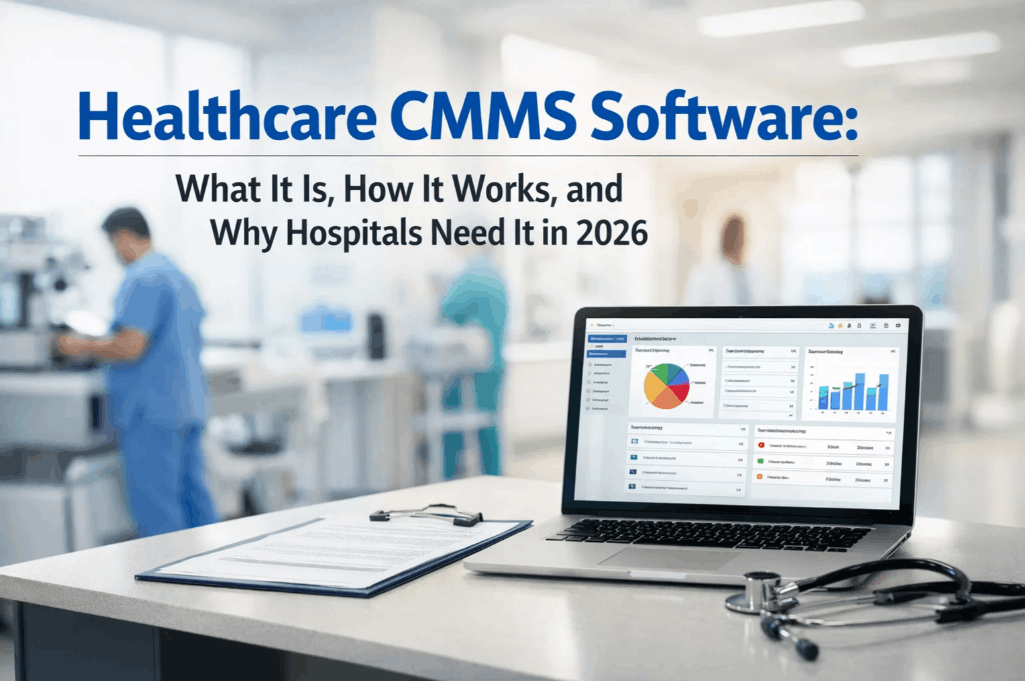
Hospital maintenance doesn't fail because of broken equipment — it fails because of broken vendor relationships. When a chiller goes down at 2 AM in an operating wing, the real question isn't whether the compressor failed. It's whether your service contract covers emergency response, whether your vendor's SLA obligates a 4-hour arrival, and whether you have the documentation to hold them accountable. Most hospital facility directors cannot answer all three with confidence. That gap — between what contracts promise and what vendors deliver — costs the average 300-bed hospital over $2.3M annually in unplanned repair premiums, compliance exposures, and deferred maintenance penalties. If managing vendors reactively sounds familiar, start a free 30-day trial or book a demo with Oxmaint to see how structured vendor tracking integrates with your CMMS workflow.
Oxmaint gives hospital facility teams a single platform to track vendor performance against SLAs, manage maintenance contracts by asset, and build the audit-ready documentation that regulators and insurers demand — with no spreadsheets required.
What Is Vendor Management in Hospital Maintenance?
Vendor management in hospital maintenance is the structured process of selecting, contracting, monitoring, and optimising the third-party service providers who maintain critical healthcare infrastructure. It spans everything from elevator service agreements and HVAC preventive maintenance contracts to OEM biomedical equipment support and outsourced facilities management.
For hospital procurement managers and facility directors, effective vendor management means knowing — with data, not intuition — which vendors are performing, which contracts are delivering value, and which SLAs are being breached without consequence. It means transforming vendor relationships from passive billing arrangements into performance-accountable partnerships. To build this kind of visibility in your facility, start a free trial with Oxmaint and track your first vendor contracts in under an hour, or book a demo and let us walk through your current vendor landscape.
OEM vs Third-Party Maintenance: The Decision That Shapes Your Cost Base
For high-value clinical and building assets, the choice between OEM service contracts and independent third-party maintenance providers (ISOs) is one of the highest-leverage procurement decisions a hospital makes. Neither is universally superior — but most hospitals choose by default rather than by data, leaving significant value on the table in both directions.
| Decision Dimension | OEM Service Contracts | Independent Third-Party (ISO) |
|---|---|---|
| Average Cost Premium | 40–60% higher than ISO alternatives for equivalent scope | 15–35% cost savings vs. OEM on comparable assets |
| Parts Availability | Exclusive access to proprietary parts. Critical for imaging systems. | OEM-equivalent or third-party parts. Suitable for most MEP assets. |
| Warranty Validity | Maintains OEM warranty. Required during warranty periods. | May void OEM warranty. Evaluate after warranty expiry only. |
| Regulatory Standing | Automatically satisfies most accreditation documentation requirements | Requires thorough documentation; may need additional compliance evidence |
| Response Time SLA | Standardised national SLAs — often 4–8 hours for critical assets | Negotiable — regional providers often deliver 1–2 hour response locally |
| Best Fit | MRI, CT, PET, robotic surgery, during-warranty clinical equipment | HVAC, lifts, generators, sterilisers, general MEP infrastructure |
The most cost-efficient hospital facilities use a hybrid model — OEM contracts for proprietary clinical systems and ISO providers for building services and commoditised assets. Oxmaint lets you map each asset to its correct service tier and track performance across both contract types in a single system. Want to audit your current vendor mix against this framework? Start a free trial and import your asset registry today, or book a demo to review your specific situation with our team.
Eight Ways Poor Vendor Management Costs Hospitals Every Month
These are not edge cases. They are the structural cost leaks that facility directors discover when they first apply data to vendor relationships — often uncovering hundreds of thousands of dollars in recoverable value sitting in existing contracts. If these sound familiar, start a free trial or book a demo to see what structured vendor management looks like in practice.
Building a Hospital Maintenance SLA That Actually Works
Most hospital maintenance SLAs fail not because vendors perform poorly — but because the SLA was written too vaguely to enforce. A legally binding response time clause means nothing without a system that timestamps work order creation, monitors vendor acknowledgement, and documents actual arrival time against that commitment. A well-structured hospital maintenance SLA has six non-negotiable components.
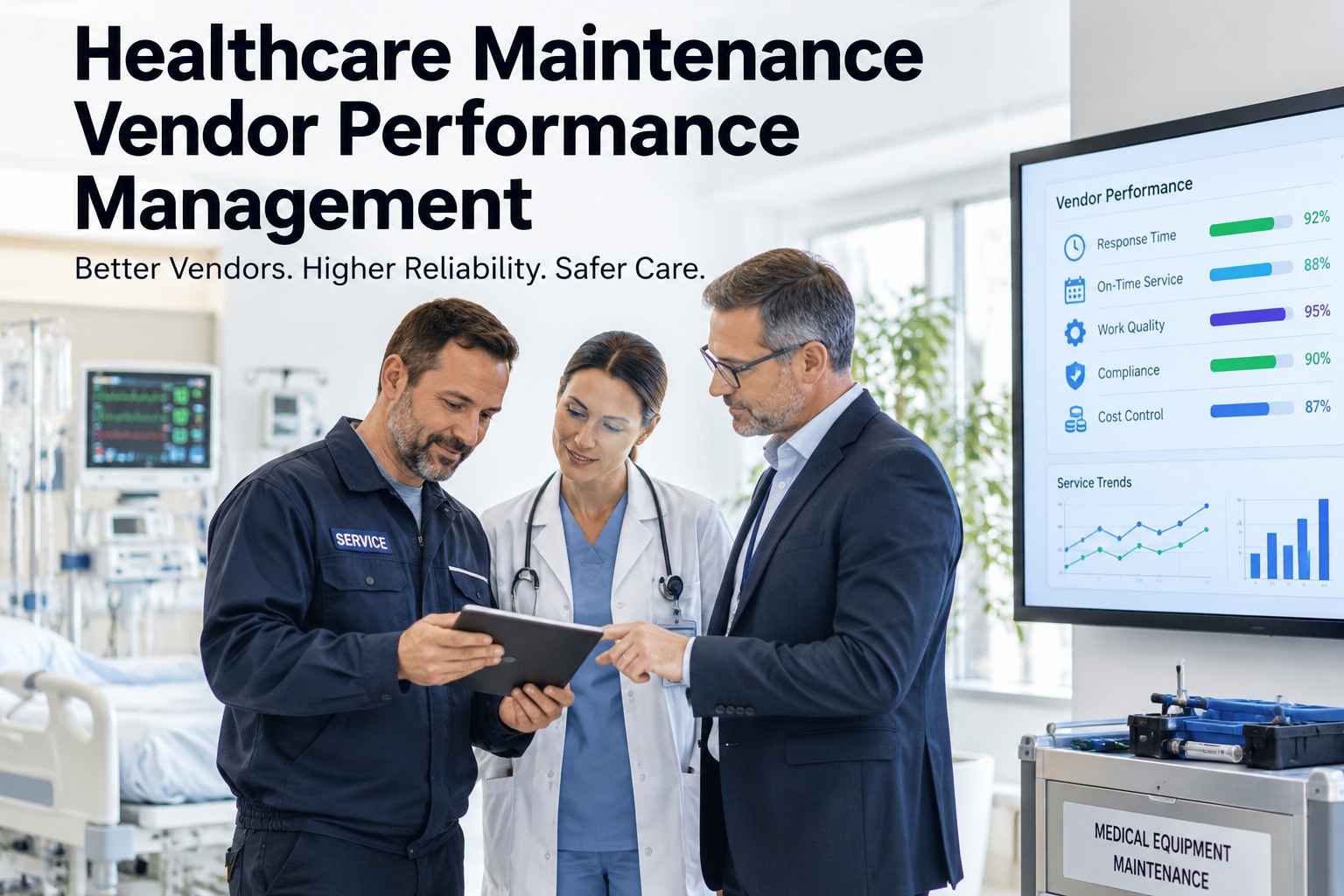
The Hospital Vendor Performance Scorecard: Eight KPIs That Matter
A vendor scorecard is only as useful as the data feeding it. These eight KPIs are measurable with a CMMS and directly linked to the operational and financial outcomes hospital facility directors are accountable for. Without tracking these, vendor reviews are opinions. With them, they are negotiations backed by evidence.
How Oxmaint Powers Structured Vendor Management for Hospital Facilities
Oxmaint is built for the operational complexity of hospital facility management — where 40 vendors, 2,000 assets, and a dozen compliance frameworks intersect simultaneously. Rather than managing vendor performance in a spreadsheet disconnected from work order data, Oxmaint links vendor contracts directly to the assets they cover, the work orders they produce, and the SLA commitments they are measured against. The result is vendor accountability that runs automatically — not just at quarterly review time. Ready to move from spreadsheets to structured vendor intelligence? Start your free trial today or book a demo with our healthcare facility specialists.
Reactive Vendor Management vs. Structured CMMS-Integrated Approach
The operational difference between managing vendors on spreadsheets and email versus a structured CMMS-integrated vendor management programme is not incremental. It is the difference between vendor relationships you hope are performing and vendor relationships you can prove are performing.
| Operational Area | Without Structured VMP | With Oxmaint Vendor Management |
|---|---|---|
| SLA Tracking | Manual — checked occasionally, disputed at invoice time | Automatic — every work order timestamped against SLA window, breach logged instantly |
| Contract Renewals | Auto-renew by default, scope rarely reviewed against current asset list | Renewal alerts 90 days prior, scope verified against live asset registry before sign-off |
| Vendor Review Meetings | Annual, based on impressions. Vendors rarely penalised for poor performance. | Quarterly, backed by CMMS scorecard data. Underperformance triggers documented consequences. |
| Compliance Documentation | Assembled manually pre-audit. Gaps discovered under inspection pressure. | Continuous — all vendor documentation stored, credential expiry dates tracked and alerted. |
| Cost Visibility | Invoice totals visible. Cost-per-asset and cost-per-work-order invisible. | Full cost breakdown per vendor, per asset, per site — available in real time. |
| Contract Negotiation Leverage | Limited. No data to counter vendor pricing claims. | Strong. 12 months of FTFR, response compliance, and cost data vs. benchmark. |
What Structured Vendor Management Delivers in Healthcare
These outcomes are drawn from healthcare facilities that implemented formal vendor management programmes integrated with CMMS platforms. Use them to build a business case for your own programme, or start a free trial with Oxmaint to begin generating your own benchmarking data, or book a demo for a tailored ROI model.
Oxmaint gives hospital facility teams a complete vendor management platform — contracts, SLAs, performance scorecards, and compliance documentation — all connected to the assets and work orders they cover. No implementation fees. No long onboarding. Operational from day one. See how it works across your facility portfolio — start a free trial or book a demo with our healthcare team today.
Frequently Asked Questions
What should a hospital maintenance SLA include to be enforceable?
An enforceable hospital maintenance SLA must include: tiered response time commitments defined by asset criticality (not just a single generic response window), documented completion standards specifying what constitutes a closed work order, measurable performance thresholds with specific breach consequences, credential verification requirements for attending engineers, escalation procedures triggered automatically on breach, and a structured renewal governance process that gates contract renewal on achieving minimum performance thresholds. Without measurable thresholds and explicit penalty clauses, an SLA is a statement of intent — not a binding performance commitment. Hospitals using CMMS platforms like Oxmaint can generate monthly SLA compliance reports directly from work order data, making enforcement data-backed rather than opinion-based.
When should a hospital use OEM vs third-party maintenance contracts?
OEM contracts are appropriate for: clinical equipment still within warranty period (any third-party service may void the warranty), proprietary imaging systems where OEM-exclusive parts access is required (MRI, CT, PET), and high-complexity robotic surgical systems where manufacturer certification is required for regulatory standing. Third-party ISO contracts typically deliver better value for: HVAC and MEP infrastructure, elevators and escalators, general electrical and plumbing systems, sterilisation equipment post-warranty, and facilities management services where multiple qualified providers exist. A hybrid model — OEM for proprietary clinical systems, ISO for building services — delivers the best overall cost efficiency. Oxmaint allows you to map each asset to its appropriate service tier, track vendor performance across both types, and compare cost-per-work-order data to validate the hybrid allocation over time.
How does a CMMS improve hospital vendor management?
A CMMS improves hospital vendor management by connecting vendor performance data directly to the work orders that generate it — eliminating the gap between what contracts promise and what vendors deliver. Specifically: work orders are timestamped at every stage (creation, acknowledgement, arrival, resolution), automatically calculating SLA compliance against each vendor's contracted response windows. Vendor scorecards are built from real work order data — not estimations. All documentation attached to closed work orders is permanently stored against the asset record, satisfying compliance requirements automatically. Contract renewal dates, insurance expiry, and credential validity are tracked and alerted before they lapse. Historical cost and performance data is available for contract negotiations. Oxmaint integrates all of this into a single platform — so vendor management is not a separate process layer but part of the same operational workflow as work order management and asset tracking.
How do you negotiate a better hospital maintenance contract using performance data?
The most effective hospital maintenance contract negotiations use 12 months of CMMS-generated performance data as the primary negotiation tool. Before the renewal meeting, compile: the vendor's actual SLA compliance rate vs. contracted commitment, first-time fix rate on your assets vs. industry benchmark (85% target), PM completion rate on scheduled visits, repeat failure rate (should be under 5%), and total actual spend vs. contracted rate including any disputed extras. This data shifts the negotiation from "we feel your performance has been inconsistent" to "your SLA compliance was 74% against the contracted 90% — here is the month-by-month record." Facilities that negotiate with data typically achieve 15–25% cost reductions or significant scope improvements at renewal. Oxmaint generates all of these reports directly from work order records with a single export, requiring no manual data preparation before the meeting.

.png)