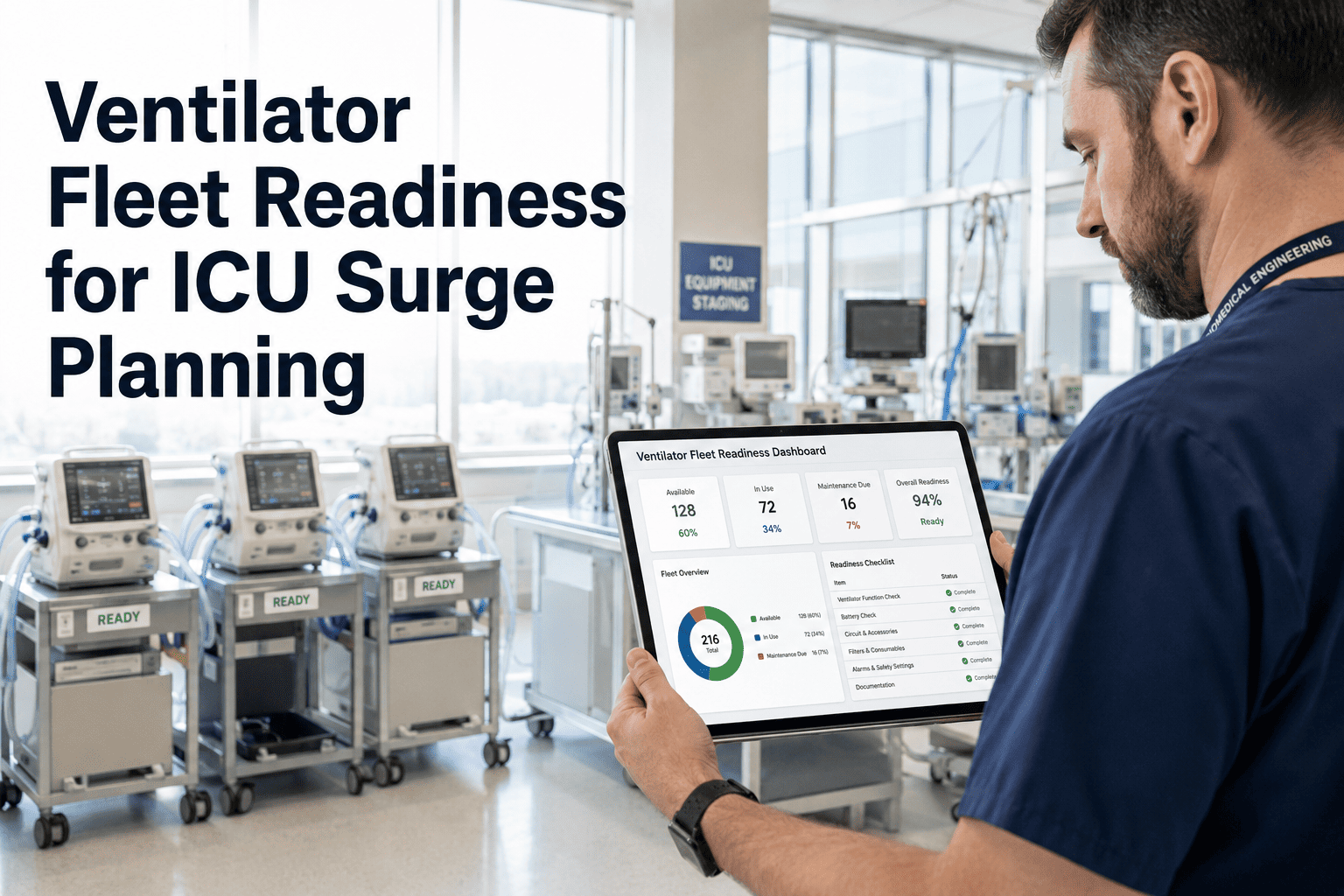
When ICU demand spikes — seasonal respiratory surges, mass casualty events, or pandemic escalation — the question hospital leadership asks first is: how many ventilators are actually ready right now? Not how many are in the inventory, but how many are fully functional, calibrated, charged, and cleared for patient use. If your biomedical or facilities team cannot answer that question in under five minutes, your ventilator fleet is not surge-ready. OxMaint tracks ventilator status, PM history, calibration cycles, and battery readiness by location, giving ICU and facilities teams a real-time fleet view that answers the surge readiness question before it becomes urgent. Book a demo with our healthcare biomedical team.
ICU Equipment — Surge Planning Guide
Ventilator Fleet Readiness for ICU Surge Planning
How to track functional status, calibration currency, battery readiness, and PM compliance for every ventilator in your fleet — so you know your surge capacity before you need it.
The 4 Ventilator Readiness Dimensions That Matter During Surge
01
Preventive Maintenance Currency
Every ventilator requires PM at manufacturer-specified intervals — typically annual or every 1,500 operating hours. A device with overdue PM is not certifiably safe for patient deployment. Fleet PM status must be visible by unit, not reconstructed from paper logs before a surge.
A ventilator with overdue PM cannot be deployed to a surge patient without risk and liability exposure
02
Calibration Cycle Status
Pressure sensing, tidal volume delivery, and oxygen concentration accuracy all require periodic calibration verification. In high-demand surge scenarios, clinicians assume devices are delivering prescribed parameters. Calibration gaps in a ventilator fleet are an invisible patient safety risk that only systematic tracking can surface.
Most ventilator manufacturers specify annual calibration verification — documented evidence required for biomedical compliance
03
Internal Battery Readiness
ICU surge scenarios often involve patient transport — floor transfers, inter-unit moves, temporary staging. Internal battery condition and last charge test date determine how long a ventilator can operate untethered. Batteries not tested within the past 12 months are an unknown variable in a high-acuity transport.
Battery failure during patient transport is a sentinel event risk — every unit's battery test date must be tracked
04
Location and Operational Status
During a surge, knowing a ventilator exists is not enough. Teams need to know where it is, whether it is in active use, staged for use, in biomedical for repair, or on administrative hold. Location tracking and status flags in OxMaint give charge nurses and supervisors a real-time deployable count without calling biomedical for an inventory check.
Unlocated ventilators are counted as inventory but not deployable — location tracking eliminates this blind spot
Know Your Surge Capacity Right Now
Fleet Readiness in Under 5 Minutes
OxMaint gives your biomedical and facilities team a live dashboard showing every ventilator's PM status, calibration date, battery test history, and current location — filterable by unit, floor, or campus.
Ventilator Fleet Maintenance Schedule Reference
| Maintenance Task | Standard Interval | Evidence Required | Compliance Standard | Risk if Missed |
|---|---|---|---|---|
| Preventive maintenance inspection | Annual or 1,500 hrs (manufacturer) | PM checklist, technician sign-off, pass/fail | EC.02.04.01 / Manufacturer IFU | Device not safe for patient deployment |
| Calibration verification | Annual (most manufacturers) | Calibration report, values within tolerance | EC.02.04.01 / ISO 80601 | Parameter delivery error — patient safety risk |
| Internal battery test | Annual or per manufacturer spec | Runtime test result, charge capacity recorded | Manufacturer IFU | Transport failure — high acuity risk |
| External circuit cleaning | Between each patient use | Cleaning work order with technician ID | Infection Control / EC.02.04.01 | Cross-contamination in surge conditions |
| Safety alarm function test | Per PM cycle | Alarm test checklist — all alarms verified active | EC.02.04.01 / AAMI guidelines | Silent alarm failure during patient event |
| Filter replacement | Per manufacturer schedule or condition | Work order with filter part number and date | Manufacturer IFU | Restricted flow, contamination risk |
Expert Review
Surge preparedness for ventilators is not about counting units — it is about knowing which units are actually deployable at any given moment. I have seen facilities with 60 ventilators in their inventory that could only confirm 38 were ready for patient use when pressed during a surge planning exercise. The rest had expired PM, unknown battery status, or active repair work orders. A CMMS that tracks all four readiness dimensions and surfaces the real deployable count — not the paper inventory count — is the difference between a facility that can respond to surge and one that discovers its capacity constraints after patients are already waiting.
KA
Karen Abramowitz
Clinical Engineering Director, former ICU Equipment Coordinator at a Level I Trauma Center, 19 years in biomedical equipment management
Frequently Asked Questions
How does OxMaint define a ventilator as "surge-ready" in its fleet dashboard?
OxMaint's surge readiness status for a ventilator is determined by three criteria checked simultaneously: PM completion within the required interval, calibration currency within the past 12 months, and battery test within the past 12 months. If all three are current and no open corrective work order is active on the device, the unit is flagged as surge-ready. If any criterion is approaching expiry within a configurable window (typically 14–30 days), the unit is flagged as "at-risk." If any criterion has lapsed or an active repair is open, the unit is flagged as not deployable. Facility managers see the deployable count by floor, unit, and campus in the live dashboard. See the fleet dashboard in a free trial.
Can OxMaint track rented or borrowed ventilators that come in during a surge?
Yes. Temporary assets — rented units, borrowed units from state stockpiles, or units transferred from other facilities — can be registered as temporary assets in OxMaint with a defined active period. Incoming units are entered with their delivery PM checklist, and an intake inspection work order is automatically generated. All temporary units appear in the fleet dashboard alongside owned inventory, giving the team a complete picture of available and deployable units during a surge event regardless of ownership. Temporary assets are automatically archived at the end of their active period. Ask about temporary asset management in a demo.
What documentation does Joint Commission require for ventilator fleet management?
Joint Commission EC.02.04.01 requires hospitals to maintain a complete medical equipment inventory, define and follow inspection intervals for each device type, and retain PM completion records. For ventilators specifically, surveyors may also review evidence of calibration verification and safety alarm testing as part of a biomedical equipment inspection. Facilities using OxMaint generate PM compliance evidence for the full ventilator fleet on demand — organized by device, date range, and compliance category — in the format Joint Commission survey teams request during an Environment of Care review. Set up your ventilator compliance records in a free trial.
How does OxMaint handle ventilators that are shared across multiple floors or units?
OxMaint tracks the current assigned location of each ventilator as part of the asset record, with location updates triggered when a unit is moved via a work order or a location transfer event. For floating equipment pools shared between ICU, step-down, and emergency units, the system shows the last confirmed location and the date it was verified. Facilities teams can generate a location accuracy report at any time to identify units whose last-known location has not been confirmed within a defined number of days — a useful practice before a surge event to identify any unlocated units in the pool. See location tracking in a demo.
ICU Equipment Management — Real-Time Readiness
Know Your Surge Capacity Before Surge Arrives
OxMaint tracks every ventilator's PM currency, calibration status, battery readiness, and location — so your team answers the surge readiness question in minutes, not hours.
<5 min
Fleet readiness check
4
Readiness dimensions tracked
Real-time
Location & status dashboard
100%
EC.02.04.01 evidence