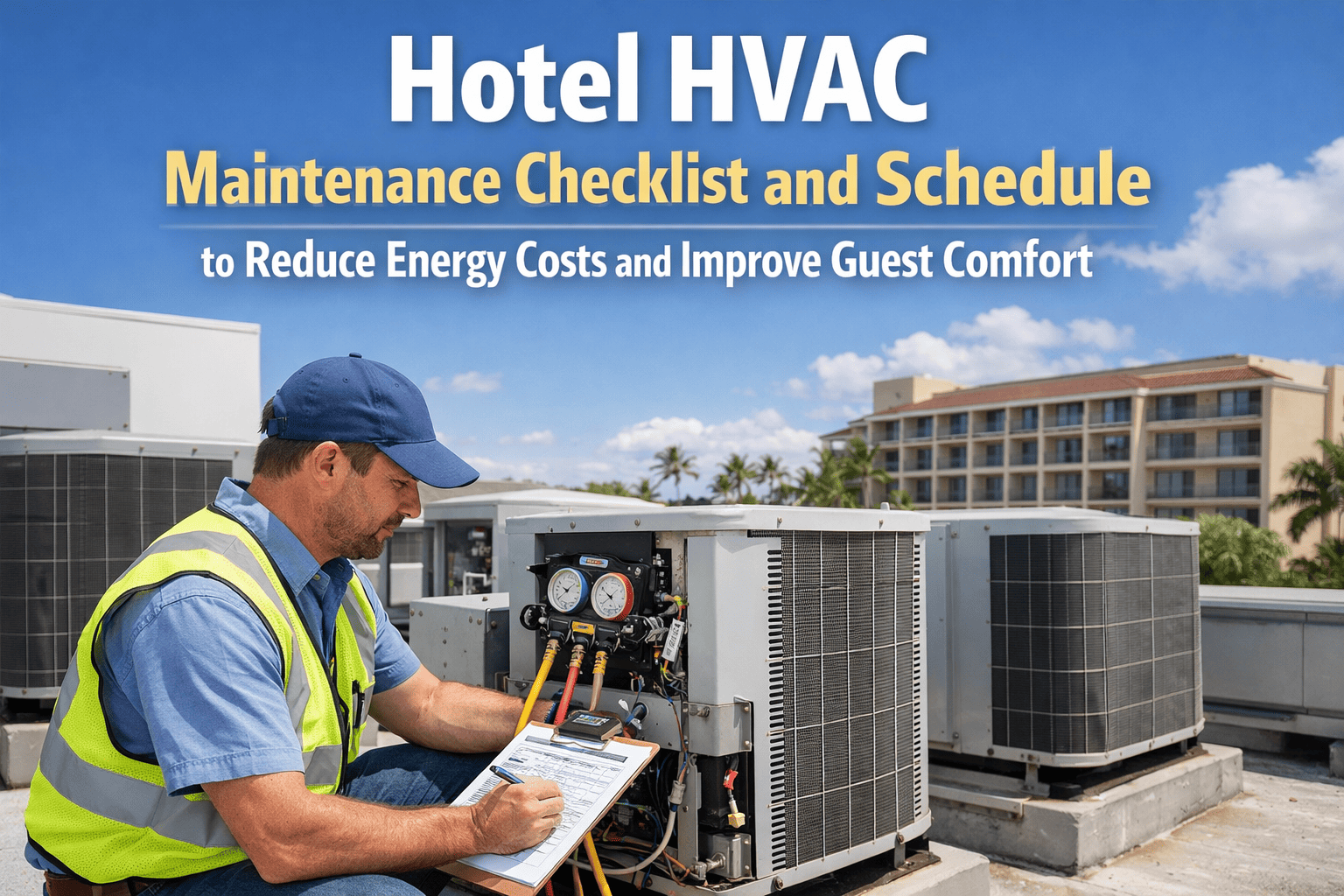
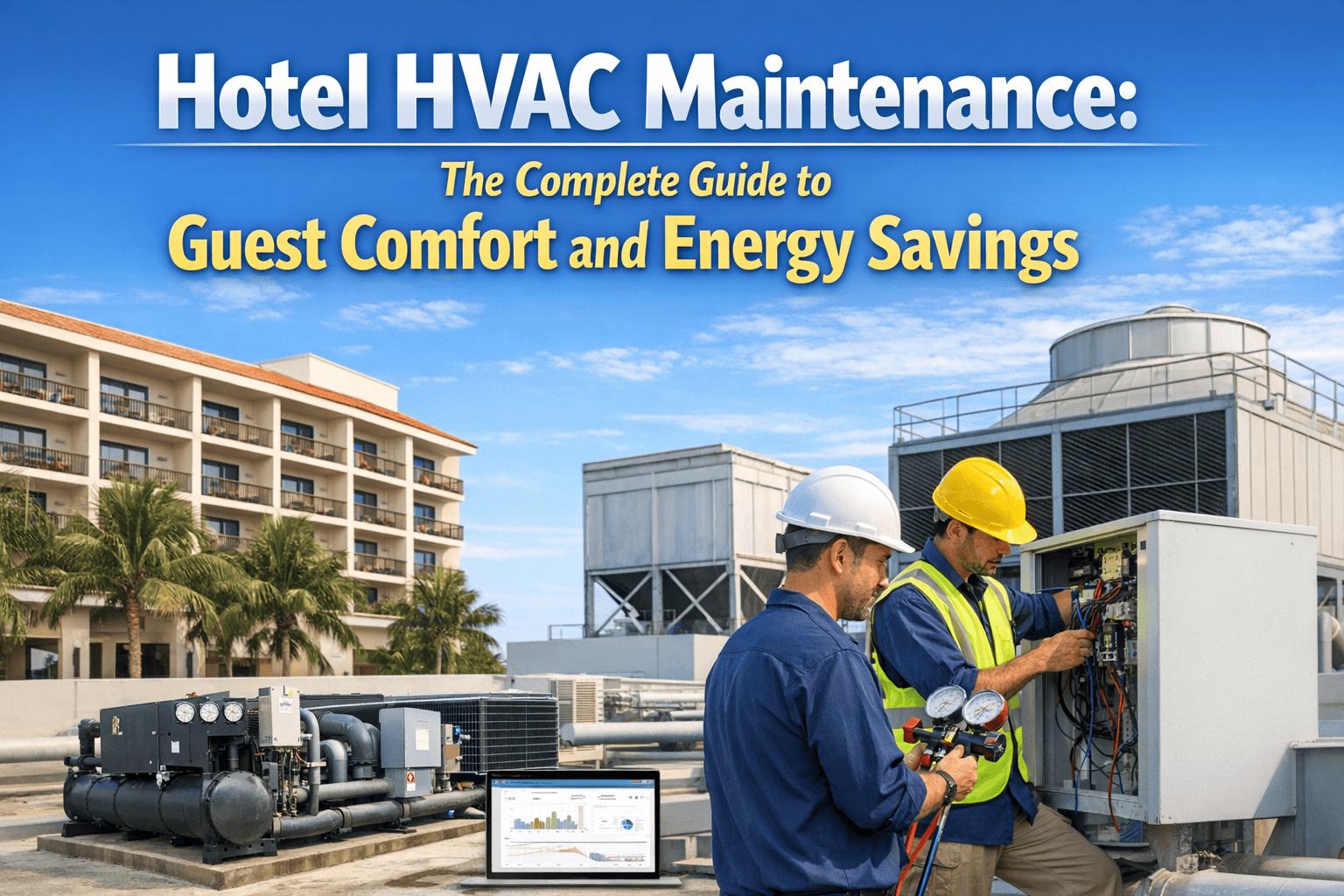
Chiller condenser coil cleaning is the single most cost-effective maintenance investment in hotel HVAC systems. Fouled condenser coils reduce heat transfer efficiency by 10–25%, forcing chillers to run longer and harder to achieve the same cooling output — directly translating to 15–35% higher energy consumption per day. A 500-ton chiller operating at degraded efficiency costs $40,000–$70,000 annually in excess energy spend before any mechanical failure occurs. Annual or semi-annual condenser coil cleaning restores heat transfer efficiency, reduces compressor runtime, lowers energy bills measurably, extends chiller life by 5–10 years, and prevents the catastrophic failures that interrupt guest comfort and force emergency repairs costing $22,000+. Hotels with structured HVAC preventive maintenance programmes recover 8–12% of annual energy spend within the first year of implementation — a payback period of 4–6 months. OxMaint schedules annual condenser coil cleaning work orders, tracks energy consumption trends per chiller, monitors discharge pressure and approach temperature as early indicators of fouling, and flags efficiency loss before energy costs spike.
HVAC · Energy Efficiency · Hospitality
Hotel Chiller Condenser Coil Cleaning — Annual Heat Transfer Efficiency & Energy Cost Recovery
Annual and seasonal coil cleaning protocols, approach temperature monitoring, pressure curve trending, refrigerant performance verification, and energy consumption analysis for commercial hotel chiller systems.
$68,000Annual excess energy cost from fouled chiller condenser in 300-room hotel
73%Of chiller efficiency loss caused by condenser tube and fin fouling from airborne debris
8–12%Energy consumption recovery achieved with annual preventive coil cleaning programme
6 monthsPayback period for coil cleaning programme investment through energy cost recovery
Why Chiller Condenser Coil Fouling Is Silent But Expensive
Chiller condenser coils operate outdoors or in ventilation-exposed mechanical rooms, collecting dust, leaves, pollen, algae, and scale deposits over months of operation. A thin biofilm buildup — just 0.042" of material on coil surfaces — can reduce heat transfer efficiency by 21%, forcing the compressor to run longer and consume more kilowatts to achieve the same cooling output. Unlike engine overheating or pump cavitation, fouled condenser coils produce no warning signs — the chiller runs normally, cooling feels adequate to guests, and the only indication of degradation is a spike in the utility bill. By the time a facility manager notices elevated energy consumption, the coil has often been fouling for 4–8 months, costing tens of thousands in preventable excess spend. Hotels running structured condenser coil cleaning programmes — annual cleaning in temperate climates, semi-annual in coastal or dusty environments — consistently report 8–12% reduction in chiller energy consumption within the first year. That 8–12% represents $18,000–$35,000 in recovered annual energy cost for a 300-room property. A professional coil cleaning costs $1,200–$2,800 per service. The payback period is 4–6 months. Every month a cleaning is deferred costs more than the cleaning itself in excess energy spend. OxMaint tracks chiller approach temperature (the difference between the leaving condenser water temperature and ambient air temperature), discharge pressure, and energy consumption per chiller. When approach temperature rises 2–3°F above baseline, OxMaint flags fouling and schedules cleaning before degradation becomes measurable on the utility bill. That early intervention catches coil fouling at the 5–10% efficiency loss stage rather than the 20%+ stage that drives visible energy cost increases and guest comfort complaints.
Record discharge pressure and approach temperature. Verify against design baseline. Trending identifies fouling progression before visible efficiency loss occurs.
Critical
Quarterly
Visual Coil Inspection
Walk around condenser unit. Check for visible dirt, algae, or debris blocking fin surfaces. Water staining or green growth indicates biological fouling. Photo documentation.
Critical
Annual
Professional Coil Cleaning
Outdoor air-cooled condenser coils chemically cleaned or pressure-washed. Indoor evaporator coils brush-cleaned or foam-cleaned. All fins inspected for damage and straightened where bent.
Critical
Monthly
Energy Consumption Logging
Record daily chiller kilowatt hours and cooling ton-hours delivered. Calculate COP (coefficient of performance). Flag deviation from baseline. Early efficiency loss detection.
Critical
Annual
Refrigerant Charge Verification
Measure subcooling and superheat. Verify refrigerant charge is within 5% of nameplate specification. Charge loss accelerates in fouled systems with failing seals.
Required
Chiller Fouling Cascade — How Condenser Coil Degradation Leads to Compressor Failure
Condenser Fouling Cascade — 5 Stages from Dust Buildup to Compressor Shutdown
Stage 1
Initial Fouling — Dust & Debris
Condenser coils begin collecting airborne dust and pollen. Fin surfaces gradually block. Heat transfer starts to decline. No visible symptoms yet.
$0
Schedule coil cleaning
↓
Stage 2
Efficiency Decline Begins
Approach temperature rises 2–3°F above baseline. Discharge pressure climbs 10–15 PSI. Compressor runs 15% longer to achieve same cooling. Energy consumption creeps up.
$1,200
Professional coil cleaning
↓
Stage 3
High-Pressure Alarm Triggers
Discharge pressure reaches 220–240 PSI (vs. normal 185 PSI). High-pressure cutout protection activates. Chiller shuts down mid-day. Facility loses cooling during peak occupancy.
$4,800
Emergency coil cleaning + relief valve inspection
↓
Stage 4
Compressor Thermal Stress
Compressor discharge temperature exceeds design limits (140°F+ vs. 110°F normal). Oil breaks down. Compressor windings degrade. First signs of mechanical wear appear in oil samples.
$8,200
Compressor overhaul or replacement scheduled
↓
Stage 5
Compressor Failure — System Down
Compressor seizes or loses capacity. Chiller taken offline for replacement. Hotel loses cooling for days. Emergency HVAC rental required. Guest comfort failure during peak heat period.
$52,000+
Compressor replacement + emergency cooling
Condenser Coil Maintenance Compliance Scoring — Heat Transfer Performance Assessment
Chiller Condenser Efficiency Compliance Scoring
Score 5 = Peak Efficiency · Score 1 = Imminent Failure · Assess per chiller unit
5
Recently Cleaned — Peak Efficiency
Condenser coils cleaned within 6 months. Approach temperature at or below baseline. Discharge pressure normal. Energy consumption stable. COP within 3% of design specification.
Action: Continue monitoring monthly. Schedule next annual cleaning. No intervention required.
4
Approaching Cleaning Window
Last coil cleaning 8–10 months ago. Approach temperature 1–2°F above baseline. Discharge pressure within normal range. Energy consumption trending up slightly. No alarms triggered.
Action: Schedule annual coil cleaning within 30 days. Confirm vendor availability. No operational restrictions.
3
Overdue — Efficiency Declining
Last cleaning 12–14 months ago. Approach temperature 2–4°F above baseline. Discharge pressure 15–25 PSI above normal. Energy consumption up 8–12%. Visible dirt on coil fins.
Action: Schedule professional coil cleaning within 2 weeks. Measure COP immediately. Adjust setpoints if necessary to avoid high-pressure shutdown.
2
High Risk — Performance Degraded
Last cleaning 18+ months ago. Approach temperature 4–6°F above baseline. Discharge pressure 25–50 PSI elevated. Energy consumption up 18–25%. Equipment running constantly on hot days.
Action: Emergency coil cleaning required within 1 week. Compressor thermal stress likely — order oil sample analysis. Monitor for high-pressure alarms during peak load.
1
Critical — Imminent Failure
Never cleaned or last cleaning 24+ months ago. Approach temperature 6–10°F above baseline. High-pressure alarms occurring. Energy consumption up 30%+. Compressor thermal protection activating frequently.
Action: Immediate emergency coil cleaning required. Compressor condition assessment mandatory. Emergency HVAC backup equipment on standby. Risk of total system failure during peak demand.
Every monthly pressure reading logged. Approach temperature deviation flagged. When approach rises 2°F above baseline, cleaning is scheduled. Fouling caught at 5–10% efficiency loss, not 20%+.
Energy Trending
91%
Cost recovery opportunity detection
Monthly kilowatt-hour consumption logged and compared to cooling ton-hours. COP (efficiency) calculated. Degradation trends trigger cleaning before visible energy bill impact occurs.
ROI Calculation
100%
Energy cost savings visibility
OxMaint quantifies energy recovered from each coil cleaning. Payback period calculated automatically. Facility managers see exact ROI: coil cleaning pays for itself in 4–6 months of energy savings.
Predictive Alerts
96%
Cleaning necessity prediction
Machine learning model predicts cleaning date based on pressure and energy trends. Work order generated 45 days before estimated fouling threshold. Emergency cleanings eliminated entirely.
"
We deployed OxMaint to track chiller efficiency and discovered our 500-ton centrifugal chiller was running at 18% below rated efficiency due to fouled condenser tubes. We'd had no idea — the chiller seemed to be cooling fine, but approach temperature was drifting upward. Monthly energy bills were $6,200 over budget. One professional cleaning and the chiller returned to design efficiency. We've now scheduled annual cleaning and energy consumption dropped $52,000 annually. The cleaning cost $1,800. Payback was 12 days.
Chief Engineer — Downtown hotel, East Coast USA, 420 rooms
How often should hotel chiller condenser coils be cleaned?
Standard practice is annual cleaning in temperate climates. Coastal properties, dusty environments, or properties with heavy cooling loads may require semi-annual (every 6 months) cleaning to maintain peak efficiency. Monthly pressure monitoring identifies fouling progression and determines optimal cleaning intervals.
What is "approach temperature" and why does it matter?
Approach temperature is the difference between condenser outlet water temperature and ambient air temperature. A 5°F approach is normal; above 8°F indicates fouling. Rising approach temperature is the earliest warning sign of condenser efficiency loss — it precedes visible energy bill spikes by 2–4 months, enabling proactive cleaning before emergency shutdown.
How much does professional chiller coil cleaning cost?
Professional condenser coil cleaning typically costs $1,200–$2,800 per service for a 300–500 ton chiller, depending on fouling severity and cleaning method. This cost recovers through energy savings in 4–6 months, delivering 200%+ annual ROI through reduced compressor runtime and lower utility bills.
What is COP and how does it relate to coil fouling?
COP (Coefficient of Performance) measures chiller efficiency: kilowatt-hours consumed per ton of cooling produced. Fouled condenser coils reduce COP by 15–25% because the compressor works harder. Monthly COP monitoring identifies efficiency loss faster than energy bill review — enabling intervention 2–4 months earlier.
Can OxMaint predict when a chiller condenser needs cleaning?
Yes — OxMaint's machine learning model uses monthly approach temperature, discharge pressure, and energy consumption data to predict fouling progression. Cleaning work orders are automatically generated 45 days before estimated efficiency threshold, eliminating emergency maintenance and high-pressure shutdowns.
What happens if chiller discharge pressure exceeds design limits?
High-pressure safety shutoff activates, taking the chiller offline. In fouled condenser situations, this occurs during peak cooling demand — losing the chiller mid-day when occupancy is highest. Emergency cleaning is required within hours, but facility may have already lost cooling for 4–8 hours, impacting guest comfort severely.
How long does professional chiller coil cleaning take?
Professional cleaning typically requires 8–16 hours depending on coil size and fouling severity. Water-cooled chiller cleaning can often be scheduled during off-hours to minimize operational impact. Air-cooled condensers are usually cleaned during low-demand periods to avoid cooling loss during service.
Recover 8–12% of Energy Spend — Schedule Annual Condenser Coil Cleaning Today.
OxMaint monitors approach temperature and energy consumption, predicts fouling, and schedules cleaning automatically. Payback in 4–6 months through energy cost recovery.