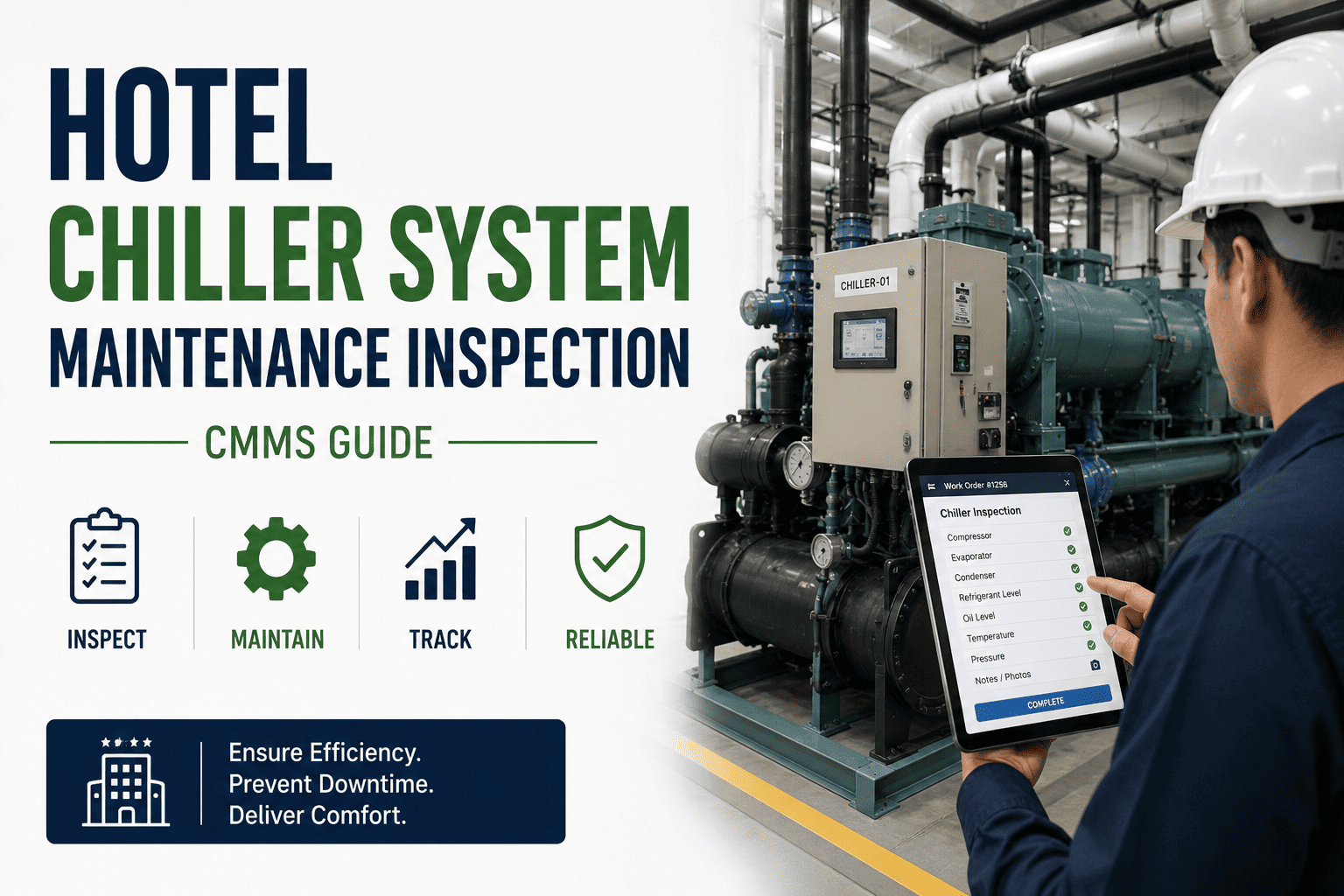
A hotel chiller is the single most expensive mechanical asset on the property — a centrifugal chiller serving a 300-room full-service hotel represents a $250,000–$450,000 capital investment that cools every guest room, public space, kitchen, and meeting room simultaneously. When it fails in July, there is no quick fix: the repair timeline runs 5–14 days, parts are backordered, and the hotel faces either a full loss of cooling capacity or the cost of emergency portable chiller rental at $4,000–$12,000 per week. Properties that track chiller health through Oxmaint's predictive maintenance tools catch developing compressor, tube, and oil system failures weeks before they escalate — eliminating the peak-season failure scenario entirely.
Hotel Chiller Plant Maintenance: Protecting Your Most Expensive HVAC Asset
Vibration analysis, oil sampling, tube inspection, and efficiency trending — the four predictive disciplines that prevent catastrophic chiller failures during the hottest weeks of your peak season.
The Five Subsystems Your PM Program Must Cover
A chiller plant is not a single machine — it is an integrated system of five interdependent subsystems. A failure in any one cascades to the others. Effective preventive maintenance treats each subsystem as a separate asset with its own inspection intervals, wear indicators, and failure modes. Oxmaint registers all five as individual digital assets within a single chiller plant record with linked PM schedules and shared work order history.
The compressor is the most expensive component to replace. Centrifugal compressors require vibration analysis every 90 days to detect bearing wear, impeller imbalance, and surge events before they cause mechanical damage. Oil analysis every 1,000 operating hours identifies refrigerant-in-oil contamination that destroys bearing surfaces.
The evaporator transfers heat from the chilled water loop to the refrigerant. Tube fouling from waterside deposits reduces heat transfer efficiency — each 1°F increase in approach temperature adds 1.5–2% to energy consumption. Eddy current tube testing detects wall thinning before a tube failure floods the refrigerant circuit.
Condenser tubes foul faster than evaporator tubes due to open-loop cooling tower water. A 1-inch deposit on condenser tube walls increases condensing pressure by 10–15%, forcing the compressor to work harder and consume 15–25% more energy per ton of cooling delivered.
Fill media degradation, drift eliminator damage, fan motor bearing wear, and basin microbial growth including Legionella risk all degrade cooling tower performance and raise chiller condensing temperatures — increasing compressor load and energy consumption.
Variable frequency drives on chilled water and condenser water pumps deliver 30–50% pump energy reduction — but require quarterly VFD inspection and annual drive calibration to maintain that efficiency advantage over time. Flow rate verification confirms the system is delivering design conditions.
Chiller Plant PM: What to Inspect, How Often, and Why It Matters
The chiller PM schedule below reflects ASHRAE Guideline 3 recommendations adapted for hotel operations where cooling continuity during peak occupancy is a revenue-critical requirement. Load these tasks into Oxmaint to automate scheduling, assignment, and completion tracking for your engineering team.
Four Predictive Disciplines That Catch Failures Before They Happen
Standard PM schedules prevent failures caused by deferred maintenance. Predictive techniques detect failures caused by material degradation and operating condition changes that no inspection schedule can anticipate. For a $350,000 chiller, these four disciplines pay for themselves in the first failure they prevent.
A calibrated vibration analyzer captures the frequency signature of the compressor motor and gearbox bearings during operation. Bearing defects, impeller imbalance, and misalignment each produce distinct frequency patterns that are detectable 30–90 days before they cause audible noise or performance loss. Trending vibration readings quarterly identifies the rate of change — allowing service to be scheduled before failure, not after.
Refrigeration oil carries wear debris from every surface it contacts. A laboratory analysis quantifies iron (bearing races), copper (heat exchanger brazing), aluminum (impeller), and chromium (shaft) particles — identifying which component is generating debris before the wear becomes catastrophic. Refrigerant-in-oil contamination above 2% by weight destroys bearing film strength and requires immediate oil change and refrigerant system investigation.
An eddy current probe passed through each heat exchanger tube measures wall thickness and detects pitting, erosion, cracking, and graphitic corrosion that are invisible to visual inspection. Testing 10% of the tube bundle annually detects tubes approaching failure wall thickness before they rupture. A single tube failure inside the refrigerant circuit causes a catastrophic refrigerant loss event costing $15,000–$40,000 in refrigerant recovery and repair.
A chiller's efficiency is expressed as kW per ton of cooling (kW/ton). A new centrifugal chiller operates at 0.50–0.65 kW/ton at design load. Efficiency trending in Oxmaint compares current kW/ton against baseline — a 10% efficiency degradation from fouled tubes, low refrigerant charge, or degraded controls surfaces before the utility bill reflects it. Oxmaint tracks kW/ton trending automatically from your BMS data feed. Correcting a 10% efficiency loss on a 500-ton chiller saves $18,000–$28,000 per year.
Chiller Failure Modes: Cost, Cause, and What Prevents Each One
All failure modes listed are detectable in advance with the predictive disciplines described above — and all have a proven preventive intervention that costs a fraction of the repair. Book a demo to see how Oxmaint surfaces these failure indicators automatically.
| Failure Mode | System | Early Warning Signal | Repair Cost | Downtime | Prevention Cost |
|---|---|---|---|---|---|
| Compressor bearing failure | CMP | Vibration increase, high oil temp, abnormal noise | $45,000–$120,000 | 7–21 days | $800/quarter (vibration + oil) |
| Evaporator tube rupture | EVP | Refrigerant in chilled water loop, low suction pressure | $15,000–$40,000 | 5–14 days | $1,200/year (eddy current test) |
| Condenser tube fouling failure | CDN | Rising condensing pressure, reduced efficiency | $8,000–$18,000 | 3–7 days | $1,800/year (annual clean) |
| Motor winding insulation failure | CMP | Declining megohm readings, overheating, VFD faults | $22,000–$60,000 | 10–18 days | $300/quarter (megohm test) |
| Cooling tower Legionella event | CTW | Water treatment gaps, temp in danger zone | $80,000–$500,000+ | Full shutdown | $4,000/year (full WMP) |
| Impeller surge damage | CMP | Surge events logged by controls, abnormal sound | $30,000–$90,000 | 14–30 days | $400/quarter (controls review) |
| Pump mechanical seal failure | PWP | Seal weeping, vibration increase, minor leaks | $400–$18,000 | 4–48 hours | $120/month (visual inspection) |
| Combined annual cost of structured predictive maintenance (all subsystems): $4,000–$8,000. Average single avoided failure: $35,000–$75,000. Oxmaint tracks every predictive task, result, and work order in a single chiller plant record. | |||||
Oxmaint as Your Chiller Plant Management Platform
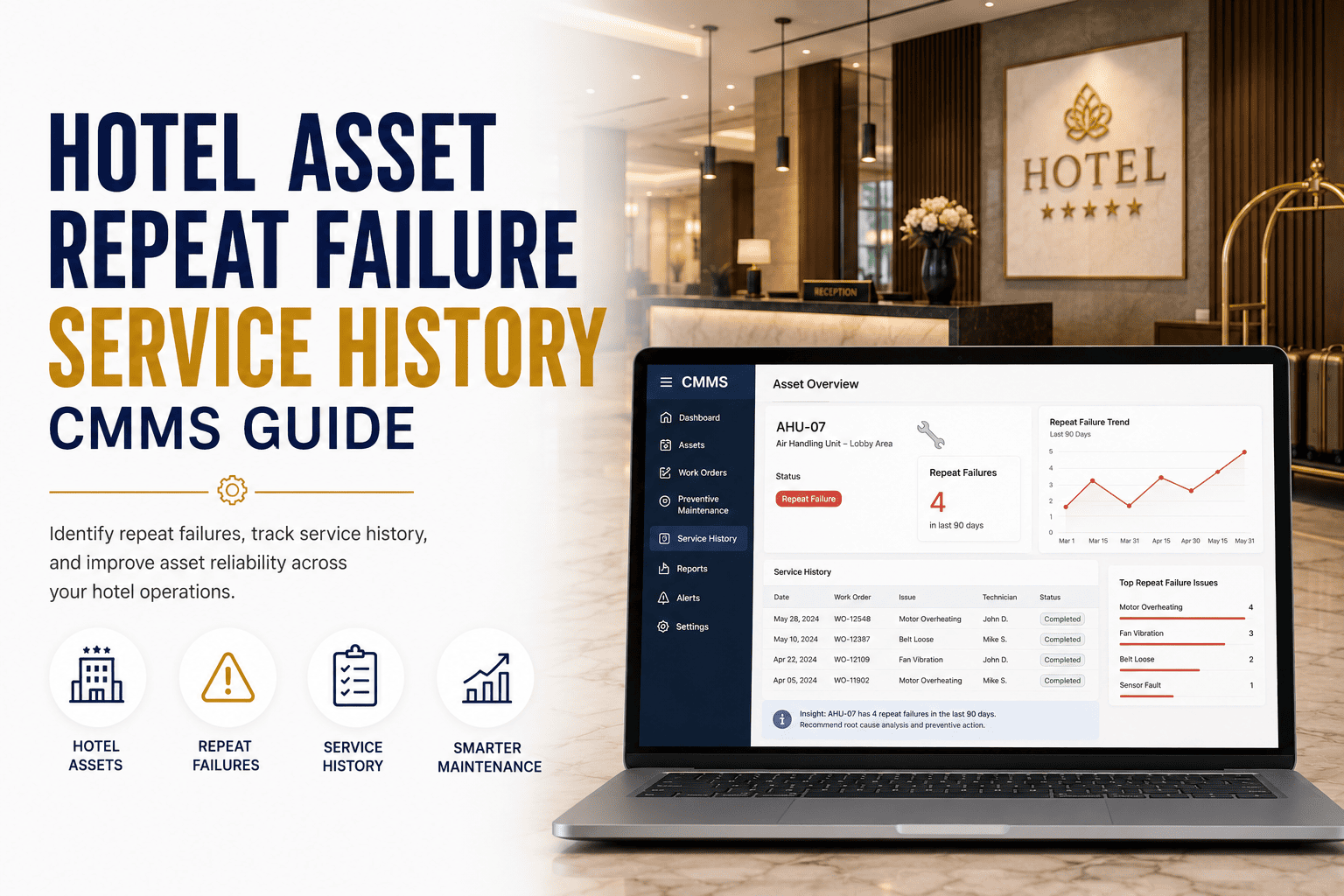
The chiller plant is registered as a parent asset with five child assets — compressor, evaporator, condenser, cooling tower, and pump/controls. Each child asset has its own PM schedule, service history, repair cost log, and predictive test record. When a bearing vibration reading is logged against the compressor, it links to the specific quarterly inspection work order and updates the compressor's condition trend automatically.
Monthly operating checks, quarterly vibration and oil sampling tasks, and annual OEM service are all scheduled automatically based on the PM intervals you configure per asset. Reminders go to the assigned engineer before each deadline. The annual OEM service date is scheduled 90 days in advance so the service provider can be booked before spring demand peaks. Sign up free to configure your chiller PM schedule in Oxmaint.
Every vibration reading, oil analysis result, approach temperature calculation, and megohm test value is logged against the asset with a timestamp. Oxmaint plots these values over time, surfacing upward trends in vibration or downward trends in efficiency that are invisible when readings are logged in isolation. A bearing vibration of 0.22 in/s looks acceptable until you see the baseline was 0.08 in/s twelve months ago — that trend is the failure prediction.
Every repair — parts cost, labor hours, and downtime — is logged against the chiller's asset record. When cumulative repair spend approaches 40–50% of replacement cost, Oxmaint surfaces a capital replacement recommendation backed by actual repair history. Ownership groups approve chiller replacement requests faster when supported by documented lifecycle cost data. Book a demo to see the lifecycle cost dashboard for capital planning.
We had a chiller fail in August two years ago. It was the compressor bearings — a $68,000 repair, 11 days of downtime, and $34,000 in portable chiller rental costs. When I looked at the operating logs from the three months before the failure, the discharge temperature trend was clearly drifting and the vibration readings I had been taking manually showed a 40% increase I had never plotted on a chart. The data was there. We just did not have a system to see it. After we moved to Oxmaint and started trending our vibration readings quarterly, we caught a developing bearing issue on our second chiller eight months later — at 0.19 in/s, well below failure threshold. We scheduled the service in November. Cost us $4,400.