Hotel electrical infrastructure ages silently — until a switchgear arcs at 2 a.m., a distribution panel overloads during peak cooling load, or a transformer fails on the busiest weekend of the year. NFPA 70B now classifies electrical equipment maintenance as a baseline requirement for risk control, yet most hotels still run breakers, panels, and GFCI circuits on reactive schedules that invite outages, fire code violations, and guest refund events costing $15K–$80K per incident. This guide lays out a complete CMMS-driven electrical PM program — infrared thermography cadence, panel inspection protocol, GFCI testing routines, and digital asset records — so your engineering team catches failures before they become fires. Ready to digitize your electrical maintenance program? Start Free Trial and configure your panel inspection templates today.
What if your hotel's main distribution panel failed tonight — would your team find it before the guest did?
A single un-scanned loose lug on a 400-amp feeder can arc into a $250K switchgear fire in under 90 seconds. The engineering teams that catch these faults early run one thing in common: a CMMS-backed electrical PM program with infrared thermography, scheduled GFCI testing, and a live panel-by-panel asset register — not a clipboard in a maintenance closet.
The hidden cost of electrical neglect in hospitality
Electrical faults are the third-leading cause of hotel fires in the U.S., responsible for roughly 3,300 hotel and motel fire incidents annually, with an average property loss of $43,200 per event. The costliest failures are rarely the equipment — they are the guest refunds, online reputation damage, and downtime during recovery that follow.
How a CMMS-built panel inspection program actually works
The 2023 edition of NFPA 70B shifted electrical maintenance from a recommendation to a documented standard of care. A CMMS turns that standard into assignable, time-stamped, photograph-backed work — not a binder on a shelf.
Inventory every panel, breaker, and feeder in the asset register
Walk every floor, mechanical room, and rooftop with a QR-tag gun. A 250-key property typically catalogs 180–240 electrical assets — from the main switchgear down to guest-room sub-panels. Each asset gets a location, voltage class, manufacturer, install date, and inspection cadence inside the CMMS.
Thermographic inspection of all load-carrying connections
A Level II thermographer scans energized panels under at least 40% load. Any connection reading ΔT ≥ 15°C above ambient is flagged as a priority work order. NFPA 70B Table 7.2 recommends this quarterly for critical facilities — a CMMS auto-schedules and attaches thermal images directly to the asset record.
Trip-test every ground-fault receptacle on the property
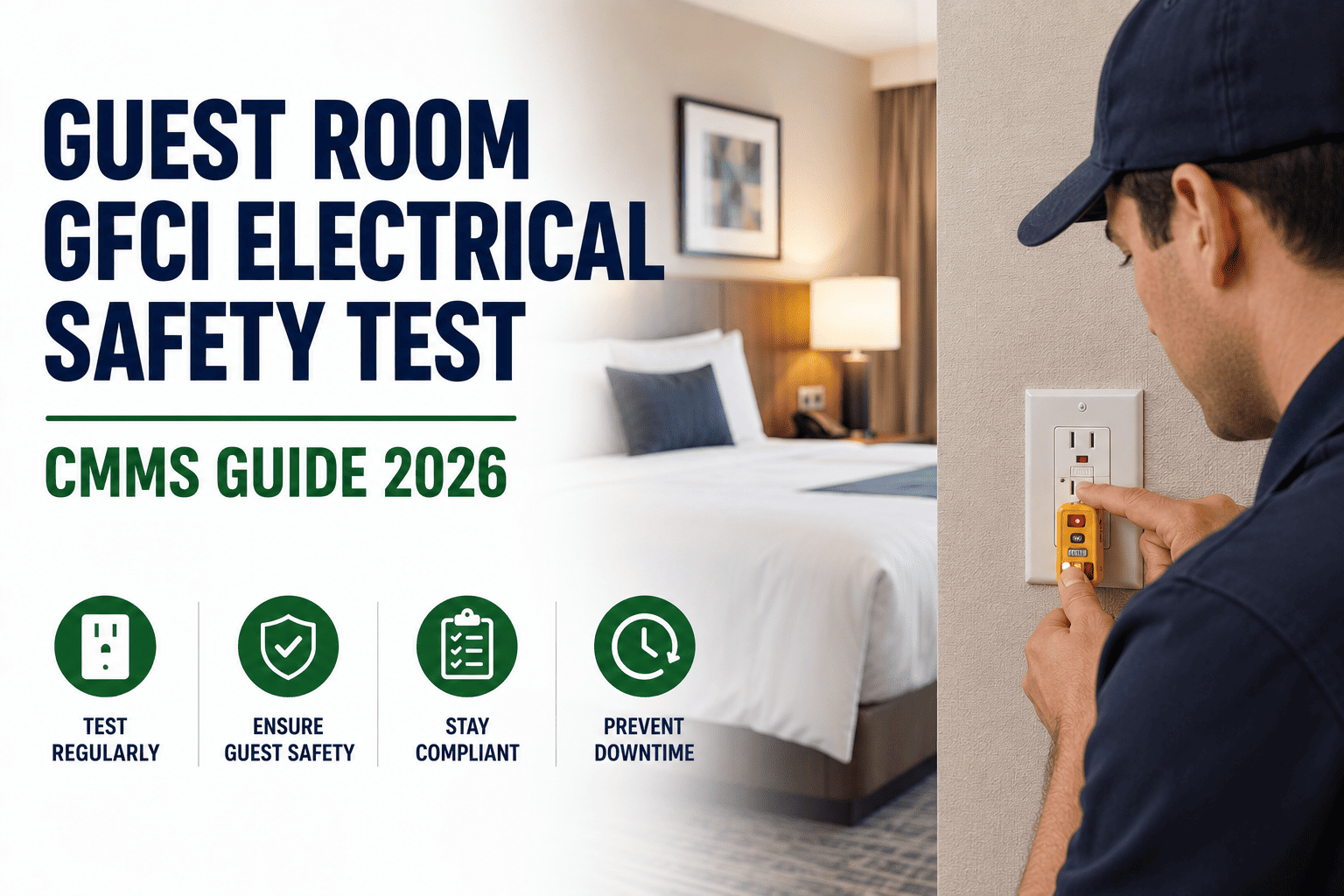
Push-to-test every guest bathroom, kitchen, pool, and exterior GFCI. A GFCI that fails to trip in under 25 ms is immediately replaced. The CMMS logs pass/fail per receptacle, so an engineer can prove compliance to an AHJ or insurance auditor without rebuilding a paper trail.
Re-torque lugs, vacuum dust, and verify arc-flash labels
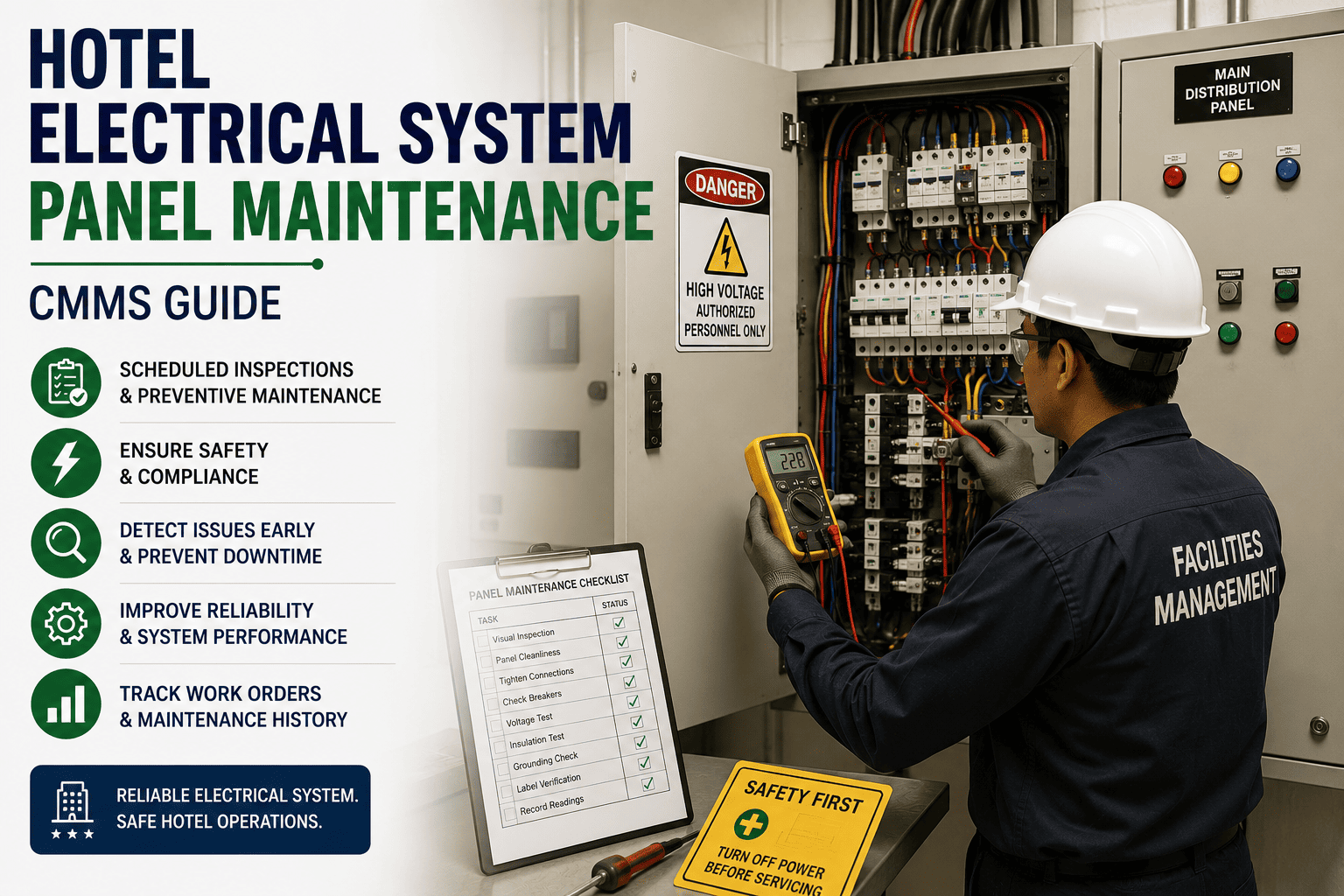
Under de-energized conditions, technicians verify lug torque to manufacturer spec, remove dust and debris from bus work, and confirm arc-flash warning labels are legible and correct. A CMMS checklist ensures no panel is closed back up without each step photo-verified and signed off.
The math: what a CMMS electrical PM program saves a 250-key hotel
Consider a 250-key full-service hotel with 210 cataloged electrical assets. The engineering team currently spends $18,400 per year on emergency electrical callouts, panel replacements after failures, and guest-comp incidents traced to power events. Here is what changes when the same labor hours are redirected through a CMMS PM program.
| Failure Mode | Reactive Cost (avg) | CMMS PM Cost (avg) | Avg Lead Time Caught |
|---|---|---|---|
| Loose lug arcing on main breaker | $8,500 | $180 | 21 days (thermal) |
| GFCI failure in guest bath | $1,200 (comp + electrician) | $35 | 30 days (monthly test) |
| Overloaded lighting circuit | $3,800 | $220 | 14 days (load audit) |
| Transformer winding degradation | $22,000 | $1,100 | 60 days (oil/DGA test) |
| Panel bus corrosion (coastal) | $6,400 | $90 | 45 days (visual + thermal) |
Hotel electrical panel inspection checklist (NFPA 70B-aligned)
Copy these items into a CMMS inspection template. Each one becomes an assignable, photo-backed step that auto-generates a work order when it fails.
Energized Panel Inspection
- Infrared scan of all breakers and lugs under load
- Flag any connection with ΔT ≥ 15°C above ambient
- Verify panel schedule is legible and matches actual circuits
- Confirm no audible buzzing or ozone smell at enclosure
- Photograph thermal anomalies and attach to asset record
De-energized Maintenance
- Verify zero voltage with calibrated meter before contact
- Re-torque all line and load lugs to manufacturer spec
- Vacuum and wipe bus bars and enclosure interior
- Inspect insulation for tracking, cracking, or heat marks
- Confirm arc-flash label is present, legible, and accurate
GFCI & AFCI Testing
- Push-to-test every GFCI receptacle (bath, kitchen, pool, exterior)
- Replace any GFCI that does not trip in under 25 ms
- Test AFCI breakers using the test button on the panel
- Log pass/fail per device in CMMS asset history
- Schedule replacement for any device failing two consecutive tests
Lighting Circuit Maintenance
- Amp-clamp each lighting circuit at peak evening load
- Flag any circuit operating above 80% of breaker rating
- Inspect ballasts and LED drivers for heat discoloration
- Verify emergency lighting battery test for 90 seconds monthly
- Replace lamps in groups per floor to reduce hot-spot labor
Stop finding electrical faults after the lights go out
Deploy a CMMS electrical PM program in under 48 hours — import your panel list, assign inspection templates, and schedule your first infrared scan this week.
Hotel electrical maintenance CMMS — questions engineering directors ask
How often should a hotel perform infrared thermography on electrical panels?
NFPA 70B recommends thermographic inspection of energized electrical connections at least annually for general facilities and quarterly for critical or high-load operations. A full-service hotel with a 400-amp-plus main service and 24/7 HVAC load should scan quarterly under at least 40% load — the CMMS auto-schedules this and attaches thermal images to each panel's asset record.
What GFCI testing frequency does a CMMS enforce for guest-facing receptacles?
UL recommends monthly push-to-test for all GFCI receptacles, and OSHA expects documented testing in commercial settings. A CMMS template assigns each GFCI — bathroom, kitchen, pool deck, exterior — to a monthly route with pass/fail logging. Any device that fails to trip in under 25 milliseconds generates an instant replacement work order. See it in action when you Start Free Trial and load the GFCI template.
Can a CMMS help prove NFPA 70B and insurance compliance after an incident?
Yes — that is its single highest-value function in a post-incident audit. Every inspection, thermogram, torque reading, and GFCI test is time-stamped, geo-tagged, and signed to a technician. An insurance adjuster or AHJ can pull a complete maintenance history for any panel in under five minutes, proving the property met the standard of care.
What does it cost to run a CMMS electrical PM program for a 250-key hotel?
A typical 250-key property with 180–220 electrical assets spends $5,000–$8,000 per year on the full program: CMMS software seats, a quarterly thermography contract, monthly GFCI testing labor, and annual de-energized panel maintenance. That replaces roughly $15,000–$20,000 in reactive callouts and guest-comp events — a payback window under 10 months.
How long does it take to deploy electrical PM templates in a CMMS?
Most properties are live in 24–72 hours. You import or QR-tag your panel asset list, attach the inspection template (infrared, GFCI, torque, lighting), assign cadences, and schedule the first round. A 30-minute walkthrough with our team will configure the full program — Book a Demo to see your property mapped live.
Your panels are aging right now — start tracking them today
Join the hotel engineering teams using CMMS-driven electrical maintenance to cut outages, pass audits, and protect guests. Set up your panel register, inspection templates, and infrared schedule this week.
Free 14-day trial · No credit card