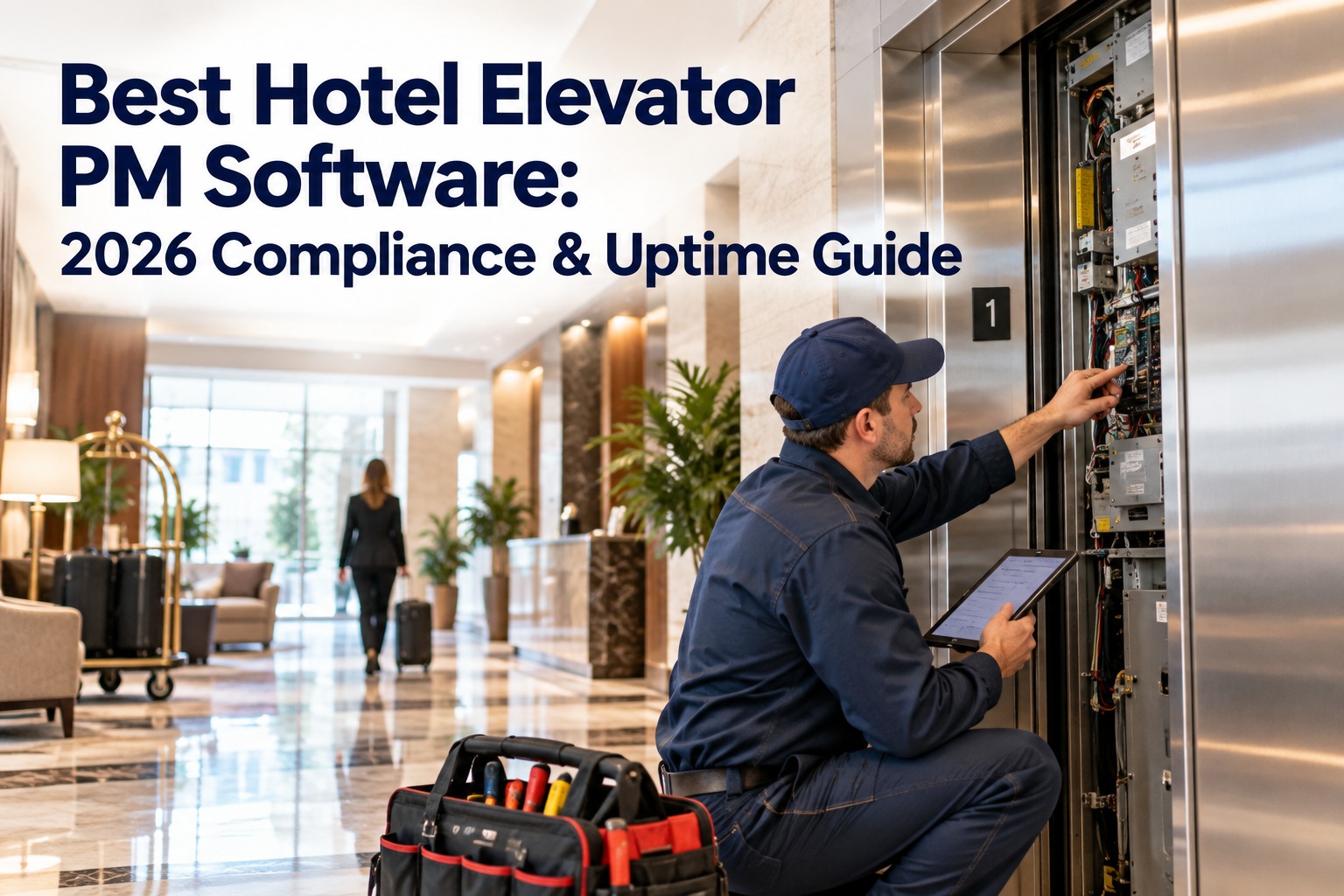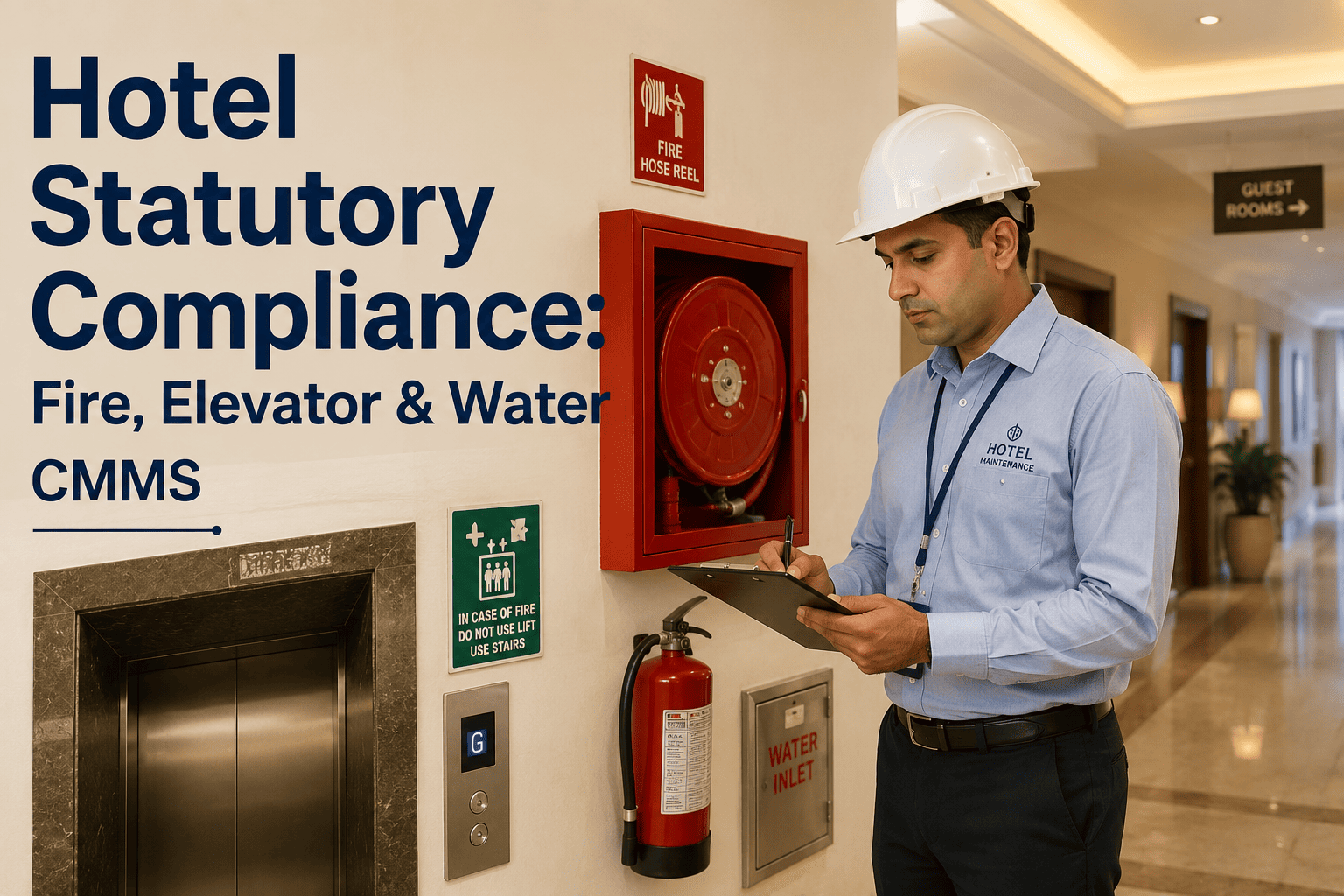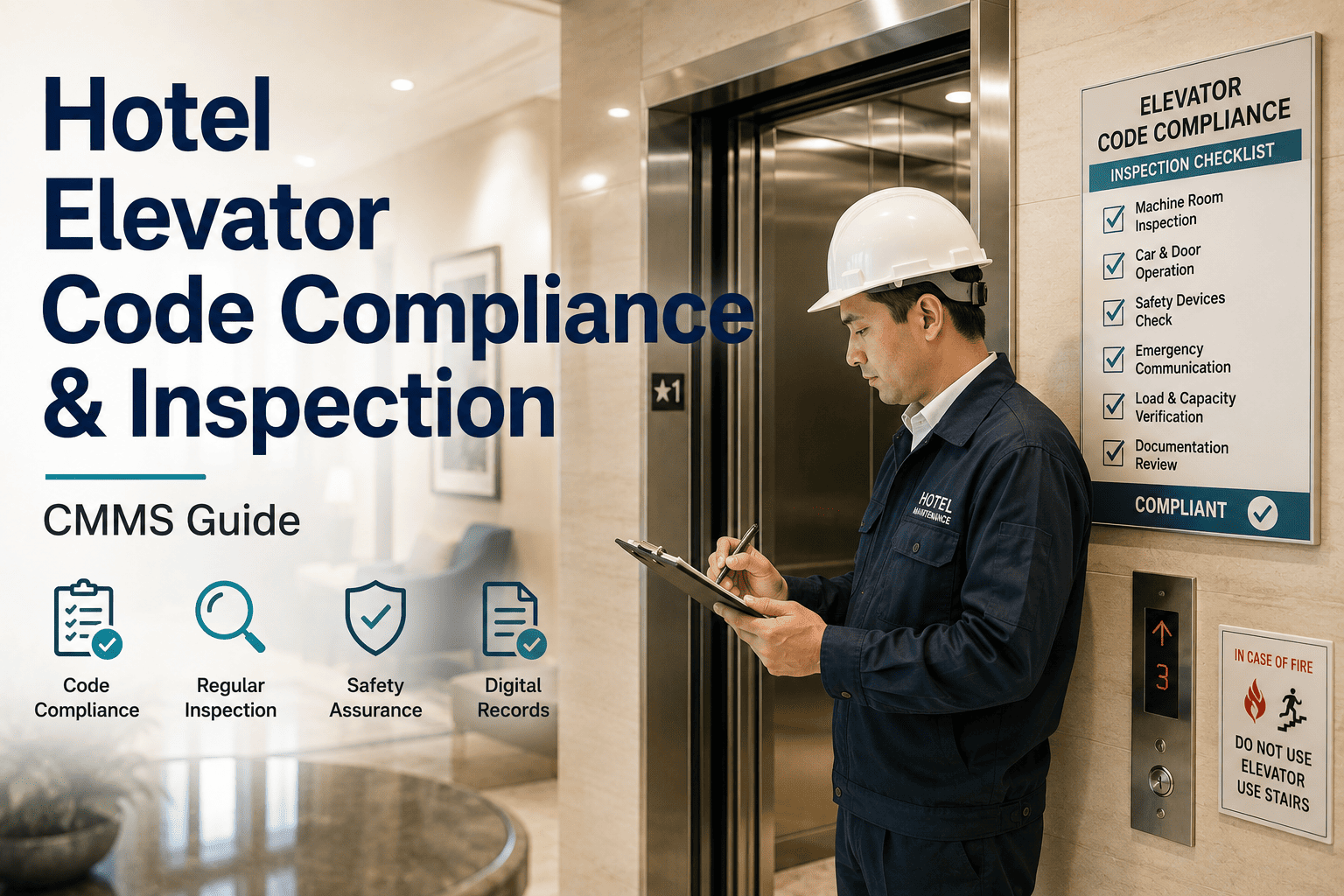
Hotel elevator code compliance demands rigorous annual inspections, precise leveling accuracy testing, and jurisdiction-specific documentation — and a single failed audit can trigger fines, shutdowns, and ADA violations that ripple through guest satisfaction and RevPAR. This CMMS hotel elevator code guide walks maintenance and reliability teams through the 2026 regulatory landscape, PM contract structures, and modernization planning so every car on the property stays certified and reliable. By centralizing jurisdiction inspection schedules, digital certificates, and preventive maintenance triggers in one AI-powered platform, OxMaint eliminates the spreadsheet chaos that causes 40% of compliance gaps. Ready to digitize your elevator compliance program? Start Free Trial or read on for the full inspection framework.
Is Every Elevator on Your Property Code-Compliant Right Now?
Hotel elevator code compliance is not a once-a-year event — it is a continuous obligation across annual certifications, leveling accuracy tests, and jurisdiction-specific documentation. A CMMS built for hospitality maintenance teams keeps every car inspection-ready 365 days a year.
Hotel elevator inspection requirements by jurisdiction
In most U.S. jurisdictions, passenger elevators in hotels require an annual inspection and a separate periodic certification — but the specifics vary by state, county, and city authority having jurisdiction (AHJ).
High-Rise Urban Hotels
Annual full-load safety tests plus monthly visual inspections are typical in NYC, Chicago, and Los Angeles. jurisdictions often require a Category 1 (no-load) test every year and a Category 5 (full-load) test every five years under ASME A17.1.
Resort & Suburban Properties
State-level codes may permit 12-month inspection cycles with private QEI-certified inspectors, but the property must retain digital certificates for 3–5 years and produce them within 48 hours of an AHJ audit request.
International & Flagged Chains
Global brands add EN 81 (Europe) or GB 7588 (China) layers on top of local code. A CMMS that tracks multiple code standards per asset prevents a flagged property from failing a brand-standard audit even when local code is met.
A 250-room hotel with four passenger elevators typically faces $18,000–$35,000 in annual compliance costs (inspections, tests, documentation). Without a CMMS, 30–40% of that spend is wasted on emergency prep and duplicate reporting.
How to structure elevator PM contracts for full code coverage
Most hotels outsource elevator maintenance to an OEM or independent service provider (ISP) under a tiered contract — but the CMMS must own the compliance calendar, not the vendor.
Full-Maintenance (OEM) Contract
Covers parts, labor, and callbacks 24/7. Best for properties with high-rise banks or traction elevators. The CMMS should log every vendor visit, track MTTR against the 4-hour callback SLA, and auto-flag when response times breach contract terms. Typical cost: $4,500–$8,000 per car annually.
Preventive-Maintenance-Only Contract
Vendor performs scheduled lubrication, cleaning, and component inspection monthly. Parts and callbacks are billable. The CMMS drives the schedule and captures digital work orders with photo evidence, so the property can audit vendor performance and renegotiate underperforming contracts.
Self-Maintained (In-House) Program
Large portfolios with certified in-house mechanics use the CMMS as the system of record for all PM tasks, safety tests, and parts inventory. OxMaint's predictive analytics layer flags wear patterns (door cycles, brake distance) 2–4 weeks before failure, cutting unplanned downtime by 30–50%.
Leveling accuracy hotel CMMS: testing protocol & pass thresholds
Leveling accuracy — the maximum vertical gap between the elevator floor and the hallway landing — is one of the most common ADA complaint drivers and is explicitly tested during code inspections.
The floor of an elevator car must stop level with the landing to within ½ inch under both no-load and full-load conditions. Variations beyond this threshold are a direct ADA Title III violation and trigger immediate out-of-service tags in most jurisdictions.
A quarterly in-house leveling check (measured at every landing, both directions, during peak and off-peak load) catches drift before the annual inspector arrives. The CMMS auto-generates the work order, captures readings, and attaches a digital certificate to the asset record.
Quarterly Leveling Test Checklist
- Measure floor-to-landing gap at every stop, up and down, with a calibrated digital feeler gauge
- Test under empty car and 25%, 50%, 75% load conditions using calibrated test weights
- Record re-leveling behavior after doors open — car must not drift more than 1 inch
- Photograph each landing reading and attach to the CMMS work order as audit evidence
Annual Inspection Readiness Checklist
- Verify all quarterly leveling logs are digitized and retrievable in under 5 minutes
- Confirm Category 1 and Category 5 test dates are current within the CMMS compliance calendar
- Check that emergency phone, fire recall (Phase 1), and power-loss operation tests are logged
- Ensure machine-room access, lighting, and temperature logs meet ASME A17.1 Section 2.8
When to modernize: cost thresholds & capital planning triggers
Elevator modernization costs $120,000–$450,000 per car, so the decision must be data-driven — not triggered by a single breakdown or an aggressive vendor quote.
| Modernization Trigger | Threshold | CMMS Data Source |
|---|---|---|
| Annual repair cost exceeds new-equipment amortization | > $8,000/car/yr for 3 consecutive years | Work-order cost rollup by asset |
| Unplanned downtime impacts guest satisfaction scores | > 12 hours/car/yr or 3+ guest complaints | Downtime analytics + guest feedback integration |
| Parts obsolescence (controller, drive, fixtures) | OEM discontinuation notice or >30-day parts lead time | Spare-parts inventory + procurement logs |
| Code update requires controller upgrade (e.g., A17.1-2019) | Jurisdiction adoption date within 12 months | Compliance calendar + regulatory alerts |
| Energy consumption exceeds modern standard by >40% | kWh/car/day vs. regenerative-drive baseline | IoT sensor data + energy meter integration |
A 4-car hydraulic elevator bank in a 220-room boutique hotel
Over 36 months the property logged 47 callback work orders, $31,200 in parts, and 96 hours of unplanned downtime — all tracked in OxMaint. The CMMS analytics dashboard flagged that annual repair spend had crossed the $8,000/car threshold and projected a 22% downtime increase over the next 18 months based on door-cycle wear trends. The Chief Engineer used the OxMaint capital-justification report to secure a $380,000 modernization budget, replacing 1980s controllers with regenerative drives — cutting energy costs 35% and eliminating callbacks for 14 months post-install.
CMMS hotel elevator compliance: the OxMaint advantage
OxMaint turns elevator compliance from a reactive fire drill into an automated, audit-ready system — mapping four concrete capabilities directly to the compliance and reliability challenges hotel maintenance teams face.
Automated Compliance Calendar
Every elevator asset carries its own jurisdiction-specific inspection schedule — Category 1, Category 5, annual certification, and ADA leveling tests — with automated work-order generation 30, 14, and 7 days before each deadline. Outcome: zero lapsed certifications and 100% audit readiness.
Predictive Wear Analytics
AI models analyze door-cycle counts, motor current draw, and vibration data from IoT sensors to predict component failure 2–4 weeks in advance — letting you schedule repairs before a guest gets stuck. Outcome: 30–50% reduction in unplanned elevator downtime.
Digital Certificate Vault
Every inspection report, test result, and vendor certificate is attached to the asset record and instantly retrievable — searchable by car number, date, inspector, or jurisdiction. Produce a full compliance packet in under 5 minutes during an audit. Outcome: eliminate 120+ hours/year of manual document prep.
Vendor Performance Tracking
Every elevator service vendor visit is logged with arrival time, work performed, parts used, and SLA compliance — giving you the data to renegotiate or switch providers. Outcome: average 15–20% reduction in annual elevator maintenance contract spend.
See OxMaint manage your elevator compliance — book a 30-min demo
Watch how hotel maintenance teams use OxMaint to automate inspection schedules, digitize certificates, and predict failures before guests notice.
Hotel elevator code compliance: your questions answered
How often must hotel elevators be inspected for code compliance?
Most U.S. jurisdictions require an annual inspection by a QEI-certified inspector, plus a Category 1 no-load safety test every year and a Category 5 full-load test every five years under ASME A17.1. Some states add monthly visual inspections. A CMMS hotel elevator code system like OxMaint auto-generates work orders for each required test date so nothing lapses. Book a Demo to see the compliance calendar in action.
What is the ADA leveling accuracy requirement for hotel elevators?
Under ADA Title III, the elevator floor must level with the landing to within ½ inch (13 mm) under both no-load and full-load conditions. The car must also re-level if it drifts after doors open. Quarterly in-house leveling tests captured in a CMMS help hotels catch drift before the annual inspector flags it — avoiding out-of-service tags and guest complaints.
Can a CMMS help with jurisdiction-specific elevator code requirements?
Yes. OxMaint lets you assign jurisdiction-specific inspection templates and compliance calendars to each elevator asset — so a hotel chain with properties in five states can manage different AHJ requirements, test intervals, and documentation standards from a single dashboard, with automated alerts when a jurisdiction updates its code.
What happens if a hotel elevator fails a code inspection?
A failed inspection typically results in a tag-out (out-of-service order) until the deficiency is corrected and a re-inspection is passed. Fines range from $500 to $5,000 per violation depending on the jurisdiction, and ADA-related failures can trigger federal complaints. A CMMS with predictive analytics and automated PM scheduling prevents 80–90% of common failure causes — worn brakes, door-zone sensor drift, leveling controller malfunction — before the inspector arrives.
How much does elevator compliance CMMS software cost for a hotel?
OxMaint pricing scales with the number of assets and users, but most hotel properties see a positive ROI within 60–90 days through reduced callback costs, avoided fines, and eliminated manual documentation labor. A 4-elevator property typically spends less on the CMMS annually than the cost of a single failed inspection penalty. Start Free Trial to evaluate the platform on your own assets.
Make every elevator audit-ready, every day
Join hotel maintenance teams using OxMaint to automate compliance, predict failures, and cut elevator downtime by up to 50%.
Free 14-day trial · No credit card