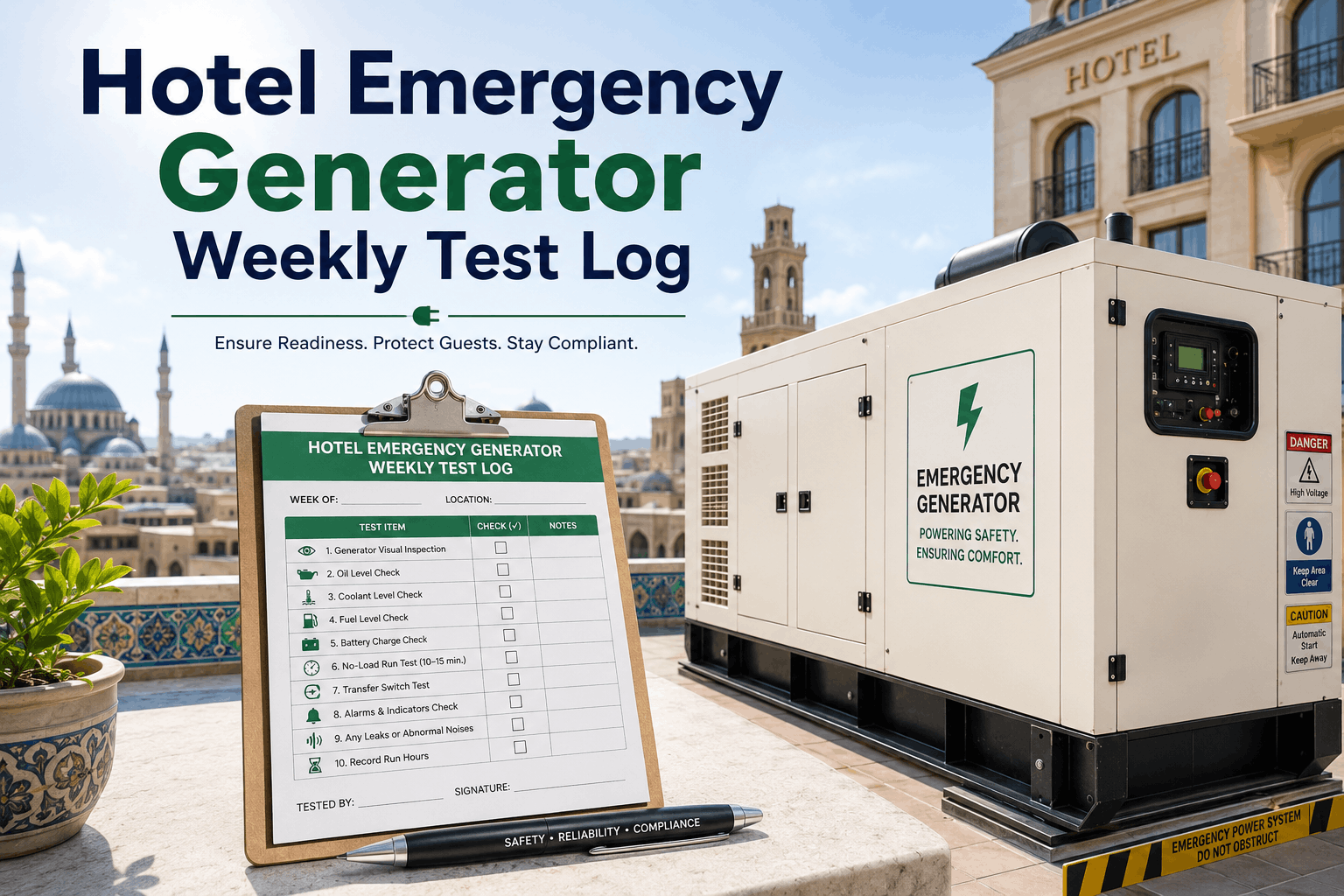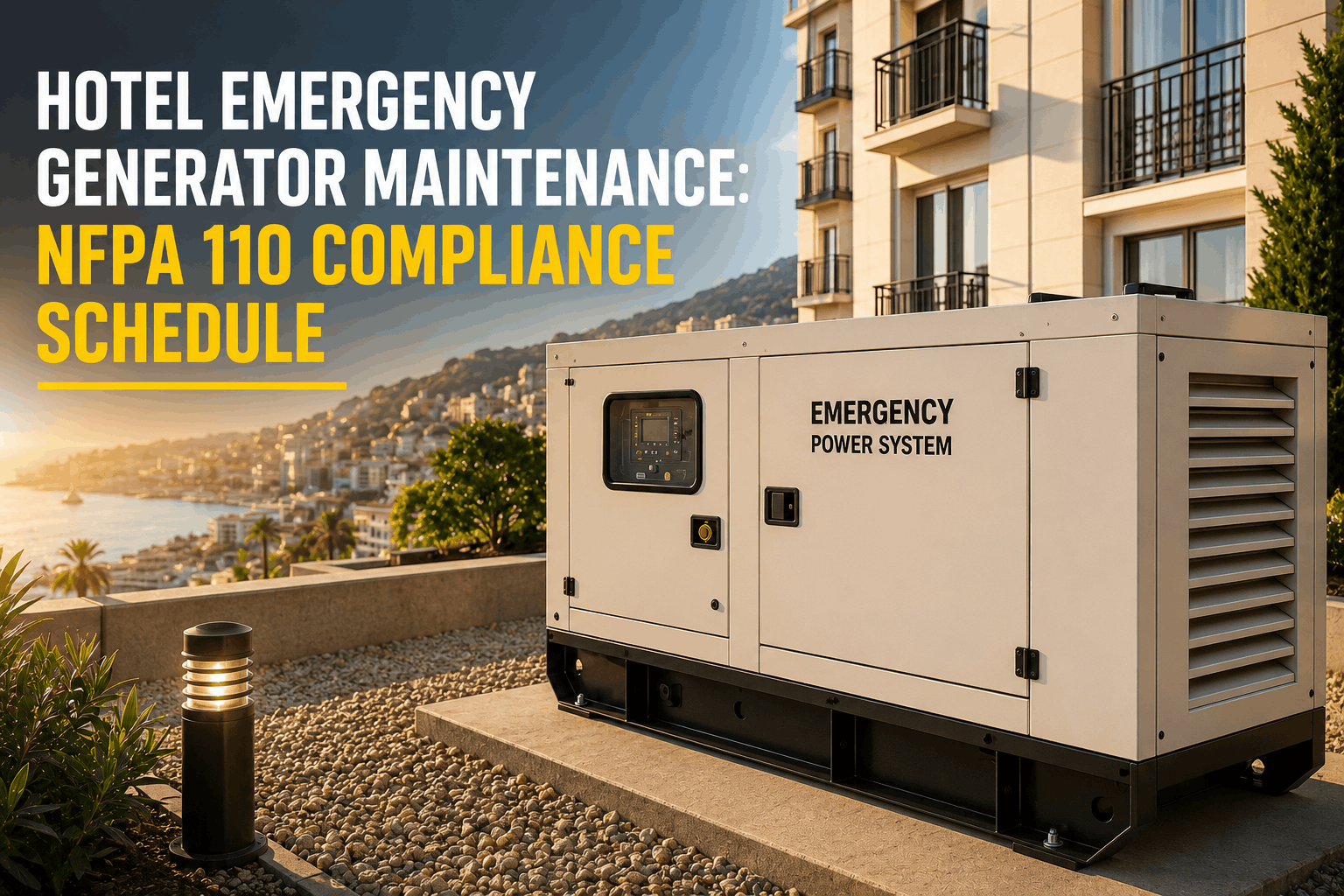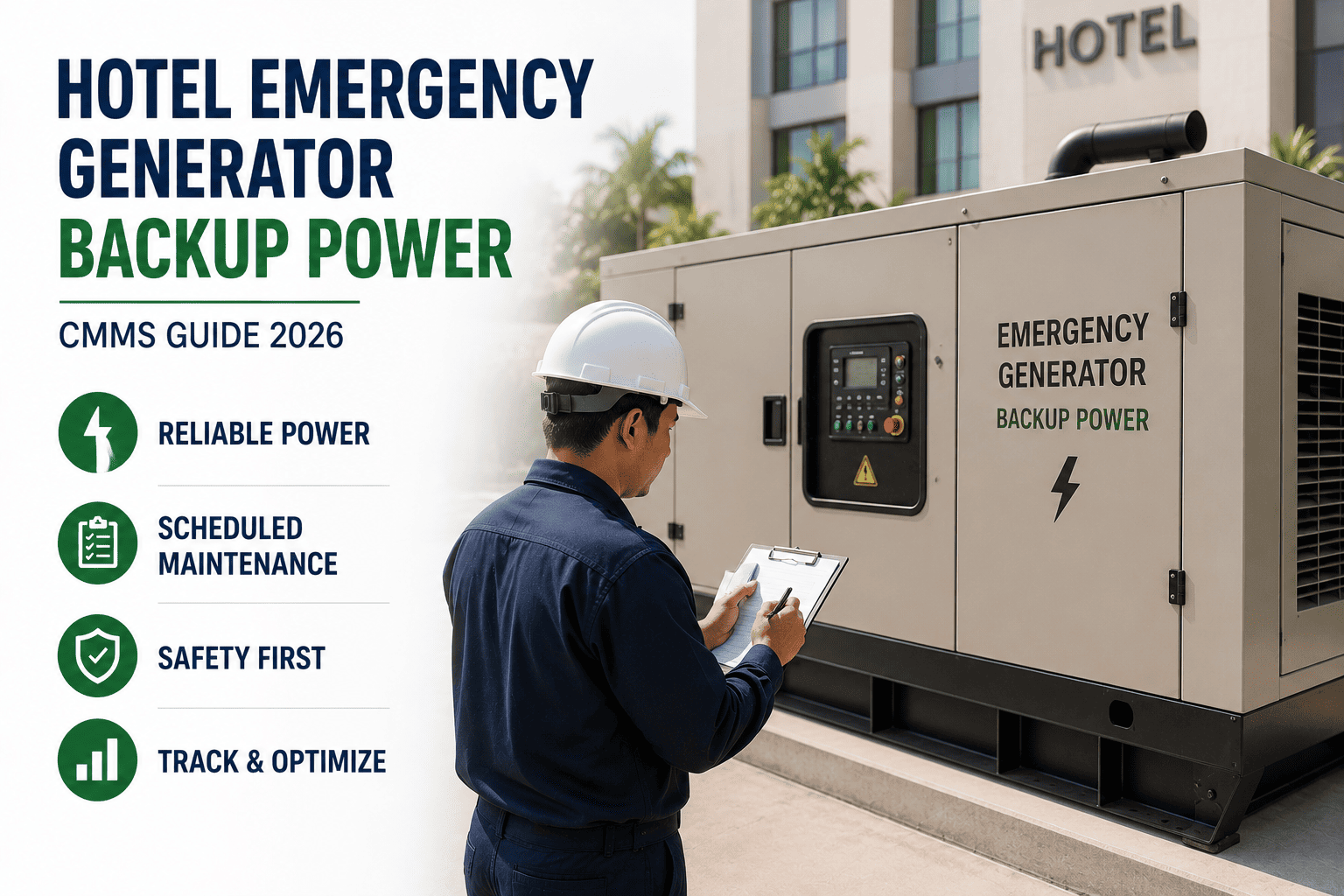
When the grid drops at 2 a.m. on a fully booked Saturday, your hotel's emergency generator becomes the single most valuable asset on the property — yet most maintenance teams only discover it has a problem when it fails to start. NFPA 110 sets the legal baseline for testing, but compliance alone does not guarantee that a 500 kW diesel unit will carry guest rooms, elevators, fire pumps, and POS systems through a 96-hour outage. This 2026 guide translates the standard into an operating playbook: fuel polishing schedules, transfer switch exercise protocols, load bank cadence, and the CMMS workflows that prove readiness to underwriters and brand auditors. If you want to stop tracking generator health on a clipboard, you can Start Free Trial and have a full backup-power asset register running before the next storm season.
When the lights go out, is your generator actually ready to carry the load?
NFPA 110 requires weekly no-load tests and monthly load tests — but 1 in 3 hotel generators still fails to start on the first pull during a real outage. The gap between a passing test log and true readiness is where guests get trapped in elevators and freezers full of banquet food spoil overnight.
The weekly, monthly, and annual tests NFPA 110 actually requires
A 240-room property running a single 400 kW diesel generator typically logs 52 no-load exercises, 12 load tests, and one full load bank run per year — but most teams cannot produce that evidence in under an hour when an auditor asks.
No-Load Exercise — 30 minutes
Run the generator with no building load for at least 30 minutes. Record start time, voltage, frequency, oil pressure, coolant temperature, and any fault codes. Confirm the battery charger is floating correctly and fuel level reads above 75%.
Operational Load Test — 30 minutes at ≥30% load
Transfer the building onto generator power via the automatic transfer switch and hold at 30% or more of nameplate capacity for 30 minutes. Verify the ATS retransfers cleanly and the generator cooldown cycle completes before shutdown.
Full Load Bank Test — 2 to 4 hours
Connect an external resistive load bank and run the generator at 100% nameplate capacity for a sustained period to burn off carbon deposits, validate cooling system performance, and confirm the engine can hold rated output without derating.
4-Hour Full Load Test
Every three years, NFPA 110 Level 1 systems must demonstrate the ability to carry full nameplate load for 4 continuous hours — the test that separates a generator that starts from one that actually sustains an extended outage.
Diesel fuel is the #1 cause of generator failure — manage it like a chemical asset
Stored diesel begins to degrade in as little as 6 months. Water accumulation, microbial growth, and asphaltene sludge will clog filters and shut down a perfectly good engine within minutes of a real load. A 500-gallon day tank that sits at 90% for a year is a liability, not a reserve.
Weekly Fuel Level Check
Confirm day tank and main storage read above 75% with a logged gauge photo. A CMMS task with a required photo field turns this from a clipboard checkbox into auditable proof.
Quarterly Water Bottom Test
Sample the bottom of the tank with a water-finding paste or probe. More than 1/4 inch of water triggers an immediate polishing cycle. Microbes breed at the fuel-water interface within 30 days.
Semi-Annual Fuel Polishing
Cycle stored fuel through a filtration system that removes water, particulates, and microbial contamination. Costs $0.15–$0.25 per gallon — far cheaper than replacing 2,000 gallons of sludged diesel.
Annual Fuel Lab Analysis
Send a sample to a lab for ASTM D975 testing: cetane index, water and sediment, microbial count, and oxidation stability. A failing report is your legal documentation to rotate or replace fuel before it voids engine warranty.
A 180-key resort in Florida spent $42,000 a year on generator service contracts but still lost $310,000 in spoiled food, guest refunds, and brand penalties after Hurricane Milton — because fuel had sat untouched for 14 months and the day tank filter collapsed 90 seconds into the outage. A CMMS fuel-polishing trigger set for every 180 days would have cost $380 and caught the water accumulation three months before landfall.
The automatic transfer switch is where most backup systems silently fail
The ATS is the single mechanical device that decides whether your generator is connected to your building. Its contacts, springs, and control logic are exercised every week — but only inspected once a year in most hotels.
| ATS Maintenance Task | Frequency | What You Are Looking For | CMMS Trigger |
|---|---|---|---|
| Visual inspection of contact alignment | Monthly | Pitting, discoloration, carbon tracking on contacts | Photo-required checklist |
| Full load transfer test | Monthly | Clean retransfer, no hesitation in engine cooldown | Pass/fail digital form |
| Lubricate mechanical linkages | Quarterly | Binding, sticky operation, spring fatigue | Spare-parts kit auto-attached |
| Torque all electrical connections | Annually | Hot spots on IR scan, loose lugs, insulation breakdown | IR photo upload required |
| Control logic firmware update | Annually | Outdated time delays, failure to recognize utility loss | Vendor-linked work order |
| Full ATS rebuild or replacement | 10–15 years | Worn contacts beyond resurfacing, PCB failure | Capital planning flag |
The five metrics that prove your generator is actually ready — not just logged
A CMMS turns your generator from a paper-trail obligation into a live readiness score. These are the five numbers a General Manager, Risk Director, or brand auditor should be able to pull in under 30 seconds.
Share of weekly and monthly tests completed and passed on the first attempt in the last 90 days. Below 95% is a red flag.
Mean time to repair on critical fault codes. A fuel leak or battery fault should be resolved within 72 hours, not 7 days.
Days since last polish divided by 180. Under 50% means you are overdue for a polishing cycle and fuel is degrading.
Every required NFPA 110 test has a time-stamped, technician-signed digital record attached. Gaps mean auditor findings.
No outstanding work orders tagged "life-safety critical." Anything open here is a direct liability during an outage.
Turn your generator log into proof of readiness — before the next outage proves it for you
Oxmaint gives your team a full NFPA 110 testing schedule, fuel management triggers, ATS inspection workflows, and a one-click readiness dashboard that satisfies any auditor.
Hotel generator and CMMS questions, answered
How often must a hotel emergency generator be tested under NFPA 110?
Level 1 systems require a 30-minute no-load exercise weekly and a 30-minute operational load test at 30% or more of nameplate capacity monthly. A full load bank test at 100% capacity is required annually, plus a 4-hour sustained full load test every three years. All tests must be documented with time, load, and technician signature — a CMMS automates the scheduling and captures the digital record automatically.
What causes most hotel generator failures during a real outage?
The three leading causes are degraded or water-contaminated fuel, sulfated or undercharged starting batteries, and automatic transfer switch contact failure. Fuel issues account for roughly 50% of inoperable generator events. A CMMS with fuel-polishing reminders and battery voltage logging catches all three before they become an outage-day failure.
Can a CMMS really prove compliance to a brand auditor or fire marshal?
Yes. A properly configured CMMS produces a time-stamped, technician-signed record for every weekly, monthly, and annual test — with photo evidence, load readings, and fault code logs attached. You can Start Free Trial and generate a 12-month NFPA 110 compliance report in under a minute, which is exactly what an auditor asks for.
How much does a hotel generator CMMS typically cost per month?
For a single property with one or two generators, a CMMS subscription runs $50–$150 per month depending on asset count and user seats. That is roughly 1% of what a single failed-outage event costs in guest refunds and food loss. Most hotels recover the annual subscription cost the first time the system prevents one missed load test.
What should I do if my generator fuel has been sitting unused for over a year?
Schedule a fuel sample and lab analysis immediately — do not run the generator on suspect fuel. If water or microbial contamination is present, arrange polishing or replacement before the next exercise cycle. A CMMS can set a 180-day polishing reminder so this never happens again. You can also Book a Demo to have our team map your fuel management workflow directly.
Your generator is only as reliable as the system that maintains it
Join the hotels using Oxmaint to cut generator downtime risk by up to 80% and turn NFPA 110 compliance from a paperwork burden into a one-click readiness report.
Free 14-day trial · No credit card