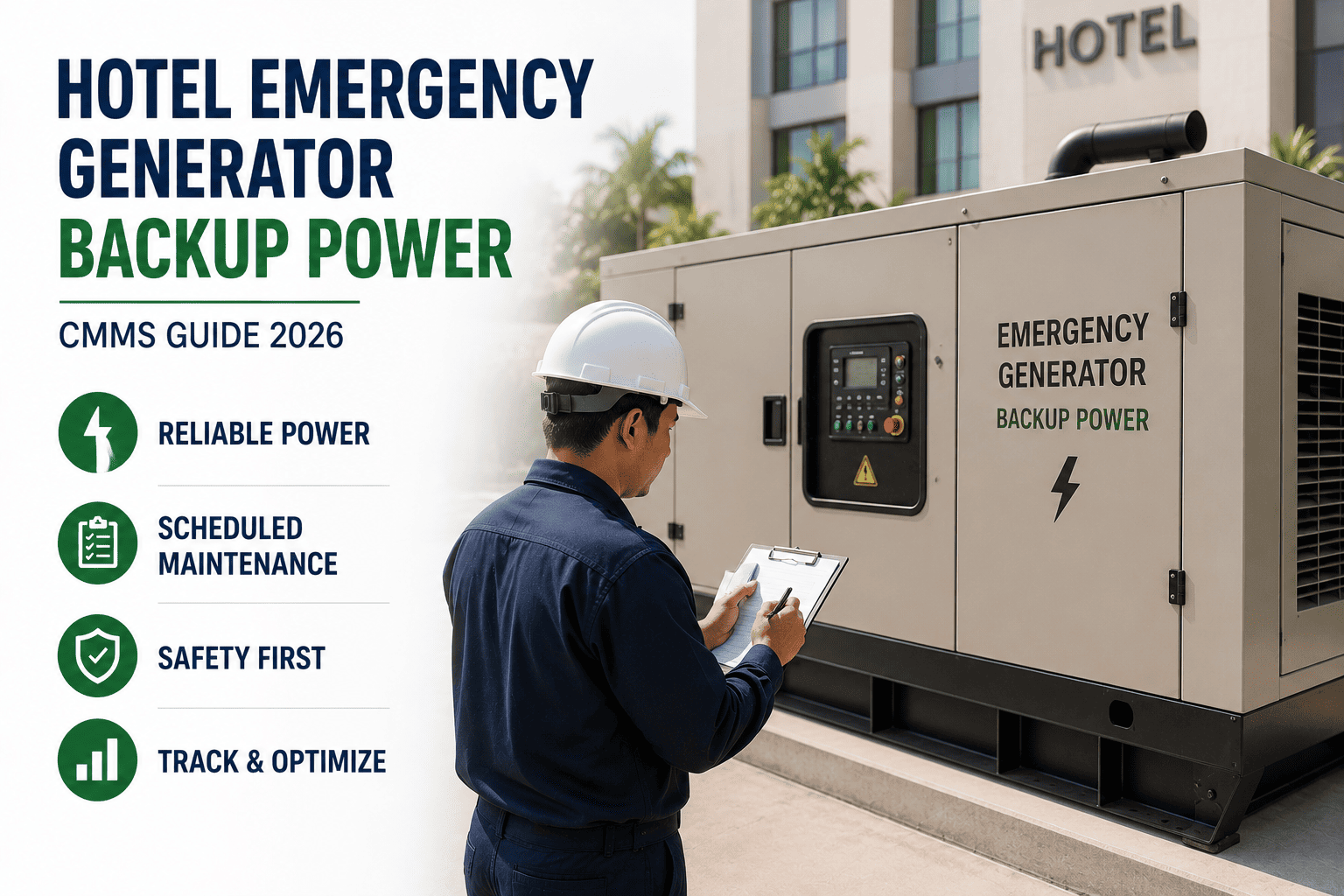
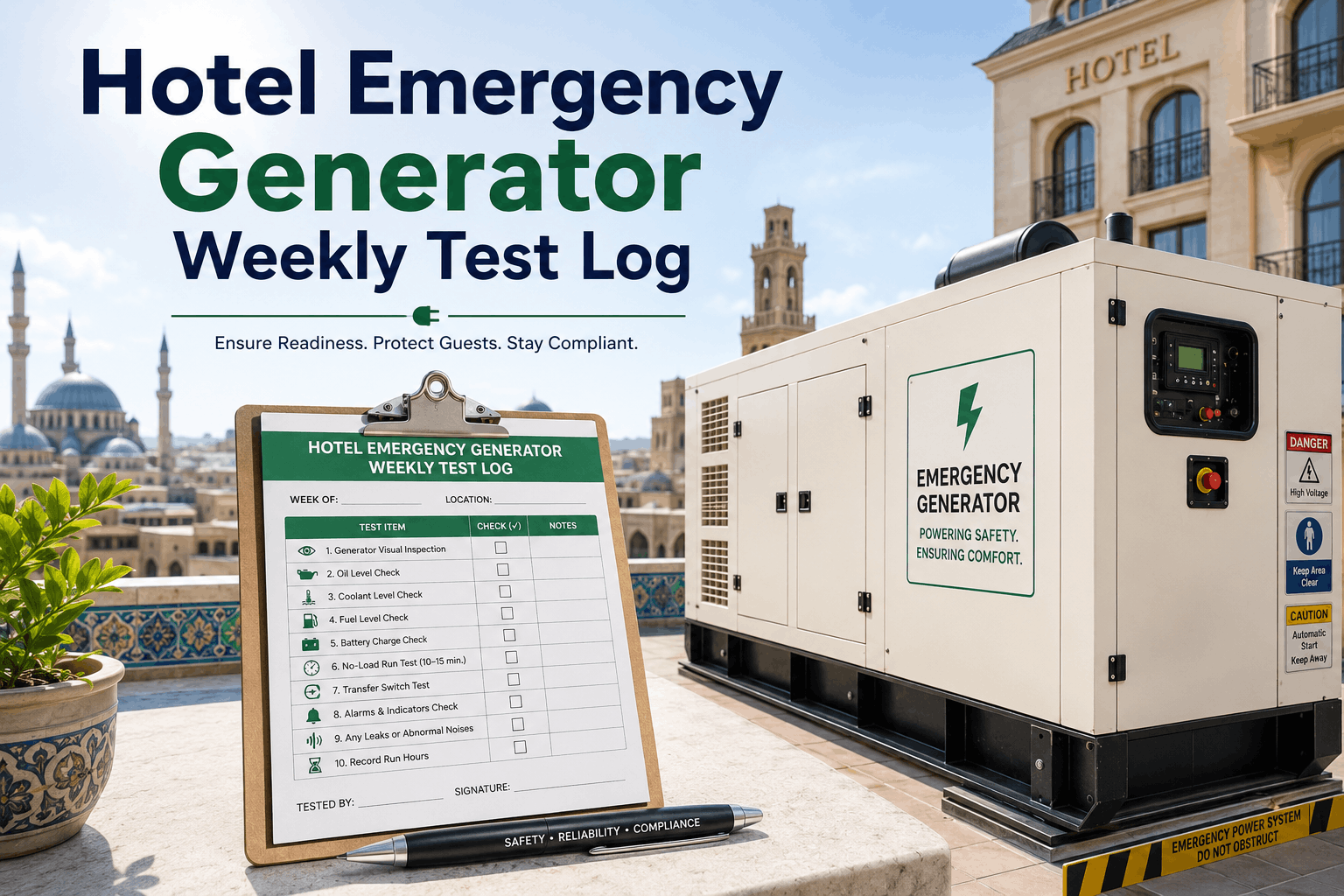
A hotel generator that fails during a power outage is not a maintenance inconvenience — it is a guest safety event, a regulatory violation, and a reputational crisis that front desk staff cannot explain away. Emergency lighting goes dark, elevator systems freeze, fire suppression pumps lose power, and CCTV drops offline. Most generator failures are not random. They are the direct result of missed load tests, deferred fuel polishing, and inspection records that exist on paper but were never verified. Oxmaint gives hotel engineering teams the automated PM scheduling and compliance documentation to keep backup power systems ready every hour of every day. Book a demo to see how Oxmaint manages hotel generator and backup power compliance.
Hotel generator maintenance requires a documented PM program covering weekly visual inspections, monthly load testing under minimum 30% rated load, quarterly fuel and coolant analysis, and annual full-load exercise tests — all with timestamped records meeting NFPA 110, OSHA 1910.303, local fire code, and brand franchisor requirements. A CMMS like Oxmaint automates every test interval, generates compliance-ready documentation, and alerts engineering teams before deadlines pass — replacing manual calendars and paper logs that consistently produce compliance gaps.
NFPA 110 requires monthly generator load testing at minimum 30% rated load with written records. Hotels relying on calendar reminders and paper logs routinely miss tests during peak occupancy periods. When a fire marshal or insurance auditor requests the last 12 months of load test records, gaps trigger immediate compliance notices.
Diesel fuel stored for more than 12 months without treatment degrades and forms microbial contamination that clogs fuel injectors and filters. Most hotel generators sit in standby mode for months between tests. Without a fuel polishing and testing schedule tracked in a CMMS, a generator may pass its visual inspection and still fail to sustain load during a real outage.
The automatic transfer switch is the critical link between utility power failure and generator pickup. ATS contacts corrode, transfer time drifts, and exercise cycles are skipped when maintenance is managed manually. An ATS failure means the generator starts but the hotel never transfers to backup power — the most dangerous failure mode because it is invisible until a real outage.
Generator starting batteries are the single most common cause of standby generator start failure. Hotels typically replace batteries reactively after a failed start rather than on a scheduled interval. Without battery voltage trending and replacement interval tracking in the CMMS, a hotel discovers a dead starting battery at the worst possible moment — during a utility outage with guests on property.
Oxmaint automates every load test, inspection interval, and fuel check — with compliance documentation ready before your next audit.
Oxmaint structures hotel generator maintenance into a fully automated PM program — from daily visual checks through annual full-load exercise tests — with compliance documentation generated automatically at every step.
Every generator, UPS system, ATS panel, and fuel storage tank is registered in Oxmaint with manufacturer specifications, installation date, rated load capacity, and replacement value. NFPA 110, OSHA, local fire code, and brand franchisor inspection intervals are pre-loaded as PM templates. The system generates work orders automatically on the correct schedule — no manual calendar management required.
Monthly load test work orders are generated 7 days in advance with the checklist pre-populated — load percentage, duration, transfer time measurement, voltage and frequency readings, and fuel consumption log. If a load test is not completed by the deadline, Oxmaint automatically escalates to the chief engineer and flags the overdue test in the compliance dashboard. No test is ever silently missed.
Fuel level checks, fuel quality testing, biocide treatment, and fuel polishing intervals are all managed as scheduled work orders in Oxmaint. Technicians record fuel level, appearance, and water detection results from the mobile app. Fuel treatment and polishing work orders are triggered automatically based on elapsed time since last treatment — not based on a supervisor remembering to schedule it.
Every completed generator PM — load test, visual inspection, ATS exercise, fuel check, battery test — produces a timestamped, technician-attributed record with GPS check-in and photo evidence. NFPA 110 and fire code compliance packages export in one click from the compliance dashboard. No manual log compilation before fire marshal visits or brand audits — records are always current and complete.
| Interval | PM Task | Regulatory Basis | Oxmaint Documentation |
|---|---|---|---|
| Weekly | Visual inspection — fuel level, coolant level, oil level, battery charger status, no-load start test, alarm panel check | NFPA 110 Section 8.4 | Timestamped checklist with photo evidence, technician attribution, GPS check-in |
| Monthly | Load test at minimum 30% rated load for minimum 30 minutes — voltage, frequency, transfer time, load percentage recorded | NFPA 110 Section 8.4.2 | Completed load test record with readings, automatic overdue escalation if not completed |
| Quarterly | Fuel quality test, coolant analysis, battery load test and voltage check, air filter inspection, belts and hoses inspection | NFPA 110, manufacturer service manual | Quarterly service record with fluid analysis results attached, parts replaced logged |
| Semi-Annual | ATS exercise and transfer time verification, fuel polishing and biocide treatment, full electrical system inspection, oil and filter change | NFPA 110, OSHA 1910.303 | ATS transfer time record, fuel treatment log, oil change documentation |
| Annual | Full-load exercise test at 100% rated load for minimum 2 hours, complete service per manufacturer, fuel tank internal inspection | NFPA 110 Section 8.4.2, local fire code | Full-load test report, complete service record, fire code compliance export package |
Oxmaint automates the full generator PM schedule and produces audit-ready records for NFPA 110, fire code, and brand inspections — without any manual calendar management.
Hotel backup power compliance requirements vary by country, state, and local fire authority. Oxmaint's compliance documentation meets the applicable standards across all major hotel operating regions.
| Region | Governing Standard | Key Requirements | Oxmaint Coverage |
|---|---|---|---|
| USA | NFPA 110, OSHA 1910.303, IBC, local AHJ fire code | Monthly 30% load tests, annual 100% load test, written records for all inspections, ATS transfer time documentation | Automated PM schedule per NFPA 110 intervals, one-click compliance export for fire marshal and AHJ audits |
| Canada | CSA C282, NFPA 110 (adopted by province), provincial electrical safety codes | CSA C282 inspection intervals, provincial electrical authority documentation, building code emergency power requirements | CSA C282-aligned PM templates, Canadian data residency, exportable provincial compliance records |
| Australia | AS/NZS 3009, Building Code of Australia Section J, state fire authority requirements | AS/NZS 3009 testing intervals, essential services maintenance records, annual fire authority compliance reporting | AS/NZS 3009 PM templates, essential services documentation compatible with state fire authority formats |
| Germany / EU | DIN VDE 0100-710, EN 50172, DGUV technical guidelines, local building authority requirements | Emergency lighting and power system testing intervals, DGUV-compliant inspection records, Sachverstandiger inspection documentation | GDPR-compliant data handling, EU data residency, DIN and EN standard PM templates, expert inspection record storage |
| United Kingdom | BS 7671, BS EN 50172, Regulatory Reform (Fire Safety) Order 2005, local authority building control | BS EN 50172 monthly and annual testing, fire safety order compliance records, responsible person documentation obligations | UK GDPR-aligned, BS 7671 and EN 50172 PM intervals pre-loaded, fire safety responsible person audit exports |
| Saudi Arabia | SASO standards, Civil Defence Authority fire protection requirements, SBC (Saudi Building Code) | Civil Defence Authority inspection records, SBC emergency power compliance, periodic certification documentation | PDPL-compliant data handling, Arabic interface support, Civil Defence-compatible documentation formats |
All compliance data is encrypted at rest using AES-256 and in transit using TLS 1.3. Role-based access controls ensure only authorized personnel can view or export compliance documentation. Data retention is configurable per regional legal requirements.
Generic CMMS platforms treat generators like any other asset. Oxmaint includes pre-built NFPA 110 PM templates, automated load test scheduling, and compliance export specifically configured for hotel emergency power systems.
| Platform | NFPA 110 Templates | Automated Load Test Scheduling | Fuel Monitoring Workflow | Compliance Export (1-click) | Hotel-Specific Configuration |
|---|---|---|---|---|---|
| Oxmaint | Yes — pre-built | Yes — with auto-escalation | Yes — full workflow | Yes | Yes — hospitality built |
| MaintainX | No — build from scratch | Partial — manual trigger | No dedicated workflow | Partial — report builder | No hotel templates |
| UpKeep | No | Basic scheduling only | No | No | No |
| Fiix (Rockwell) | No — industrial focus | Via custom workflow | No | Custom report only | No hospitality context |
| Limble CMMS | No | Basic PM scheduling | No | No | No |
| IBM Maximo | Via custom configuration | Via custom workflow | Via configuration | Enterprise reporting | No hotel templates |
| Hippo CMMS (Eptura) | No | No | No | No | No |
Hotels running Oxmaint generator PM programs report zero load test compliance gaps and produce audit-ready documentation in under 2 hours for any inspection authority.
Oxmaint deploys a complete hotel generator and backup power PM program in under two weeks. No IT project, no consultant fees, no hardware replacement.
All generators, UPS systems, ATS panels, fuel tanks, and emergency lighting systems registered with nameplate data, capacity ratings, and installation dates. QR asset tags assigned. Existing compliance records uploaded and linked to asset profiles.
NFPA 110, OSHA, and local fire code PM templates activated for each asset. Inspection intervals configured to match the property's specific regulatory requirements. Escalation thresholds set — overdue alerts routed to chief engineer and property management.
Engineering technicians trained on mobile app — work order completion, inspection checklists, photo uploads, and QR asset scanning. First fully digital generator inspections completed with Oxmaint onboarding support. Compliance dashboard activated for management review.
Complete generator PM program running independently. All inspections auto-scheduled, all compliance records current, audit export available at any time. Multi-property hotel groups receive portfolio-level compliance visibility from day one.
Hotels running Oxmaint generator PM programs achieve 100% load test compliance, eliminate fuel-related start failures, and produce NFPA 110 audit documentation in under 2 hours — live in 14 days, no consultant fees.