Hotel maintenance failures don't happen without warning — they happen when warnings go unnoticed. CMMS maintenance automation gives facility managers real-time visibility into HVAC anomalies, water chemical drifts, and guestroom defect logs across every room, catching breakdowns before they happen rather than after. Start automating your property with Oxmaint and replace reactive clipboard checks with automated control.
The complexity of modern luxury and midscale hotels makes manual, paper-based tracking not only inefficient but highly dangerous. Chief Engineers in properties across the USA, UK, and Germany are managing intricate capital assets: high-velocity secondary chiller pumps, massive steam-driven commercial laundry boilers, commercial grease-laden kitchen exhaust hoods, and highly sensitive ADA-compliant pool lifts. When engineering coordinators rely on physical clipboards, binder ledgers, or fragmented spreadsheets, minor parameter drifts are systematically missed. A two-degree rise in hot water loops, a micro-vibration in a secondary HVAC circulating pump, or a minor chemical variance in a jacuzzi loop goes unnoticed until a catastrophic failure occurs. The consequences of waiting are immediate: emergency contractor rates, expediting spare parts fees, and deep brand standard violations from guest complaints. Transitioning to a mobile-first, automated properties maintenance solution eliminates this operational friction, guaranteeing that critical anomalies trigger direct technical sweeps before guest satisfaction scores drop. Schedule a 30-Minute Properties Automation Consultation
1. Continuous Legionella Prevention & Hot Water Loop Temperature Sweeps
Hot water boilers and secondary loop recirculation systems represent critical public health liabilities. Municipal and federal sanitary guidelines (including CDC and OSHA recommendations in the USA) dictate strict thermal tracking to prevent the rapid multiplication of waterborne Legionella pneumophila. A modern CMMS automates this by linking directly to wireless LoRaWAN temperature sensors placed on secondary flow and return loops. The software logs unalterable temperature readings every 15 minutes, instantly generating a high-priority flushing work order the moment water parameters drop into the danger zone (between 68°F and 122°F). This replaces manual thermometer logs with audit-ready, 100% compliant historical ledger records.
2. Real-Time Bidirectional PMS Room Status Synchronizations
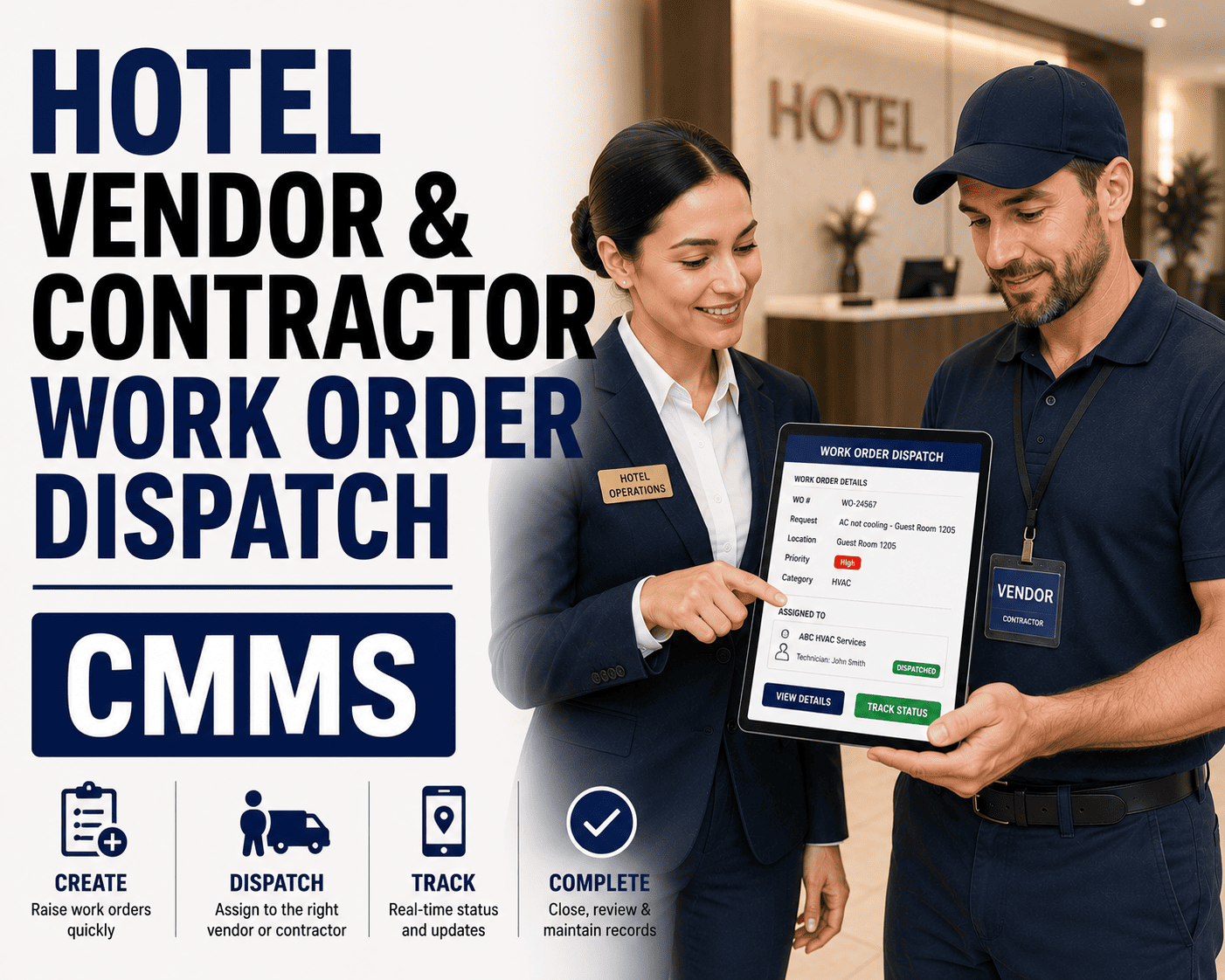
Housekeeping and front office departments operate in high-pressure loops during busy check-in hours. If housekeeping spots a broken PTAC air conditioner, a leaking bathroom sink, or a damaged RFID entry lock, they report it. Historically, this required calling the operator, who manually keyed in a maintenance task. By automating PMS integration, submitting a room defect inside OxMaint instantly flags the room as dirty or "out of order" inside Oracle Opera or Mews. Once the assigned floor technician completes the work order and uploads a verification photograph, the room status automatically flips back to vacant-clean, allowing front-desk agents to check in arriving guests immediately without manual phone delays.
3. Automated Spa Water Chemistry Diagnostics & Compliance Logs
USA municipal health departments mandate pool, jacuzzi, and spa water chlorine and pH parameters to be recorded every 4 hours. Manual logging on clipboard sheets is highly susceptible to human error and data loss. Automation resolves this by streaming pH, free chlorine, and temperature data directly from digital chemical controllers to cloud databases. If the chlorine level slips below 1.5 ppm, the CMMS generates an automated high-priority dispatcher dispatch alert to the designated spa attendant. This prompt action prevents pool closures, keeping guest satisfaction high and meeting local board of health requirements flawlessly. Activate automated pool chlorine checking charts.
4. Guestroom Comfort PTAC Current Draw and Filter Anomalies
Packaged Terminal Air Conditioners (PTAC) are located in almost every hotel guestroom and account for up to 40% of the property's overall energy utility bill. Standard preventive calendars suggest cleaning filters every 90 days. However, high-occupancy rooms build up dust and lint much faster. An automated CMMS tracks runtime data and current draw parameters via smart plugs. If current draw spikes by more than 15% (indicating a clogged filter forcing the fan motor to work harder), the system automatically schedules a filter-sweep work order. This proactive intervention saves substantial utility costs, preserves compressor useful life, and avoids midnight guest complaints about noisy rooms.
5. Commercial Kitchen Exhaust Hood Grease Build-Up Alarms
Hotel kitchens operate commercial exhaust hoods continuously, accumulating thick layers of grease that represent severe fire hazards. NFPA 96 regulations in the USA require deep duct cleaning based on grease volume sweeps. Rather than relying on simple calendar dates, automated CMMS applications utilize thermal camera vision and current-clamp telemetry on fan motor belts. If the fan motor speed drifts or duct heat rises beyond standard operational parameters, the software flags a potential build-up and auto-dispatches an NFPA compliance cleaning sweep. This guarantees robust kitchen safety and prevents costly regulatory fines or emergency kitchen shutdowns.
6. Elevator Shaft Vibration Diagnostics & Safety Compliance
Elevators are one of the most visible and highly regulated assets in high-rise hotels. Traditional vertical passenger transport sweeps occur on strict annual compliance cycles, leaving properties vulnerable to random elevator cable or motor breakdowns. CMMS automation connects directly to accelerometer sensor pods placed on main elevator hoisting motors and elevator car frames. The software tracks lateral vibration patterns and cabinet acceleration forces. The moment vibration drifts indicate a worn bearing, the system auto-schedules an elevator technician service visit. This avoids passenger entrapment incidents and keeps elevator uptimes at a perfect 99.8% rate.
7. BOH Laundry Steam Valve Steam Trap Pressure Drifts
Commercial laundry steam ironers and dryers consume vast volumes of high-pressure boiler steam. A single leaking steam trap can lose up to $4,500 in energy waste annually, while a blocked trap leads to system water hammer and pipe ruptures. CMMS automation monitors differential pressures across input steam lines and steam traps. The moment pressure drops beyond normal tolerances, the system generates an immediate maintenance order, keeping laundry lines functioning at full capacity and protecting municipal clean energy goals.
8. ADA Pool Lift Hydraulic Pressure and Battery Level Tracing
ADA pool lift compliance is a top priority for premium hotels to prevent lawsuits and guarantee accessibility. Lifeguards are tasked with manual daily inspections, but busy schedules lead to skipped logs. Automation handles this by linking the lift's backup battery and hydraulic pressure loops to the central CMMS ledger. If the battery charge drops below 24V or hydraulic loops experience pressure shifts, a high-priority technician sweeps work order is auto-triggered, ensuring complete property compliance and guest safety.
| Health Pillar | What AI Detects | Sensor / Method | Action Triggered |
|---|---|---|---|
| Chiller Temp | Viscosity drop, pump vibration, motor current spikes | LoRaWAN temp probes, accelerometer sensors | Targeted HVAC repair order, technician alert |
| Spa Chemistry | pH and chlorine drift, sensor calibration drifts | Continuous probe nodes, digital test ledgers | Automatic dosing calibration order in spa |
| Steam Loops | Laundry pressure drops, valve micro-leaks, seal fatigue | LoRaWAN pressure sensors, thermal camera bay scan | Targeted valve replacement, emergency block order |
| Room Comfort | PTAC current draw spikes, dirty air coil drifts | Mobile checksheet QR scan, room current clamp | Automated filter replacement task before guest checkin |
| Boiler Loops | Heating element scale crusting, secondary loops drops | Secondary loop temp sensors, diagnostic volt meters | Automated descaling flush cycle schedule trigger |
| ADA Lifts | Actuator fluid shifts, battery voltage drop below 24V | Hydraulic pressure check, battery telemetry node | Monthly lift compliance check, immediate battery dispatch |
This routine monitoring catches dangerous grease buildup anomalies early, preventing devastating BOH kitchen fire closures.
This guarantees consistent, unalterable water sanitization ledgers, keeping spa amenities 100% compliant with local municipal codes.
This ensures continuous diagnostic parameter streams from deep mechanical pits back to your property's cloud CMMS.
This sync locks down dirty guestrooms during rushes, preventing double-bookings and guest disappointment.
This eliminates floor translation hurdles and increases daily platform adoption across all properties.
This is highly valuable for high-value properties, predicting mechanical room wear without requiring daily physical inspections.
A single prevented HVAC compressor failure or hot water boiler leak easily covers the annual platform fee.
This compiles safe, unalterable regulatory trace logs to satisfy municipal health inspectors and mitigate legal liabilities.