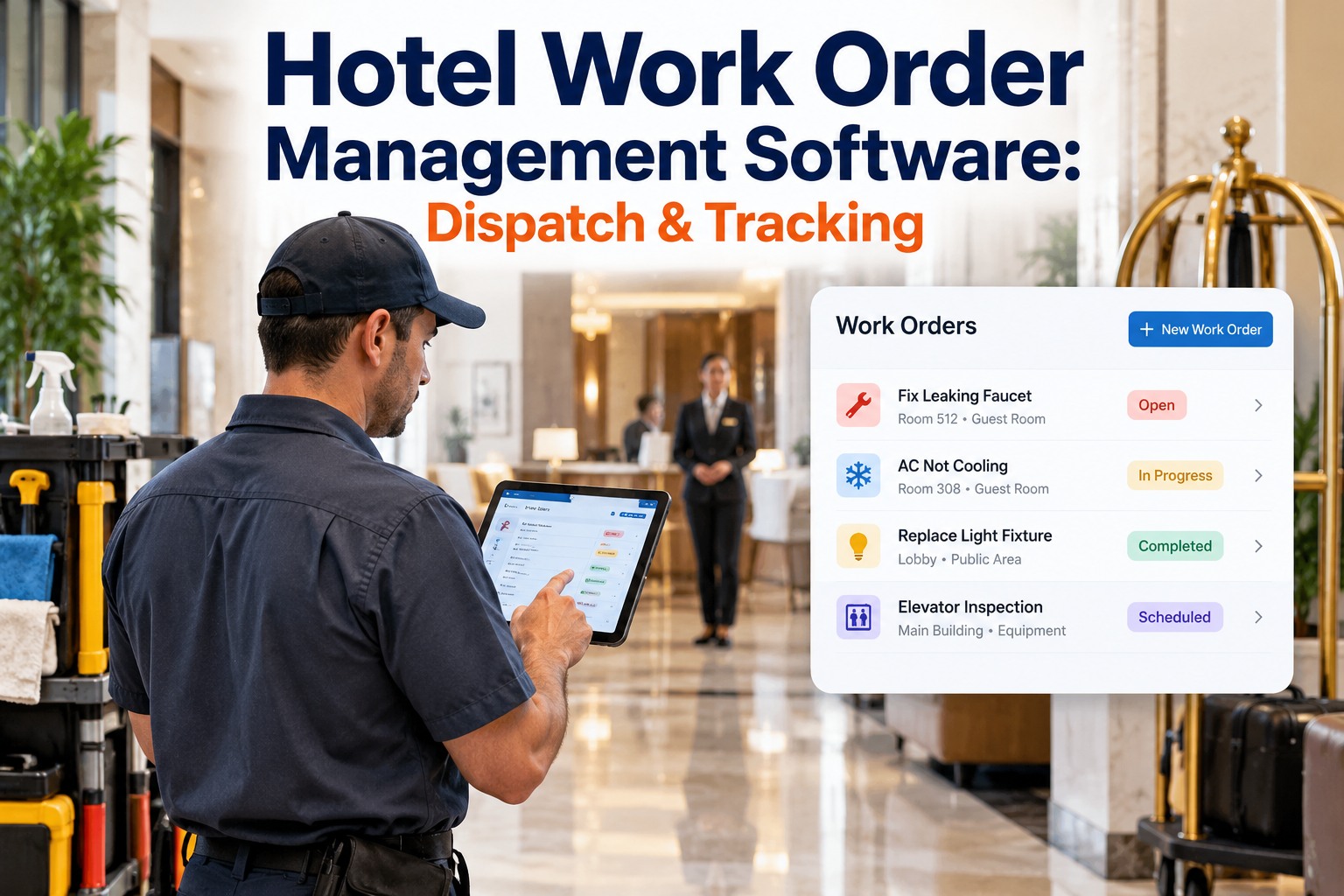
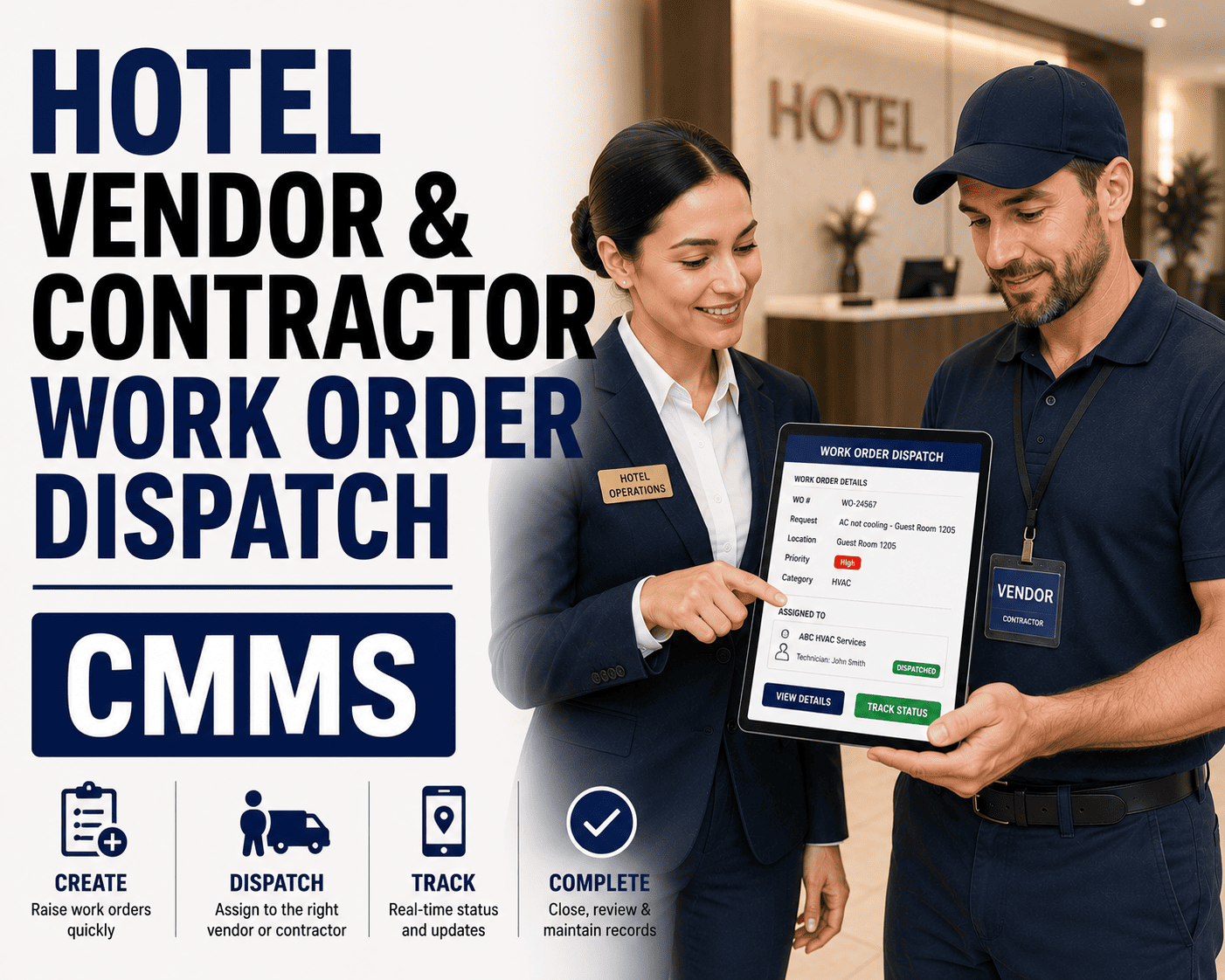
Hotel engineering teams spend hours every week writing the same work orders — HVAC filter change, elevator monthly inspection, boiler pressure check. Generative AI changes that completely. When a sensor alert fires or a guest complaint lands, AI reads the signal, identifies the asset, writes the work order description, attaches the relevant procedure, assigns the right technician, and schedules it around occupancy — in seconds, without anyone touching a keyboard. This is not a future concept. It is how forward-thinking hotel operators are reclaiming engineering hours and eliminating the response delays that turn small issues into expensive failures.
AI-Generated Work Orders. Zero Manual Entry.
OxMaint's generative AI engine converts sensor alerts, guest requests, and inspection findings into complete, structured work orders — automatically. Your engineers spend time fixing problems, not writing about them.
What Generative AI Actually Does in Hotel Maintenance
The term "AI" gets applied loosely across hotel tech. In the context of maintenance, generative AI specifically refers to models that produce structured, natural-language outputs — work order descriptions, technician instructions, fault diagnoses, and parts lists — from raw input data like sensor readings, alarm codes, or a brief voice note from a guest. The result is a complete, actionable work order that a technician can execute immediately, not a partial alert that someone still has to interpret and type up. Sign up free to see how OxMaint's AI engine handles this end-to-end for your property.
The Problem Generative AI Solves for Hotel Engineering Teams
A hotel engineering team managing 200 assets across multiple floors generates dozens of maintenance events every week. Each one, under a traditional CMMS workflow, requires a staff member to open the system, select the asset, write a description, attach a procedure, choose a technician, and schedule the job. Multiply that by shift changes, overnight faults, and guest-reported issues, and it becomes clear why 62% of hotel PM programs still rely on paper or spreadsheets — the data entry burden of traditional systems exceeds what lean teams can sustain. Generative AI eliminates that burden entirely. Book a demo to see the time saved at your property.
- Engineer receives sensor alert on phone
- Opens CMMS, searches for the asset manually
- Writes work order description from memory
- Checks technician availability separately
- Schedules around occupancy by checking PMS
- Average time to work order creation: 12-18 minutes
- Sensor alert fires and AI reads the signal
- Asset identified automatically from device ID
- Work order written with full procedure and parts
- Available technician selected by skill and location
- Scheduled around occupancy data automatically
- Average time to work order creation: under 30 seconds
Five Ways OxMaint's AI Engine Automates Hotel Work Orders
Sensor-to-Work-Order in Seconds
When a vibration sensor on a chiller exceeds its baseline threshold, OxMaint's AI does not just send an alert. It reads the sensor pattern, identifies the likely fault mode, writes a complete work order description including the specific component and recommended action, and assigns it to the technician with the relevant refrigeration certification — before anyone has picked up the phone.
Natural Language Fault Entry
A technician walking a floor can speak or type a brief note — "AC in 412 making noise, smells burnt" — and AI expands that into a structured work order with asset lookup, fault classification, suggested diagnostic steps, and parts to bring. No CMMS navigation required. The data capture happens in the field, where the problem is, not at a desk thirty minutes later.
Occupancy-Aware Scheduling
AI checks live occupancy data from your PMS before scheduling any work order. Non-urgent repairs in occupied rooms are automatically queued for check-out windows. HVAC shutdowns are placed in low-occupancy periods. Guest experience is protected without the scheduling manager having to cross-reference two systems manually for every job.
Predictive Work Orders Before Failure
OxMaint's AI models learn each asset's healthy operating baseline within 2 to 4 weeks of deployment. Once trained, they detect degradation patterns 4 to 8 weeks before guest-impacting failure — and generate a planned work order during that window. Technicians arrive with the diagnosis already done, the right parts staged, and the repair scheduled in a planned downtime slot.
Compliance Work Orders Auto-Generated
Fire suppression inspections, elevator monthly checks, boiler annual certifications — AI generates these work orders automatically on the correct schedule, attaches the relevant checklist, and routes them with digital sign-off requirements. When the inspector arrives, every record is already structured and timestamped. Audit preparation drops from days to minutes.
Performance Impact: What AI-Driven Work Order Automation Delivers
Which Hotel Assets Benefit Most from AI Work Order Automation
AI-generated work orders deliver the highest impact on assets that are high-frequency, high-consequence, or heavily regulated. Here is where automation changes the operating model most dramatically.
| Asset Category | AI Detection Signal | Auto Work Order Outcome |
|---|---|---|
| HVAC and Chillers | Temperature drift, vibration spike, refrigerant pressure anomaly | Planned inspection with diagnostic steps and parts staged before failure |
| Elevators and Escalators | Door cycle anomaly, drive motor current deviation, bearing wear pattern | Compliance-ready inspection work order with digital sign-off routing |
| Commercial Kitchen Equipment | Cooler temperature excursion, dishwasher cycle anomaly, exhaust flow drop | Priority work order with food safety flag and F&B manager notification |
| Boilers and Pressure Vessels | Pressure fluctuation outside operating range, temperature variance | Urgent work order with lockout/tagout procedure and certification check |
| Pool and Spa Systems | Chemical dosing deviation, circulation pump flow drop, filtration anomaly | Health authority-compliant corrective work order with water quality log update |
| Fire and Life Safety | Panel communication fault, suppression system pressure drop, egress light failure | Immediate priority work order with compliance documentation auto-attached |
From First Alert to Closed Work Order — The Full AI Workflow
Alert Received From Any Source
IoT sensor, BMS alarm code, guest complaint via front desk, or a technician's voice note on the floor. OxMaint accepts all input types and routes them into the AI engine without requiring manual classification first.
AI Reads, Classifies, and Writes
The AI engine identifies the asset from device ID or location tag, classifies the fault type against historical patterns, writes a complete work order description in plain English, attaches the relevant standard procedure, and generates a parts list based on the diagnosed fault.
Technician Selected and Scheduled
AI checks current technician workload, certifications relevant to the fault, and physical location on the property. It cross-references occupancy data from the PMS to schedule the repair in an appropriate window — occupied rooms go to the next check-out, critical systems get immediate dispatch.
Technician Completes on Mobile
The technician receives the work order on their mobile device with the full procedure, parts requirement, and safety notes already populated. They complete the job, attach a photo, record any findings, and close the work order — all from the asset location, with offline capability for basement and plant room access.
Compliance Record Created Automatically
Closure triggers automatic documentation — technician sign-off, timestamp, photo evidence, and any corrective action notes are stored against the asset record. The work order becomes part of the audit trail for regulatory inspections, capital planning, and MTBF analysis — without any additional filing step.
Frequently Asked Questions
How does generative AI create hotel maintenance work orders automatically?
Generative AI reads incoming signals — sensor alerts, BMS alarm codes, guest complaints, or technician voice notes — and produces a complete, structured work order in natural language. This includes asset identification, fault description, recommended procedure, parts list, and technician assignment. The entire process takes under 30 seconds and requires no manual data entry. Sign up free to see OxMaint's AI engine do this live at your property.
Does the AI need weeks of training before it can generate useful work orders?
No. Physics-based fault detection — identifying temperature anomalies, vibration spikes, and pressure deviations — begins immediately upon sensor connection. The predictive failure forecasting layer, which learns each asset's specific baseline, reaches full accuracy within 2 to 4 weeks. Basic AI work order generation is available from day one.
Can the AI schedule work orders around hotel occupancy automatically?
Yes. OxMaint integrates with Property Management Systems to access live occupancy data. AI uses this data when scheduling generated work orders — non-urgent in-room repairs are queued for check-out windows, HVAC interventions are placed in low-occupancy periods, and critical faults bypass scheduling and dispatch immediately regardless of occupancy.
What if the AI generates an incorrect work order?
All AI-generated work orders are reviewable by the engineering manager before dispatch if required. Teams can configure approval thresholds — routine PM work orders dispatch automatically while high-cost or safety-critical jobs route through a quick human review. The system learns from corrections over time, improving accuracy with each interaction.
How quickly do hotels see results from AI work order automation?
Most hotel engineering teams see measurable reductions in admin time and response delays within the first 30 days. Predictive maintenance value — avoiding failures before they occur — becomes visible at 60 to 90 days as the AI models accumulate asset baseline data. Full program ROI, including avoided failure costs and recovered room revenue, typically arrives within 60 to 90 days of full deployment. Book a demo to map this timeline to your specific property.
Let AI Handle the Work Orders. Let Your Engineers Handle the Work.
OxMaint's generative AI engine turns sensor alerts into complete, assigned, scheduled work orders automatically — protecting guest experience, reducing admin burden, and catching failures before they happen. Start your free trial or book a 30-minute demo to see it running at your property.