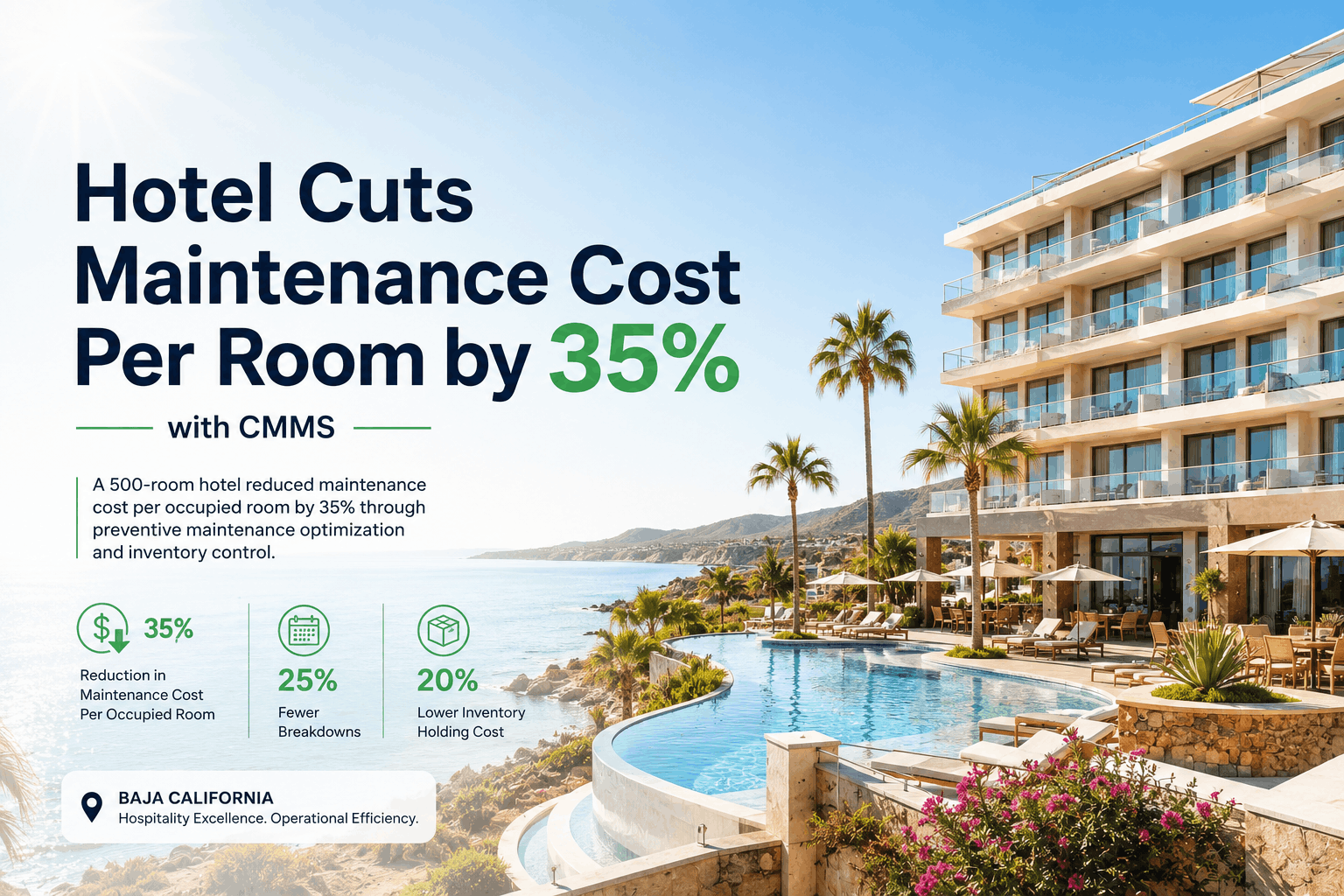
Hotel maintenance budgets are the most misunderstood line item in hotel operations finance. Most general managers can tell you their room rate to the cent and their RevPAR variance to three decimal places. Ask the same GM what their cost per work order is, what percentage of their maintenance spend is reactive versus preventive, or what a single unplanned HVAC failure costs when it falls on a Saturday night in peak season — and the answer is usually silence. This reference guide gives hotel engineering directors, GMs, and ownership groups a structured framework for calculating the real ROI of a CMMS investment — with pre-calculated benchmarks for properties from 60 to 600 rooms so you can estimate your own savings position before you ever speak to a vendor. Sign up free to run a live calculation on your own property data, or book a demo and we will model your ROI in the call.
OxMaint Hotel Maintenance ROI
Get Your Property-Specific Savings Estimate — Free
Bring your room count and maintenance budget. In 30 minutes we will model your exact reactive-to-preventive shift, payback period, and 5-year net ROI — no obligation, no pressure.
What Hotels Actually Spend on Maintenance: The Cost Breakdown
Before you can calculate ROI, you need a realistic baseline. The figures below are drawn from industry benchmarking data across full-service, select-service, and boutique hotel segments. Your property's actual numbers will vary — but most hotel operators are surprised to find their reactive maintenance share is significantly higher than they estimated.
Reactive Emergency Repairs
$110,200
Planned Preventive Maintenance
$63,800
Vendor and Contractor Callouts
$52,200
Parts and Consumables
$40,600
Guest Complaint Compensation
$23,200
High reduction potential with CMMS
Moderate reduction potential
Limited reduction potential
The Core Insight
The 38% reactive repair share is the primary target. CMMS-driven preventive maintenance programmes reduce this to 18–22% in 12 months — shifting the same budget from expensive reactive responses to lower-cost scheduled interventions. The same maintenance outcome costs 3.1x less when it is planned.
ROI Calculator: Estimated Savings by Property Size
The table below shows pre-calculated ROI estimates across five property tiers. These use conservative industry averages — most OxMaint deployments exceed these figures by 15 to 25%. Use your own room count and current maintenance spend to find the closest tier, then adjust proportionally. Sign up free to input your exact figures and get a property-specific projection.
Boutique / Small
60 – 100 Rooms
Est. Annual Maint. Spend$87K – $145K
Reactive Share (before)~38%
Reactive Share (after)~20%
Estimated Annual Saving$16K – $28K
OxMaint Annual Licence~$6,400
Payback: 6 – 9 months
Select Service
100 – 200 Rooms
Est. Annual Maint. Spend$145K – $290K
Reactive Share (before)~40%
Reactive Share (after)~21%
Estimated Annual Saving$28K – $58K
OxMaint Annual Licence~$9,600
Payback: 6 – 10 months
Most Common
Full Service
200 – 350 Rooms
Est. Annual Maint. Spend$290K – $510K
Reactive Share (before)~42%
Reactive Share (after)~20%
Estimated Annual Saving$64K – $112K
OxMaint Annual Licence~$14,400
Payback: 8 – 14 months
Upper Upscale
350 – 500 Rooms
Est. Annual Maint. Spend$510K – $725K
Reactive Share (before)~44%
Reactive Share (after)~19%
Estimated Annual Saving$128K – $182K
OxMaint Annual Licence~$19,200
Payback: 7 – 11 months
Luxury / Resort
500+ Rooms
Est. Annual Maint. Spend$725K – $2.1M+
Reactive Share (before)~46%
Reactive Share (after)~18%
Estimated Annual Saving$203K – $588K
OxMaint Annual Licence~$28,800+
Estimated ROI
7.0 – 20.4x
Payback: 4 – 10 months
Get Your Property-Specific ROI Calculation
The estimates above use industry averages. Your actual ROI depends on your current reactive maintenance share, vendor contract structure, and guest complaint volume. We model this precisely for each property in a 30-minute demo.
The 5 Factors That Determine Your Hotel's CMMS ROI
01
Your Current Reactive-to-Preventive Ratio
The single biggest driver. Hotels running above 40% reactive spend have the most to gain — every percentage point shifted to planned maintenance saves approximately 2.1x its cost value. Hotels already at 25% reactive or below see lower but still material ROI from work order efficiency and asset life extension.
Industry average
38–46% reactive
02
Vendor and Contractor Callout Frequency
Each unplanned vendor callout carries a mobilisation cost of $180 to $650 depending on trade, location, and time of day. Hotels with lean in-house engineering teams who rely heavily on external contractors for reactive work see the fastest CMMS ROI — because predictive maintenance eliminates the reactive callout trigger, not just the repair cost.
Average callout cost
$180 – $650 each
03
Guest Complaint Volume and Compensation Cost
Industry data puts the average cost of resolving a maintenance-related guest complaint at $140 to $220 — including staff time, room compensation, OTA rating impact, and repeat booking loss. Hotels with more than 150 maintenance complaints per month per 200 rooms are carrying a hidden cost that does not appear on the maintenance budget line but is directly preventable.
Cost per complaint resolved
$140 – $220
04
Asset Replacement Cycle Acceleration
HVAC units maintained preventively last 15 to 18 years. The same unit maintained reactively — serviced only when it malfunctions — typically needs replacement at 9 to 11 years. For a 200-room hotel with 180 HVAC units averaging $3,200 replacement cost, the difference in asset replacement schedule is worth $126,000 to $198,000 over a 15-year ownership horizon.
Asset life extension value
6 – 9 additional years per unit
05
Engineering Team Labour Efficiency
Studies across hospitality maintenance teams show that technicians in reactive-only environments spend 34% of their time on activities that are not direct maintenance — verbal briefings, writing paper work orders, travelling to locate parts, and chasing status updates. Automated work order routing and mobile dispatch reclaim this time without adding headcount, increasing effective maintenance output by 28 to 40% on the same team size.
Time recovered per technician
~2.7 hours per shift
ROI Payback Timeline: How the Savings Accumulate
ROI from a hotel CMMS does not arrive as a single event — it accumulates across multiple savings streams simultaneously. The visual below shows how a typical 300-room full-service hotel sees its investment recover over 12 months.
Month 1–2
Work order automation active. Response time down 60%. First vendor overspend disputes raised. Savings: ~$9K
Month 3–4
PM schedules live. First HVAC anomalies flagged. Guest complaint volume begins falling. Cumulative: ~$22K
Month 5–6
Reactive share falling below 30%. Parts spend optimised. OTA rating movement visible. Cumulative: ~$38K
Month 7–8
Break-even reached. Full deployment cost recovered. All future savings are net positive ROI. Cumulative: ~$54K
Month 9–10
Predictive asset alerts preventing first major equipment failures. Energy savings layer activating. Cumulative: ~$72K
Month 11–12
Full annual savings confirmed. Reactive share at 20–22%. Asset life metrics tracked. Year 1 Total: ~$96K saved
How to Calculate Your Own Hotel Maintenance ROI
ROI Benchmarks by Hotel Type
| Hotel Type |
Typical Reactive % |
Expected Saving (Yr 1) |
Avg Payback |
5-Year Net ROI |
| Boutique (60–120 rooms) |
36–42% |
$16K – $40K |
6–9 months |
$62K – $156K |
| Select-Service (100–200 rooms) |
38–44% |
$28K – $70K |
7–11 months |
$109K – $272K |
| Full-Service (200–350 rooms) |
40–46% |
$64K – $130K |
8–14 months |
$249K – $506K |
| Upper Upscale (350–500 rooms) |
42–48% |
$128K – $210K |
7–11 months |
$498K – $817K |
| Luxury Resort (500+ rooms) |
44–50% |
$203K – $600K+ |
4–8 months |
$790K – $2.34M+ |
| Multi-Property Group (5–20 properties) |
42–48% |
$320K – $1.4M |
5–9 months |
$1.25M – $5.45M |
5-year net ROI calculated as (Annual Saving × 5) minus total 5-year CMMS cost (year 1 deployment + 4 years licence). Figures are conservative estimates based on documented OxMaint hospitality deployments. Individual results vary based on baseline reactive maintenance percentage, property complexity, and deployment quality.
Frequently Asked Questions
Questions Hotel Operators Ask Before Committing to a CMMS Investment
QOur maintenance budget is already tight. How do we justify adding a new software cost?
The most effective framing for CMMS investment approval is not "we are adding a new cost" — it is "we are converting an uncontrolled expense into a managed one." In a hotel running 40% reactive maintenance, the CMMS does not add cost; it eliminates a cost premium you are already paying. For a 200-room property spending $290,000 on maintenance, $110,200 is going to reactive repairs. A CMMS at $14,400 per year that reduces that by 50% returns $55,100 in net savings — a 3.8x return. The approval case is not a technology budget request; it is a cost reduction proposal.
Book a demo and we will prepare a one-page ROI summary you can present to ownership or asset management.
QHow quickly does ROI start appearing after deployment — do we see savings in month one?
Some savings appear in the first 30 days — specifically the work order automation and vendor invoice matching functions. Hotels that have previously managed maintenance through phone calls and paper forms typically see a 40 to 60% reduction in response time immediately, which directly reduces the labour premium on reactive work. The larger savings — reduced emergency callout volume, lower parts spend from predictive ordering, and guest complaint reduction — build over months 2 to 6 as the PM programme matures and the asset data accumulates. Full ROI payback for most full-service properties falls in the 8 to 14 month range.
Sign up free to see the onboarding timeline for your property size.
QIs the ROI different for franchise hotels versus independent properties?
Franchise properties typically have an additional ROI layer that independent hotels do not: brand standard audit compliance. Franchise agreements often carry financial penalties for failed brand audits — and maintenance documentation is one of the most common audit failure points. A CMMS that produces timestamped, photo-evidenced PM completion records eliminates this risk and can protect several thousand dollars per property per year in potential penalty exposure. Independent boutique hotels see proportionally higher ROI on the guest satisfaction and OTA rating side — because without a brand buffer, a single maintenance-driven 1-star review has a more direct impact on their booking rate. Both property types see comparable maintenance cost ROI; the source of the savings is slightly different.
QWhat data do I need to have ready to get an accurate ROI estimate?
The five most useful data points for an accurate property-specific ROI calculation are: total maintenance spend in the last 12 months (labour, parts, vendor invoices combined); number of emergency or reactive work orders in the last 12 months; number of maintenance-related guest complaints in the last 12 months; number of HVAC and major mechanical assets (units, lifts, pool systems, boilers); and current preventive maintenance schedule — or an honest estimate of how many scheduled PM tasks are completed on time versus deferred. If you have all five, we can model your ROI precisely. If you only have your room count and a rough annual maintenance budget, the calculator tiers above will give you a working estimate.
Book a demo — bring whatever data you have and we will work from there.
QDo the ROI estimates above include the cost of staff time to learn and use the new system?
The ROI figures in this guide are net of a conservative training and adoption period. We model a 60-day ramp period during which the system is being adopted and savings are partial — typically 30 to 40% of full run-rate savings during months 1 and 2. The OxMaint mobile app is designed for frontline maintenance staff with minimal smartphone experience — most engineering teams reach operational proficiency within 3 to 5 days of structured on-site training. The deployment cost figures in the calculator tiers above include onboarding, asset setup, and training for up to 20 staff members per property. For properties with high seasonal staff turnover, OxMaint's built-in guided tutorial means new starters can be onboarded without requiring a dedicated training session.
Sign up free and try the onboarding flow yourself — it takes under 10 minutes to set up a sample property.
OxMaint Hotel Maintenance ROI
Stop Estimating. Calculate Your Exact Hotel Maintenance ROI.
Bring your maintenance budget, room count, and current reactive work order volume to a 30-minute demo. We will model your property-specific savings projection, payback period, and 5-year net ROI — at no cost and no obligation.