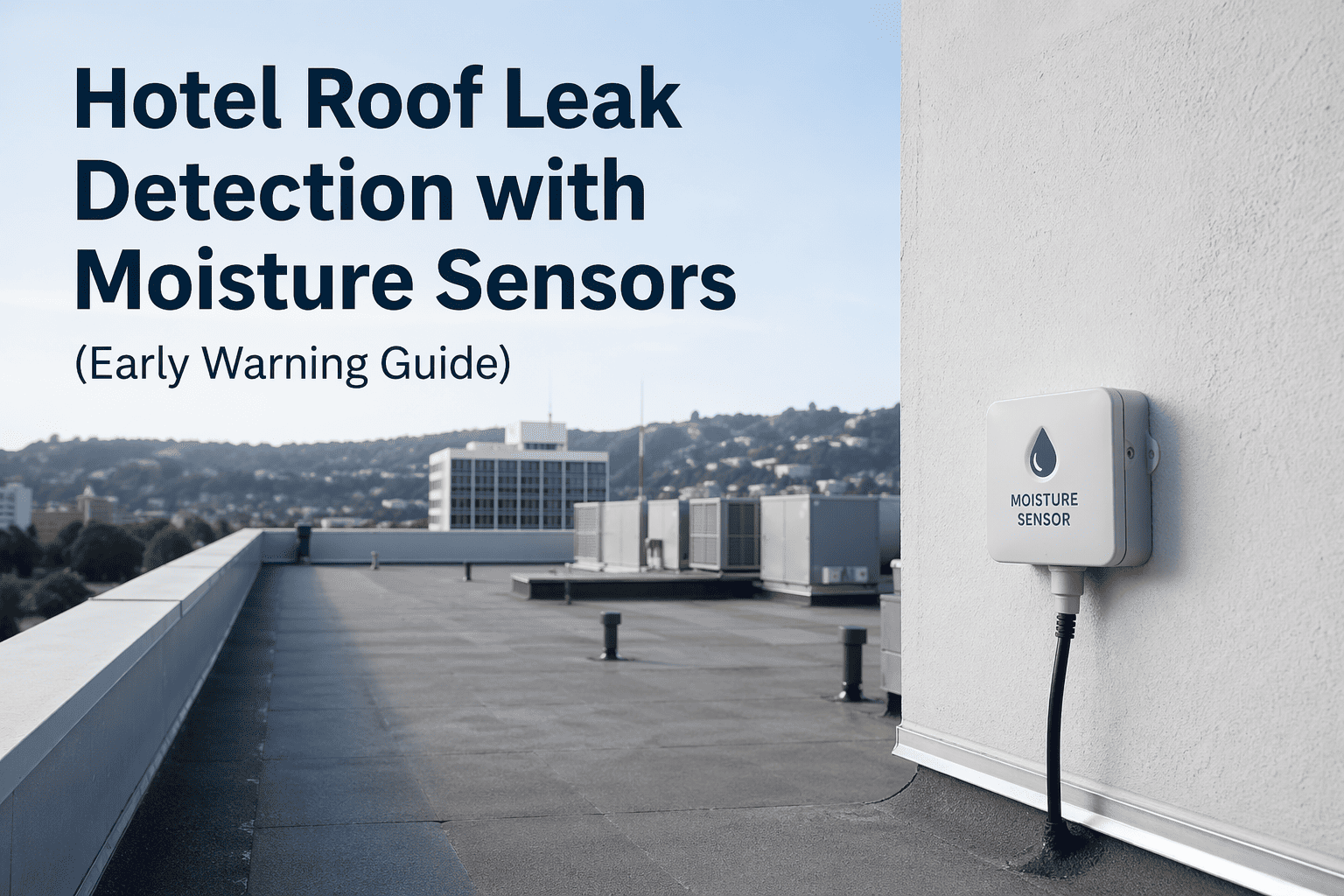
Advanced Roof and Building Envelope Maintenance with Smart Sensors for Hotels
By Mark Strong on April 9, 2026
A hotel roof failure rarely announces itself. By the time a leak reaches a guest room ceiling, moisture has already been spreading through insulation, structural decking, and interior finishes for weeks — sometimes months. The average commercial roof water intrusion claim costs $39,000 in repairs and business interruption. Yet most hotel facility teams still inspect roofs on a calendar schedule with no real-time awareness of what is happening between visits. Smart sensors integrated with a CMMS change that entirely. Book a demo to see how Oxmaint integrates building envelope sensors into hotel maintenance workflows.
What Building Envelope Failures Actually Cost Hotels
$39K
Average cost of a commercial roof water intrusion claim including repairs and disruption
78%
Of roof failures show measurable moisture signals 30 to 90 days before visible damage appears
6x
Higher repair cost when envelope failures are addressed reactively vs. detected early
14 days
Typical sensor-to-CMMS integration deployment timeline with no hardware replacement
Quick Answer
Hotel roof and building envelope maintenance with smart sensors means moisture detectors, thermal sensors, and structural monitors feeding real-time data into a CMMS — so facility managers receive automated work order alerts when conditions indicate risk, weeks before a visible failure reaches a guest space. This replaces reactive leak response with predictive envelope management.
The Three Ways Hotel Envelopes Fail Without Sensors
01
Silent Moisture Migration
Water enters through membrane seams, flashing joints, or penetrations and spreads laterally through insulation layers. No surface evidence appears until saturation reaches the structural deck or interior ceiling — by which point mould, rot, and structural compromise are already underway.
02
Thermal Bridging and Energy Loss
Gaps in insulation continuity and failed vapour barriers create thermal bridges that inflate HVAC load without triggering any alarm. Facility teams discover the problem when energy bills spike — not when the envelope integrity is compromised.
03
Calendar-Only Inspection Gaps
Twice-yearly roof inspections miss failures that develop in the weeks between visits. Seasonal temperature swings, storm events, and HVAC condensate discharge can all trigger rapid envelope degradation that a calendar schedule simply cannot catch.
Water ingress at entry points before lateral migration begins. Alerts trigger within hours of membrane breach — not weeks later when it reaches interior surfaces.
Thermal Imaging Sensors
Roof surface, exterior facade, window and door perimeters, expansion joints
Detects
Insulation gaps, thermal bridges, and areas of wet insulation showing anomalous heat retention. Identifies failure zones before moisture reaches structural elements.
Micro-movements, settlement, and differential expansion that indicate failing anchors, cracked substrates, or compromised structural connections — before deformation becomes visible or unsafe.
Environmental Sensors
Roof drainage points, mechanical rooms, attic and plenum spaces
Detects
Humidity levels, ponding water conditions, and temperature differentials that signal drainage failure, condensation risk, or ventilation breakdown before they become visible maintenance issues.
How Sensor Data Flows Into Oxmaint CMMS
1
Sensor Threshold Configured in Oxmaint
Moisture percentage, temperature delta, or movement threshold set per sensor location. Oxmaint monitors continuously — no manual data review required by facility staff.
2
Threshold Breach Triggers Automatic Work Order
When a sensor reading exceeds its threshold, Oxmaint instantly creates a work order with the sensor location, reading value, timestamp, and asset ID pre-populated. No manual data entry, no alert acknowledgement required.
3
Technician Dispatched via Mobile App
The assigned technician receives the work order on the Oxmaint mobile app with GPS check-in and photo evidence requirements. Inspection findings logged against the sensor location with structured data fields.
4
Permanent Record with Trend History
Every sensor alert and technician response is permanently logged against the asset. Trend data shows whether moisture levels are increasing, stable, or resolved — supporting capital repair decisions with documented condition evidence.
Connect Your Building Envelope to Real-Time Maintenance Workflows
Oxmaint integrates moisture, thermal, and structural sensors into automated work order routing — so your team responds to envelope conditions hours after detection, not weeks after visible damage.
Oxmaint integrates with building envelope sensors via OPC-UA, MQTT, and REST API — compatible with most commercial IoT sensor platforms and building management systems. Wireless LoRaWAN and cellular sensor networks are supported alongside hardwired BMS connections. No replacement of existing sensor infrastructure is required.
Thresholds are set per sensor location in the Oxmaint platform — a moisture sensor above a ballroom ceiling may have a lower threshold than one above an unoccupied plant room. Oxmaint's onboarding team provides recommended starting thresholds by sensor type and location, with the ability to refine them based on seasonal baselines after the first 30 days of operation.
Yes. Oxmaint exports sensor alert history, technician response records, and condition trend reports per building zone. These packages are used for insurance underwriter submissions, building condition assessments, and capital repair justification — providing the timestamped evidence base that verbal assessments and calendar inspection logs cannot produce.
No. Hotels without existing sensors typically begin with Oxmaint's structured PM and inspection workflows, then layer in sensor integration as monitoring infrastructure is added. For hotels adding sensors for the first time, Oxmaint works with sensor vendors to define a phased installation starting with highest-risk envelope zones — flat roof drains, HVAC penetrations, and parapet walls.
Stop Discovering Roof Failures in Guest Room Ceilings
Oxmaint connects building envelope sensors to automated work order workflows — so moisture, thermal, and structural alerts become maintenance actions in hours, not weeks. Live in 14 days.