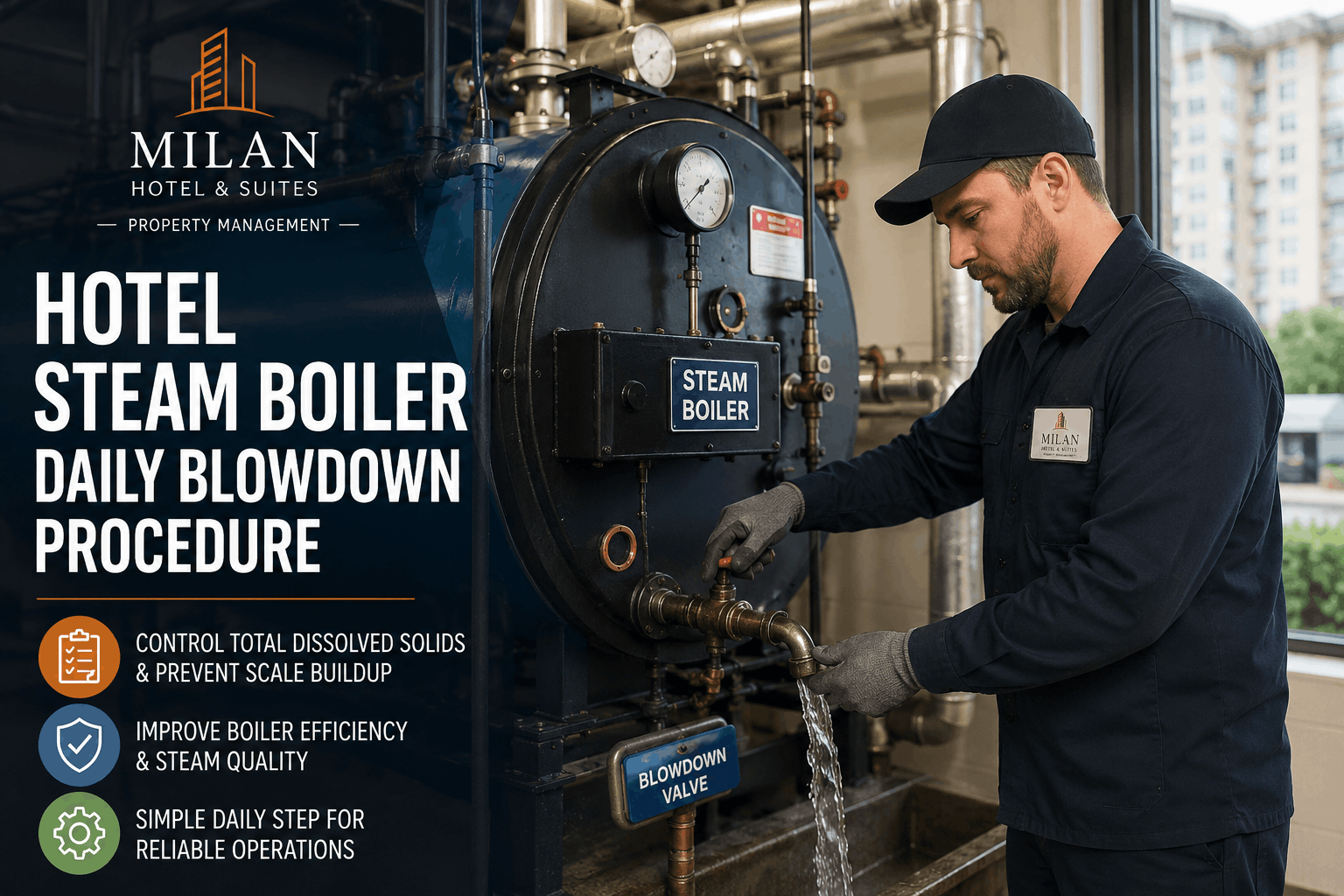
Steam boilers in hotel facilities operate continuously to supply heat, hot water, and steam for kitchen equipment and laundry systems. Without proper blowdown procedures, your boiler accumulates total dissolved solids (TDS) that reduce heat transfer efficiency, create scale buildup on internal surfaces, and eventually damage equipment worth tens of thousands of dollars. Hotel engineering teams that implement structured daily blowdown logs with Oxmaint CMMS reduce emergency boiler repairs by 40-60% and extend equipment life by 5-10 years while maintaining steam quality and compliance with ASME boiler safety standards.
Why Daily Blowdown Quality Controls Boiler Efficiency, Steam Quality, and Equipment Life in Hotels
Hotel steam boilers generate pressurized steam by evaporating feedwater—the same water supplies from municipal mains that contain dissolved minerals, salts, and impurities. As water evaporates into steam, these impurities remain behind and concentrate in the boiler water. Without controlled blowdown, TDS levels climb unchecked, creating scale deposits on heat exchanger tubes that insulate the metal and block heat transfer. Scale buildup forces boilers to work harder to reach setpoint pressure, consuming more fuel and reducing thermal efficiency. Worse, concentrated solids foam inside the boiler drum, carrying liquid carryover into the steam lines where it slugs turbines, fouls heat exchangers, and triggers emergency shutdowns during peak heating demand—exactly when hotels cannot afford downtime. Hotels practicing structured daily blowdown reduce TDS levels within recommended ranges (typically 1,500-3,500 ppm depending on boiler type), maintain steam purity, and avoid the 2-5x cost premium of emergency boiler repairs compared to scheduled maintenance.
Understanding Total Dissolved Solids (TDS) and Boiler Water Quality Standards
Total Dissolved Solids (TDS) measures the concentration of minerals, salts, and chemical compounds dissolved in boiler water—expressed in parts per million (ppm). The recommended maximum TDS level depends on boiler type and design pressure, but typical hotel steam boilers operate safely within 1,500-3,500 ppm. Above 3,500 ppm, foaming begins and steam carryover increases, degrading steam quality. Continuous blowdown targets the surface layer where dissolved solids accumulate, while intermittent bottom blowdown removes sediment and sludge. Manual blowdown procedures, when performed daily with conductivity measurement, form the foundation of preventive boiler management. Hotels that skip blowdown for even 2-3 days allow TDS to creep above safe limits, and within a week accumulation reaches levels that require emergency corrective blowdown or worst case, boiler shutdown for descaling.
Above 3,500 ppm, boiler water foams and carries over into steam lines causing carryover damage, pipe corrosion, and downstream equipment slugging. Conductivity measurement (which correlates to TDS) is the fastest field indicator of water quality drift.
Each 1/8-inch of scale reduces heat transfer by 50-80%, forcing boilers to overfire and consume 15-25% more fuel. Scale also creates hot spots that lead to tube failure and dangerous pressure spikes.
Many hotels blowdown only when problems appear (reactive) instead of on a fixed schedule (preventive). Daily or twice-daily blowdown intervals maintain TDS consistently, while skipping days allows rapid accumulation that requires larger emergency blowdowns.
Hard water with high mineral content (calcium, magnesium, silica) concentrates faster. Hotels on hard water supplies need more aggressive blowdown schedules and chemical water treatment programs to prevent TDS exceedances.
Manual conductivity meters require calibration and technique training. Meters read temperature-dependent and require cooled samples for accuracy. Operators without training often misinterpret readings and over/under-blowdown, wasting water or allowing TDS to climb.
Boiler compounds and chelating agents only work if dosed correctly. Insufficient treatment fails to sequester hardness, while overdosing increases TDS itself. Blowdown logs must track chemical dosing alongside TDS to diagnose treatment effectiveness.
Daily Blowdown Procedures: Manual Bottom Blowdown, Continuous Surface Blowdown, and Conductivity Testing
Effective boiler blowdown uses two complementary methods: intermittent bottom blowdown removes accumulated sludge and suspended solids from the boiler mud drum (typically 2-5 minutes per event), while continuous surface blowdown uses a calibrated valve to discharge a small, steady flow from the top of the boiler where dissolved solids concentrate. Hotels that combine both approaches with daily conductivity testing capture the full benefit of TDS control. The procedure is straightforward but discipline is essential—skipping a single day's log breaks the data chain that predicts when TDS will exceed limits.
| Blowdown Method | Purpose & Target | Procedure & Duration | Frequency | Key Metrics to Log |
|---|---|---|---|---|
| Bottom (Mud) Blowdown | Remove settled sludge, rust, and sediment from boiler mud drum bottom | Open bottom blowdown valve for 2-5 seconds until water runs clear; close firmly. Water is hot and pressurized—direct away from personnel. | Twice Daily (start & end of shift) | Blowdown duration (seconds), water clarity, boiler pressure before/after, sludge discharge observation |
| Continuous Surface Blowdown | Maintain dissolved solids within 1,500-3,500 ppm by removing top-layer water where TDS accumulates | Calibrated valve opens continuously at fixed rate (typically 0.5-2 gpm depending on boiler size). Fresh feedwater replaces it at same rate, maintaining water level and TDS dilution. | Continuous (24/7 operation) with manual flow rate confirmation per shift | Flow rate (gpm), blowdown tank temperature, back-pressure on blowdown line, boiler water level stability |
| Conductivity Testing | Measure boiler water electrical conductivity, which correlates directly to TDS concentration; compare to target range | Cool sample to room temperature using cooler or wait for natural cooling. Place sample in conductivity meter. Record reading in micromhos or millisiemens per cm. Convert to estimated ppm using meter calibration or reference table. | Daily (at least once per shift at consistent time). More frequent testing (3x daily) during peak seasons or high feedwater hardness. | Conductivity reading (µmho/cm), estimated TDS (ppm), water temperature at measurement, sample collection time, meter calibration status |
| Feedwater Quality Check | Detect incoming water hardness changes that increase TDS accumulation rate; trigger increased blowdown if needed | Collect sample from feedwater line upstream of boiler. Test for alkalinity, hardness, and silica using kit or lab analysis (typically done weekly or monthly). | Weekly (minimum). Monthly lab testing recommended during seasonal transitions. | Alkalinity (ppm CaCO3), hardness (ppm), silica concentration, water source/treatment changes, lab report date |
| Chemical Dosing Verification | Confirm that boiler compounds and chelating agents are dosed at correct rate and effective in sequestering hardness | Record chemical type, dose amount, date/time added, and pump setting if using automatic dosing. Cross-reference with conductivity trend to verify treatment is working (TDS should stabilize or trend down post-dose). | Per boiler compound manufacturer schedule (typically daily or every other day) | Chemical type and quantity, dosing time, boiler pressure at time of dose, conductivity trend post-dose, pump/valve status |
| Blowdown Tank Temperature | Ensure safe discharge of hot blowdown water and verify heat recovery system (if present) is operating | Read temperature gauge on blowdown tank or discharge line using infrared thermometer. Safe discharge temperature below 50°C (122°F) after cooling. | Per shift when continuous blowdown is active | Tank temperature, cooling flow rate, safety relief valve status, environmental compliance (no discharge of water above facility limits) |
Building a High-Quality Daily Blowdown Program: Implementation Steps and Success Factors
Hotels that achieve consistent boiler efficiency and avoid emergency repairs use structured daily blowdown programs integrated into their CMMS platforms. Oxmaint automates blowdown scheduling, logs conductivity readings with timestamp and operator attribution, and alerts engineering teams when TDS trends exceed safe limits—eliminating guesswork and ensuring accountability. Implementing a robust blowdown program takes 2-3 weeks and requires training, but ROI appears immediately in reduced fuel consumption and extended equipment life.
- Obtain boiler design manual specifying maximum recommended TDS for your equipment (typically 1,500-3,500 ppm but varies by manufacturer and pressure rating)
- Conduct lab analysis of current boiler water to establish baseline TDS, alkalinity, and hardness
- Calibrate conductivity meter against standard solution and document calibration in CMMS before first measurement
- Configure bottom blowdown at shift start and end (twice daily minimum)
- Set continuous surface blowdown flow rate based on boiler size and feedwater hardness (consult treatment vendor if unsure)
- Schedule conductivity testing at same time each shift (e.g., 8 AM, 4 PM, midnight) so readings are comparable day-to-day
- Document target TDS range, alarm thresholds (e.g., alert at 3,000 ppm, escalate at 3,200 ppm), and corrective blowdown volume if TDS exceeds limits
- Conduct hands-on training for all shift engineers: safe bottom blowdown procedure, sample cooling, conductivity meter operation, TDS interpretation, and corrective actions
- In Oxmaint, create daily blowdown work orders with mandatory fields: bottom blowdown start time, duration, water clarity, conductivity reading, TDS ppm calculated, and engineer sign-off
- Set automated escalation: if conductivity exceeds target, system notifies chief engineer and suggests corrective blowdown volume
- Link all blowdown logs to boiler asset record for historical trending
- Review daily conductivity trends in Oxmaint dashboard (first 3 weeks to establish baseline pattern)
- If TDS rises above target by end of shift despite scheduled blowdown, increase continuous blowdown flow rate or add extra bottom blowdown cycle
- If TDS trends down too fast (below 1,200 ppm), reduce continuous blowdown rate to preserve boiler compounds and reduce water/chemical waste
- Monthly: compare feedwater hardness trends with boiler TDS trends to forecast when increased chemical treatment or blowdown may be needed (e.g., before seasonal peak demand)
Key Performance Indicators: Blowdown Compliance, TDS Stability, and Fuel Efficiency Metrics
Hotels that track blowdown KPIs connect maintenance discipline directly to fuel savings, boiler reliability, and equipment lifespan. Oxmaint's analytics dashboard surfaces these metrics in real time, enabling facility managers to identify drift before it becomes a breakdown. Start measuring today with a free trial.
Percentage of scheduled bottom blowdowns completed and logged per shift. Below 85% predicts TDS exceedances within 2-4 weeks and increased emergency boiler service calls.
7-day rolling average of daily conductivity measurements converted to estimated TDS. Trending above 3,200 ppm signals inadequate blowdown or increased feedwater hardness requiring corrective action.
Count of consecutive days when daily blowdown held TDS in target range without emergency corrective actions. Dropping streak indicates schedule or feedwater quality change requiring adjustment.
Monthly fuel meter reading divided by steam production volume. Improvement driven by scale prevention and consistent TDS control. Deterioration signals accumulating scale buildup.
Count of out-of-hours or emergency boiler service requests. Direct result of blowdown program effectiveness—consistent TDS control prevents carryover, foaming, and pressure spikes that trigger emergency stops.
Count of emergency descaling or chemical cleaning required due to TDS accumulation. Well-managed blowdown prevents scale from forming, eliminating unexpected shutdowns and 3-5x cost premium of reactive descaling.