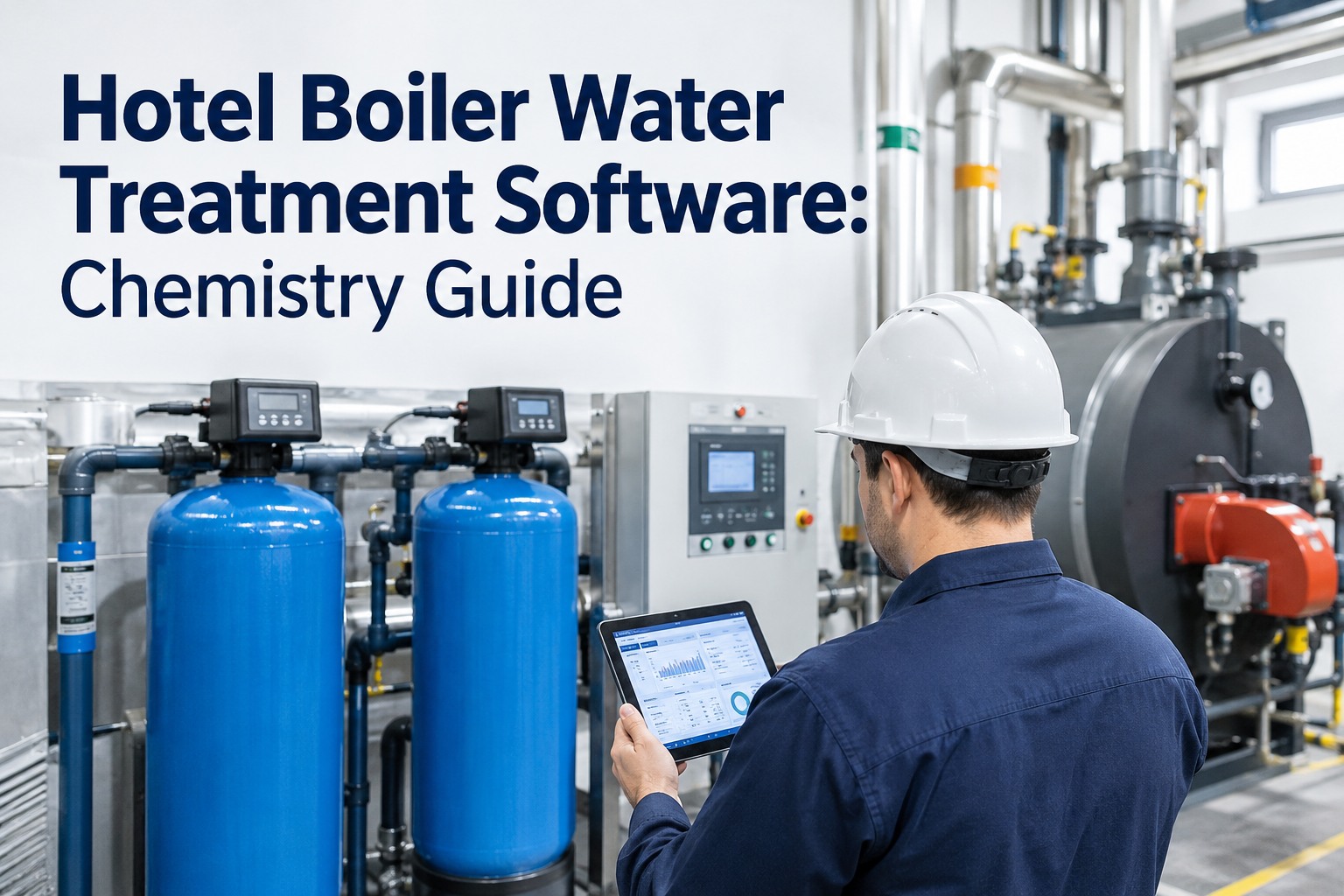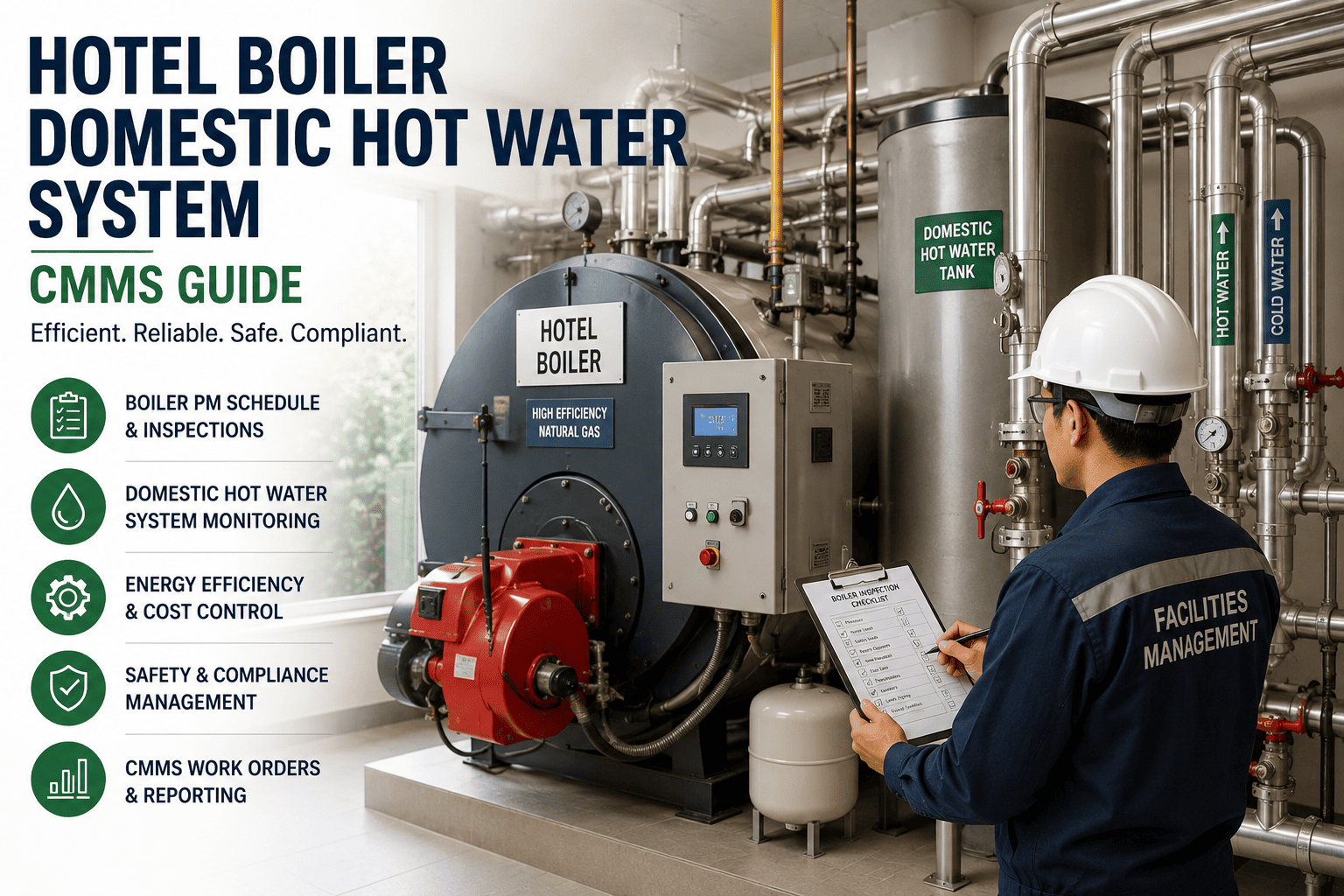
Hotel boilers and domestic hot water systems carry the invisible load of hospitality — every guest shower, every laundry cycle, every fan-coil unit depends on a pressure vessel that most general managers never think about until January, when a single tube failure can take 40% of rooms offline during peak rate season. This guide translates the code requirements — ASME CSD-1 combustion limits, ASHRAE 188 Legionella risk management, and the 120-140°F storage temperature band most AHJs enforce — into a CMMS-driven maintenance program you can audit, defend, and hand to an insurance underwriter without apology. A 200-key property running annual boiler downtime of 14 hours typically loses $18K-$28K in displaced revenue and comp rooms; the same property on a disciplined preventive schedule holds downtime under 2 hours. If you want to skip ahead and stand up the workflow today, Start Free Trial and the Oxmaint team will pre-load the boiler and DHW asset templates covered below.
What happens when your boiler drops 40% of rooms in January?
One pressure-vessel failure during peak season turns into comped suites, refund cascades, and a guest-satisfaction freefall — most of which a 30-minute monthly PM round would have prevented. This guide maps the full CMMS workflow: annual inspection, combustion tuning, Legionella control, and the defensible compliance trail.
Why hotel hot water is a year-round liability, not a winter problem
Domestic hot water (DHW) sits inside the top three guest complaint drivers at every brand standard audit — and the failure modes are staggeringly predictable. Here is what the numbers look like across a typical 150-250 key full-service property.
"A 200-key property we audited in 2024 was logging DHW temperatures on a clipboard twice a week. Three months after migrating to a CMMS schedule with auto-escalation, they caught a mixing valve drift at 118°F on day one — before the leggett colony count could establish. That is the entire ROI conversation in one work order."
— Senior facilities consultant, mid-scale national brand portfolioThe 12-month boiler & DHW maintenance timeline
Boiler compliance is not one inspection — it is a rolling cadence of monthly, quarterly, and annual events. Map every one of these to a CMMS trigger so nothing falls on memory.
Weekly flue-gas analysis (O2 6-9%, CO under 400 ppm, stack temp under 480°F). Daily DHW temperature log at the furthest fixture. CMMS auto-generates a deficiency work order if any reading drifts more than 5°F from setpoint for two consecutive days.
Annual fireside cleaning, waterside inspection of tubes and refractory, full combustion tune by a licensed contractor. This is the window to retune burner modulation — a 2% efficiency gain on a 1.5 MMBtu boiler is roughly $1,800/yr in gas.
Flush all guest-room DWV lines and dead legs. Exercise all isolation and balancing valves. Test pressure-reducing valves and expansion tanks. ASHRAE 188 requires documented water-management-plan review — store the signed review inside the CMMS asset record.
Pop-test the ASME safety relief valve, verify low-water cutoff by an actual evaporation test (not just a blowdown), test flame safeguard response time, and confirm aquastat high-limit cutout. File manufacturer test sheets and technician license number in the CMMS.
Temperature, safety valves, and the compliance trail auditors want
Three controls decide whether your boiler program passes an insurance audit or triggers a surcharge: storage temperature verification, safety-relief-valve test records, and combustion reports. Each one needs a CMMS-attached document, not a filing cabinet.
DHW temperature verification (120-140°F)
- Log storage tank top + bottom temperature daily — CMMS mobile form with min/max validation
- Log furthest-fixture temperature weekly — below 120°F triggers a deficiency work order automatically
- Calibrate tank aquastat and mixing valve quarterly — record before/after setpoints
- Attach thermistor calibration certificate to the asset record annually
Safety relief valve & low-water cutoff
- Manual pop-test the ASME SRV monthly during peak season — log lift pressure + reseat
- Annual full-capacity test by licensed contractor — attach manufacturer test sheet
- Monthly blowdown of low-water cutoff — quarterly evaporation test to verify actual trip
- Flame safeguard response time under 4 seconds — annual, with ignition trace documented
Combustion & controls documentation
- Flue-gas analysis: O2 6-9%, CO under 400 ppm, stack temp under 480°F — quarterly
- Annual full combustion tune by licensed contractor — file NFPA 85 / CSD-1 report
- Burner modulation curve verified across 25/50/75/100% firing rate
- Gas train leak test annually — document with technician license number
ASHRAE 188 — turning a water-management plan into a CMMS workflow
ASHRAE 188 is not a suggestion — it is the documented standard of care for Legionella in building water systems, and hotels are explicitly in scope. The plan only protects you if it is operationalized, which is where most properties fail.
Auto-logged temperature readings
Mobile form enforces min/max on every DHW reading — no more clipboard gaps during shift change or weekend rotations.
Dead-leg flush schedule
Every unoccupied wing, VIP suite, and seasonal bar sink gets a CMMS flush trigger tied to the PMS occupancy feed.
Annual plan review trail
Signed ASHRAE 188 review, team training roster, and legionella sample lab results all attached to the asset record.
Insurance-ready export
One click produces a date-stamped PDF of every temperature log, valve test, and corrective action for the underwriter.
Stop running boiler PM on memory and clipboards.
Pre-load the full hotel boiler + DHW asset template, PM triggers, and ASHRAE 188 workflow in under an hour — then watch downtime, comp rooms, and audit prep time collapse together.
What a CMMS-managed boiler program actually costs and saves
A worked example: a 200-key full-service hotel, two 1.5 MMBtu hydronic boilers, 80-gallon DHW storage with recirculation, gas-fired. Here is the before/after over a 12-month window.
| Metric (12-month rolling) | Before CMMS | With CMMS PM | Delta |
|---|---|---|---|
| Boiler unplanned downtime | 14.0 hrs | 1.8 hrs | -87% |
| Comp rooms issued (hot water related) | 38 nights | 4 nights | -89% |
| Gas spend (combustion tuning impact) | $84,200 | $81,100 | -$3,100 |
| DHW temp log gaps (missing readings) | 41% | 0% | Eliminated |
| Legionella flush compliance | ~60% documented | 100% documented | Audit-ready |
| Audit prep labor (insurance + brand) | 22 hrs | 3 hrs | -86% |
| Est. total annual cost avoided | — | — | $22,400+ |
Hotel boiler & DHW CMMS — the five questions we hear most
What DHW storage temperature does code require for hotels?
Most authorities having jurisdiction (AHJs) and brand standards require DHW storage at 120-140°F — below 120°F invites Legionella growth, above 140°F creates scald liability. Local codes and the 2018/2021 IPC may tighten this band, so the CMMS form should enforce your specific AHJ range and flag any out-of-band reading for immediate corrective action.
How often should the ASME safety relief valve be tested?
Manual pop-test monthly during heating season, full-capacity bench test annually by a licensed contractor. Both need a documented record — the CMMS attaches the technician's license number, test pressure, and reseat observation directly to the boiler asset so the trail survives staff turnover.
Does ASHRAE 188 really apply to my hotel?
Yes — ASHRAE 188 explicitly includes hotels and motels as buildings with multiple housing units and centralized water systems. You need a written water-management plan, a designated team, and documented control measures (temperature, flush, disinfection). The plan is only defensible if it is operationalized — most properties fail not on writing the plan but on executing it. You can Book a Demo and we will show you the pre-built ASHRAE 188 workflow.
How long does it take to set up a boiler CMMS program from scratch?
A typical 150-300 key property is live in 4-8 hours of admin time. Oxmaint ships with a hotel boiler + DHW asset template, the 12-month PM calendar, ASHRAE 188 flush triggers, and mobile temperature-log forms pre-configured — you adjust setpoints, assign technicians, and connect the PMS occupancy feed.
What does it cost to NOT have a CMMS on hotel boilers?
Beyond the $18K-$28K single-outage hit, properties without CMMS-tracked PM average 3x more comp nights, 40% more emergency contractor calls, and 6-8x the audit prep labor. One unresolved Legionella claim in hospitality has settled in the $1M-$6M range — the CMMS is the cheapest insurance you will ever buy. Start Free Trial to see the full ROI model applied to your property.
Your boilers run all year. Your PM discipline should too.
Stand up the full hotel boiler + DHW CMMS workflow — annual inspection triggers, combustion tune schedule, ASHRAE 188 Legionella controls, and a defensible audit trail — in one afternoon.
Free 14-day trial · No credit card