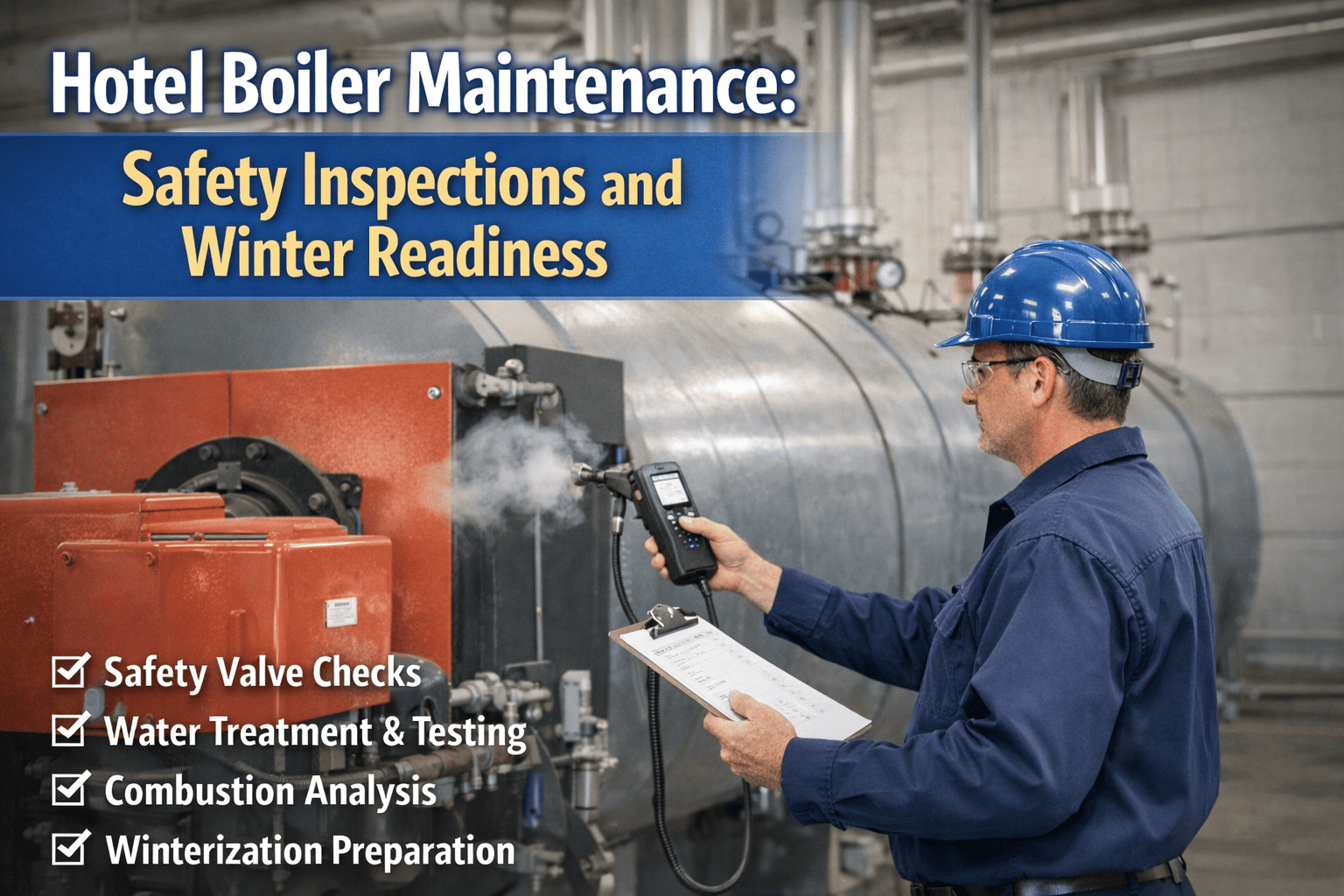
The chief engineer at a 440-room downtown hotel hears the fire alarm at 2:47 AM—but it's not a fire. The 15-year-old steam boiler in the basement suffered a low-water cutoff failure because the control hadn't been tested in 14 months. The resulting dry-fire condition warped three fire tubes, releasing superheated steam into the mechanical room at 250°F. Two overnight staff are hospitalized with steam burns. The boiler is a total loss—$185,000 for emergency replacement plus $340,000 in business interruption while 280 rooms go without heat and hot water for 11 days in January. The insurance carrier denies 60% of the claim after discovering zero documented maintenance records for the low-water cutoff, the safety relief valve, or annual combustion analysis. Three floors above, guests evacuate into 18°F weather in bathrobes. Every element of this catastrophe traces to one root cause: the hotel treated boiler maintenance as optional instead of the life-safety obligation it is.
68%
Preventable Boiler Failures
Nearly seven in ten hotel boiler emergencies—including dry-fire tube failures, pressure relief events, carbon monoxide leaks, and catastrophic ruptures—originate from missed safety device testing and neglected preventive maintenance that systematic scheduling eliminates entirely.
Hotel boilers operate under extreme conditions—pressurized vessels generating steam or high-temperature hot water through continuous combustion that demands rigorous safety oversight. Unlike most building systems where failure means inconvenience, boiler failure means potential injury, property destruction, and regulatory shutdown. Properties using OXmaint's boiler maintenance and compliance tracking platform maintain 97% PM completion rates—ensuring every safety device test, combustion analysis, and water treatment task executes on schedule with documentation ready for inspectors and insurers. Hotels managing complex boiler plants can schedule a free consultation to see automated boiler maintenance scheduling mapped to their equipment.
Average emergency boiler replacement cost including expedited installation and temporary heating equipment rental
$340,000
Business interruption from 11-day boiler outage during peak heating season—lost room revenue plus guest relocation costs
60% Claims Denied
Insurance carriers routinely deny boiler claims when properties cannot produce documented maintenance and safety device testing records
15 vs. 30+ Years
Neglected boilers fail at 15 years; properly maintained systems with full PM programs deliver 30+ years of safe operation
6 Core Components of Hotel Boiler Maintenance
Effective hotel boiler management integrates six maintenance disciplines into one trackable system. Properties using digital boiler asset management achieve 97% PM completion versus 41% with paper-based tracking—the difference between catching a failing low-water cutoff at its quarterly test and discovering it during a 2 AM catastrophe.
Essential Boiler Maintenance Components
1. Safety Device Testing
Scheduled verification of low-water cutoffs, pressure relief valves, flame safeguard controls, high-limit switches, and emergency shutoffs with fully documented test results.
2. Water Treatment Program
Chemical treatment monitoring, blowdown scheduling, condensate return testing, pH and hardness tracking to prevent scale buildup and oxygen corrosion inside boiler vessels.
3. Combustion Analysis
Quarterly flue gas analysis measuring CO, CO2, O2, stack temperature, and combustion efficiency—detecting burner degradation before it wastes fuel or creates CO hazards.
4. Fireside & Waterside Inspection
Annual internal inspection of fire tubes, refractory lining, gaskets, and waterside surfaces for scale deposits, corrosion pitting, and tube wall thinning that precedes failure.
5. Burner & Fuel System Service
Burner cleaning, nozzle replacement, ignition electrode adjustment, fuel train leak testing, gas valve verification, and linkage calibration for optimal combustion performance.
6. Efficiency & Performance Monitoring
Tracks fuel consumption trends, steam/hot water output ratios, cycling frequency, and operating pressure to detect efficiency degradation before energy costs spike.
Preventive Maintenance Schedule
Hotel Boiler PM Task Matrix
Component
Weekly
Monthly
Quarterly
Annually
Low-Water Cutoff
Blowdown test
Float mechanism check
Full operational test
Disassemble & clean
Safety Relief Valve
Visual inspection
Lift test operation
Discharge pipe check
Replace or recertify
Water Treatment
Chemical test & log
Full water analysis
Treatment program review
System flush & reset
Burner System
Flame observation
Ignition system check
Combustion analysis
Full burner overhaul
Flame Safeguard
Indicator verification
Response time test
Full sequence test
Controller review
Boiler Vessel
Pressure gauge check
External inspection
Blowdown & check
Internal NDT inspection
Flue & Venting
Draft verification
CO monitoring check
Flue gas analysis
Full flue inspection
OXmaint automatically generates work orders for each task at the correct interval, tracks completion rates, sends overdue alerts, and maintains the inspection documentation that insurers and jurisdictional inspectors require.
Critical Safety Device Testing Protocols
Boiler Safety Verification Requirements
Low-Water Cutoff
Weekly blowdown, quarterly full test—prevents catastrophic dry-fire tube failure
Pressure Relief Valve
Monthly lift test, annual recertification—last defense against overpressure explosion
Flame Safeguard
Monthly response test, quarterly full sequence—prevents unburned fuel accumulation
OXmaint schedules every low-water cutoff test, relief valve verification, combustion analysis, and water treatment task—building the compliance documentation that protects your property, your guests, and your insurance coverage.
Boiler Water Treatment: The Invisible Maintenance Priority
Water Chemistry Management for Boiler Longevity
Untreated water destroys boilers from the inside — scale, corrosion, and carryover are all preventable
Scale & Deposit Prevention
Maintain feedwater hardness below 1 ppm
Softener salt and resin monitored weekly
Bottom blowdown per TDS readings
Surface blowdown for dissolved solids
Chemical treatment dosing verified daily
1/4"
scale = 25% efficiency loss
Corrosion & Oxygen Control
Oxygen scavenger at proper residual levels
pH controlled between 10.5-11.5 range
Condensate return tested for pH and iron
Deaerator operation verified weekly
Annual waterside inspection for pitting
pH 10.5-11.5
optimal boiler water alkalinity
ROI of Structured Boiler Maintenance
Documented Benefits of Proactive Boiler Management
Based on commercial and hospitality boiler maintenance studies
68%
Reduction in boiler emergency incidents
2x
Equipment life extension with full PM program
18%
Fuel cost reduction from combustion tuning
35%
Lower annual boiler maintenance costs
"Boiler failures don't happen suddenly—they develop over months of neglect. A low-water cutoff that hasn't been blown down in 8 weeks accumulates sediment that prevents it from protecting the vessel. A safety relief valve untested for a year may be seized shut. A burner running 3% low on efficiency wastes $4,000-$8,000 annually in fuel while depositing soot that accelerates tube degradation. The hotels that never experience boiler emergencies aren't lucky—they test, treat, tune, and document on schedule without exception. The documentation alone has saved our clients millions in insurance claims and liability defense."
— Director of Engineering, National Hotel Management Company, 22 years boiler operations
Implementation Timeline
Typical Boiler Maintenance Program Rollout
Week 1
Asset Inventory
Catalog all boilers • Record nameplate data • Document safety devices • Capture current conditions
Week 2
PM Configuration
Define task frequencies • Configure safety tests • Set water treatment schedule • Map compliance requirements
Week 3
Team Training
Mobile app deployment • Safety test procedures • Water treatment protocols • Documentation standards
OXmaint automates every boiler safety test, water treatment log, combustion analysis, and inspection task—building the compliance trail that protects your property, your guests, and your insurance coverage year-round.
How often should hotel boilers be inspected and serviced?
Hotel boilers require multi-frequency maintenance across different components. Weekly tasks include low-water cutoff blowdown testing, water treatment chemical testing, flame observation, pressure gauge verification, and draft checks. Monthly tasks include safety relief valve lift tests, external boiler inspection, ignition system checks, and CO monitoring verification. Quarterly tasks include full combustion analysis measuring CO, CO2, O2, and stack temperature, complete low-water cutoff operational testing, water treatment program review, and flame safeguard full sequence testing. Annual tasks include internal fireside and waterside inspection with non-destructive testing, full burner overhaul, safety relief valve replacement or recertification, flue system cleaning, and jurisdictional inspection preparation. Most jurisdictions also require annual inspection by a licensed inspector from the insurance carrier or state boiler authority—separate from the hotel's internal PM program.
What are the most critical boiler safety devices and testing frequencies?
Four safety devices are non-negotiable for hotel boiler operations. The low-water cutoff prevents catastrophic dry-fire conditions that warp tubes and can cause vessel failure—requiring weekly blowdown testing to clear sediment, quarterly full operational testing simulating actual low-water conditions, and annual disassembly with internal cleaning. The safety relief valve is the last defense against overpressure—requiring monthly lift tests to verify it opens at set pressure, and annual replacement or recertification. The flame safeguard control prevents unburned fuel accumulation in the combustion chamber—requiring monthly response time testing and quarterly full lockout sequence verification. The high-limit pressure or temperature control provides secondary overpressure protection—requiring monthly verification and annual calibration. Failure to test any of these devices on schedule creates both immediate safety risk and insurance coverage gaps, as carriers routinely deny claims when documentation shows missed safety device testing.
Why is boiler water treatment essential for hotels?
Untreated or improperly treated boiler water causes three forms of internal destruction. Scale deposits from hard water minerals act as insulation on heat transfer surfaces—just 1/4 inch of scale reduces efficiency by 25% and causes localized overheating that leads to tube failure. Oxygen corrosion creates pitting on boiler metal surfaces that weakens tube walls and eventually causes pinhole leaks or catastrophic rupture. Carryover from high dissolved solids contaminates steam systems with water droplets that damage valves, traps, and heat exchangers throughout the building. Proper water treatment requires weekly chemical testing and logging, daily blowdown based on TDS readings, softener monitoring to maintain feedwater hardness below 1 ppm, oxygen scavenger dosing to eliminate dissolved oxygen, and pH control between 10.5-11.5. Hotels without structured water treatment programs typically experience 40-60% shorter boiler life and 15-25% higher fuel consumption from scale-related efficiency losses.
What does a boiler combustion analysis involve and why does it matter?
Combustion analysis measures the chemical composition of flue gases to evaluate how efficiently the burner converts fuel to heat. A technician inserts a probe into the flue stack and measures CO (carbon monoxide), CO2 (carbon dioxide), O2 (oxygen), stack temperature, and calculates combustion efficiency percentage. Optimal gas-fired boiler combustion produces 82-86% efficiency with CO below 50 ppm, O2 between 3-5%, and stack temperature 300-450°F above ambient. Deviations indicate specific problems: high CO means incomplete combustion (dirty burner, misadjusted air), high O2 means excess air (wasted energy heating unused air), and high stack temperature means heat not transferring properly (scale or soot buildup). Hotels should perform combustion analysis quarterly and after any burner service. A boiler operating 3% below optimal efficiency wastes $4,000-$8,000 annually in excess fuel for a typical hotel heating plant—making quarterly $200 combustion analyses one of the highest-ROI maintenance tasks available.