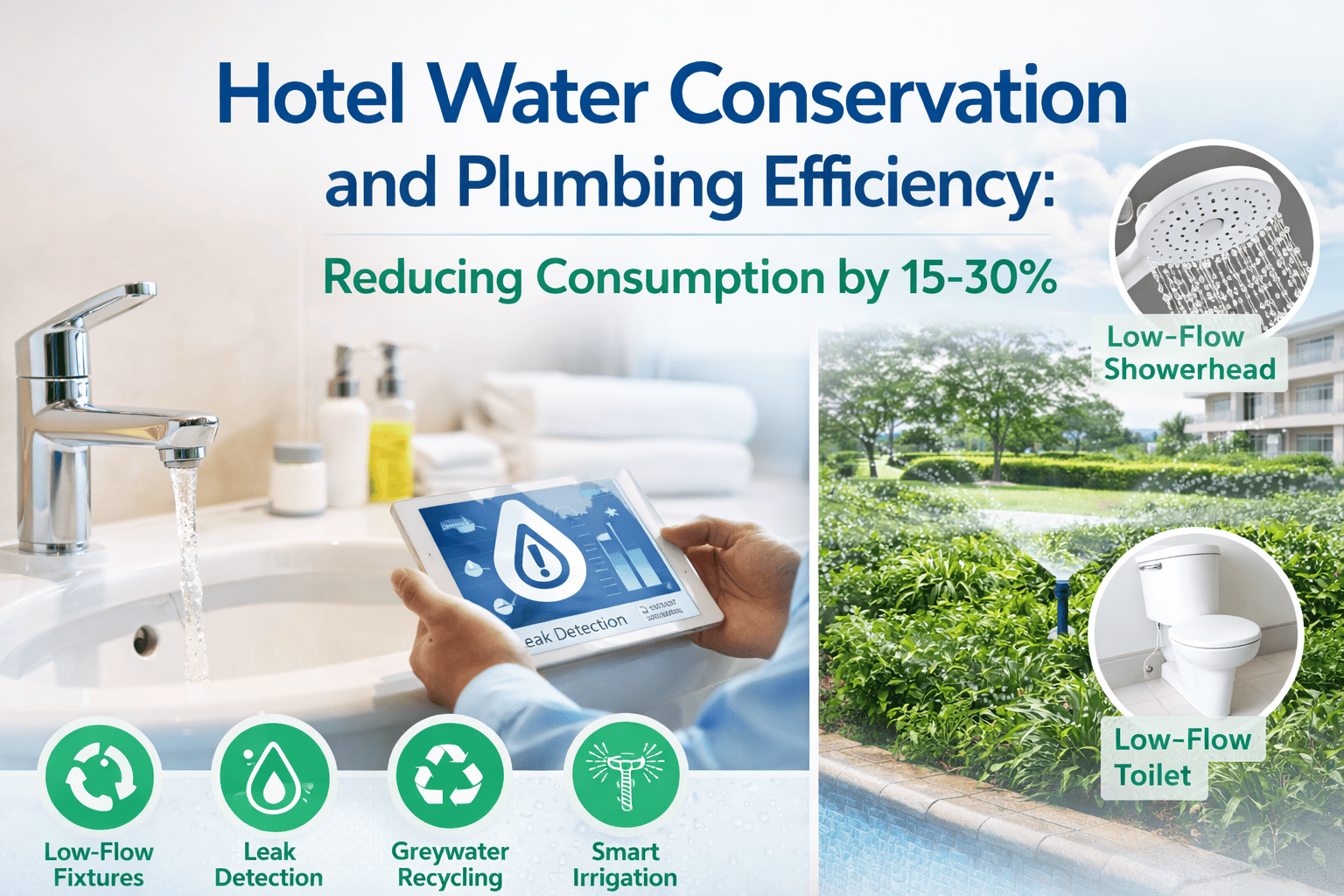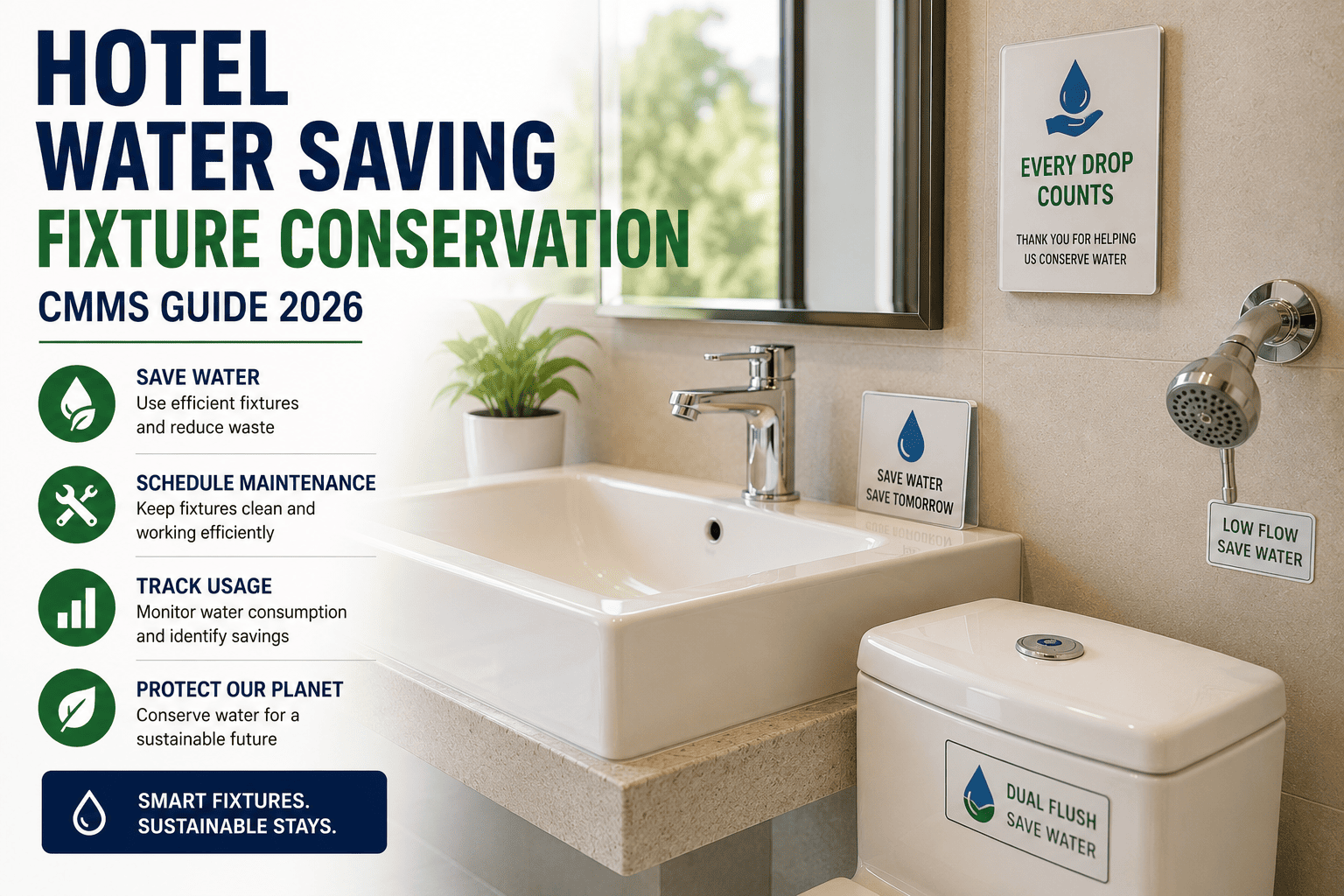
Water consumes roughly 8–12% of a hotel's utility budget, yet it remains one of the easiest utility lines to cut — most properties see a 20–40% reduction within the first year of a structured conservation program. The math is hard to argue with: a 150-room property spending $48,000 annually on water and sewer can recover $12,000–$19,000 of that through low-flow fixture retrofits, linen reuse protocols, irrigation tuning, and cooling tower make-up controls. The catch is execution. Fixture retrofits get installed and forgotten, aerators clog, sensors drift, and nobody owns the meter data — which is why CMMS-tracked water programs sustain savings while ad hoc efforts quietly leak back 8–15% per year. This 2026 guide walks through the fixtures, the programs, and the CMMS workflows that tie them together. Start Free Trial to put the workflow described here into production inside your property this quarter.
Can your hotel afford to keep flushing 40% of its water budget down the drain?
A 200-room property leaks an average of $11,400 per year in unmetered water loss — failed aerators, over-tuned irrigation, and untracked cooling tower cycles. CMMS-led conservation programs close that gap in 90 days and hold it.
Where hotel water actually goes — and what each fixture costs you
Roughly 45% of hotel water flows through guest-room fixtures, 25% through cooling and HVAC, 18% through laundry and kitchens, and 12% through landscape irrigation. Targeting the top three streams captures 80% of the available savings.
The low-flow fixture program that pays back in under 15 months
A 180-room limited-service property spending $42,000/yr on water retrofitted 360 aerators, 180 showerheads, and 180 toilet flappers for $4,100 in materials. Year-one verified savings: $9,800. Here is the sequence that got them there.
Baseline meter read + fixture inventory
Walk every floor with a flow-bag kit, log current GPM on each fixture into the CMMS asset register, and capture 12 months of meter history. Without a baseline, the utility cannot confirm savings later.
Swap 0.5 GPM faucet aerators across all guest rooms
Highest ROI move in the program. A 1.0 GPM aerator costs $1.40 and saves 0.7 GPM per minute of use. At 8 minutes/day/room, that is 5.6 gallons per room per day — 370,000 gallons annually across 180 rooms.
Install 1.5–2.0 GPM WaterSense showerheads
Drop shower flow from 2.5 to 1.75 GPM and you save 15 gallons per shower without guest complaints — provided pressure is checked. Log each install as a CMMS work order against the room asset.
Retrofit flappers + dual-flush valves on high-flow toilets
Pre-1994 toilets flush 3.5+ gallons. A $12 dual-flush valve cuts that to 1.1/1.6. Full toilet replacement ($180–$280/unit) is justified only above 4,000 flushes/year per unit.
Post-retrofit meter read + CMMS savings report
Run a 14-day normalized comparison against the baseline. The 180-room property above cut daily consumption from 21,400 to 14,900 gallons — a 30.4% reduction, verified by sub-meter data logged hourly in the CMMS.
The water-savings formula every GM should know
Conservation savings are not a guess — they are a function of flow reduction, daily use minutes, occupancy, and blended water+sewer rate. Run the formula before you buy a single aerator.
| Retrofit measure | Material cost / room | Labor hrs / room | Annual savings / room | Payback |
|---|---|---|---|---|
| 0.5 GPM faucet aerator | $1.40 | 0.10 | $36 | 2 weeks |
| 1.75 GPM showerhead | $18.00 | 0.25 | $58 | 4 months |
| Dual-flush valve kit | $32.00 | 0.50 | $71 | 6 months |
| Leak-detection sensor (in-room) | $45.00 | 0.40 | $94 | 6 months |
| Pre-rinse kitchen spray valve (1.15 GPM) | $60.00 | 0.30 | $310 | 3 months |
Four CMMS-tracked programs that compound your fixture savings
Fixtures are the headline; these four programs are where the other 12–18% hides. Each one is a recurring CMMS workflow — not a one-time project.
Linen & Towel Reuse Protocol
A well-communicated opt-in program cuts laundry water 17% per participating room. The CMMS tracks opt-in rate by room and triggers laundry load-reduction reports weekly. Properties hitting 60% participation save $1.80–$2.40 per occupied room per night.
Irrigation Optimization
Smart controllers tied to soil-moisture sensors and local ET data cut landscape water 25–40%. The CMMS schedules seasonal controller audits, logs broken-head work orders, and flags zones where consumption exceeds the monthly budget by more than 15%.
Cooling Tower Efficiency
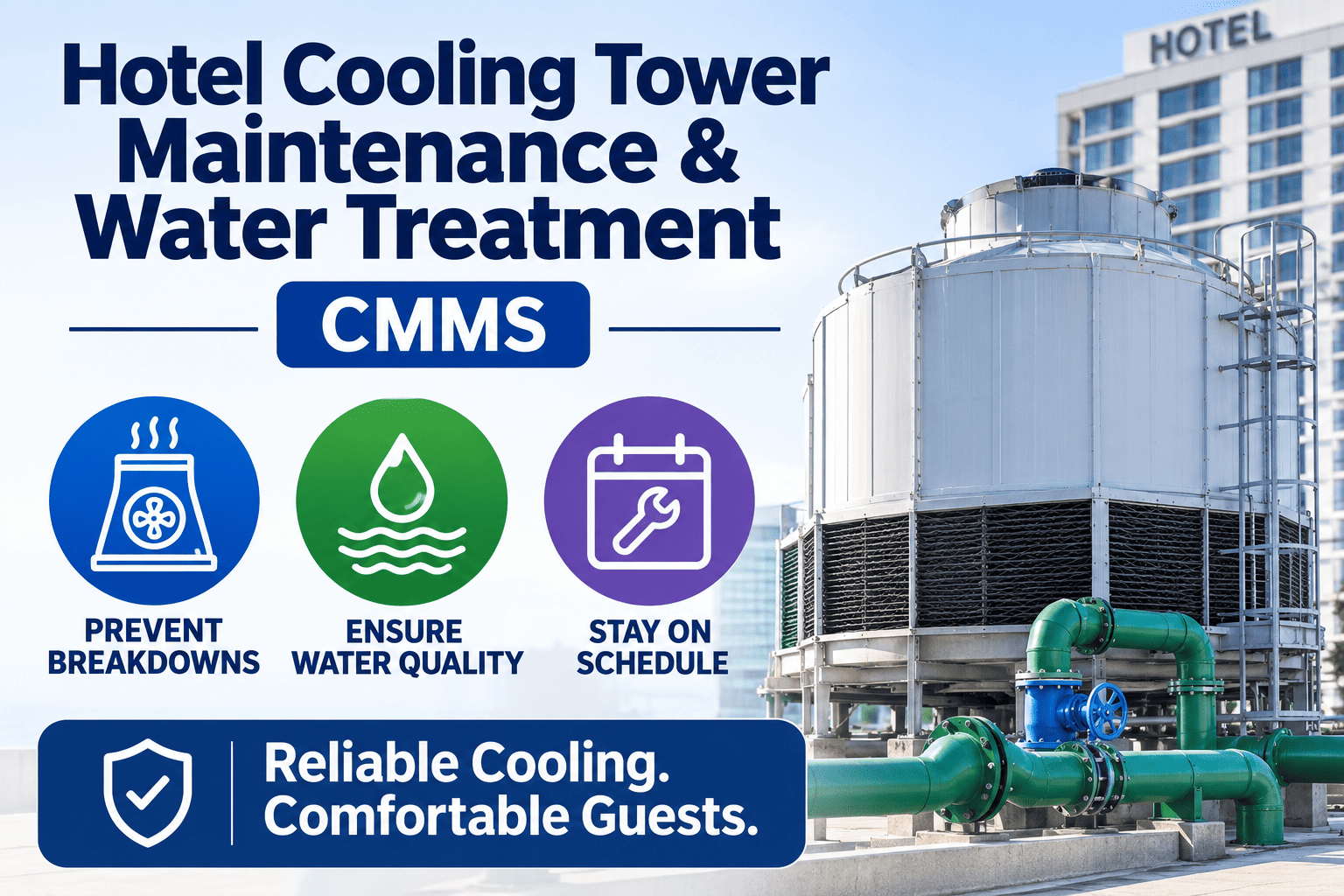
Pushing cycles of concentration from 3 to 6 reduces make-up water 25% and blowdown by half. The CMMS auto-generates weekly conductivity-test work orders, logs chemical dosing, and alerts when drift exceeds 0.002% of recirculation flow.
Leak Detection & Sub-metering
A single running toilet wastes 200–1,000 gallons/day. CMMS-tracked night-flow anomaly alerts (any flow above 2 GPM between 2–4 AM) catch leaks in 24 hours instead of the industry-typical 47 days. Sub-meter cooling, irrigation, and laundry separately to attribute every gallon.
How the CMMS holds the program together — month by month
The reason most hotel water programs fail in year two is that nobody owns the data. A CMMS turns conservation from a project into a managed asset with a 12-month recurring rhythm.
Meter read + variance alert
Auto-import utility bill or AMR data, compare to baseline normalized for occupancy, flag any month exceeding budget by 10%.
Fixture flow audit
Sample 20% of rooms with a flow-bag. Any fixture above 110% of spec GPM gets a corrective work order generated automatically.
Cooling tower water test
Conductivity, pH, TDS, and cycles-of-concentration logged against asset. Out-of-range results trigger chemical-treatment adjustment work orders.
Irrigation controller reprogram
Adjust run-times to monthly ET reference. Inspect every head and zone. Document in CMMS with photo evidence for sustainability audits.
Savings report & ESG disclosure
Roll up verified gallons saved, dollars avoided, and kBtu of embedded energy avoided (water heating + pumping) for GRI 303 and CDP Water Security reporting.
Leak anomaly monitoring
Sub-meter data streams into the CMMS. Night-flow thresholds trigger priority work orders to engineering within 1 hour of detection.
A 240-room resort cut water cost 34% in 11 months — here is how
"We had tried low-flow fixtures twice before and the savings disappeared within a year because nobody tracked the meter. The CMMS workflow gave us a quarterly fixture audit, a night-flow alert that caught three running toilets in month two, and a cooling-tower test cadence that pushed us from 3 to 6 cycles. Water cost dropped from $185K to $122K. The energy savings on hot water added another $14K."
Turn your water program into a tracked, repeating asset
Deploy fixture audits, leak alerts, and irrigation schedules in one CMMS — and hold the 30% savings year after year.
Hotel water-saving fixture & CMMS — five questions answered
How much can a hotel realistically save with a water conservation program?
Most properties achieve 20–40% reductions in total water consumption within the first 12 months. Fixture retrofits alone typically deliver 15–25%, with irrigation optimization and cooling tower tuning adding another 8–15%. A 150-room property spending $45,000/yr on water and sewer can expect $9,000–$18,000 in verified annual savings, with payback under 15 months on materials and labor.
Why use a CMMS for water conservation instead of a spreadsheet?
Spreadsheets capture intent; a CMMS captures execution. The CMMS ties every fixture to a room asset, auto-generates quarterly flow-audit work orders, streams sub-meter data for night-flow leak alerts, and produces audit-ready savings reports for ESG disclosure. Properties using spreadsheets typically lose 8–15% of their initial savings within 18 months because nobody re-checks the fixtures or the meter.
Do low-flow showerheads and aerators hurt the guest experience?
Not when specified correctly. WaterSense-labeled 1.75 GPM showerheads with pressure-compensating technology deliver the same perceived spray as 2.5 GPM units — guest-complaint rates in independent hotel studies are statistically unchanged. The key is to verify pressure at install and log it in the CMMS; properties that skip the pressure check see a 4–7% uptick in maintenance calls. Book a Demo to see the install-checklist workflow.
What is the single highest-ROI water fixture change a hotel can make?
Bathroom faucet aerators. Swapping a 1.5 GPM aerator to a 0.5 GPM unit costs roughly $1.40 in material and saves $30–$45 per room per year in water and sewer. Payback is typically under two weeks. The second-highest is a 1.15 GPM pre-rinse spray valve in the kitchen — one valve, $60, saves $300+ annually.
How does the CMMS support sustainability and ESG water reporting?
The CMMS normalizes monthly consumption against occupancy, stores 36 months of meter history, and exports verified gallon-saved totals plus embedded-energy avoidance (water heating + pumping kBtu) for GRI 303, CDP Water Security, and LEED EBOM credits. Every savings figure is traceable to a work order and a meter read — auditors can drill from the annual report down to a single aerator swap on a single room. Start Free Trial to generate your first baseline report.
Stop paying for water you never use
Deploy the full hotel water-saving fixture program — CMMS-tracked, audit-ready, and holding 30% savings year over year.
Free 14-day trial · No credit card