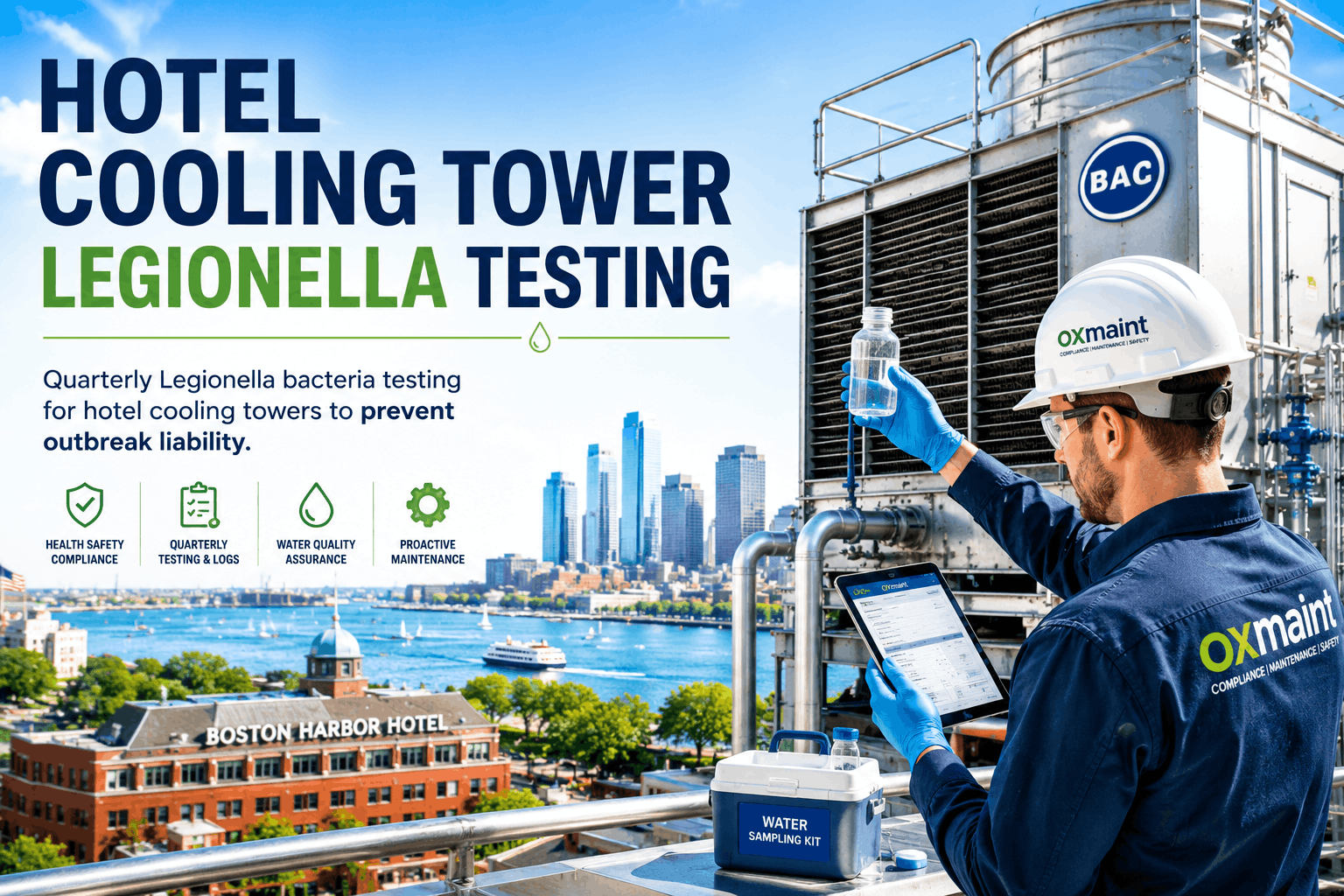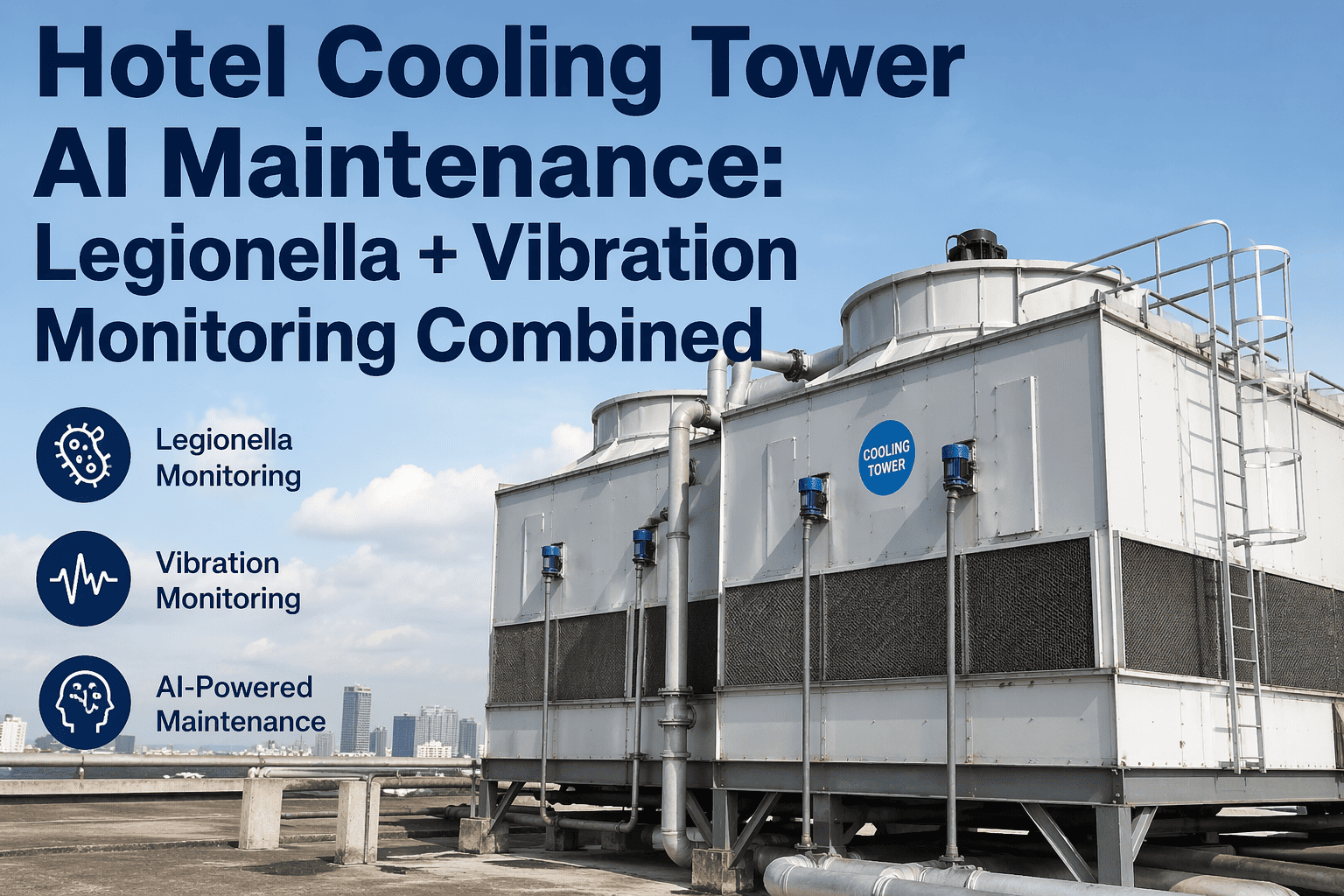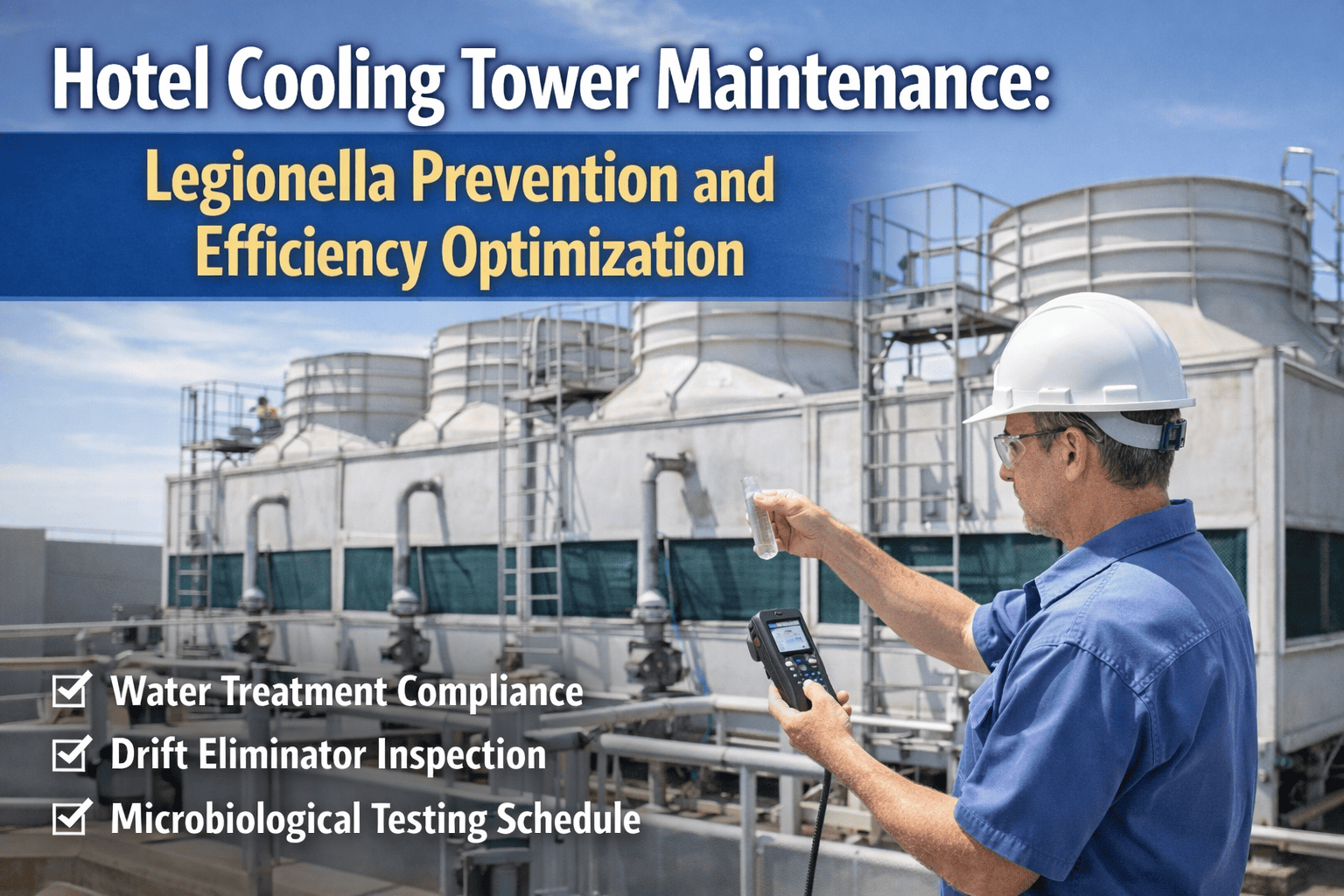
Hotel cooling towers sit at the intersection of energy efficiency and public health risk — a single untreated tower can drift Legionella bacteria across an entire property and trigger catastrophic liability under ASHRAE 188. For engineering directors managing multiple buildings, the difference between a defensible water management program and a citation comes down to documentation: dosing logs, basin cleaning intervals, Heterotrophic Plate Count trends, and the corrective-action trail when a sample comes back hot. A purpose-built CMMS turns that paper nightmare into a 90-second audit pull. Start Free Trial to see how oxmaint consolidates every cooling-tower task into one compliance-ready workspace.
Can you prove your cooling tower was clean the day a guest checked in?
A documented water management plan is not optional under ASHRAE 188 — and the gap between "we treat the tower" and "we can prove it in 4 minutes" is where hotels lose lawsuits, brand reputation, and operating budgets to Legionella outbreaks and scaling-driven energy waste.
Three failures that turn a routine tower into a liability
Cooling towers are the single highest-risk aerosol-generating asset on a hotel property. Here is what goes wrong when maintenance lives in binders and group chats.
Biocide drift — dosing that "feels right"
Without logged oxidant residuals and half-life bleed schedules, bromine and chlorine levels swing between 0.2 ppm and 4.0 ppm across a 48-hour cycle. Sub-0.5 ppm windows let biofilm regrow in 36 hours; the tower becomes a Legionella incubator long before the next weekly check.
No flow — sampling without trend data
Dip-slide results taken once a quarter and stapled to a paper log are legally thin. Defensible ASHRAE 188 programs sample HPC weekly, Legionella quarterly, and chart the trend so a spike is visible — not buried in a filing cabinet 11 months later.
Scale & fouling — silent energy bleed
A 0.6 mm calcium carbonate scale layer on tower fill drops heat-transfer efficiency by roughly 21%, forcing chillers to run 8–12% harder. At a 400-room property that is $18K–$31K in avoidable annual energy spend — invisible without logged conductivity, bleed, and makeup metering.
What a defensible hotel water management plan actually contains
ASHRAE 188-2018 requires a written program covering seven control elements. Each one maps to a CMMS module — not a spreadsheet.
| Control Element | CMMS Implementation | Trigger / Threshold | Audit Frequency |
|---|---|---|---|
| Program team & roles | Role-based task assignment with e-sign sign-off on every work order | Onboarding / role change | Annual review |
| Building water system survey | Asset register with tower schematic, dead-leg mapping, drift-eliminator photos | Any plumbing change | Quarterly walk-down |
| Control location analysis | Geotagged control points: basin, makeup, condenser-water return, drift eliminator | Survey triggers re-analysis | Annual |
| Control limits | Free chlorine 0.5–1.5 ppm · conductivity bleed at 1,200 µS/cm · pH 7.4–8.2 | Out-of-limit auto-alert | Continuous + daily log |
| Monitoring & correction | Scheduled sampling WOs; failed result auto-generates corrective WO with 24-hr SLA | HPC > 500 CFU/mL · Leg. > 10 CFU/mL | Weekly HPC / quarterly Leg. |
| Confirmation & validation | Trend dashboard with 13-month rolling chart per tower; outlier flags highlighted gold | 2 consecutive excursions | Monthly review |
| Documentation | Immutable audit log — every reading, dose, cleaning, and corrective action time-stamped | Any inspector request | On-demand (under 5 min) |
A year of cooling-tower work, scheduled and provable
The cadence below is the minimum viable schedule for a hotel running one to four crossflow or counterflow towers. Every item becomes a recurring work order inside the CMMS with photo proof on close.
Quarterly basin cleaning & disinfection
Drain basin, pressure-wash fill and drift eliminators, vacuum sump, apply 5 ppm shock chlorination for 2 hours. Log before/after photos and residual readings. CMMS auto-opens the next 90-day WO on close.
Mechanical drift-eliminator inspection
Remove access panels, inspect drift eliminators for scale buildup and misalignment. Drift rate must stay below 0.005% of circulating flow — exceeded drift is the primary Legionella aerosol pathway.
Annual Legionella culture sampling
Draw from the warmest return-water point. Use an AMO-accredited lab. Any result above 10 CFU/mL triggers an immediate superheat-and-flush protocol with a 48-hour follow-up sample logged in the CMMS.
Peak-load efficiency audit
Verify approach temperature within 3°C of design. If approach drifts above 4°C, schedule fill descaling. At a 400-room property this single check typically recovers $9K–$14K in chiller energy over the cooling season.
Off-season layup & corrosion coupon pull
If tower is taken offline: drain, dry, and seal. Pull corrosion coupons for annual mpy analysis (mild steel target under 3.0 mpy, copper under 0.2 mpy). Document in CMMS asset history for ISO 55000 alignment.
Annual program review & sign-off
Roll up 12 months of data: excursions, corrective actions, mean time-to-resolution, total biocide consumption, and energy delta vs. baseline. Director of Engineering and water-treatment vendor both e-sign in the CMMS.
The four-chemistry loop every hotel tower runs
Each chemistry has a control limit, a dosing trigger, and a CMMS work-order type. Get one wrong and the whole loop cascades.
Sodium hypochlorite or bromine tablets. Maintain 0.5–1.5 ppm free residual. CMMS logs metered dose every 4 hours; any reading below 0.3 ppm auto-triggers a shock-dose work order within 60 minutes.
Isothiazolinone or DBNPA to break biofilm the oxidizer cannot reach. Rotate actives to prevent resistance. CMMS enforces rotation — it will not schedule the same active twice within a quarter.
Phosphonate/polymer blend dosed proportional to makeup flow. Bleed valve opens at 1,200 µS/cm (typical hotel setpoint). Hold 3.0 cycles — every 0.5 cycle above 2.0 saves roughly $4,200/year in water and sewer at a mid-size property.
Tolyltriazole for copper protection, orthophosphate for mild steel. Residual tested weekly via test kit, result logged in CMMS. Excursion below 6 ppm for 48 hours flags a dosing-pump failure work order.
A 180-room hotel, two towers, 14 months
Before CMMS: paper logs, vendor-managed dosing with no trend visibility, one basin cleaning per year. After: scheduled cadence, real-time alerts, defensible audit trail.
"We had two Legionella samples come back above threshold in the same quarter the year before we switched. Once the CMMS started auto-scheduling weekly HPC draws and alerting on chlorine below 0.4 ppm, we went 14 months clean. The health inspector asked for our packet — we had it in her inbox before she finished her coffee."
Your cooling tower will be inspected. Be ready in 4 minutes, not 6 hours.
Deploy oxmaint on one tower this week — full ASHRAE 188 documentation, dosing logs, and sampling trends live in under 48 hours.
Cooling-tower CMMS, answered straight
Does a CMMS replace our water-treatment vendor?
No — it replaces the paper and the blind spots. Your vendor still doses chemicals and pulls samples, but every reading, dose, and result is logged inside the CMMS against the specific tower asset. The system flags excursions your vendor might miss between visits and gives you a trend chart no monthly service report can match. Book a Demo to see a vendor-integrated workflow.
How quickly can we stand up an ASHRAE 188 program in the CMMS?
A single-property hotel with one to three towers is typically live in 36–48 hours. Asset setup, control-point mapping, recurring work-order templates, and the sampling schedule import from our hospitality template. Multi-property groups with shared vendors add roughly one day per additional building for asset register import.
What happens when a Legionella sample comes back positive?
The lab result is entered as a failed inspection on the tower asset. The CMMS immediately auto-generates a corrective work order with a 24-hour SLA, assigns it to the on-call engineer, and triggers the superheat-and-flush checklist (165°F for 30 minutes, re-sample in 48 hours). Every step is time-stamped and photographically documented for legal defensibility.
Can the system integrate with our IoT chlorine and conductivity sensors?
Yes — oxmaint ingests continuous data from common hotel-grade controllers (Pulsafeeders, Walchem, Lakewood instruments) via secure API or Modbus gateway. Readings populate the same trend dashboard as manual dip-slide results, so you see the full residual picture in one chart. Start Free Trial to connect a sensor during onboarding.
Is this defensible in a Legionella lawsuit or health-department audit?
The CMMS produces an immutable, time-stamped audit log for every tower: every dose, every sample, every corrective action, and every e-signed sign-off. Directors of Engineering who have used it during health-department inspections report pulling a complete packet in under five minutes. That said, the CMMS supports your program — it does not replace the legal review of your water management plan.
Stop guessing. Start documenting.
Join hotel engineering teams using oxmaint to keep cooling towers compliant, efficient, and audit-ready — every single day.
Free 14-day trial · No credit card