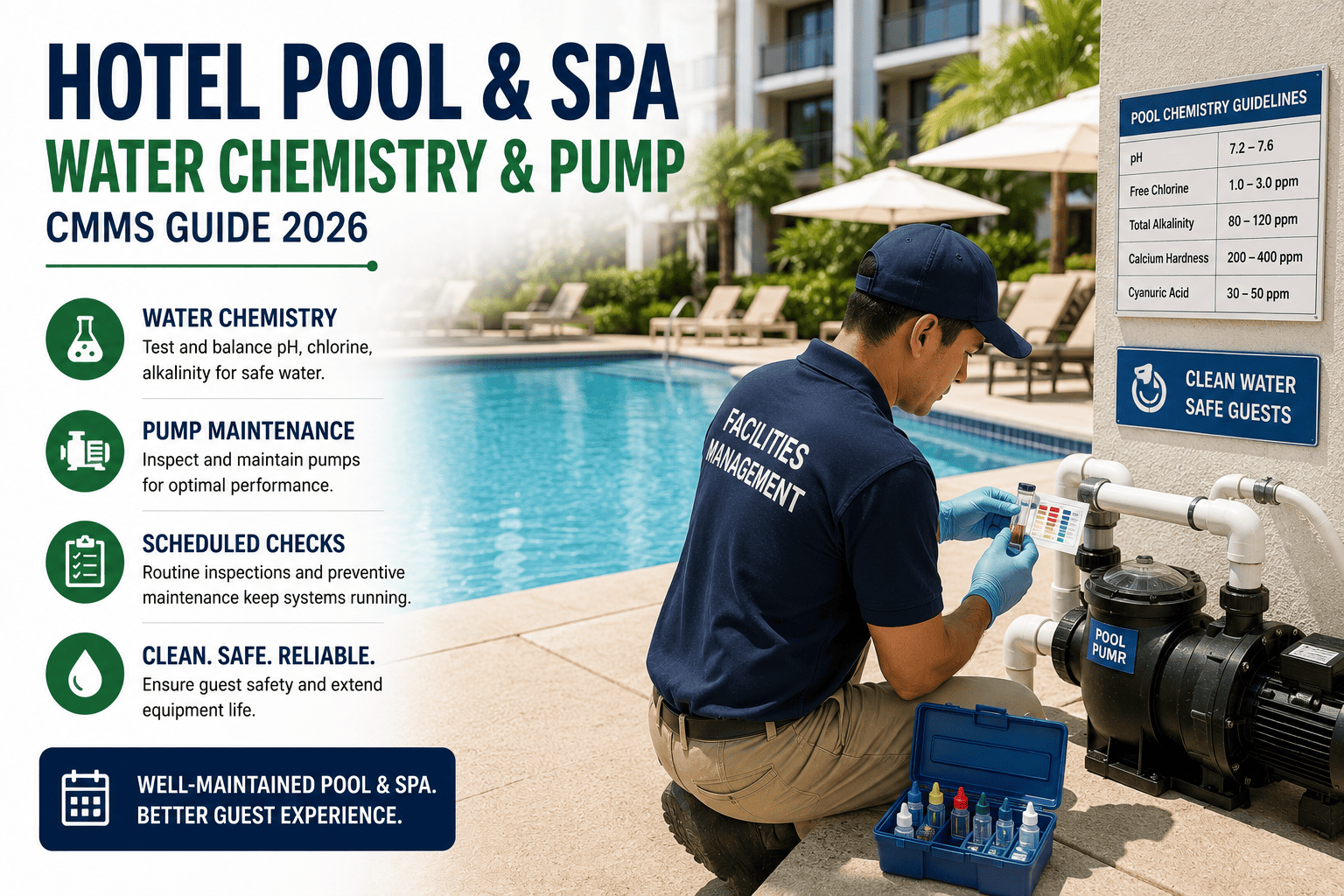
Hotel pool and spa operations sit at the intersection of guest experience, health-code compliance and asset reliability — a single recirculation pump failure or a 0.4 drift in pH can close a pool, trigger a health-department citation and produce a wave of negative reviews within hours. This 2026 guide walks hospitality engineering and facilities teams through the chemistry benchmarks, VGBA-compliant pump monitoring, filter service intervals and CMMS documentation practices that keep water safe, clear and open. You will find specific ranges for pH, free chlorine, total alkalinity and cyanuric acid, plus a preventive-maintenance framework you can deploy inside a CMMS today — and you can Start Free Trial to operationalize every checklist, reading and work order in this article.
One pump failure. One chlorine imbalance. One review-score problem.
For a 250-room resort, a single pool closure averages $18K in lost ancillary revenue and refunds — and the reputation damage lingers long after the water clears. CMMS-driven chemistry logging and pump PM close that gap before guests ever notice.
The four readings that decide whether your pool stays open
Health inspectors do not negotiate on chemistry. Maintain these four parameters within range, log them at the frequency shown, and 90% of pool-code violations disappear before the inspector arrives.
pH Level
Below 7.2 corrodes pumps and irritates eyes; above 7.8 reduces chlorine efficacy by up to 80% and clouds water. Target 7.4–7.6 for guest comfort and sanitizer performance.
Free Chlorine
Hot tubs require 3–5 ppm due to higher bather load and warmer water. Log combined chlorine; if it exceeds 0.4 ppm, superchlorinate to break out chloramines that cause the "pool smell" guests complain about.
Total Alkalinity
TA is the buffer that keeps pH stable. Below 80 ppm, pH bounces with every chemical dose; above 120 ppm, pH locks high and chlorine loses kill power. Adjust TA before touching pH.
Cyanuric Acid
CYA protects chlorine from UV loss in outdoor pools, but above 50 ppm it over-stabilizes and slows the kill rate — a common cause of Crypto and E. coli outbreaks in heavily used hotel pools. Drain and dilute when CYA climbs.
Tiered task grid for safe, compliant, guest-ready water
Build these tasks as recurring PM triggers in your CMMS so nothing depends on memory or a clipboard. Frequencies follow CDC Model Aquatic Health Code and typical state health-department minimums.
- Test pH and free chlorine at poolside; log in CMMS with timestamp
- Inspect water clarity — a Secchi disk at the deepest point must remain visible
- Confirm main drain cover is visible, intact and VGBA-compliant
- Skim surface, empty skimmer baskets, check return-jet flow
- Verify rescue equipment, signage and emergency phone are in place
- Backwash or clean filter when pressure gauge reads 8–10 psi above baseline
- Record pump pressure, suction and discharge — flag any 5 psi swing
- Walk deck for slip hazards, broken tile and loose grout
- Superchlorinate spa at closing to hit 5 ppm overnight residual
- Reconcile chemical inventory; reorder when 7-day stock remains
- Test total alkalinity, calcium hardness and cyanuric acid weekly
- Strip and clean chemical feed pump injection check-valves weekly
- Verify flow meter accuracy against pump curve monthly
- Inspect pump seal, motor amps and bearing temperature monthly
- Calibrate pH and ORP probes against standard solution monthly
- Submit water sample to a certified lab for complete panel monthly
VGBA compliance and the pressure gauge that saves lives
The Virginia Graeme Baker Pool & Spa Safety Act requires anti-entrapment drain covers and compliant suction systems — but the recirculation pump behind them is what actually keeps water safe. A pump running outside its curve is a quiet public-health failure.
Health code requires a 6-hour turnover for pools and a 30-minute turnover for spas. A 80,000-gal pool needs a minimum 222 gpm flow rate to meet code. Log flow readings in the CMMS daily — a 10% drop signals a clogged filter or impeller wear.
Record the clean-filter pressure after every backwash as the baseline. When the gauge climbs 8–10 psi above that number, flow has dropped enough to threaten turnover rate. Ignoring it shortens pump motor life by 30–40% and risks a health-code closure for inadequate circulation.
A 220-room beachfront resort runs two 80,000-gal pools and a 4,000-gal spa on a shared equipment pad. Without CMMS-driven PM, the team averaged 9 unplanned pool closures per year at $2,100 per closure in refunds, comp rooms and expedited service — plus a documented 0.6-point drop in TripAdvisor review score during closure weeks. After deploying a CMMS with chemistry-reading templates, pump-pressure alerts at +8 psi and 30-day drain-cover inspection tasks, unplanned closures dropped to 1 per year, the annual chemical spend fell 18% through tighter dosing, and the engineering team recovered roughly 11 hours per week previously spent on manual logs.
The compliance gap a clipboard cannot close
Most hotel pool failures are documentation failures first — an inspector asks for 30 days of chemistry logs and the team produces a damp, partial clipboard sheet. The table below maps the operational gap.
| Operational Area | Manual / Paper System | CMMS-Driven System |
|---|---|---|
| Chemistry logging | Clipboard sheet, often back-filled, no timestamp integrity | Mobile readings auto-stamped with user, time and GPS location |
| Compliance audit prep | 4–6 hours assembling paper records per inspection | One-click 90-day report exportable to PDF for the inspector |
| Pump pressure alerts | Caught only during rounds — usually after flow has dropped | Automatic work order generated at +8 psi over baseline |
| Drain-cover VGBA inspection | Verbal handoff between shifts; easily skipped | Recurring 30-day task with photo proof required to close |
| Chemical inventory | Monthly manual count; stockouts cause dosing gaps | Auto-reorder at 7-day stock; usage trend visible by shift |
| Closure cost exposure | $18K average per closure event, 5–10 per year | Under $4K per year total with predictive PM in place |
Stop closing pools. Start documenting compliance.
Deploy pool chemistry templates, VGBA inspection tasks and pump-pressure alerts in under 30 minutes — then prove it to the health inspector with one click.
From sign-up to health-inspection-ready in four weeks
A realistic rollout for a single-property hotel pool and spa program. Each phase maps to a CMMS configuration milestone — no consulting engagement required.
Asset & Chemistry Setup
Create asset records for each pump, filter, heater and chemical feeder. Import pool volume, turnover target, baseline filter pressure and design flow rate. Build chemistry-reading templates for pH, FC, TA and CYA with pass/fail ranges.
PM Triggers & Alerts
Set 4-hour chemistry-reading tasks, daily opening checklist, weekly TA/CYA test and 30-day VGBA drain-cover inspection. Configure pump-pressure alert thresholds at +8 psi above each filter's recorded baseline.
Shift Handoff & Mobile Adoption
Train day, evening and weekend staff to log readings from a phone or tablet. Enforce photo proof on drain-cover inspections and chemical-inventory counts. Replace the clipboard entirely — no dual logging.
Audit-Ready Report
Generate a 30-day compliance report covering chemistry logs, pump-pressure history, filter backwash events and VGBA inspections. Hand it to the health inspector on arrival — or schedule a demo to review before your next audit.
Hotel pool & spa CMMS, answered
How often should hotel pool and spa water be tested?
Pool and spa water should be tested for pH and free chlorine at least twice per day during operating hours, with additional tests during peak bather load. Total alkalinity and calcium hardness should be checked weekly, and cyanuric acid monthly. A CMMS enforces this cadence with timestamped mobile readings — every entry becomes a defensible compliance record.
What does VGBA compliance require for hotel pools?
The Virginia Graeme Baker Pool & Spa Safety Act requires anti-entrapment drain covers, compliant suction-fitting covers and, in many jurisdictions, a documented physical inspection of those covers every 30 days. A CMMS recurring task with mandatory photo proof is the cleanest way to demonstrate compliance during an audit.
Can a CMMS send alerts when pump pressure is abnormal?
Yes. After recording each filter's clean baseline pressure, you set a threshold — typically +8 to +10 psi — that auto-generates a backwash or filter-inspection work order the moment an engineer logs a reading above it. This catches flow degradation before it breaches the required turnover rate. Start Free Trial to configure pump-pressure alerts in your account.
What chemistry records does a health inspector expect to see?
Most state and local codes require at least 30 days of pH and disinfectant readings, available for inspection on demand, with operator initials and timestamps. A CMMS exports a filtered, date-stamped PDF in seconds — paper clipboards typically cannot produce a complete, legible 30-day history under audit pressure.
How long does it take to deploy CMMS for hotel pool maintenance?
A single-property pool and spa program can be fully operational in under four weeks: week one for asset and chemistry setup, week two for PM scheduling, week three for staff training, and week four to produce an audit-ready compliance report. To see a guided walkthrough tailored to your property, Book a Demo.
Your next health inspection should take 15 minutes, not 4 hours.
Deploy CMMS-driven pool chemistry logging, VGBA inspections and pump PM — and turn your pool operation into the most defensible asset on the property.
Free 14-day trial · No credit card