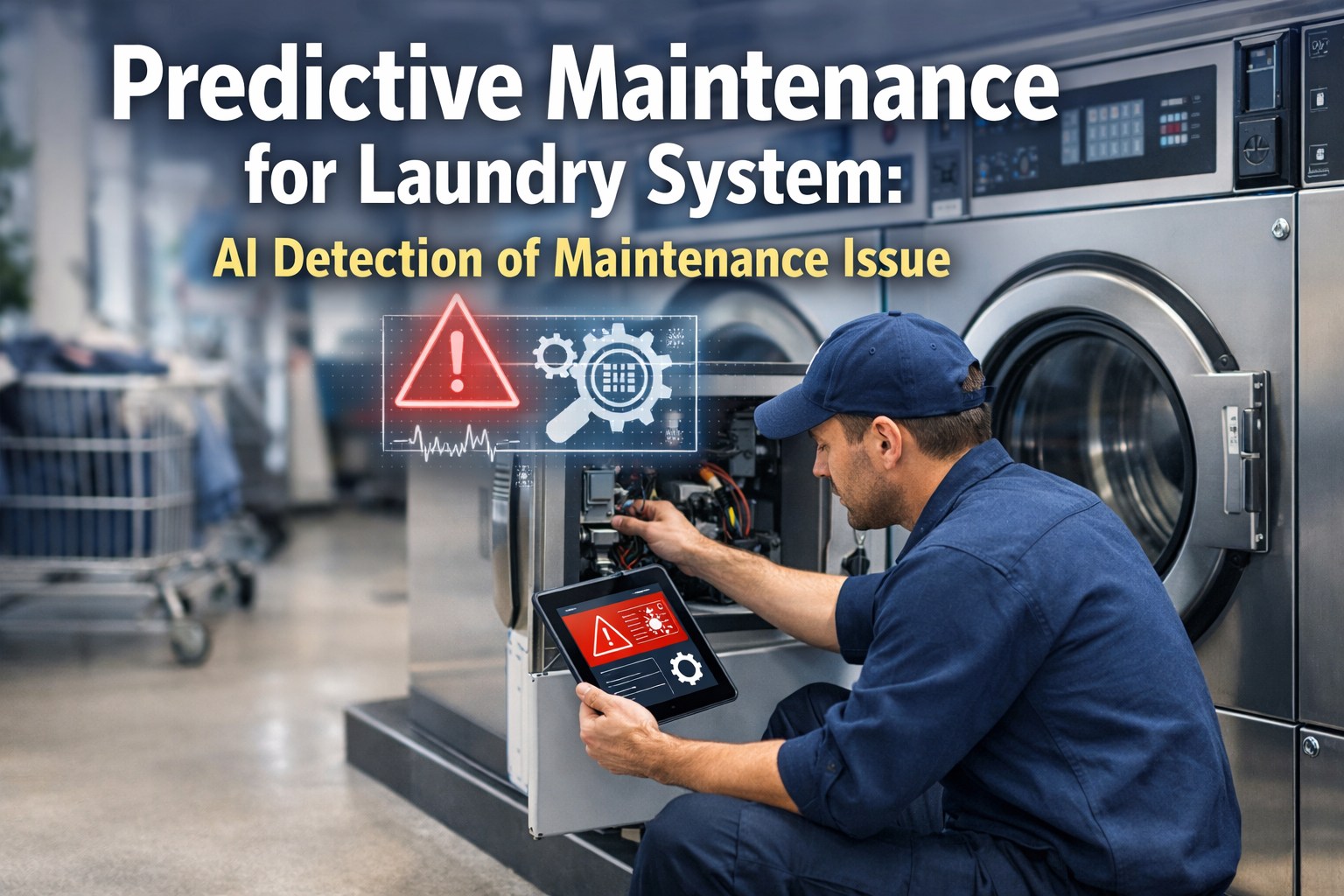
The laundry manager received the emergency call at 6:47 AM on Monday—the main tunnel washer controller had crashed overnight, leaving 2,400 pounds of soiled linens stacked in receiving. What the building management system couldn't reveal: the controller's processor had been showing intermittent communication errors for 31 days. Memory read cycles had been degrading for 6 weeks. Power supply voltage had been drifting 3.1% below specification for 22 days. Control loop timing errors had increased 420% over the past five weeks. Emergency technician callout: $3,200. Controller board replacement: $12,800. Lost production during 18-hour shutdown: $48,000. Outsourcing costs to handle backlog: $18,500. Customer service recovery for delayed deliveries: $12,000. Potential contract cancellation exposure: $250,000+. An AI monitoring system would have detected the processor anomaly 27 days earlier—when a $1,800 board replacement during scheduled downtime would have prevented everything.
Complete Shutdown
$40-120K
AI Prevents: 87%
Emergency Repairs
$3-12K
AI Reduces: 84%
Production Loss
$8K+/day
AI Prevents: 88%
Component Cost
5-7x Price
AI Prevents: 81%
Equipment Life
-50%
AI Extends: 45%
76%
Of laundry equipment failures show detectable degradation patterns weeks before crash
4-8 wks
Average warning window when AI monitors laundry system parameters continuously
92%
Detection accuracy for AI systems predicting commercial laundry equipment failures
AI-powered predictive maintenance transforms commercial laundry system management from reactive emergency response to proactive protection. Instead of waiting for complete breakdowns, bearing seizures, or controller crashes—which occur after damage has already begun—machine learning algorithms detect the subtle patterns that precede equipment problems weeks in advance. When laundry operations implement AI-powered equipment monitoring, they're not just preventing failures—they're building the operational intelligence that turns emergency shutdowns into scheduled maintenance windows.
How AI Detects Laundry Equipment Faults Before Failures Occur
Traditional laundry monitoring systems track equipment operations as binary states—running or faulted—and alarm only when the system crashes or enters safety lockout. By then, the equipment has already failed, production has stopped, and emergency repairs are unavoidable. AI takes a fundamentally different approach: analyzing dozens of correlated parameters to identify the conditions that cause equipment failures before the system itself crashes. This predictive capability provides weeks of advance warning instead of zero.
1
Motor & Bearing Health
Vibration Analysis, Current Signature, Temperature Rise, Speed Variance, Load Patterns
Bearing Condition
Motor Efficiency
Failure Proximity
2
Control Systems
Processor Load, Memory Integrity, I/O Response, Communication Bus, Timing Accuracy
Controller Health
Logic Stability
System Reliability
3
Thermal Performance
Heat Exchange Efficiency, Temperature Differentials, Thermal Gradients, Recovery Time, Energy Input
Heat Transfer
Element Health
Efficiency Trend
4
Mechanical Systems
Belt Tension, Drum Balance, Seal Integrity, Valve Response, Actuator Performance
Component Wear
Alignment Status
Replacement Timing
5
Fluid Systems
Water Flow Rates, Pressure Stability, Leak Detection, Drain Performance, Chemical Injection
Flow Health
Pressure Trends
Valve Condition
6
Process Quality
Cycle Time Variance, G-Force Achievement, Moisture Removal, Temperature Accuracy, Chemical Dosing
Performance Drift
Quality Index
Calibration Need
The AI Detection Process: From Sensor Data to Predictive Alert
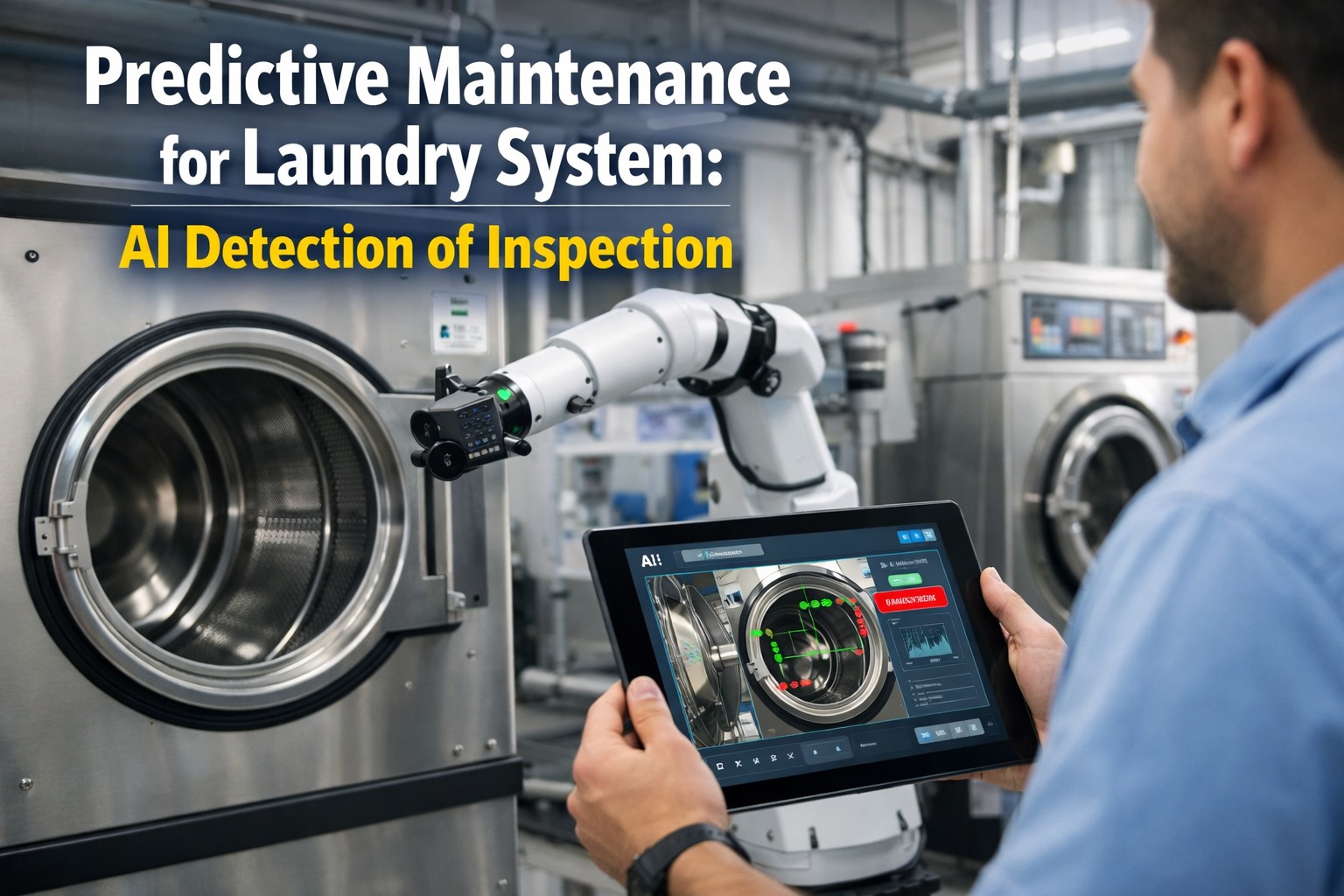
Understanding how AI transforms raw equipment telemetry into actionable maintenance intelligence helps laundry managers evaluate and implement predictive systems. The process runs continuously, analyzing thousands of data points every second to identify developing problems invisible to traditional monitoring. When your team can see how AI detection works on your laundry equipment, the potential for preventing failures becomes immediately clear.
1
Continuous Data Capture
IoT sensors stream vibration, temperature, power consumption, and control system health every 50 milliseconds
2
Baseline Comparison
AI compares current readings against baselines adjusted for load size, cycle type, and environmental conditions
3
Pattern Recognition
Machine learning identifies subtle deviations matching known equipment failure signatures across fleet data
4
Root Cause Analysis
AI determines probable cause—bearing wear, motor degradation, control failure, or mechanical component issue
5
Predictive Alert
System generates prioritized work order with diagnosis, failure timeline, and recommended corrective action
See What Your Laundry Equipment Is Trying to Tell You
AI-powered monitoring detects equipment faults weeks before traditional alarms trigger. Find out what predictive analytics would reveal about your system health.
Common Laundry Equipment Faults: What AI Detects Early
Laundry equipment problems don't appear suddenly—they develop through specific failure modes that AI can identify weeks before system crashes occur. Understanding these patterns helps facility teams appreciate why AI monitoring succeeds where traditional approaches fail. Each fault type has distinct signatures that machine learning recognizes from historical failure data across thousands of commercial laundry systems.
AI Detection Signals: Vibration frequency shifts, current signature anomalies, temperature rise patterns, speed irregularities, load imbalance indicators, bearing resonance changes
4-8 weeks advance warning
AI Detection Signals: Processor timing drift, memory write errors, I/O response delays, communication bus faults, power supply voltage variation, logic execution anomalies
3-6 weeks advance warning
AI Detection Signals: Temperature ramp rate decline, energy consumption increase for target temps, thermal differential changes, recovery time extension, element resistance drift
5-10 weeks advance warning
AI Detection Signals: Belt tension variation, seal leakage patterns, valve response time increase, drum balance shift, actuator position feedback errors, cycle time creep
3-7 weeks advance warning
Traditional Monitoring vs. AI Predictive Detection
The fundamental difference between traditional laundry equipment monitoring and AI predictive detection is timing. Traditional systems tell you the equipment has crashed; AI tells you a crash is developing. This shift from reactive to predictive changes everything about how commercial laundries protect their equipment investments and production capacity. Industry data confirms predictive maintenance delivers 52% cost savings over reactive approaches. Properties ready to see the difference can create a free account and start monitoring immediately.
Detection Timing:
After breakdown/lockout
Warning Time:
Zero—already failed
Root Cause:
Hours of diagnosis
Trend Analysis:
Post-mortem only
Work Orders:
Emergency dispatch
Detection Timing:
Pattern deviation detected
Warning Time:
4-8 weeks advance
Root Cause:
AI-identified component
Trend Analysis:
Continuous automated
Work Orders:
Scheduled with parts
92%
laundry equipment fault prediction accuracy
84%
fewer emergency service calls
52%
lower equipment maintenance costs
Implementation Lifecycle: From Pilot to Full Deployment
Successful AI laundry equipment monitoring implementations follow a proven lifecycle—starting with baseline establishment, progressing through algorithm training, and culminating in fully automated predictive maintenance. This phased approach validates savings, builds internal expertise, and ensures the AI system learns your specific equipment characteristics before making critical predictions.
Baseline
Sensor installation, Data collection, Normal operation mapping, Equipment profiling
Training
AI model calibration, Failure pattern loading, Threshold optimization, Alert tuning
Validation
Prediction testing, False positive reduction, Technician feedback, Model refinement
Automation
CMMS integration, Auto work orders, Escalation rules, Dashboard deployment
Optimization
Continuous improvement, Accuracy tracking, Fleet expansion, ROI measurement
ROI: What Commercial Laundries Actually Achieve with AI Monitoring
The business case for AI-powered laundry equipment fault detection extends beyond prevented crashes. Reduced emergency repairs, extended component life, lower outsourcing costs, and improved customer satisfaction all contribute to ROI. Operations that discuss their specific situation with our team receive customized ROI projections based on their equipment fleet, production volume, and current maintenance approach.
Weeks 1-3
Baseline & Training
Sensor integration, Data collection, AI learning equipment behavior patterns
Foundation building
Weeks 4-10
Early Detection
First predictive alerts, Prevented faults identified, Component optimization begins
30-40% savings begin
Months 3-6
Full Prediction
Mature AI models, Automated work orders, Comprehensive equipment trending
45-52% savings
Month 6+
Sustained Value
Continuous improvement, Equipment life extension, Zero unplanned breakdowns
52%+ sustained
Typical Payback Period
Single Prevented Breakdown
Expert Perspective: Why AI Succeeds Where Traditional Monitoring Fails
Industry Insight
"Traditional laundry monitoring is like checking your car's oil light—you only know there's a problem when the engine is already damaged. AI equipment monitoring is like having a mechanic who hears that bearing starting to wear, sees that belt losing tension, feels that motor drawing more current than it should, weeks before anything breaks. We've seen commercial laundries go from 5-6 emergency breakdowns per year to zero in the first 18 months—not because they upgraded their equipment, but because they're catching the vibration pattern that predicts bearing failure in 32 days, the temperature trend that indicates heating element degradation in 47 days, the control system errors that forecast controller crash in 23 days."
— Commercial Laundry Systems Engineer & Maintenance Specialist, 28 years industry experience
Multi-Parameter Analysis
AI correlates vibration, temperature, power consumption, and cycle performance simultaneously—detecting patterns no single sensor could reveal.
Component-Level Precision
Unlike generic fault codes, AI pinpoints the specific failing component—bearing #3, heating element bank 2, inlet valve actuator—enabling targeted replacement.
Cross-Fleet Intelligence
Machine learning leverages failure patterns from thousands of laundry systems to recognize developing problems specific to your equipment manufacturer and model.
Implementation Requirements: What AI Laundry Monitoring Needs
AI laundry equipment monitoring builds on existing infrastructure where possible but requires specific technical foundations for accurate fault prediction. Understanding these requirements helps operations teams evaluate implementation feasibility and plan integration strategically.
Vibration sensors, Temperature probes, Power monitoring, Control system interface, Flow sensors, Pressure transducers
Comprehensive data capture
Facility network, Cellular backup, Cloud platform connection, Secure data transmission, Edge computing
Real-time data streaming
Cloud AI platform, Machine learning models, CMMS integration, Mobile alerts, Analytics dashboards, Reporting tools
Predictive intelligence
Stop Equipment Failures Before They Stop Your Production
Oxmaint's AI-powered predictive maintenance gives commercial laundries 4-8 weeks advance warning before equipment failures. Protect your operations, protect your customers, protect your revenue.
Frequently Asked Questions
How accurately can AI predict commercial laundry equipment faults?
Modern AI predictive maintenance systems achieve 89-92% accuracy in detecting conditions that lead to laundry equipment failures 4-8 weeks before traditional monitoring would detect any problem—which typically means after the breakdown has already occurred. Accuracy improves over time as AI learns your specific equipment characteristics, production patterns, and environmental factors. Systems monitoring vibration, temperature, power consumption, control system health, and process performance achieve the highest accuracy for equipment fault prediction. The remaining 8-11% of unpredicted failures are typically sudden catastrophic events like power surges, foreign object damage, or operator errors.
What types of laundry equipment faults can AI detect early?
AI excels at detecting the gradual degradation that causes equipment failures: bearing and motor degradation (32-38% of cases), control system failure (24-30%), heating element degradation (18-24%), and mechanical component wear (15-22%). Each fault type has distinct signatures—bearing problems show as vibration pattern changes and temperature rise, control issues create timing errors and communication faults, heating element degradation produces temperature ramp rate decline and energy efficiency loss, and mechanical wear creates cycle time drift and performance variation. Traditional monitoring only knows the equipment has failed; AI sees the developing causes weeks in advance.
How much does AI laundry equipment monitoring cost to implement?
Initial implementation typically costs $1,200-4,500 per machine for sensor hardware installation (vibration, temperature, power, control interface), plus $400-800 for network connectivity if not already present, with ongoing cloud platform subscriptions of $200-600/month depending on equipment count. Most commercial laundries recover this investment with a single prevented major breakdown. An emergency washer-extractor bearing replacement costing $18,000-28,000 plus production downtime versus a $4,500 scheduled bearing replacement during planned maintenance demonstrates the value proposition. Many implementations leverage existing control system data ports, reducing initial hardware costs significantly.
How long before AI starts making accurate equipment predictions?
AI systems require a baseline learning period of 3-4 weeks to understand normal equipment behavior before making reliable predictions. During this period, the system collects operating data across varying load sizes, cycle types, and operating conditions to establish performance baselines. Industry-wide failure pattern libraries for major laundry equipment manufacturers (Alliance, UniMac, Continental, Milnor, Kannegiesser, Jensen) allow some predictions even during baseline collection. Full prediction accuracy is typically achieved within 60-90 days as the AI accumulates enough operational data to distinguish true anomalies from normal equipment variation and load-dependent performance changes.
Does AI monitoring work with all laundry equipment brands and ages?
Yes—AI monitoring platforms are designed to integrate with commercial laundry equipment from all major manufacturers and across equipment generations from 1990s mechanical controls to modern touchscreen systems. Interface methods vary by equipment type: modern equipment often provides diagnostic port access or network integration, while older equipment requires external sensor installation for vibration, temperature, and power monitoring. The AI platform operates as an analytics layer above the equipment, not a modification to it—no changes to safety systems or compliance certification. Equipment without digital diagnostic access can still achieve 88%+ prediction accuracy through external sensor monitoring of vibration, temperature, current draw, and cycle performance.
Ready to Predict Equipment Faults Before They Happen?
Join hundreds of commercial laundries using Oxmaint to predict equipment faults weeks in advance. Start protecting your operations today.


.png)