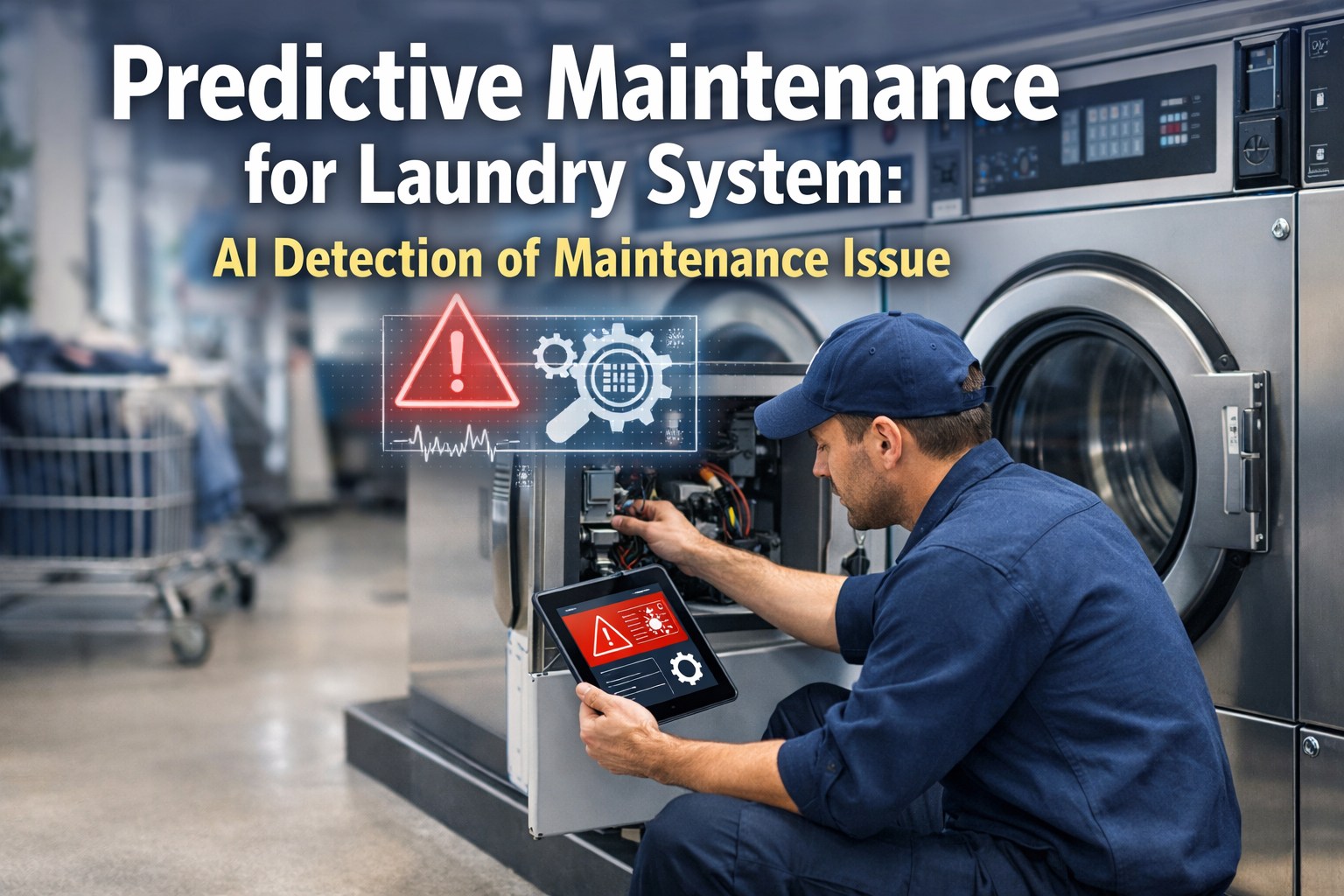
The maintenance supervisor got the call at 4:47 AM on the busiest Monday of the month—the hospital's primary 400-pound washer extractor had seized mid-cycle with a full load of surgical linens. The bearing had catastrophically failed, sending metal fragments into the drum seal and destroying the main shaft. Emergency repairs weren't possible; the machine needed complete disassembly. Rental equipment couldn't arrive until Wednesday. What the maintenance team didn't know: bearing temperature had been trending 18°F above baseline for 22 days. Vibration signatures showed classic outer race degradation for four weeks. Motor amp draw had been climbing 12% above normal since early in the previous month. Oil analysis from three weeks prior flagged elevated iron particulates. An AI monitoring system would have detected the bearing anomaly 26 days earlier—when a $1,800 bearing replacement during scheduled downtime would have prevented the $67,000 crisis now unfolding, including $34,000 in emergency repairs, $18,000 in rental equipment, and $15,000 in overtime labor and expedited linen services.
Emergency Repairs
$25-75K
AI Prevents: 78%
Production Loss
$8K+/day
AI Reduces: 85%
Energy Waste
15-30%
AI Cuts: 22%
Parts Markup
3-5x Cost
AI Prevents: 80%
Equipment Life
-40%
AI Extends: 35%
78%
Of laundry equipment failures show detectable degradation patterns weeks before breakdown
3-6 wks
Average warning window when AI monitors equipment parameters continuously
92%
Detection accuracy for AI systems predicting laundry equipment failures
AI-powered predictive maintenance transforms laundry operations from reactive emergency response to proactive equipment protection. Instead of waiting for bearing seizures, motor burnouts, or complete breakdowns—which occur after damage has already begun—machine learning algorithms detect the subtle patterns that precede equipment failures weeks in advance. When laundry teams implement AI-powered equipment monitoring, they're not just preventing failures—they're building the operational intelligence that turns emergency shutdowns into scheduled maintenance windows coordinated with production schedules.
How AI Detects Laundry Equipment Failures Before They Occur
Traditional laundry maintenance relies on calendar-based schedules or waiting for obvious symptoms—strange noises, visible vibration, or complete failure. By then, secondary damage has often occurred, costs have multiplied, and production has stopped. AI takes a fundamentally different approach: analyzing dozens of correlated parameters to identify the conditions that cause equipment failures before the symptoms become apparent. This predictive capability provides weeks of advance warning instead of hours or minutes.
1
Vibration Analysis
Bearing Frequencies, Imbalance, Misalignment, Looseness, Resonance
Bearing Health
Shaft Condition
Mount Integrity
2
Motor Performance
Amp Draw, Power Factor, Winding Temp, Startup Current, Load Profile
Winding Health
Efficiency Trend
Thermal Stress
3
Thermal Patterns
Bearing Temp, Motor Temp, Exhaust Temp, Heating Elements, Ambient Delta
Hot Spots
Heat Transfer
Insulation
4
Mechanical Systems
Belt Tension, Chain Wear, Seal Condition, Gasket Integrity, Door Alignment
Drive Condition
Seal Life
Wear Rate
5
Fluid Systems
Water Pressure, Flow Rate, Drain Time, Pump Current, Valve Response
Pump Health
Valve Function
Flow Efficiency
6
Operational Patterns
Cycle Times, Load Weights, Extract G-Force, Runtime Hours, Error Frequency
Performance Drift
Anomaly Score
Degradation Rate
The AI Detection Process: From Sensor Data to Predictive Alert
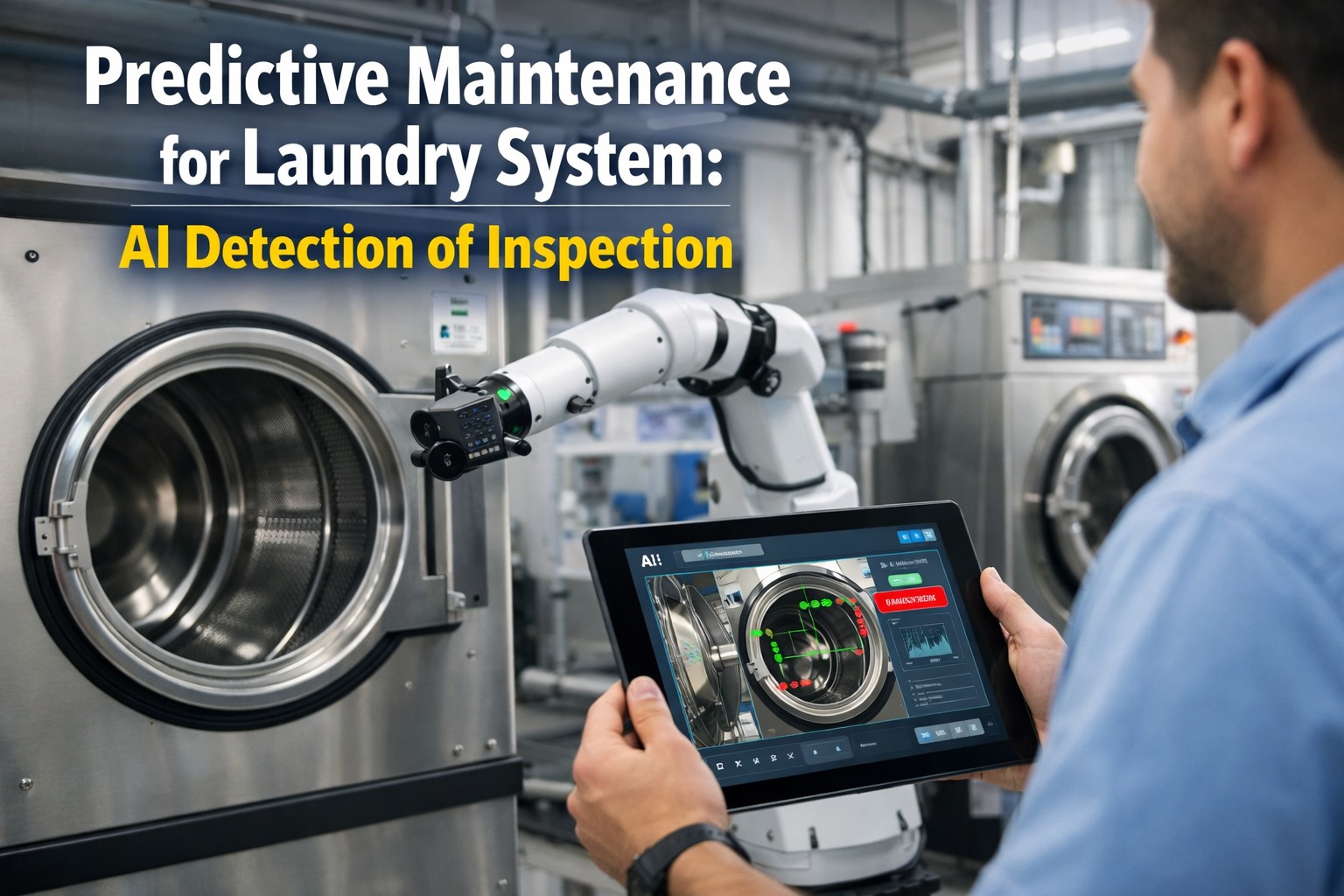
Understanding how AI transforms raw equipment telemetry into actionable maintenance intelligence helps laundry teams evaluate and implement predictive systems. The process runs continuously, analyzing thousands of data points every minute to identify developing problems invisible to human observation or traditional monitoring. When your team can see how AI detection works on your laundry equipment, the potential for preventing failures becomes immediately clear.
1
Continuous Data Capture
IoT sensors stream vibration, temperature, current, pressure, and cycle data every 30 seconds from each machine
2
Baseline Comparison
AI compares current readings against equipment-specific baselines adjusted for load size, cycle type, and age
3
Pattern Recognition
Machine learning identifies subtle deviations matching known failure signatures from thousands of documented cases
4
Root Cause Analysis
AI determines probable cause—bearing wear, motor degradation, belt slip, pump cavitation, or heating element failure
5
Predictive Alert
System generates prioritized work order with diagnosis, remaining useful life estimate, and recommended action
See What Your Laundry Equipment Is Trying to Tell You
AI-powered monitoring detects equipment failures weeks before traditional methods. Discover what predictive analytics would reveal about your equipment health.
Common Laundry Equipment Failures: What AI Detects Early
Laundry equipment failures don't appear suddenly—they develop through specific degradation modes that AI can identify weeks before catastrophic breakdown occurs. Understanding these patterns helps operations teams appreciate why AI monitoring succeeds where traditional approaches fail. Each failure type has distinct signatures that machine learning recognizes from historical data across thousands of laundry installations worldwide.
AI Detection Signals: Increasing vibration at bearing frequencies, temperature rise above baseline, characteristic acoustic signatures, lubricant degradation patterns, axial/radial play indicators
4-8 weeks advance warning
AI Detection Signals: Amp draw deviation from baseline, power factor degradation, winding resistance changes, startup current anomalies, VFD fault frequency increase
3-6 weeks advance warning
AI Detection Signals: Belt slip signatures in vibration data, tension loss patterns, pulley alignment drift, chain elongation indicators, sprocket wear acoustics
2-4 weeks advance warning
AI Detection Signals: Pump current anomalies, cavitation signatures, valve response time drift, pressure fluctuation patterns, flow rate degradation, seal leak indicators
2-5 weeks advance warning
Traditional Maintenance vs. AI Predictive Detection
The fundamental difference between traditional laundry maintenance and AI predictive detection is timing. Traditional approaches tell you equipment has failed or is showing obvious symptoms; AI tells you failure is developing weeks before any human-detectable signs appear. This shift from reactive to predictive changes everything about how laundry operations protect their equipment investments. Industry data confirms predictive maintenance delivers 45% cost savings over reactive approaches. Operations ready to see the difference can create a free account and start monitoring immediately.
Detection Timing:
After breakdown/symptoms
Warning Time:
Hours to zero
Root Cause:
Post-failure diagnosis
Parts Availability:
Emergency sourcing
Production Impact:
Unplanned shutdown
Detection Timing:
Early degradation patterns
Warning Time:
3-6 weeks advance
Root Cause:
AI-identified component
Parts Availability:
Pre-ordered & staged
Production Impact:
Scheduled window
92%
failure prediction accuracy
78%
fewer emergency repairs
45%
lower maintenance costs
Equipment-Specific AI Monitoring Capabilities
Different laundry equipment types require tailored AI monitoring approaches based on their unique failure modes, criticality, and operational characteristics. Understanding how AI adapts to each equipment category helps operations teams prioritize implementation and maximize protection for their most critical assets.
AI Monitors: Main bearing vibration, motor current signature, door seal pressure, suspension dampening, extract imbalance, drain pump performance
Prediction Accuracy: 94%
AI Monitors: Burner efficiency, exhaust temperature profile, drum bearing condition, belt tension/wear, airflow restriction, moisture sensor calibration
Prediction Accuracy: 91%
AI Monitors: Chest temperature uniformity, roll bearing vibration, padding compression, wax buildup patterns, belt tracking, steam trap function
Prediction Accuracy: 89%
AI Monitors: Module drive health, transfer mechanism timing, water flow balance, chemical injection accuracy, press cylinder pressure, conveyor alignment
Prediction Accuracy: 93%
Implementation Lifecycle: From Pilot to Full Deployment
Successful AI laundry equipment monitoring implementations follow a proven lifecycle—starting with baseline establishment, progressing through algorithm training, and culminating in fully automated predictive maintenance. This phased approach validates savings, builds internal expertise, and ensures the AI system learns your specific equipment characteristics before making critical predictions.
Baseline
Sensor deployment, Data collection, Normal operation mapping, Equipment profiling
Training
AI model calibration, Failure pattern loading, Threshold optimization, Alert tuning
Validation
Prediction testing, False positive reduction, Technician feedback, Model refinement
Automation
CMMS integration, Auto work orders, Parts pre-staging, Dashboard deployment
Optimization
Continuous improvement, Fleet expansion, Accuracy tracking, ROI measurement
ROI: What Laundry Operations Actually Achieve with AI Monitoring
The business case for AI-powered laundry equipment monitoring extends beyond prevented failures. Energy optimization from properly maintained equipment, extended asset lifecycles, reduced emergency labor costs, and improved production reliability all contribute to ROI. Operations that discuss their specific situation with our team receive customized ROI projections based on their equipment inventory, production volume, and current maintenance approach.
Weeks 1-4
Baseline & Training
Sensor installation, Data collection, AI learning equipment behavior patterns
Foundation building
Months 2-3
Early Detection
First predictive alerts, Prevented failures identified, Energy anomalies flagged
20-30% savings begin
Months 4-6
Full Prediction
Mature AI models, Automated work orders, Comprehensive equipment trending
35-45% savings
Year 1+
Sustained Value
Continuous improvement, Equipment life extension, Near-zero unplanned failures
45%+ sustained
Typical Payback Period
3-5 Months
Expert Perspective: Why AI Succeeds Where Traditional Monitoring Fails
Industry Insight
"In 25 years of laundry maintenance, I've seen the same pattern thousands of times: a bearing that's been degrading for weeks finally seizes on the busiest day of the month, a motor that's been drawing extra amps for a month burns out during peak production, a belt that's been slipping for weeks finally breaks at the worst possible moment. AI doesn't prevent failures by magic—it prevents them by seeing what humans can't: the 0.3mm increase in vibration amplitude, the 2-degree temperature rise, the 50-millisecond timing drift that means a component has three weeks of life left instead of three months. That visibility is the difference between a $2,000 scheduled repair and a $40,000 emergency."
— Senior Maintenance Director, Multi-site Healthcare Laundry Network, 25 years experience
Micro-Signal Detection
AI identifies subtle degradation signatures humans can't detect—like the 15Hz vibration harmonic that indicates bearing outer race wear four weeks before audible symptoms.
Context-Aware Analysis
Unlike fixed thresholds, AI baselines adjust for load size, cycle type, ambient conditions, and equipment age—detecting true anomalies, not normal variation.
Cross-Fleet Intelligence
Machine learning leverages failure patterns from thousands of similar machines worldwide to recognize developing problems specific to your equipment make and model.
Implementation Requirements: What AI Monitoring Needs
AI laundry equipment monitoring builds on existing infrastructure where possible but requires specific technical foundations for accurate failure prediction. Understanding these requirements helps operations teams evaluate implementation feasibility and plan sensor deployment strategically.
Vibration sensors, Temperature monitors, Current transformers, Pressure transducers, Flow meters
Comprehensive data capture
WiFi, cellular, or LoRaWAN gateway, Cloud platform connection, Secure data transmission
Real-time data streaming
Cloud AI platform, Machine learning models, CMMS integration, Mobile alerts and dashboards
Predictive intelligence
Stop Equipment Failures Before They Stop Your Production
OXmaint's AI-powered predictive maintenance gives laundry teams 3-6 weeks advance warning before equipment failures. Protect your equipment, protect your production, protect your budget.
Frequently Asked Questions
How accurately can AI predict laundry equipment failures?
Modern AI predictive maintenance systems achieve 89-94% accuracy in detecting conditions that lead to equipment failures 3-6 weeks before traditional methods would detect any problem—which typically means after obvious symptoms appear or complete breakdown occurs. Accuracy varies by equipment type: washer extractors achieve 94% prediction accuracy due to their predictable failure modes, while more complex equipment like tunnel washers achieves 93%. Accuracy improves over time as AI learns your specific equipment characteristics, operating patterns, and environmental factors. The remaining 6-11% of unpredicted failures are typically sudden catastrophic events like electrical surges, foreign object damage, or unprecedented operating conditions.
What laundry equipment failures can AI detect early?
AI excels at detecting the gradual degradation that causes most laundry equipment failures: bearing wear and degradation (35-42% of failures), motor and drive system issues (22-28%), belt and drivetrain wear (15-20%), and pump/valve failures (12-18%). Each failure type has distinct signatures—bearing problems show increasing vibration at characteristic frequencies plus temperature rise, motor issues create amp draw deviations and power factor changes, belt wear produces slip signatures and tension anomalies, and pump problems cause current fluctuations and flow degradation. Traditional maintenance only detects these after obvious symptoms appear; AI sees the developing patterns weeks earlier when repairs are simpler and cheaper.
How much does AI laundry equipment monitoring cost to implement?
Initial implementation typically costs $400-1,500 per machine for sensors (vibration, temperature, current, and relevant process sensors), plus $200-500 for gateway equipment if not already present, with ongoing cloud platform subscriptions of $75-250/month depending on machine count. Most operations recover this investment within 3-5 months through a single prevented major failure. A bearing replacement costing $1,800 during scheduled maintenance versus $35,000+ for emergency repair with secondary damage demonstrates the value proposition. Many implementations leverage existing PLC data and building networks, reducing initial hardware costs. ROI accelerates with fleet size—monitoring 10+ machines typically achieves payback in 60-90 days.
How long before AI starts making accurate equipment predictions?
AI systems require a baseline learning period of 2-4 weeks to understand normal equipment behavior before making reliable predictions. During this period, the system collects operating data across varying load sizes, cycle types, and production schedules to establish performance baselines for each machine. Industry-wide failure pattern libraries for major equipment manufacturers (Milnor, Continental, Chicago, Kannegiesser, Jensen, Pellerin Milnor) allow some predictions even during baseline collection. Full prediction accuracy is typically achieved within 60-90 days as the AI accumulates enough operational data to distinguish true anomalies from normal operational variation specific to your equipment and operating environment.
Does AI monitoring work with older laundry equipment?
Yes—AI monitoring platforms work with laundry equipment of any age, from 1980s mechanical machines to modern PLC-controlled systems. The approach differs by equipment generation: modern machines often provide direct data access through PLCs, Modbus, or proprietary protocols, while older equipment requires external sensor installation for vibration, temperature, current, and process monitoring. The AI platform analyzes sensor data regardless of how it's collected—the physics of bearing degradation, motor wear, and mechanical failure don't change based on equipment age. In fact, older equipment often benefits most from AI monitoring because failure risks are higher and replacement decisions depend on accurate remaining useful life projections that AI can provide.
Ready to Predict Equipment Failures Before They Happen?
Join thousands of laundry operations using OXmaint to predict equipment failures weeks in advance. Start protecting your equipment investment today.



.png)