A full-service hotel with 350 rooms was replacing its chiller system every 8 years based on age alone — spending $280,000 per replacement cycle on equipment that condition data would have shown had 3–4 additional years of useful life. After deploying predictive maintenance through Oxmaint CMMS — start a free trial to see how it works, their engineering team extended average HVAC asset life by 28%, cut unplanned equipment failures by 44%, and reduced total maintenance spend by $190,000 in the first year. Guest complaint rates tied to room comfort dropped by 61%. If your hotel is still running calendar-based PM schedules, you are leaving measurable money and guest satisfaction on the table — book a demo with Oxmaint to see predictive maintenance in action across a live hotel environment.
44%
Reduction in unplanned equipment failures
4.8x
Emergency repair cost vs. planned intervention
28%
Extension in average HVAC asset useful life
61%
Drop in guest complaints from equipment failures
Foundation
What Is Predictive Maintenance for Hotel Equipment?
Predictive maintenance (PdM) uses real-time sensor data, equipment telemetry, and AI-driven analytics to forecast equipment failures before they occur — replacing fixed-schedule PM with interventions timed to actual asset condition.
Condition-Based
Maintenance triggered by actual asset health data — vibration, temperature, pressure, runtime — not arbitrary calendar intervals
AI-Powered
Machine learning models detect anomaly patterns in sensor streams and rank failure probability with 2–4 week advance warning windows
Asset-Specific
Every asset — chiller, elevator, pool pump, kitchen equipment — has its own condition profile, failure history, and predictive threshold
ROI-Measurable
Savings are tracked asset-by-asset: reduced repair costs, extended replacement cycles, and lower emergency spend all quantified in the CMMS
3 Maintenance Strategies — Only One Prevents Failures
Reactive
Fix after failure. Highest cost, highest guest impact, zero warning.
Preventive
Fixed schedules. Wasteful on healthy assets. Still misses condition failures.
Predictive
Condition-driven. Catches failures 2–4 weeks early. Maximum ROI.
Equipment Focus
Hotel Equipment That Needs Predictive Maintenance Most
Not every asset warrants sensor-level monitoring — but the eight categories below represent 80% of unplanned downtime events and emergency repair spend across full-service hotel operations. These are the highest-leverage targets for predictive maintenance deployment.
Failure impact: Critical — affects every occupied room
Monitor refrigerant pressure, compressor vibration, and filter differential
Runtime-based triggers replace calendar PM schedules
Predict coil fouling 3 weeks before efficiency drop affects guest comfort
HVAC failures cost an avg. $22,000 per emergency replacement event
Failure impact: High — direct guest safety and mobility concern
Track door cycle counts, motor temperature, and brake wear rates
Alert on abnormal travel time variance — early rope and pulley indicator
Reduce elevator downtime by 52% through cycle-based servicing
Elevator entrapments generate avg. $45,000 in liability and remediation cost
Failure impact: Critical — hot water outages affect all guest rooms
Monitor flue gas temperature, burner cycling rate, and scale accumulation
Predict heat exchanger failure 4–6 weeks ahead via efficiency degradation
Extend boiler life by 30% with condition-based descaling schedules
Hot water outages generate immediate 1-star reviews within 90 minutes of failure
Failure impact: High — closure triggers health inspections and revenue loss
Continuous pH, chlorine, and pump flow monitoring against threshold bands
Predict filter media degradation before water quality compliance fails
Alert on pump cavitation signatures 2 weeks before mechanical failure
Pool closures cost full-service hotels avg. $8,500 per day in amenity revenue
Failure impact: High — F&B revenue exposure and health compliance risk
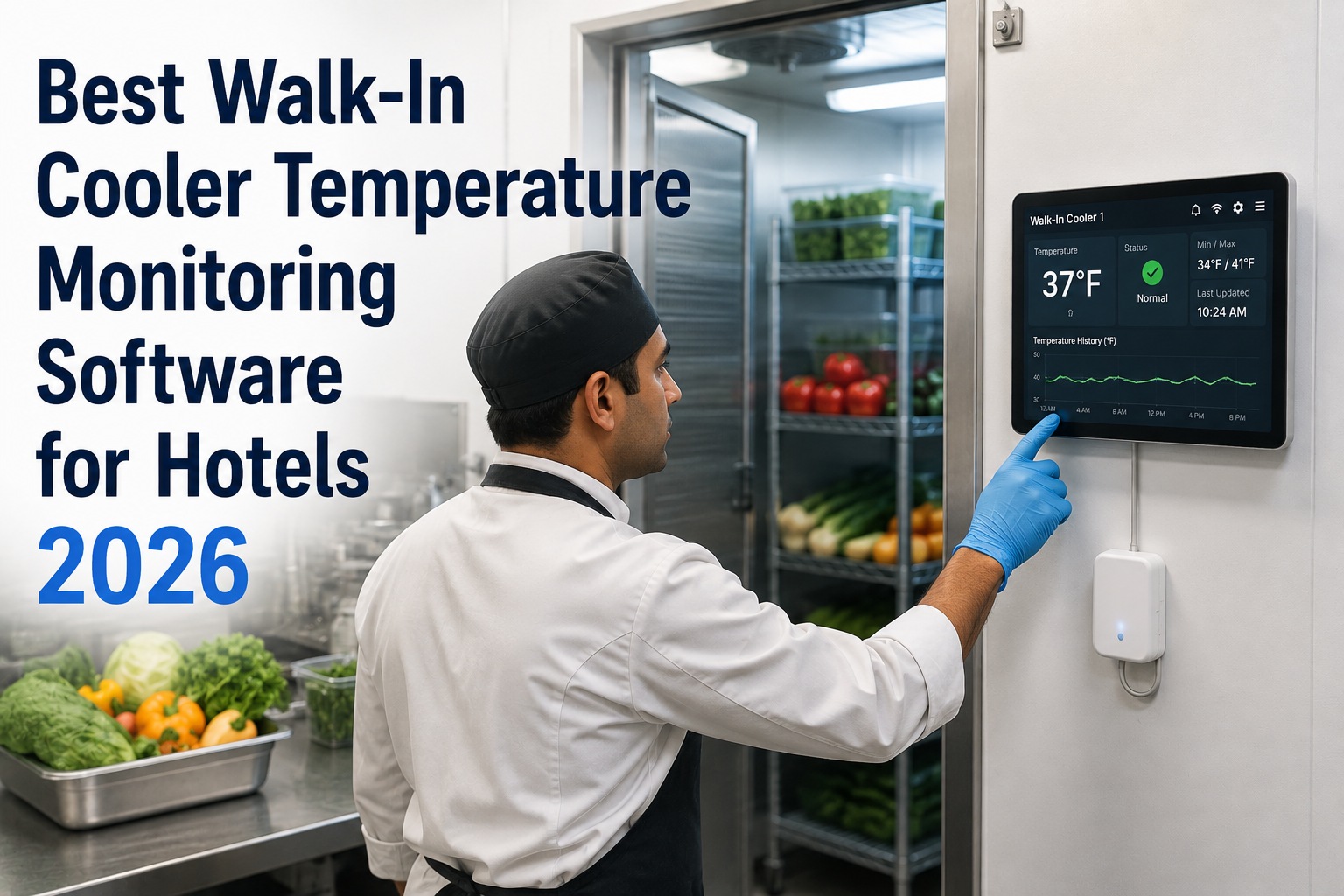
Monitor compressor temperatures in walk-in coolers against food safety bands
Track conveyor oven belt wear cycles and heating element efficiency
Predict refrigerant leaks in cold storage 3 weeks before spoilage risk
Walk-in refrigeration failures cause avg. $30,000 in food spoilage per incident
Failure impact: Critical — full property outage risk
Thermal imaging on switchgear to catch connection failures before arc events
Generator load bank testing results tracked against baseline degradation curves
UPS battery health monitoring with replacement timeline projections
Generator failures during peak occupancy average $120,000 in combined losses
Failure impact: Medium-High — housekeeping throughput and linen availability
Track cycle counts, drum bearing vibration, and heating element draw
Predict belt and bearing wear before mid-cycle failures jam linen workflows
Reduce laundry equipment downtime by 36% with cycle-based maintenance
Laundry equipment failures delay housekeeping by 2–4 hours per incident
Failure impact: Critical — regulatory compliance and guest safety
Automated inspection scheduling for sprinkler heads, smoke detectors, and suppression
Compliance status tracked by asset across all properties with digital sign-off
Alert on battery backup degradation in panel systems 60 days before failure
Fire safety compliance failures generate avg. $75,000 in fines and remediation
Pain Points
Why Hotels Still Lose to Reactive Maintenance
Despite the clear ROI of predictive maintenance, most hotel engineering teams still default to reactive or calendar-based approaches. These six operational realities explain why — and exactly how predictive maintenance eliminates each one.
01
No Real-Time Asset Visibility
Engineering teams discover failures when guests complain — not from monitoring dashboards. 68% of hotel equipment failures are first reported by guests, not maintenance staff.
02
Calendar PM Wastes Budget
Servicing healthy equipment on fixed schedules wastes 22% of PM budgets. Busy periods mean PMs get skipped. Asset condition varies with occupancy loads — fixed dates don't.
03
No Failure History Per Asset
Without digital maintenance records per asset, patterns are invisible. The same equipment fails repeatedly because root causes are never identified or tracked over time.
04
Emergency Repair Costs Spike
Emergency repairs cost 4.8x more than planned interventions. After-hours callouts, expedited parts, and guest compensation multiply costs per incident by 3–6x.
05
CapEx Decisions Lack Data
Asset replacement decisions based on age and gut feel replace equipment with 3–4 years of useful life remaining. 22% of hotel CapEx goes to premature replacements annually.
06
Multi-Property Blind Spots
Portfolio operators with 5+ properties have no consolidated equipment health view. A failing chiller at Property C is invisible until it disrupts guests and triggers an emergency callout.
The Oxmaint Approach
How Oxmaint Delivers Predictive Maintenance Across Hotel Properties
Oxmaint is purpose-built for multi-site commercial and hospitality operations. The predictive maintenance engine connects IoT sensors, asset condition data, and AI-driven work order automation into a single platform. Ready to see it live? Book a 30-minute demo or start your free trial today — no setup fees required.
1
Asset Registry with Condition Scoring
Every asset is registered under a full hierarchy — Portfolio > Property > System > Asset > Component. Each record includes manufacturer specs, install date, service history, current condition score (0–100), and predicted remaining useful life. Condition scores update automatically from sensor data and completed work orders.
100% asset visibility from day one — no missing records
2
IoT and Sensor Integration
Connect BMS, SCADA, and third-party IoT sensors to feed real-time telemetry into Oxmaint. Temperature, vibration, pressure, and runtime data stream continuously. When readings cross condition thresholds, the system flags the asset and begins failure probability modeling — no human monitoring required.
67% more data points per asset vs. manual inspection-only programs
3
AI Failure Prediction and Work Order Generation
Anomaly patterns trigger failure probability scores ranked by urgency. High-probability failures auto-generate prioritized work orders assigned to the right technician by skill and availability — with location, diagnostic data, and parts needed pre-populated. Engineering teams arrive informed, not guessing.
2–4 week advance warning before equipment failures occur
4
CapEx Forecasting from Asset Condition Data
Asset condition scores and replacement cost data feed rolling 5–10 year CapEx models. Ownership groups see projected replacement timelines per property and system — with evidence-based justification replacing guesswork. CapEx requests backed by condition data are approved 2.3x faster than estimate-based submissions.
22% CapEx savings from eliminating premature asset replacements
Before vs. After
Reactive vs. Predictive: The Real Numbers for Hotels
The financial gap between reactive and predictive maintenance compounds across multiple cost categories. This comparison reflects a 300-room full-service hotel over a 12-month period.
Reactive Maintenance Status Quo
$48,000+ in emergency repair spendFailures drive callouts at 4.8x the cost of planned interventions
68% of failures discovered by guestsNo monitoring means guest complaints are the first alert system
Calendar-based PM — 22% budget wasteHealthy assets serviced unnecessarily while degraded ones are missed
Asset replaced at 8 years regardless of conditionPremature CapEx spend of $50,000–$280,000 per major asset cycle
Paper compliance records — 3-day audit prepMissing entries trigger citations and brand standard violations
No multi-property visibilityPortfolio-wide asset failures invisible until they impact guests
Predictive Maintenance with Oxmaint
44% reduction in emergency repair spendFailures caught 2–4 weeks early when repair costs a fraction of emergency rates
Failures detected before guest impactSensor alerts trigger work orders 2–4 weeks before equipment disrupts operations
Condition-based PM — right time, right assetService only what needs it. Runtime and sensor triggers replace arbitrary schedules.
Asset replaced when condition data says so28% longer average asset life. CapEx extended by $50K–$280K per major asset.
Auto-generated compliance records — 5 min auditEvery action timestamped, signed, and stored. Zero manual prep required.
Portfolio dashboard across all propertiesKPIs, condition scores, and CapEx exposure visible in one consolidated view
ROI Results
The Measurable ROI of Predictive Maintenance in Hospitality
These outcomes reflect documented results from hospitality operations deploying AI-driven predictive maintenance through CMMS platforms. The ROI is measurable, trackable, and compounds over time.
44%
Fewer Unplanned Equipment Failures
Condition-based intervention eliminates the failures that generate guest complaints, emergency callouts, and brand reputation damage
28%
Longer Average Asset Useful Life
Replacing on condition rather than age extends major equipment lifecycles by an average of 2–3 years — material CapEx deferral per property
31%
Reduction in Total Maintenance Spend
Combining fewer emergencies, optimized PM schedules, and automated workflows cuts total maintenance operating expenditure by nearly one-third
61%
Drop in Guest Maintenance Complaints
Failures caught before they affect occupied rooms drive direct improvements in satisfaction scores, online ratings, and repeat booking rates
Take Action
Catch Equipment Failures Before Your Guests Do
Oxmaint gives hotel engineering teams AI-driven predictive maintenance with real-time asset condition scoring, automated work order generation, and investor-grade CapEx reporting — all without heavy implementation costs or long onboarding timelines. Hotels using Oxmaint reduce unplanned failures by 44% and cut total maintenance spend by 31%. Want to know more about what we do, explore the platform, start a free trial, or book a demo with our hospitality team? We're ready when you are.
FAQ
Frequently Asked Questions
How is predictive maintenance different from preventive maintenance in hotels?
Preventive maintenance runs on fixed schedules — service every 90 days regardless of equipment condition. Predictive maintenance triggers interventions based on actual asset health data: vibration signatures, temperature trends, runtime hours, and pressure readings. The result is maintenance performed exactly when needed — not too early (wasting budget on healthy equipment) and not too late (after a failure has already disrupted guests). Hotels using predictive maintenance reduce PM budget waste by 22% while cutting unplanned failures by 44%.
Start a free trial to see how Oxmaint applies both approaches to your asset register.
What sensors and IoT equipment does Oxmaint connect to?
Oxmaint integrates with building management systems (BMS), SCADA platforms, and major third-party IoT sensor networks via API and direct integrations. Common hotel connections include HVAC telemetry, elevator monitoring systems, water quality sensors, electrical load monitoring, and commercial refrigeration controllers. If your building uses a standard BMS protocol, Oxmaint can typically connect within the first week of deployment.
Book a demo to confirm compatibility with your specific systems.
How quickly does predictive maintenance deliver ROI for hotels?
Most hotel properties see measurable ROI within the first 6–9 months. The fastest returns come from HVAC and elevator PM optimization — these two asset categories typically account for 60–70% of total emergency repair spend. As condition data accumulates, the predictive models improve, and CapEx forecasting becomes increasingly accurate. Full payback on platform costs typically occurs within 12 months for properties above 150 rooms. Smaller properties with high F&B operations achieve similar timelines through kitchen equipment and refrigeration monitoring.
Can Oxmaint support multi-property hotel portfolios with predictive maintenance?
Yes — Oxmaint is built specifically for multi-site hospitality portfolios. The portfolio dashboard aggregates asset condition scores, maintenance KPIs, open work orders, and CapEx exposure across all properties in a single view. Ownership groups and asset managers can benchmark property performance, identify systemic equipment failures appearing across multiple sites, and build consolidated capital plans with evidence from every property's asset register. Portfolio operators managing 5 to 500+ properties use this to eliminate the blind spots that let failures compound undetected across their portfolio.
Get Started Today
Predictive Maintenance Built for Hotel Engineering Teams
From a single boutique property to a 50-hotel portfolio, Oxmaint delivers the asset condition scoring, IoT integration, and AI-driven work order automation that transforms reactive hotel maintenance into a proactive, data-driven operation. No heavy implementation. No long onboarding. Immediate visibility from day one across every asset in your portfolio — from HVAC systems and elevators to pool equipment and commercial kitchens. Trusted by hospitality operations across the USA, UK, UAE, Australia, and beyond.