AHU Fault Detection and Diagnostics for Smart Buildings

By James Smith on May 5, 2026

ahu-fault-detection-diagnostics-smart-buildings

Air handling units are the lungs of every commercial building — and like lungs, they fail silently and gradually before they fail completely. A single AHU serving a 50,000 sq ft floor can be running 18% above its design energy consumption for months before a technician notices, because the degradation happens across dozens of small, individually invisible fault conditions: a filter that has gone from 40% to 85% loaded, a supply fan belt that has stretched 3mm, a chilled water valve that is hunting instead of modulating. Individually, none of these triggers an alarm. Collectively, they represent thousands of dollars in wasted energy, accelerated wear, and building occupant complaints that erode tenant satisfaction. AI-driven AHU fault detection and diagnostics changes this — not by adding more sensors, but by extracting pattern intelligence from the data your BMS already collects and surfacing actionable faults before they become failures. Facilities deploying automated AHU diagnostics reduce unplanned HVAC downtime by an average of 63% and cut AHU energy waste by 17 to 24% within the first year. Start a free OxMaint trial to connect your AHU data to AI diagnostics, or book a 30-minute demo to see the fault detection workflow live.

The Fault Landscape

Most Common AHU Faults and Their Hidden Cost

The faults below account for over 85% of AHU performance degradation in commercial buildings. Most facilities discover them reactively — after energy bills spike, occupants complain, or equipment fails. Fault detection and diagnostics identifies each of these fault signatures weeks or months earlier.

Filter
Filter Loading and Bypass
Energy penalty: +8–15% fan energy as filter loads from 20% to 80%
Detection signal: Rising static pressure differential across filter bank
FDD trigger: dP exceeds set threshold or rate of rise exceeds baseline
Moderate — Frequent
Fan
Supply and Return Fan Faults
Energy penalty: +10–20% power draw on degraded belt or bearing
Detection signal: Deviation from fan curve: flow vs. pressure vs. power triangle
FDD trigger: Fan efficiency index below baseline or vibration anomaly
High Impact — Costly if Missed
Coil
Cooling and Heating Coil Fouling
Energy penalty: +15–25% chiller or boiler load from degraded heat transfer
Detection signal: Coil leaving air temperature deviation from setpoint at rated flow
FDD trigger: Approach temperature exceeds 2°C above commissioning baseline
High Impact — Energy and Comfort
Damper
Economiser and OA Damper Faults
Energy penalty: Stuck-open OA damper adds +20–35% to cooling load in summer
Detection signal: Mixed air temperature vs. weighted OA + return air calculation
FDD trigger: Mixed air temperature inconsistent with commanded OA position
Critical — Very Common
Valve
CHW and HHW Valve Faults
Energy penalty: Simultaneously open CHW and HHW valves waste 100% of both plants
Detection signal: Coil delta-T inconsistent with valve position signal from BMS
FDD trigger: Simultaneous cooling and heating command — a.k.a. "fighting coils"
Critical — High Waste
Controls
Sensor Drift and Calibration Faults
Energy penalty: Offset temperature sensor causes continuous over-heating or cooling
Detection signal: Cross-reference between redundant sensors and expected physics
FDD trigger: Sensor reading deviates from cross-validated estimate by threshold
Moderate — Often Invisible

Connect Your AHU Data to Automated Maintenance Workflows

OxMaint's Predictive Maintenance AI ingests BMS data, applies ASHRAE-aligned fault detection rules, scores faults by energy and equipment impact, and converts confirmed anomalies into mobile work orders — automatically. Your technicians stop searching for problems and start solving the ones that matter most.
How FDD Works

From BMS Data to Actionable Work Order — The FDD Workflow

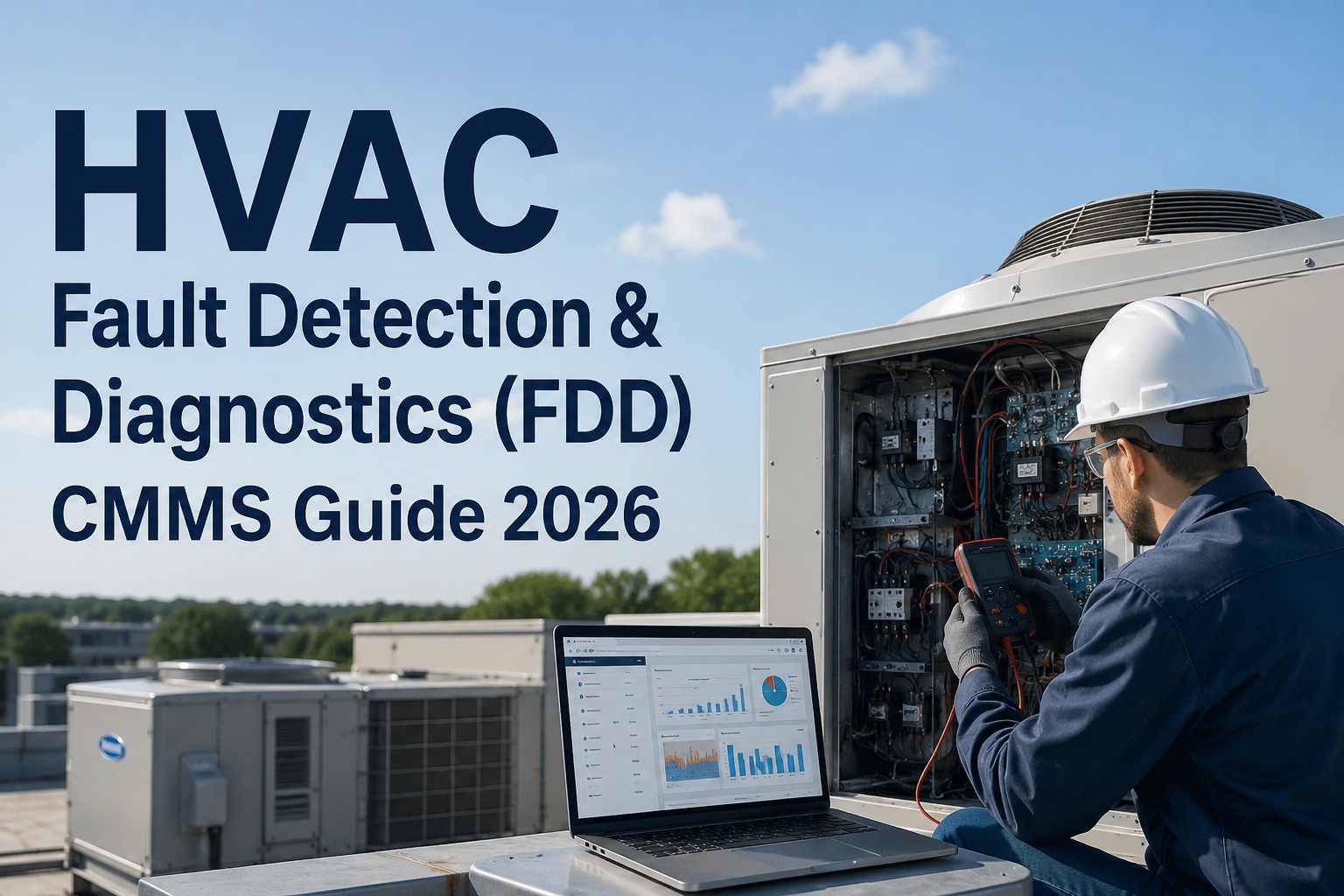
Fault detection and diagnostics is not magic — it is systematic pattern recognition applied to data your building already produces. The workflow below shows how raw BMS signals are converted into prioritised maintenance actions in OxMaint.

1
Data Ingestion
BMS sensor data — temperatures, pressures, valve positions, fan speeds, power — streams into OxMaint via API, BACnet, or Modbus integration. No additional hardware required if your BMS is already instrumented.
2
Baseline Profiling
The AI engine establishes performance baselines for each AHU under normal operating conditions — learning the expected relationships between airflow, temperature, pressure, and power draw during the first 2 to 4 weeks of monitoring.
3
Fault Rule Application
Fault detection rules — drawn from ASHRAE Guideline 36 and APAR libraries — run continuously against live data. Rules detect deviations from baseline, impossible physical states, and equipment operating outside design parameters.
4
Fault Prioritisation
Each detected fault is scored by estimated energy waste per day, comfort impact, and equipment risk. High-value faults rise to the top of the maintenance queue automatically — technicians see what to fix first, not just what went wrong.
5
Work Order Generation
OxMaint converts confirmed faults into work orders automatically — including the fault description, asset location, recommended corrective action, and estimated energy savings from resolution. Technicians receive tasks on the mobile app with full diagnostic context.
Performance Data

AHU FDD in Practice — What Facilities Measure

The results below represent typical outcomes from commercial facilities that have deployed automated AHU fault detection integrated with a CMMS for work order management. Results vary by building age, BMS quality, and baseline maintenance discipline.

63%
Reduction in unplanned HVAC downtime
Faults caught in early-stage before equipment failure
21%
Average AHU energy reduction
Primarily from damper, valve, and fan fault resolution
4.2x
First-year ROI on FDD implementation
Energy savings and avoided repair costs vs. platform cost
11 days
Average time from fault detection to resolution
Down from 47 days for manually-discovered faults
ASHRAE Guideline 36

ASHRAE Guideline 36 Fault Rules — What Smart Buildings Implement

ASHRAE Guideline 36 provides the definitive fault detection rule library for commercial HVAC systems. The table below lists the highest-priority rules for AHU systems and the BMS signals required to implement each.

Fault Rule Sensors Required Detection Logic Priority
Supply air temperature too high in cooling mode SAT, cooling coil valve position, OAT SAT > setpoint + 2°C while CHW valve >90% open for >15 min Critical
Economiser — OA fraction low while economising MAT, OAT, RAT, OA damper position MAT > expected mixed air temp by >2°C at commanded OA% Critical
Simultaneous heating and cooling (fighting coils) CHW valve, HHW valve, SAT Both CHW and HHW valves >10% open simultaneously Critical
Supply fan — low airflow at high speed CFM sensor or velocity pressure, fan speed (VFD Hz) Airflow <80% design at >90% fan speed — belt or damper fault High
Filter pressure drop — high delta-P Filter bank differential pressure sensor dP across filter exceeds 125% of clean filter design pressure High
Supply air temperature sensor fault SAT, MAT, coil valve position SAT reading physically impossible given upstream MAT and valve state Moderate
Return air CO2 — ventilation rate below minimum RA CO2 sensor, OA damper, occupancy CO2 > 1,100 ppm during occupied hours with OA damper at minimum High

Connect Your AHU Data to Automated Maintenance Workflows

OxMaint's Predictive Maintenance AI ingests BMS data, applies ASHRAE-aligned fault detection rules, scores faults by energy and equipment impact, and converts confirmed anomalies into mobile work orders — automatically. Your technicians stop searching for problems and start solving the ones that matter most.

Expert Review

What Smart Building and HVAC Specialists Say

The most surprising finding when we deploy AHU fault detection at a new site is always how many faults are already present before we even begin. In our last ten deployments, the average building had 14 active AHU faults on day one — most of them present for months, none of them visible to the FM team. The energy waste from those faults typically paid for the entire FDD platform subscription within 90 days.
BT
Brian Torres
Smart Building Systems Architect, Commercial Real Estate Technology
The integration between fault detection analytics and a CMMS is the piece that most buildings are missing. Detecting a fault is useful. Converting it automatically into a work order with diagnostic context — the asset, the fault type, the recommended fix, and the estimated energy impact — is what actually drives repair rates. Without that connection to the maintenance workflow, fault lists become another dashboard nobody acts on.
NS
Nadia Shafiq
Head of Building Performance, Facilities Operations Group
Frequently Asked Questions

AHU Fault Detection and Diagnostics — Common Questions

In most commercial buildings with a functioning BMS, you already have the majority of signals needed to run the highest-priority ASHRAE Guideline 36 fault rules — supply air temperature, return air temperature, mixed air temperature, valve positions, fan speed, and filter differential pressure. The sensors you may need to add are filter differential pressure transmitters if your current BMS does not monitor them, and CO2 sensors for ventilation fault rules. A BMS data gap assessment — which OxMaint can help you structure — will identify exactly which signals are available and which rules are implementable without additional hardware. Book a session to discuss your BMS data availability with our team.
Most FDD platforms establish statistically meaningful baselines within two to four weeks of continuous data collection, provided the AHU cycles through its normal operating modes — occupied, unoccupied, heating, cooling, economiser — during that period. Some rule-based faults like simultaneous heating and cooling or sensor physically impossible readings can be detected from day one without any baseline learning. Pattern-based faults that rely on deviation from normal behaviour need the learning period. OxMaint's system flags which rules are immediately active and which are in baseline-learning mode so your team knows what is being monitored from the moment data starts flowing. Start your free trial to begin the data connection and baseline process.
Fault prioritisation in a well-designed FDD system combines three dimensions: estimated energy waste per day in dollar terms, occupant comfort impact severity, and equipment damage risk if the fault persists. A stuck-open OA damper wasting $180 per day in cooling load ranks above a slightly loaded filter costing $8 per day in extra fan energy — even if the filter fault is more visible. OxMaint presents faults in a prioritised queue ranked by combined impact score, so your maintenance team always knows the highest-return repair to address first. Faults that indicate imminent equipment failure — such as bearing vibration anomalies or coil freeze risk — are escalated to critical regardless of energy cost. Book a walkthrough to see the fault prioritisation interface.
Yes — LEED v4.1 and WELL Building Standard both include credits and performance requirements that AHU FDD directly supports. LEED's Building-Level Energy Metering and Commissioning credits require ongoing monitoring and documentation of HVAC system performance deviations. WELL's Air Concept requires documented evidence of ventilation rate compliance and CO2 control performance. FDD data — with timestamped fault records, resolution documentation, and before/after energy performance comparisons — provides exactly the evidence base these certification frameworks require. ASHRAE 211 energy audits also benefit from FDD data as a source of documented fault history and energy savings attribution. OxMaint's reporting module exports performance data in formats suitable for certification submissions.

Connect Your AHU Data to Automated Maintenance Workflows

OxMaint's Predictive Maintenance AI ingests BMS data, applies ASHRAE-aligned fault detection rules, scores faults by energy and equipment impact, and converts confirmed anomalies into mobile work orders — automatically. Your technicians stop searching for problems and start solving the ones that matter most.


Share This Story, Choose Your Platform!