The chief engineer at a 14-story, 420,000-square-foot medical office complex in Atlanta couldn't explain why the east tower's energy consumption had climbed 23% over 18 months while the west tower—identical equipment, identical schedules—stayed flat. The BAS showed no alarms. No tenants had complained. Every chiller, AHU, and VAV box reported normal. It took a third-party energy auditor three days and $18,000 to find the answer: 37 simultaneous faults hiding in plain sight. Fourteen VAV boxes had failed actuators stuck at 80-100% open, flooding zones with conditioned air. Eight economizer dampers had drifted to minimum position due to linkage wear, forcing mechanical cooling during 1,200 hours of free-cooling weather. Six supply air temperature sensors had drifted 3-5°F, causing the AHUs to overcool continuously. And nine reheat valves were passing hot water into cold ducts—the system was simultaneously heating and cooling the same air. No single fault triggered an alarm. Together, they were burning $187,000 per year in excess energy. An automated Fault Detection and Diagnostics (FDD) system would have identified every one of these faults within its first week of operation—for a fraction of the audit cost.
Of total HVAC energy in U.S. commercial buildings is consumed by equipment operating with undetected faults—stuck dampers, drifted sensors, leaking valves, failed actuators, and degraded components that the BAS never flags
Average number of simultaneous active HVAC faults per 10,000 square feet in commercial buildings—most operating silently below alarm thresholds while steadily increasing energy consumption
$0.65/sf
Annual Fault Cost
Average annual energy cost per square foot attributable to undetected HVAC faults—hidden inside utility bills, invisible to BAS systems, and accumulating silently month after month
Why Your BAS Isn't Catching These Faults
Building automation systems are designed to control—not diagnose. A BAS monitors whether equipment is running and whether zone temperatures are satisfied. It doesn't ask whether a VAV box is using 3x the energy it should to maintain setpoint. It doesn't notice that an economizer hasn't opened in six months. It doesn't flag that a sensor has drifted 4°F over a year, causing the AHU to overcool 24/7. These faults don't trigger alarms because the system is "working"—it's just working extremely inefficiently. FDD technology closes this gap by continuously analyzing operational patterns to identify faults that waste energy, degrade comfort, and shorten equipment life.
Every commercial building in the United States is running HVAC equipment with active, undetected faults right now. Not sometimes. Not maybe. Studies from Pacific Northwest National Laboratory, Lawrence Berkeley National Laboratory, and ASHRAE consistently show that 50-90% of commercial buildings have significant HVAC faults that increase energy consumption, degrade comfort, and accelerate equipment wear—and the vast majority of these faults are invisible to traditional building automation systems. Fault Detection and Diagnostics (FDD) technology changes this reality by continuously analyzing HVAC operational data to identify, diagnose, and prioritize faults before they become energy crises or comfort complaints. Buildings that implement automated HVAC fault detection don't just find problems faster—they discover problems they never knew existed, typically recovering 10-30% of wasted HVAC energy within the first year.
Why 30% of HVAC Energy Disappears Without a Trace
The 30% waste figure isn't a guess—it's the consistent finding from decades of building performance research across every climate zone, building type, and BAS platform in the U.S. The waste comes not from equipment failure (which triggers alarms and gets fixed) but from equipment degradation—the slow, silent drift from optimal performance that accumulates across dozens or hundreds of components until the building is consuming 30% more energy than it should while the BAS reports "all systems normal." Understanding where this waste hides is the first step toward recovering it.
Faults Persist 5-40x Longer Without Automated Detection
Without FDD, the average HVAC fault persists for 6-18 months before discovery—usually found during an energy audit, tenant complaint investigation, or equipment failure. With automated FDD, faults are identified within hours to days of onset. That 5-40x detection speed difference translates directly to energy savings, because every day a fault persists is a day of wasted energy.
$273K
Average annual energy waste from undetected faults in a 400,000 sf commercial office building
10-30%
HVAC energy reduction typically achieved in the first year of automated FDD deployment
47%
Of all HVAC service calls could be eliminated with proactive fault detection before failure occurs
$2,400
average annual energy cost per stuck economizer damper in Climate Zones 3-5
14 mo
average time an HVAC fault persists before discovery without automated FDD
26%
reduction in HVAC maintenance costs from prioritized, fault-based work orders
How FDD Technology Works: From Raw Data to Actionable Diagnostics
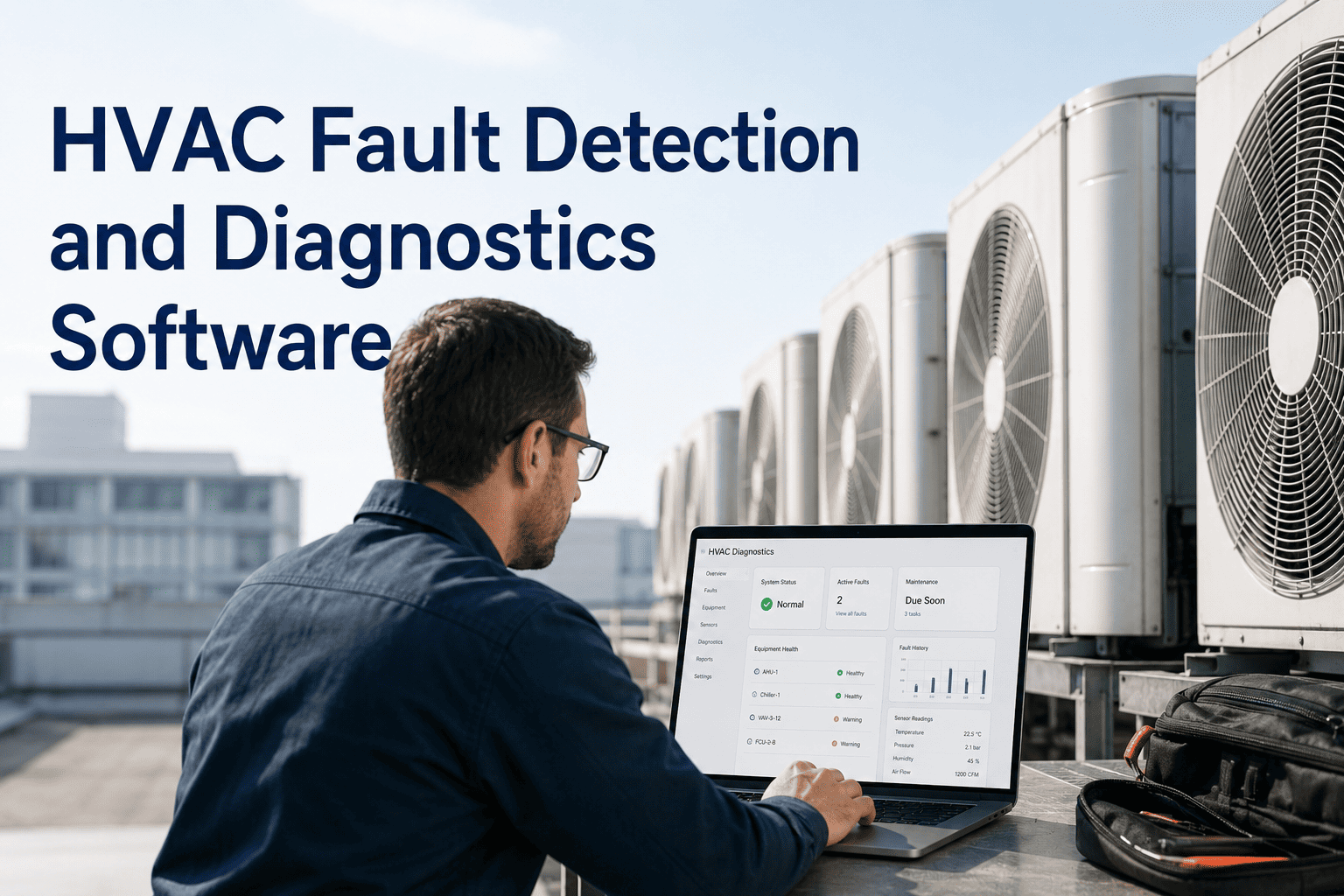
Fault Detection and Diagnostics isn't a simple alarm system with lower thresholds. It's an analytical engine that ingests thousands of data points from your BAS every few minutes—temperatures, pressures, flows, positions, runtimes, energy consumption—and applies physics-based models, statistical analysis, and machine learning to determine whether each piece of equipment is operating correctly. When it detects a deviation, it doesn't just flag it—it diagnoses the probable cause, estimates the energy and comfort impact, and prioritizes the fault against every other active fault in the building. When facility teams see how FDD integrates with their existing BAS and maintenance workflow, the value proposition becomes immediate—it's like giving your building an always-on diagnostic physician.
| Fault Category |
What FDD Detects |
Why BAS Misses It |
Annual Energy Impact Per Fault |
| Stuck/Failed Dampers |
Economizer dampers locked at minimum, VAV dampers stuck open/closed, mixed air dampers not modulating, exhaust dampers failed in position |
BAS reads the command signal, not actual position. Damper actuator can fail while BAS shows "operating normally" |
$1,200-$4,800 per damper per year in excess cooling/heating energy |
| Sensor Drift & Failure |
Temperature sensors reading 2-8°F off true value, pressure sensors drifted, humidity sensors degraded, CO2 sensors reading low (causing over-ventilation) |
BAS trusts sensor readings implicitly. A 4°F drift on a supply air sensor causes continuous overcooling with no alarm |
$800-$3,200 per drifted sensor per year; supply air sensors have highest impact |
| Valve Leakage & Failure |
Heating valves passing hot water when commanded closed, chilled water valves not seating fully, three-way valve bypass issues, actuator disconnection |
BAS sends close command and reports "closed." Valve seat wear allows flow-through that BAS cannot detect |
$600-$2,800 per leaking valve per year; reheat valves in VAV systems are most common |
| Simultaneous Heating & Cooling |
Zones where heating and cooling systems fight each other—reheat active while mechanical cooling runs, perimeter heating with interior cooling on same AHU |
Each system operates within its own control loop. BAS doesn't cross-reference heating and cooling energy flowing to the same zone |
$1,500-$6,000 per affected zone per year; most common fault in VAV reheat systems |
| Schedule & Sequencing Errors |
Equipment running during unoccupied hours, improper lead-lag staging, AHUs fighting each other in shared zones, overnight setback not activating |
Programming errors look "normal" to BAS—the system executes wrong logic faithfully. Only pattern analysis reveals the waste |
$3,000-$15,000 per scheduling error per year depending on equipment size |
Swipe to see full table
A typical 200,000 sf office building has 15-40 active faults at any given time. FDD prioritizes them by energy impact and comfort risk, ensuring maintenance teams fix the most expensive problems first.
How Many Silent Faults Are Running in Your Building Right Now?
The average commercial building has 3.4 active HVAC faults per 10,000 square feet—most invisible to the BAS and accumulating energy waste every hour. See how FDD technology finds, diagnoses, and prioritizes every fault hiding in your system.
The Six Most Expensive HVAC Faults Hiding in U.S. Commercial Buildings
Not all HVAC faults are equal. Some waste hundreds of dollars per year. Others waste thousands—per device, per year, silently. FDD research across thousands of commercial buildings has identified the six fault categories that account for over 85% of all HVAC energy waste from undetected equipment issues. These aren't exotic failures. They're common, predictable, and present in virtually every building over three years old. The difference between buildings that waste 30% of their HVAC energy and those that don't isn't equipment quality—it's whether these faults are found in days or in years.
01
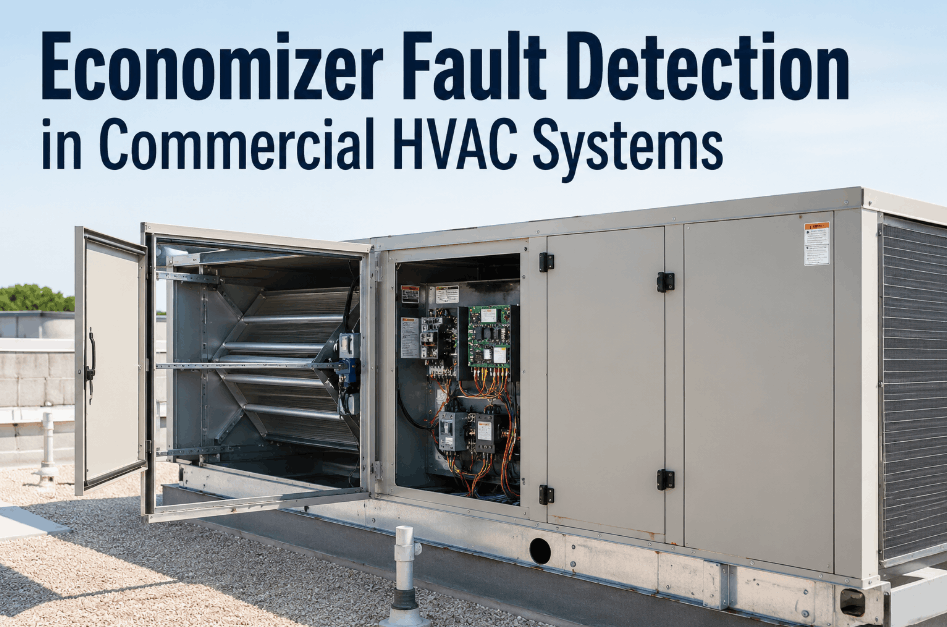
Economizer Failures
22%
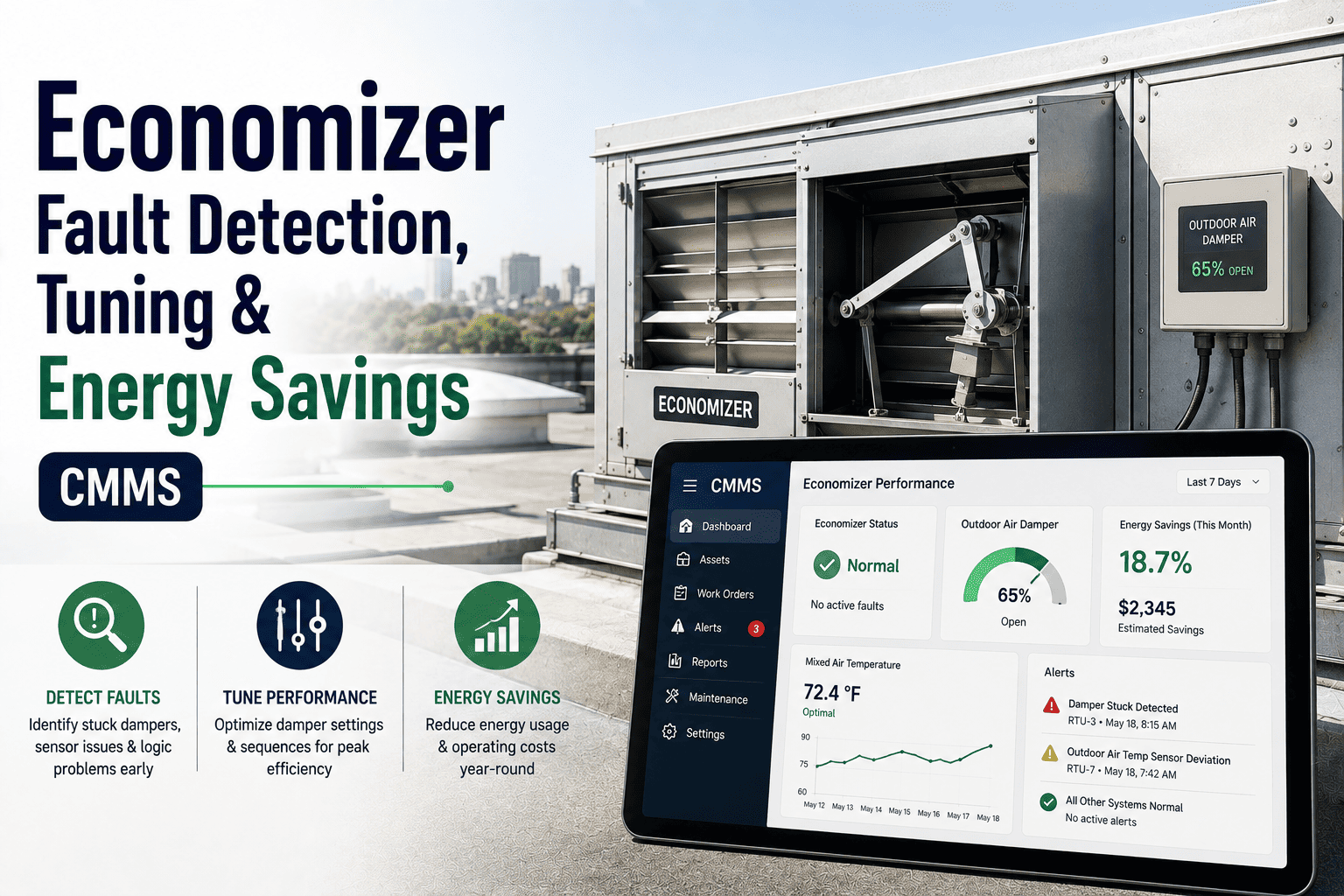
The single largest source of HVAC energy waste in most U.S. climates. Economizer dampers stuck at minimum position, outdoor air sensor drift causing incorrect lockout, actuator failures, and linkage wear. A single stuck economizer on a 20-ton AHU wastes $2,400-$4,800 per year in unnecessary mechanical cooling—and most buildings have multiple AHUs affected simultaneously.
FDD Detection: Compares outdoor conditions to mixed air temperature and damper position. Flags any AHU not using free cooling when outdoor conditions permit it—typically within 24-48 hours of fault onset.
02
Simultaneous Heating & Cooling
19%
The most wasteful HVAC operating condition. Reheat coils adding energy to air that was just mechanically cooled. Perimeter radiant heating running while the AHU cools the same zone. Hot water circulating through "closed" valves that don't fully seat. Every BTU of unnecessary reheat requires a corresponding BTU of unnecessary cooling—doubling the waste.
FDD Detection: Cross-correlates heating and cooling energy at zone level. Identifies zones where both systems are active simultaneously, quantifies the waste in dollars per day, and diagnoses whether the cause is valve leakage, sensor error, or control logic.
03
Sensor Drift & Calibration Loss
17%
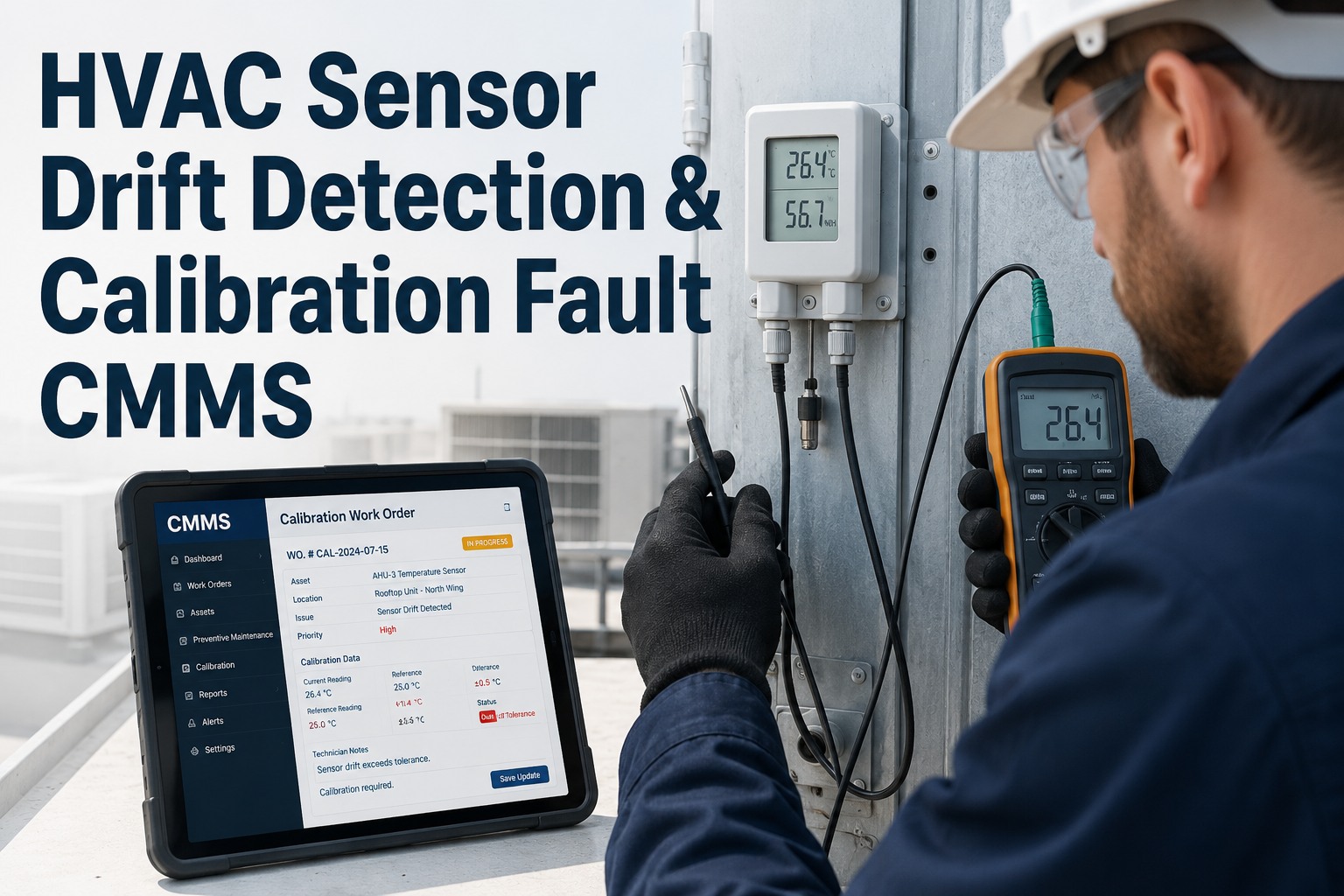
Temperature, pressure, humidity, and CO2 sensors drift over time—typically 1-2°F per year for temperature sensors. A supply air temperature sensor reading 3°F low causes the AHU to produce air that's 3°F colder than needed—continuously. An outdoor air sensor reading warm locks out the economizer. A CO2 sensor reading low drives excessive ventilation. Each drifted sensor cascades waste through every control decision that depends on it.
FDD Detection: Uses cross-referencing, physics-based models, and statistical pattern analysis to identify sensors whose readings are inconsistent with other data points in the system. Flags drift direction, magnitude, and estimated energy impact.
04
VAV Box Failures
15%
Stuck damper actuators (open or closed), failed flow sensors causing minimum airflow overrides, reheat valves leaking or stuck open, and controller communication failures. In a building with 200 VAV boxes, 10-25 typically have active faults at any time. Each stuck-open box wastes $800-$2,000 per year in excess conditioning while potentially overcooling the zone it serves.
FDD Detection: Monitors airflow vs. demand, damper position vs. command, zone temperature vs. setpoint, and reheat activity patterns. Identifies underperforming or over-consuming VAV boxes and ranks them by energy waste magnitude.
05
Schedule & Programming Errors
14%
Equipment running 24/7 when scheduled occupancy is 10 hours. Holiday schedules not updated. Override commands left in place weeks after the reason for them ended. Night setback not activating due to a BAS programming change that accidentally disabled it. AHUs and pumps starting 2 hours before occupancy "just in case" when 30 minutes of pre-conditioning would suffice.
FDD Detection: Compares equipment runtime against occupancy schedules, identifies after-hours operation, flags permanent overrides, and calculates the cost of each scheduling anomaly. Catches errors that persist for months because nobody reviews BAS schedules after initial commissioning.
06
Central Plant Inefficiency
13%
Chillers running at poor part-load efficiency due to improper staging. Cooling towers with fouled fill or failed fans cycling unevenly. Condenser water temperature setpoints too low for current conditions. Chilled water reset not functioning. Pumps with degraded impellers consuming excess energy for reduced flow. Boilers with fouled heat exchangers and drifted combustion efficiency.
FDD Detection: Calculates real-time kW/ton for chillers, compares equipment efficiency against manufacturer curves, monitors condenser approach temperatures, and flags performance degradation trends before they become failures.
Manual Troubleshooting vs. Automated FDD: The Detection Gap That Costs Millions
Traditional HVAC troubleshooting is reactive, labor-intensive, and incomplete. A skilled technician investigates a comfort complaint, fixes the obvious issue, and moves to the next call. They don't have time to analyze whether the AHU they just worked on has an economizer that hasn't opened in four months. They don't cross-reference whether the VAV boxes downstream are simultaneously heating and cooling. They fix symptoms, not systems—because manual diagnosis of hundreds of interconnected components is physically impossible within normal staffing levels. FDD automates the diagnostic analysis that would require an army of engineers to perform manually. Buildings ready to close the detection gap can start with a free fault assessment and see how many silent faults are active right now.
Manual / BAS Alarms Only
avg. fault persistence time
Faults detected:
15-25% of active faults
Root cause identified:
Sometimes
Energy impact quantified:
Rarely
Automated FDD
avg. fault detection time
Faults detected:
90-95% of active faults
Root cause identified:
Automated diagnosis
Energy impact quantified:
$/day per fault
10-30%
HVAC energy reduction from fault correction in first year
47%
reduction in reactive HVAC service calls with proactive fault detection
2-3x
extension in equipment lifespan when faults are corrected early
Expert Perspective: Why Leading Building Operators Are Making FDD Standard Practice
"I managed a 2.8-million-square-foot portfolio for seven years before we deployed FDD. I thought we ran tight buildings—we had a good BAS, a good maintenance team, and we benchmarked with ENERGY STAR. In the first 90 days of FDD, we found 340 active faults across six buildings. Stuck economizers, leaking reheat valves, drifted sensors, scheduling errors that had been burning energy for years. We recovered $412,000 in annual energy waste—and our comfort complaints dropped 38% because many of those faults were also causing hot and cold spots. FDD didn't replace our maintenance team. It made them surgical instead of reactive. Every morning they came in to a prioritized list of exactly what needed fixing and exactly how much money each fix would save."
— Director of Engineering, Multi-Building Commercial Portfolio, Southeast U.S.
Prioritized Fault Work Orders
FDD doesn't just find faults—it ranks them by energy cost, comfort impact, and equipment risk. Your maintenance team stops chasing nuisance alarms and starts fixing the $4,800/year stuck economizer before the $200/year sensor offset. Every hour of technician time goes to the highest-value repair.
Continuous Retro-Commissioning
Traditional retro-commissioning is a $50,000-$150,000 point-in-time exercise that degrades within 12-18 months. FDD provides permanent, continuous commissioning—detecting new faults as they develop, verifying repairs, and ensuring savings persist year after year without repeated audits.
Regulatory Compliance Engine
Multiple U.S. jurisdictions now require FDD or continuous commissioning—NYC Local Law 87, California Title 24, Washington State energy code, and growing. FDD platforms provide automated compliance documentation, fault logs, and correction verification that satisfy regulatory requirements without additional staff time.
The economics of undetected HVAC faults are unforgiving. Every day a fault persists is a day of wasted energy, degraded comfort, and accelerated equipment wear. A building with 30 active faults averaging $1,500 per fault per year is losing $45,000 annually—but the loss is invisible because it's embedded in the utility bill, indistinguishable from "normal" HVAC operating cost. FDD makes the invisible visible. Owners who schedule a fault detection assessment consistently discover that their buildings have been subsidizing waste for years—and that the technology to stop it pays for itself within months.
Your Building Has Faults Right Now. The Only Question Is Whether You Can See Them.
Every commercial building over three years old has active HVAC faults that are wasting energy, degrading comfort, and shortening equipment life. That's not an opinion—it's the consistent, measured finding across every major building performance study conducted in the last two decades. The buildings that stop the waste aren't newer or better equipped. They made one decision: to stop relying on a BAS that was designed to control, not diagnose, and to add the analytical layer that finds what human operators and traditional alarms cannot. That decision starts with understanding exactly how many faults are active in your building right now—and how much each one is costing you every day it goes unfixed.
Find Every Fault. Fix What Matters Most. Stop the 30% Waste.
Oxmaint's FDD platform continuously monitors your HVAC systems, detects faults within hours of onset, diagnoses root causes automatically, quantifies energy waste per fault per day, and delivers prioritized work orders to your maintenance team. See your building's specific fault profile with a free diagnostic assessment.
Frequently Asked Questions
What is HVAC Fault Detection and Diagnostics (FDD)?
FDD is an automated analytical technology that continuously monitors HVAC system operation by analyzing data from building automation systems (BAS), sensors, meters, and equipment controllers. Unlike traditional BAS alarms that only trigger on hard failures (equipment off, temperature out of range), FDD uses physics-based models, statistical analysis, and machine learning to detect soft faults—equipment that's running but operating inefficiently. When a fault is detected, the system automatically diagnoses the probable cause (stuck damper, drifted sensor, leaking valve, scheduling error), estimates the energy and comfort impact in dollars per day, and prioritizes the fault relative to all other active faults. FDD transforms HVAC maintenance from reactive complaint-driven repair to proactive, data-driven optimization.
How much energy waste can FDD realistically recover?
Buildings deploying FDD for the first time typically recover 10-30% of HVAC energy consumption within the first year. The range depends on building age (older buildings have more accumulated faults), existing maintenance quality (well-maintained buildings have fewer faults but still benefit significantly), BAS sophistication (advanced BAS systems provide better data for FDD analysis), and fault correction response time (faster repair equals faster savings). For a 200,000 sf office building spending $434,000 annually on HVAC energy, 10-30% recovery represents $43,000-$130,000 in first-year savings. Beyond energy, FDD typically reduces reactive maintenance costs by 26%, extends equipment life by preventing fault-driven wear, and reduces comfort complaints by 25-40%.
Does FDD work with my existing building automation system?
Yes. Modern FDD platforms integrate with all major BAS systems—Tridium Niagara, Siemens, Honeywell, Johnson Controls, Schneider Electric, Carrier, and others—using standard protocols like BACnet, Modbus, and API connections. FDD reads operational data from the BAS without modifying control logic or replacing equipment. The BAS continues to operate exactly as before; FDD adds an analytical diagnostic layer on top. Most integrations require 2-4 weeks for data connectivity and 2-4 additional weeks for the diagnostic models to calibrate to your building's specific equipment and operating patterns. Buildings with older or non-networked systems may need targeted data access upgrades, but these are typically modest investments compared to the fault-driven energy waste they enable FDD to detect.
How is FDD different from a regular energy audit or retro-commissioning?
Traditional energy audits and retro-commissioning are point-in-time exercises—a team inspects the building, identifies issues, recommends corrections, and leaves. Studies consistently show that 50-75% of retro-commissioning savings degrade within 18 months as new faults develop and previously corrected issues recur. FDD provides continuous, automated monitoring that never stops. It detects new faults within hours or days of onset, verifies that repairs were effective, and identifies when previously corrected faults return. Think of it as permanent retro-commissioning at a fraction of the cost. A typical retro-commissioning engagement costs $0.25-$0.50/sf every 3-5 years; FDD costs $0.05-$0.15/sf per year and provides continuous monitoring, not periodic snapshots.
Are there regulatory requirements for FDD in commercial buildings?
Yes, and they're expanding rapidly. California Title 24 requires FDD on all new commercial buildings with DDC systems. New York City's Local Law 87 requires energy audits and retro-commissioning on a 10-year cycle (which FDD satisfies continuously). Washington State's energy code requires FDD for buildings over 50,000 sf. ASHRAE Standard 36 (High-Performance Sequences of Operation) includes FDD as a required component. Multiple additional jurisdictions have FDD requirements in development. Beyond regulations, LEED v4.1 awards credits for ongoing commissioning including FDD, and many institutional and government building standards now require continuous monitoring. Implementing FDD proactively positions buildings for compliance with current and upcoming requirements while capturing immediate energy savings.
What is the ROI and payback period for implementing FDD?
FDD implementation typically costs $0.05-$0.15 per square foot per year for software, with initial setup and integration costs of $10,000-$50,000 depending on building complexity and existing data infrastructure. For a 200,000 sf building at $0.10/sf, annual FDD cost is approximately $20,000. With typical first-year energy recovery of 10-30% (saving $43,000-$130,000 on a $434,000 HVAC budget), plus 26% reduction in reactive maintenance costs, most deployments achieve payback within 3-9 months. ROI improves in subsequent years as the system learns and as additional faults are detected and corrected. Unlike capital equipment investments that depreciate, FDD delivers ongoing, compounding value—every new fault detected and corrected adds to cumulative savings.