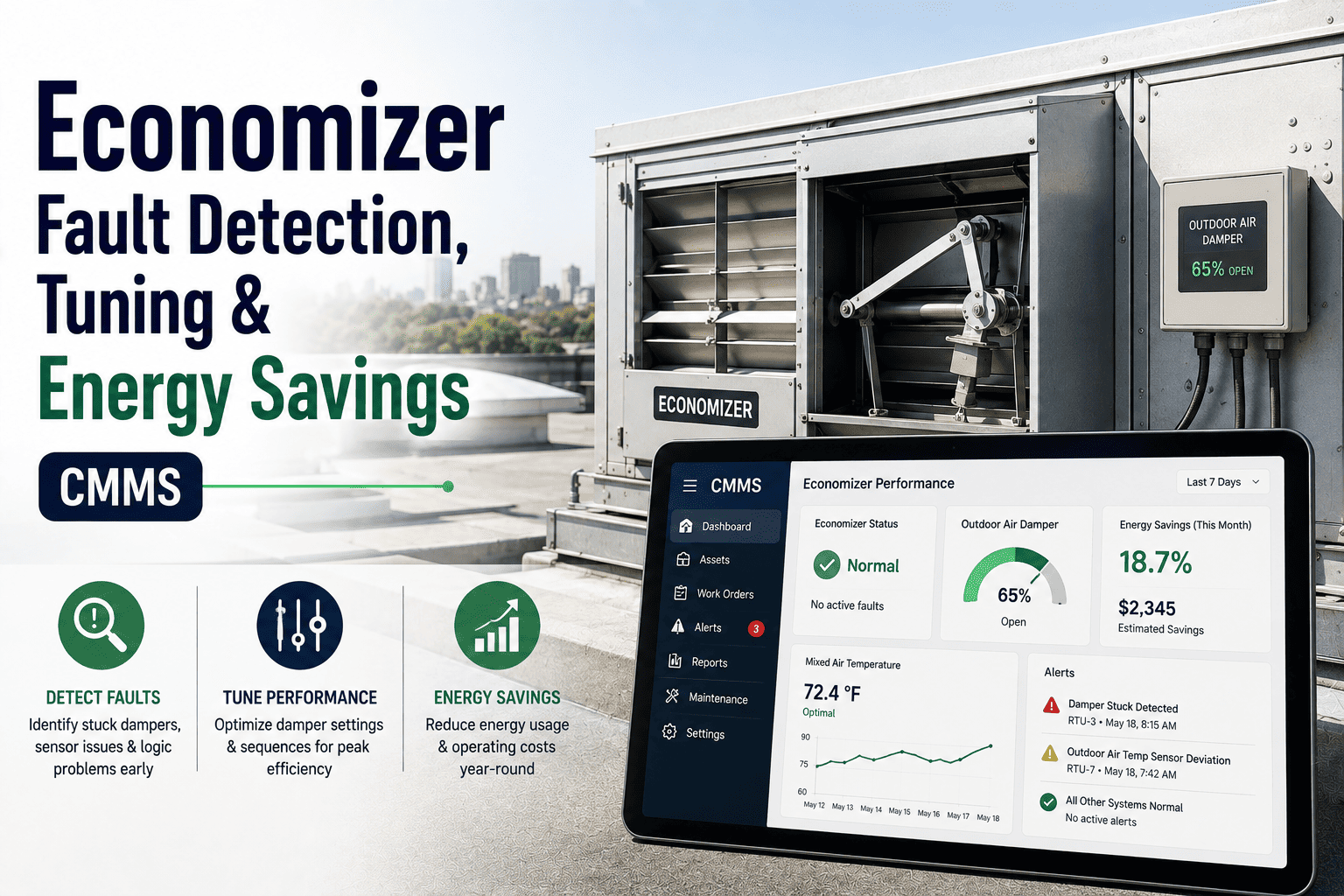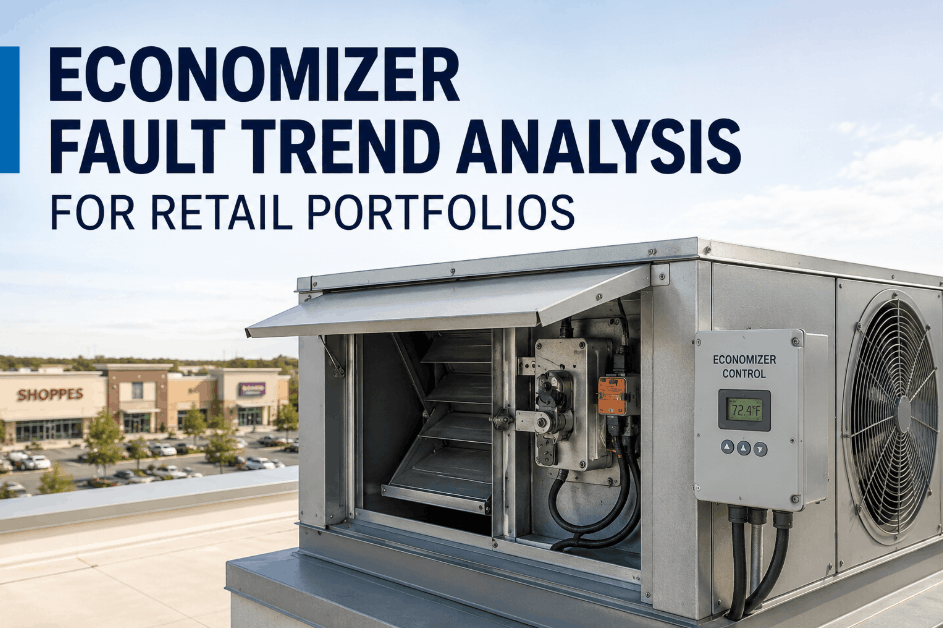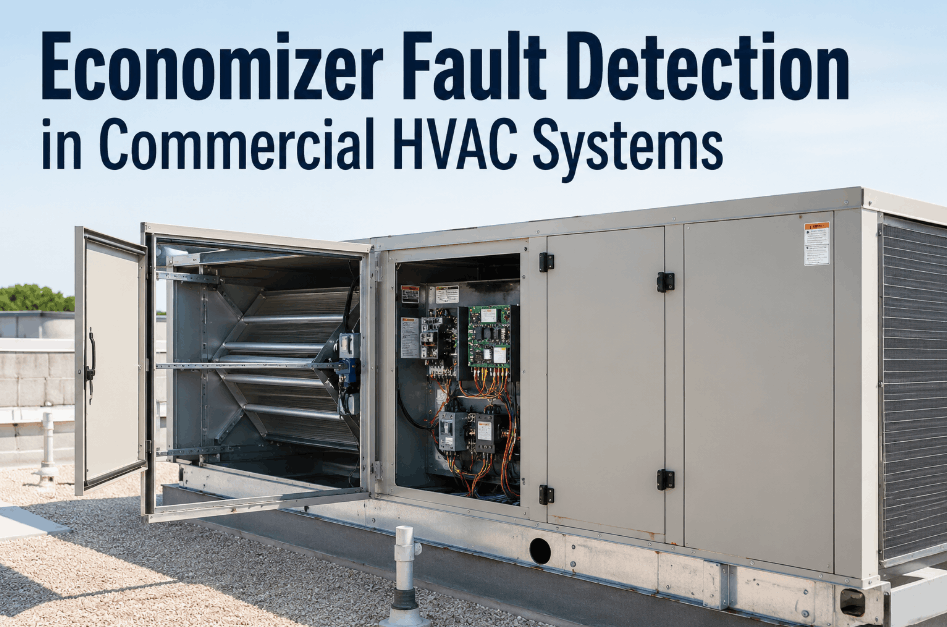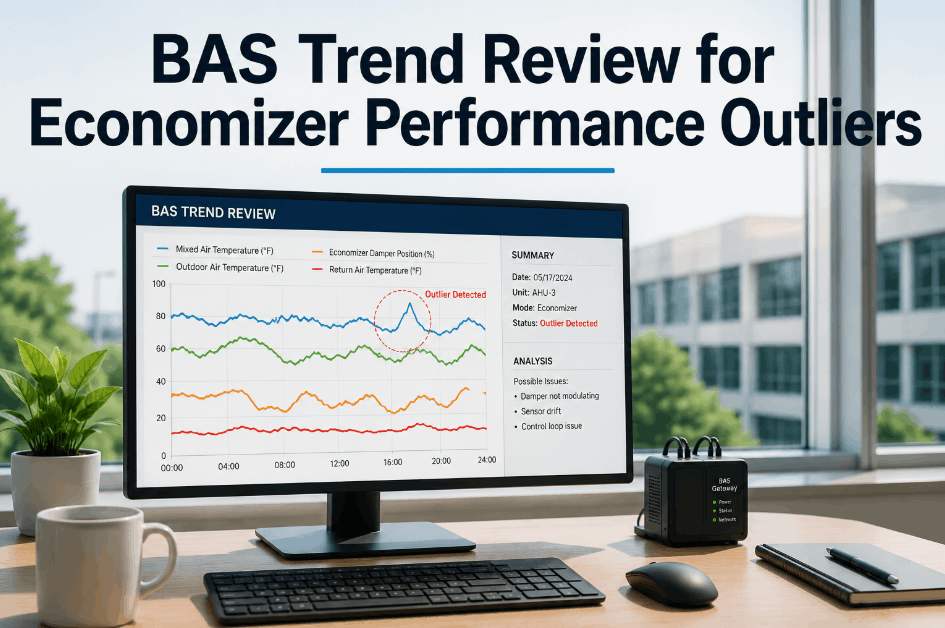
BAS trend review for economizer performance outliers is one of the highest-value diagnostic activities available to facility engineering teams — yet most buildings operate economizers for years without a structured trend analysis that would reveal whether the units are actually performing to their control sequence. When mixed-air behavior goes uncompared against outdoor conditions, damper movement is never trended across seasons, and outdoor-air response anomalies remain buried in months of BAS historian data, economizer faults consume cooling energy, reduce ventilation effectiveness, and accelerate damper actuator wear without ever triggering an alarm. Maintenance teams using Sign Up Free on OxMaint can build the structured work order records, inspection findings, and equipment history that a BAS trend review for economizer performance outliers requires to translate raw trend data into actionable corrective maintenance across commercial HVAC systems.
Why Economizer Outlier Detection Requires Structured BAS Trend Analysis
Economizer faults rarely trigger alarms because most BAS systems monitor setpoint deviations rather than operating logic failures — and an economizer that modulates dampers in the wrong direction, fails to open during favorable outdoor conditions, or holds mixed-air temperature outside its target band can operate for months as an energy penalty rather than an energy asset. Book a Demo to see how OxMaint's inspection and corrective work order structure links BAS trend findings to field-verified damper condition, actuator status, and sequence verification records that close the gap between trend anomaly identification and confirmed fault resolution.
Six BAS Trend Signals That Expose Economizer Performance Outliers
Economizer performance outlier detection requires comparison of multiple BAS trend signals simultaneously — not isolated point reviews. OxMaint's inspection work order structure provides the field-verification complement to BAS trend analysis, capturing damper condition, actuator function, and sequence compliance data that confirms or rules out each trend-identified outlier. Sign Up Free to configure OxMaint's inspection templates for economizer field verification linked to your BAS trend review process.
Mixed-Air Temperature vs. Outdoor and Return Air Blend
Trending mixed-air temperature against the expected blend ratio of outdoor and return air in the BAS historian identifies economizers where the actual mixed-air reading deviates from the calculated target — indicating sensor error, damper leakage, or actuator failure that prevents proper outdoor air modulation.
Damper Position Command vs. Actual Position Feedback
Comparing commanded damper position against actuator position feedback in the BAS trend identifies stuck actuators, feedback sensor failures, and mechanical binding that prevent the damper from reaching its commanded position — the most common damper-level economizer fault type.
Economizer Enable Status vs. Outdoor Air Conditions
Reviewing BAS enable/disable logic status against logged outdoor air temperature and enthalpy identifies economizers that fail to enable during favorable conditions or remain enabled during conditions where mechanical cooling is more efficient — indicating sensor drift, lockout logic errors, or control sequence misconfiguration.
Outdoor Air Percentage vs. CO2 or Occupancy Schedule
OxMaint inspection records capture field-verified outdoor air percentage measured at the AHU against the BAS-logged value — identifying units where the actual outdoor air fraction deviates from the logged command due to damper leakage, linkage failure, or damper blade deformation that the BAS trend alone cannot detect.
Cooling Plant Energy During Economizer-Eligible Hours
Correlating chiller or DX compressor runtime and energy during outdoor-air-favorable hours against economizer enable status in the BAS trend identifies units that are consuming mechanical cooling energy during hours when economizer operation should have satisfied the cooling load — quantifying the energy cost of each outlier.
Seasonal Mixed-Air Behavior Comparison Across AHU Fleet
Comparing mixed-air temperature behavior across multiple AHUs serving similar zones in the BAS historian identifies outlier units that deviate from the fleet average response during identical outdoor conditions — highlighting economizer fault candidates for targeted field inspection without requiring individual unit analysis of every AHU.
Economizer Outlier Types and Field Verification Approach
Book a Demo to see how OxMaint structures AHU asset records and inspection work orders to support BAS trend-driven economizer outlier field verification and corrective action tracking across commercial building HVAC fleets.
| Outlier Type | BAS Trend Indicator | Field Verification Check | Common Root Cause | OxMaint Record Type |
|---|---|---|---|---|
| Damper Won't Open | High command, no mixed-air response | Actuator movement, linkage condition | Failed actuator or seized linkage | Damper inspection + actuator work order |
| Economizer Never Enables | Enable output off during eligible hours | OA sensor reading vs. handheld reference | Sensor drift above lockout threshold | Sensor calibration record + sequence check |
| Mixed-Air Sensor Error | MAT deviates from calculated blend | Sensor location, averaging array integrity | Sensor displacement or averaging failure | Sensor inspection + location verification |
| Damper Leakage at Minimum | MAT too low at minimum OA command | Damper blade seal and closure gap | Worn blade seals or bent blades | Damper condition rating + seal work order |
| Wrong Sequence Configured | Damper response opposite to expected | BAS sequence review vs. design documents | Control logic reversal after upgrade | Sequence verification + BAS change record |
Four Outcomes a Structured Economizer Trend Review Program Delivers
Sign Up Free to build the structured economizer inspection and corrective work order history in OxMaint that makes all four outcomes achievable across your commercial building HVAC fleet.
Building a BAS Economizer Trend Review Program with OxMaint
Register AHU Economizer Assemblies as Asset Records
Create OxMaint asset records for each AHU economizer assembly with damper type, actuator model, control type (dry-bulb, enthalpy, differential), BAS point addresses, and design minimum outdoor air percentage — establishing the asset baseline that anchors each trend review finding and field inspection record.
Define Trend Review Schedule and Outlier Thresholds
Configure OxMaint PM work orders for quarterly BAS trend review cycles — with inspection fields that capture mixed-air temperature deviation, enable status compliance rate, and damper command-to-feedback gap against defined outlier thresholds that trigger corrective work order creation when breached.
Link Trend Findings to Field Inspection Work Orders
Create OxMaint corrective work orders for each trend-identified economizer outlier — with inspection checklists covering damper condition, actuator movement, sensor calibration, and sequence verification — ensuring every BAS trend anomaly receives field-confirmed diagnosis rather than remaining as an unresolved data observation.
Track Corrective Action Outcomes and Retest
Record corrective action outcomes in OxMaint — actuator replacement, sensor recalibration, sequence correction — and schedule post-correction trend review inspection work orders that verify the BAS trend outlier has been resolved and the economizer is performing within normal bounds under comparable outdoor conditions.
Generate Fleet Outlier Reports and Prioritize by Energy Impact
OxMaint's reporting dashboards enable economizer outlier queries filtered by AHU, floor, building, control type, and outlier category — producing the fleet performance reports that facility engineers and energy managers use to prioritize corrective maintenance by estimated cooling energy recovery impact across the building portfolio.
Frequently Asked Questions: BAS Trend Review for Economizer Performance Outliers
What is a BAS trend review for economizer performance?
A BAS trend review for economizer performance analyzes historian data for mixed-air temperature, damper position, outdoor air conditions, and enable status — comparing actual behavior against the expected control sequence to identify outlier units where performance deviates from design intent without triggering standard BAS alarms.
How often should economizer BAS trend reviews be conducted?
Quarterly seasonal reviews capture economizer behavior across heating, cooling, and transition periods where different fault types are most visible. Buildings with known economizer faults or high cooling energy cost benefit from monthly mixed-air and enable status trend checks to track correction progress.
What are the most common economizer performance outliers found in trend data?
The most frequent outliers are economizers that never enable during eligible outdoor conditions, dampers that respond to commands without mixed-air temperature change, mixed-air sensors reading outside the expected blend ratio, and units holding dampers in fixed positions regardless of control signals.
How does OxMaint support BAS economizer trend review programs?
OxMaint provides economizer asset registration, structured field inspection templates linked to trend findings, corrective work order tracking for each identified outlier, and cross-AHU fleet reporting — giving facility teams the CMMS structure that converts BAS trend observations into documented, verified corrective maintenance outcomes.
Can economizer faults be identified without BAS trend data?
Some faults — failed actuators, seized dampers, visible sensor displacement — are detectable through physical inspection alone. However, faults like intermittent enable logic failures, subtle mixed-air sensor drift, and sequence misconfigurations require BAS trend comparison across operating hours and seasonal conditions to identify reliably.