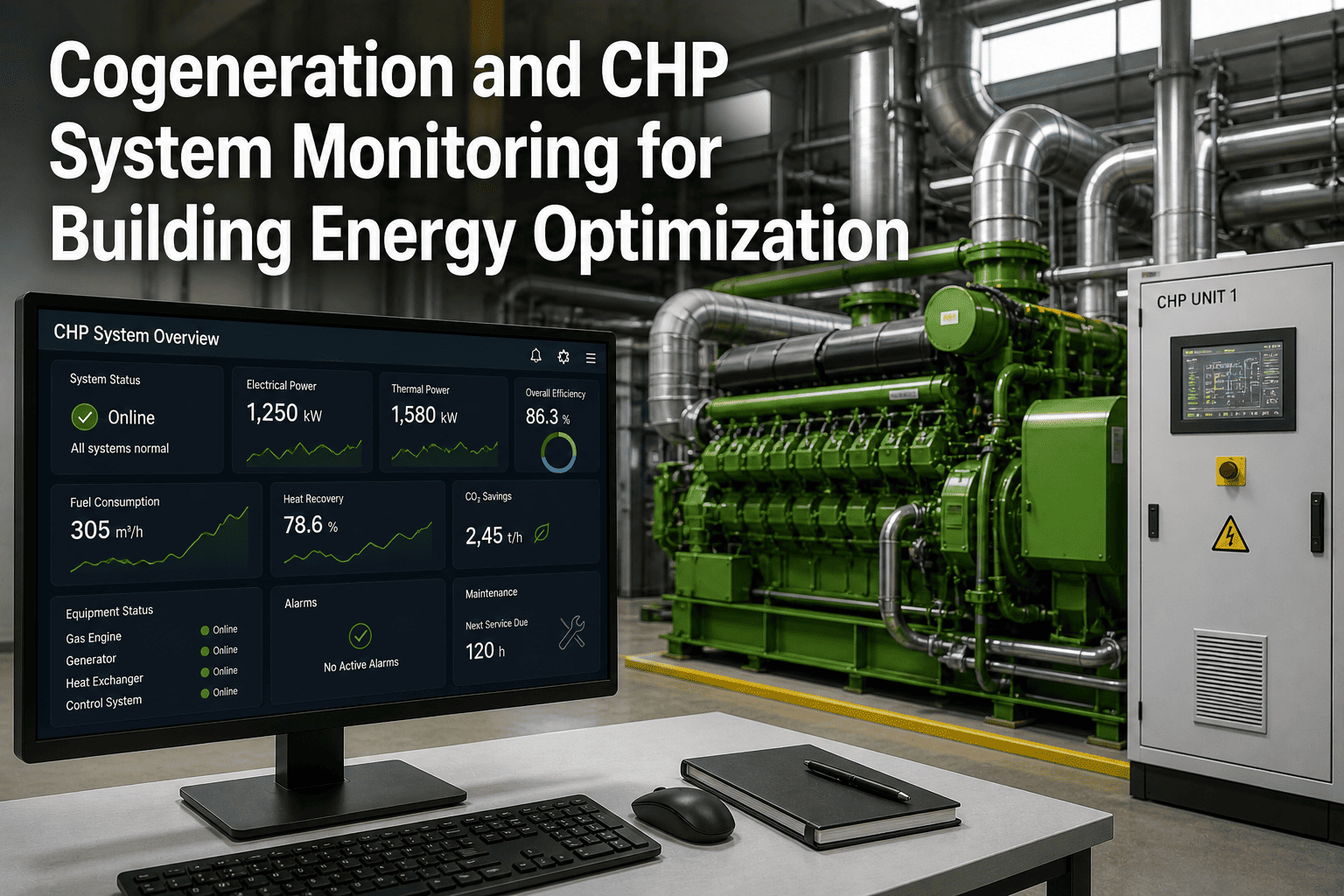
A combined heat and power system running at 78% efficiency instead of its design target of 91% is not a mechanical failure — it is a silent energy tax paid every hour the system runs unmonitored. CHP and cogeneration plants generate electricity and useful heat simultaneously, but the performance gap between a well-monitored system and an unmonitored one compounds daily across fuel consumption, heat recovery rates, and grid export revenue. OxMaint's CMMS platform gives building energy managers live visibility into engine runtime, heat exchanger effectiveness, electrical output, and waste heat recovery — turning cogeneration data into decisions that protect both uptime and efficiency margins.
Article · Energy Systems · Preventive Maintenance
Cogeneration and CHP System Monitoring for Building Energy Optimization
Engine Runtime · Heat Recovery · Electrical Output · Fuel Efficiency · Predictive PM
CHP System · Live Dashboard
Monthly Efficiency Trend
70–90%
Total CHP system efficiency (vs 35% grid-only generation)
23%
Efficiency lost when heat recovery goes unmonitored for 90+ days
8,000 hrs
Annual runtime target — PM compliance is the deciding factor
40%
Energy cost reduction vs separate heat and power generation
Why CHP Systems Degrade Without Continuous Monitoring
01
Heat Exchanger Fouling Reduces Recovery Silently
Heat exchanger effectiveness drops 1–3% per month under normal operating conditions without cleaning. A fouled heat exchanger running at 75% effectiveness wastes the recoverable thermal energy that justifies the CHP investment — and no operator notices until the quarterly energy report.
02
Engine Degradation Shows in Exhaust Temperature Before Power Output
Elevated exhaust temperatures are the earliest indicator of combustion inefficiency, valve wear, or turbocharger degradation — appearing 3–6 weeks before measurable electrical output decline. Without continuous exhaust temperature monitoring, the degradation curve is invisible until the engine misses a peak demand window.
03
Unplanned CHP Downtime Triggers Double Energy Cost
When a CHP system fails unexpectedly, the building loses both its on-site generation and its heat recovery simultaneously — reverting to grid power and boiler heat at full market rates. A 48-hour unplanned outage on a 250 kW system at peak tariff rates costs $3,000–$6,000 in direct energy spend alone.
04
PM Compliance Determines Engine Lifespan by 40%
CHP engines operating at 95%+ PM compliance achieve 60,000–80,000 hours between major overhauls. Engines with 70–75% PM compliance average 35,000–45,000 hours. The difference is not mechanical luck — it is oil analysis intervals, spark plug replacement timing, and coolant quality checks done on schedule.
Key Performance Indicators — CHP Monitoring Targets
| KPI |
World-Class Target |
Investigate Below |
OxMaint Alert Trigger |
| Overall System Efficiency |
88–92% |
Below 80% |
2% drop from 30-day baseline |
| Electrical Efficiency |
38–45% |
Below 34% |
Output deviates 5% from rated nameplate |
| Heat Recovery Effectiveness |
Above 85% |
Below 75% |
Monthly HX cleaning compliance missed |
| Engine Runtime Hours |
7,500–8,200 hrs/yr |
Below 7,000 hrs/yr |
Unplanned stop exceeding 4 hours |
| Exhaust Gas Temperature |
Within ±15°C of design |
Above +25°C design |
Trend rising 3°C/week over 4 weeks |
| PM Compliance Rate |
95%+ on engine PMs |
Below 85% |
Any overdue PM on critical engine tasks |
| Coolant Quality (pH) |
7.5–9.0 |
Below 7.0 or above 9.5 |
Scheduled test missed or out-of-range result logged |
How OxMaint Monitors CHP Systems — Preventive Maintenance Framework
Daily
Electrical output vs rated capacity check
Exhaust temperature log — trend vs baseline
Coolant temperature and pressure verification
Heat recovery flow rate confirmation
Weekly
Oil level and quality visual inspection
Vibration check on engine mounts and alternator
Heat exchanger differential pressure reading
Fuel supply pressure and quality check
Monthly
Oil analysis sample sent to laboratory
Heat exchanger cleaning — fouling factor reset
Coolant pH and freeze protection test
Efficiency trend report — electrical and thermal
Annual
Major service — spark plugs, filters, belts, valve clearance
Emissions test and regulatory compliance report
Turbocharger inspection and cleaning
Full system efficiency certification
"
Cogeneration is not a set-and-forget technology. The economics only work when the system runs at high efficiency continuously — and efficiency is a maintenance outcome, not a design outcome. I have audited CHP installations where the engine was technically operational but running at 76% of its design efficiency due to fouled heat exchangers and overdue oil changes. The operators did not know because there was no monitoring system connecting the performance data to the maintenance schedule. OxMaint closes that loop. When the heat exchanger effectiveness trend drops below threshold, a PM work order is generated before the inefficiency compounds. That discipline is worth 8–12 percentage points of system efficiency over a 12-month operating cycle — which translates directly to fuel savings and grid export revenue at scale.
James Harrington, CEng MIMechE
Energy Systems Director — 24 Years CHP and District Energy Engineering · Chartered Engineer (IMechE) · Specialist in cogeneration performance optimisation, CMMS integration for energy plant, and building energy management systems across commercial and industrial portfolios
Your CHP System Is Losing Efficiency Every Day It Runs Without Monitoring
OxMaint connects your CHP engine, heat exchangers, and electrical output to a live PM dashboard — flagging efficiency drops and scheduling maintenance before they compound into fuel waste or unplanned downtime.
CHP vs Separate Generation — The Efficiency Case for Monitoring Investment
Grid Power + Boiler (Unmonitored)
32–38%
Effective energy utilisation
Fuel burned twice — once at power station, once in boiler. No waste heat recovery. Full market rate for both.
CHP — Unmonitored (Typical)
72–78%
Effective energy utilisation
Fouled heat exchangers, deferred PM, and missed exhaust temperature trends erode 10–18% from design efficiency.
CHP — OxMaint Monitored
88–92%
Effective energy utilisation
PM compliance at 95%+, heat exchanger cleaning on schedule, and exhaust trend monitoring sustain design efficiency year-round.
Frequently Asked Questions
How does OxMaint integrate with existing CHP control systems and SCADA?
OxMaint connects to CHP engine control units and SCADA systems via Modbus TCP, BACnet, and OPC-UA — the three protocols covering the majority of commercial CHP installations from manufacturers including Caterpillar, MAN, Jenbacher, and Cummins. For older systems without digital protocol support, OxMaint can ingest data from manual operator readings entered via the mobile work order interface, with the same PM scheduling and alert logic applied to manually-logged values. IoT gateway integration for analog signal inputs is also available for legacy installations.
Start a free trial to assess your CHP system's integration options.
What PM intervals does OxMaint recommend for natural gas CHP engines?
OxMaint configures PM intervals based on the specific engine manufacturer's service schedule, adjusted for fuel quality, load factor, and operating environment. For natural gas reciprocating engines, oil change intervals typically run every 1,000–1,500 operating hours, spark plug replacement at 4,000–6,000 hours, and valve clearance checks at 8,000–10,000 hours. These intervals are configured as runtime-triggered PMs in OxMaint — not calendar-based — so high-utilisation engines are serviced at the correct point in their operating cycle rather than on a fixed date that may over- or under-service the engine.
Book a demo to see OxMaint's CHP PM interval configuration.
Can OxMaint track waste heat recovery performance separately from electrical output?
Yes. OxMaint tracks electrical efficiency, thermal efficiency, and overall system efficiency as separate KPIs — each with independent alert thresholds and trend monitoring. Heat exchanger effectiveness is calculated from supply and return temperature differentials and flow rate readings, which can be entered manually or ingested via sensor integration. When thermal recovery effectiveness drops below the configured threshold, OxMaint automatically generates a heat exchanger inspection or cleaning work order — closing the loop between performance data and the maintenance action that restores it.
Explore OxMaint's energy performance tracking with a free trial.
OxMaint · CHP & Cogeneration Monitoring
CHP Efficiency Is a Maintenance Outcome. Monitor It Like One.
OxMaint tracks electrical output, heat recovery, exhaust temperature, and PM compliance across your entire CHP installation — live, automatically, and connected to the work orders that protect efficiency.