R-32 refrigerant is reshaping commercial HVAC service, compliance, and retrofit planning across facilities management. As the industry moves away from high-GWP refrigerants like R-410A, operations and maintenance teams face new demands — A2L flammability classifications, updated service tooling, revised safe handling protocols, and asset-level retrofit decisions that affect total cost of ownership. Sign Up Free to build your refrigerant asset register in OxMaint and track every unit's refrigerant type, service history, and compliance status from a single platform. Understanding R-32's service profile, safety requirements, and retrofit economics is now a frontline facility management competency — not just an HVAC contractor conversation. Book a Demo to see how OxMaint helps facilities teams manage HVAC asset data, maintenance schedules, and refrigerant compliance workflows without spreadsheets.
Manage Your HVAC Refrigerant Assets in One Platform
OxMaint tracks refrigerant type, service intervals, compliance status, and retrofit readiness across your full commercial HVAC portfolio — so your team is always audit-ready and maintenance-proactive.
What Is R-32 and Why Is Commercial HVAC Transitioning to It?
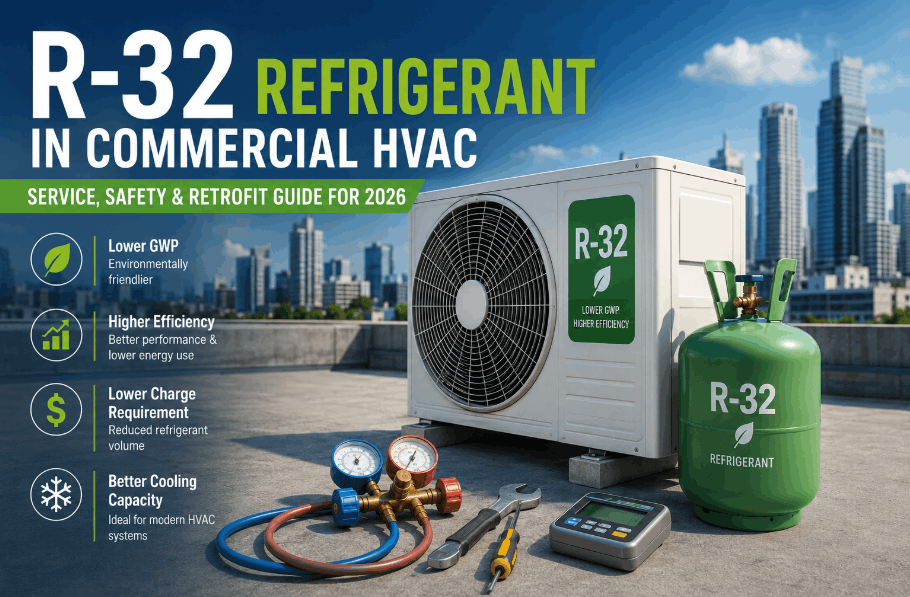
R-32 (difluoromethane) is a single-component A2L refrigerant with a Global Warming Potential of 675 — approximately one-third of R-410A's GWP of 2,088. It delivers comparable cooling capacity in a smaller refrigerant charge, meaning commercial systems operating on R-32 typically require 20–30% less refrigerant volume than equivalent R-410A equipment. The trade-off is its A2L mildly flammable classification, which introduces new service, installation, and ventilation requirements that facility and operations teams must embed into maintenance programs and contractor management protocols.
R-32 vs R-410A: Key Differences for Commercial Facilities Teams
GWP Comparison
R-32 has a GWP of 675 vs R-410A at 2,088 — a 68% reduction in climate impact per kg of refrigerant. This directly affects F-Gas quota compliance and carbon reporting obligations for commercial operators.
Refrigerant Charge Volume
R-32 systems typically require 20–30% less refrigerant charge by weight than R-410A equivalents, reducing per-service top-up costs and leak-event risk volume.
Flammability Classification
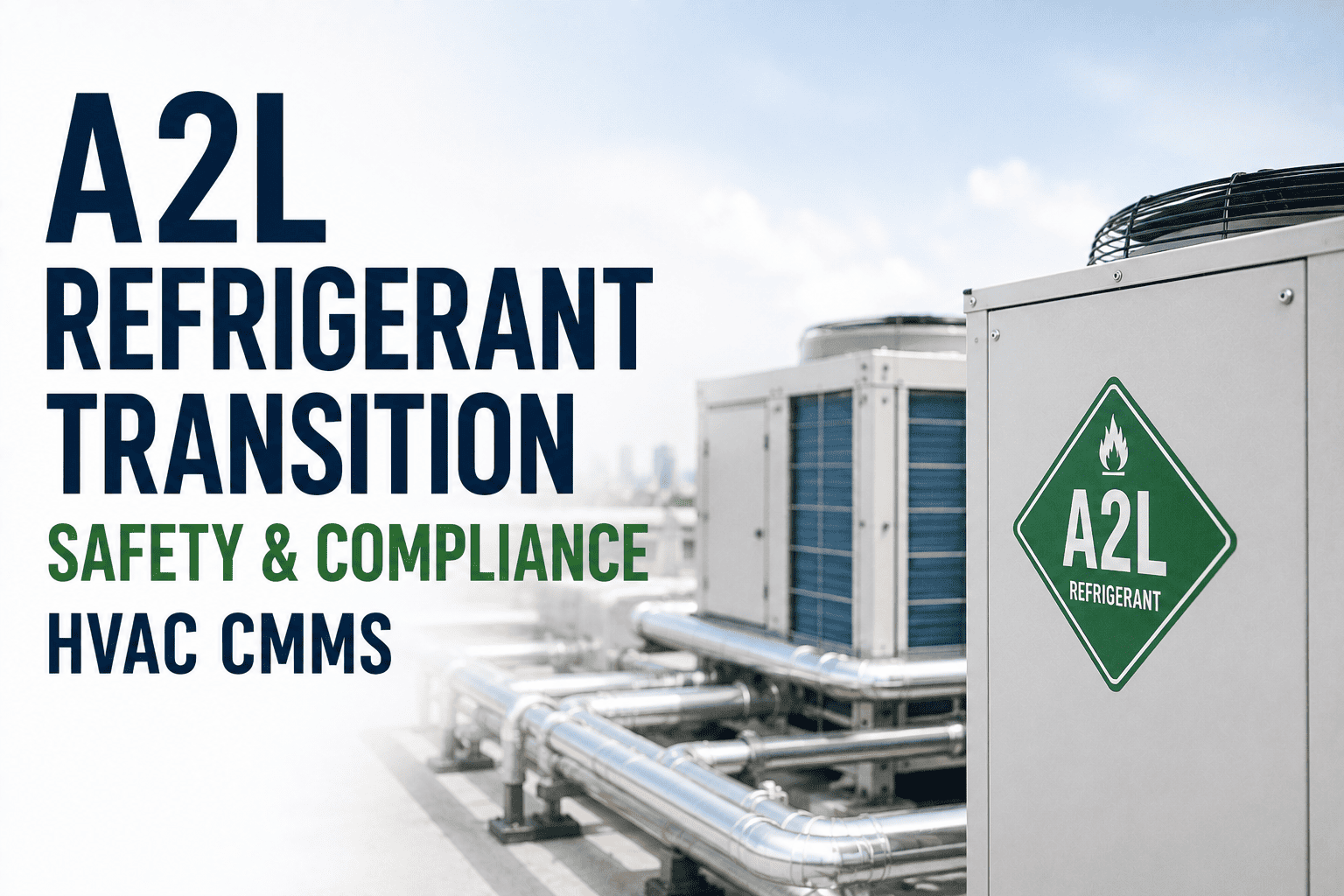
R-32 is classified A2L — mildly flammable. Unlike A1 refrigerants (R-410A, R-22), A2L service requires compliant ignition-source controls, ventilation protocols, and certified technician handling procedures.
Pressure Profile
R-32 operates at slightly higher discharge pressures than R-410A. Existing R-410A equipment and manifold gauges are not directly interchangeable — tooling verification is a required pre-service step.
System Efficiency
R-32 demonstrates higher volumetric efficiency than R-410A in comparable system designs — commercial units operating on R-32 can achieve measurably better seasonal energy performance in optimised configurations.
Retrofit Compatibility
R-32 cannot be retrofitted as a drop-in replacement for R-410A. Transition requires new equipment or purpose-designed retrofit kits — making asset-level tracking and replacement planning essential for multi-site facility operators.
A2L Safety Requirements: What Facility Teams Must Enforce
Step 01
Technician Certification
All technicians handling R-32 must hold valid A2L refrigerant handling certification. Facility managers must verify and document contractor credentials before permitting service access.
Step 02
Ignition Source Controls
A2L service areas require elimination of active ignition sources — open flames, non-sparksafe tools, and unprotected electrical equipment must be controlled or isolated before refrigerant handling begins.
Step 03
Ventilation Standards
Minimum airflow and ventilation requirements apply in confined plant rooms and rooftop enclosures. Ventilation adequacy must be assessed before any refrigerant recovery or charge work commences.
Step 04
Compliant Tooling
R-32 requires dedicated manifold gauges, recovery equipment, and leak detection tools. Cross-contamination with R-410A tools must be prevented. Asset service records should log tooling compliance per visit.
Step 05
Leak Detection & Response
R-32 leak events require A2L-rated detection equipment. Emergency response procedures for A2L releases differ from standard refrigerant protocols and must be embedded in facility emergency plans.
Commercial R-32 HVAC Service: What Changes in Your Maintenance Program
Scroll →
| Service Area |
R-410A Standard Practice |
R-32 Required Adjustment |
Facility Action Required |
| Technician Qualification |
Standard F-Gas certification |
A2L-specific handling certification required |
Verify and log contractor A2L credentials before scheduling |
| Service Tooling |
R-410A gauges and recovery equipment |
R-32 dedicated manifold, recovery, and vacuum equipment |
Update contractor service requirements in work order templates |
| Leak Testing Protocol |
Standard electronic leak detection |
A2L-rated leak detectors only; defined sensitivity thresholds |
Specify compliant leak detection in PM checklists |
| Plant Room Ventilation |
Recommended for good practice |
Mandatory pre-service ventilation assessment for A2L |
Add ventilation check as mandatory PM step for R-32 units |
| Refrigerant Top-Up Records |
Log charge weight and type |
Log charge weight, type, batch number, and A2L compliance verification |
Update work order completion forms for R-32 assets |
| Emergency Procedures |
Standard refrigerant release response |
A2L-specific release response protocols required on-site |
Update site emergency plans for all R-32 plant locations |
R-32 Asset Identification: Knowing What Your Portfolio Contains
Before any retrofit decision or A2L compliance program can be implemented, facilities teams need a clear, current picture of which HVAC units in their portfolio operate on R-32, which remain on R-410A, and which older assets still carry R-22. Multi-site operators without a centralised asset register routinely discover refrigerant type only at the point of service — creating compliance gaps, incorrect contractor briefings, and missed maintenance requirements. Sign Up Free to build a complete refrigerant-tagged HVAC asset register in OxMaint and eliminate the guesswork from portfolio compliance management.
Where to Find Refrigerant Type
Unit nameplate or data label — refrigerant type and charge weight are mandatory OEM fields on all commercial HVAC equipment
Installation commissioning records — refrigerant type and initial charge weight captured at first service
Contractor service reports — any F-Gas compliant service record must log refrigerant type and quantity handled
OEM product documentation — model number lookups confirm factory refrigerant specification for all installed units
What to Record in Your Asset Register
Refrigerant type (R-32, R-410A, R-22, or other) — tagged at unit level, not site level
Factory charge weight and current operating charge — to track top-up history and leak rate
A2L flag — whether the unit requires A2L-certified contractor and compliant tooling for all service visits
Installation date and estimated end-of-life year — to support phased retrofit planning across the portfolio
Last service date, next PM due, and open compliance actions — live maintenance status per unit
R-32 Retrofit Planning: Making the Right Asset-Level Decision
Continue on R-410A
Existing equipment and service protocols remain unchanged in the short term
R-410A supply restrictions and cost increases will intensify through 2025–2030 phase-down schedules
F-Gas quota costs increase as HFC allowances tighten annually
End-of-life equipment will require replacement — not retrofit — to transition refrigerant type
Deferred transition increases disruption and capital concentration risk at forced replacement
Suitable for assets approaching end-of-life within 2–3 years where early transition investment cannot be recovered
Transition to R-32
Lower refrigerant charge volumes reduce per-service top-up costs and F-Gas quota consumption
Modern R-32 equipment delivers measurably better energy efficiency — operational cost reduction over asset life
Compliance with incoming A2L regulations avoids future forced-replacement disruption
Contractor capability investment in A2L is a one-time adjustment with long-term value across the portfolio
Planned transition distributes capital spend, enables phased contractor training, and avoids emergency replacement costs
Suitable for assets with 5+ years remaining useful life where energy and compliance savings justify transition investment
How OxMaint Supports R-32 and HVAC Refrigerant Transition Management
1
Asset-Level Refrigerant Register
Know What You Have
OxMaint builds a complete HVAC asset register with refrigerant type, charge weight, installation date, and compliance status recorded at unit level — across every site in your portfolio.
2
R-32 Compliant PM Checklists
Enforce Every Requirement
Build A2L-specific PM checklists in OxMaint — ventilation checks, tooling verification, technician credential capture — enforced as mandatory steps before work order completion on R-32 assets.
3
Retrofit Planning Workflows
Plan the Transition
Use OxMaint asset age, condition score, and maintenance cost data to identify and prioritise R-410A units for planned R-32 transition — phased capital planning backed by real asset intelligence.
4
Compliance Audit Readiness
Always Audit-Ready
Every service visit, refrigerant top-up, and compliance check is timestamped and logged in OxMaint — giving facilities teams complete, exportable refrigerant compliance records at any time.
What R-32 Transition Delivers for Commercial Facility Operations
68%
Lower GWP than R-410A — reducing F-Gas quota costs and carbon reporting obligations for commercial operators
30%
Less refrigerant charge required per unit — lower top-up costs and reduced leak-event volume risk per service
A2L
Compliance requires structured maintenance protocols — OxMaint enforces A2L requirements at work order level across your portfolio
Live
OxMaint tracks refrigerant type, service status, and compliance records across every HVAC asset — in real time
Build Your R-32 Compliance Workflow in OxMaint
OxMaint links refrigerant asset data to PM schedules, A2L compliance checklists, contractor credential tracking, and service history — giving facility teams the structure they need to manage refrigerant transition without gaps.
Book a Demo to see how OxMaint supports commercial HVAC compliance and refrigerant transition planning, or
Sign Up Free and start building your HVAC asset register today.
Frequently Asked Questions
Can R-32 be used as a drop-in replacement for R-410A in existing commercial HVAC systems?
No. R-32 is not a drop-in retrofit refrigerant for R-410A systems. Transition requires new equipment designed for R-32 or manufacturer-approved retrofit kits. Facility teams should plan refrigerant transitions as part of structured equipment replacement cycles.
What does A2L classification mean for commercial HVAC maintenance teams?
A2L means mildly flammable — requiring certified technicians, ignition-source controls, adequate ventilation, and compliant tooling for all service work. Facility managers must embed these requirements into contractor management and PM workflows.
How does OxMaint help manage refrigerant compliance for commercial HVAC assets?
OxMaint tracks refrigerant type, service history, and compliance records at asset level. A2L-specific PM checklists enforce safety steps at work order level, and full service histories are available for audit at any time.
Is R-32 more energy efficient than R-410A in commercial applications?
R-32 has higher volumetric efficiency than R-410A and requires a smaller refrigerant charge. In purpose-designed commercial equipment, R-32 systems typically deliver better seasonal energy performance and lower operating costs over asset life.
When should a facility team prioritise R-32 retrofit versus continuing on R-410A?
Assets with 5 or more years of remaining useful life are generally strong retrofit candidates. OxMaint asset data — age, condition score, maintenance cost trends — supports evidence-based prioritisation decisions across multi-site HVAC portfolios.
What records should facilities teams maintain for R-32 refrigerant compliance?
Facilities teams should maintain records of refrigerant type and charge weight per unit, service visit logs with technician credentials, top-up quantities and batch numbers, leak test results, and ventilation compliance checks. OxMaint captures all of these at work order level.
Free to Start — No Credit Card Required
From R-32 Asset Data to Full HVAC Compliance — In One Platform
OxMaint connects your commercial HVAC asset register to refrigerant compliance workflows, A2L PM checklists, contractor tracking, and service history — so every unit is maintained safely, every service is documented, and every audit is ready.