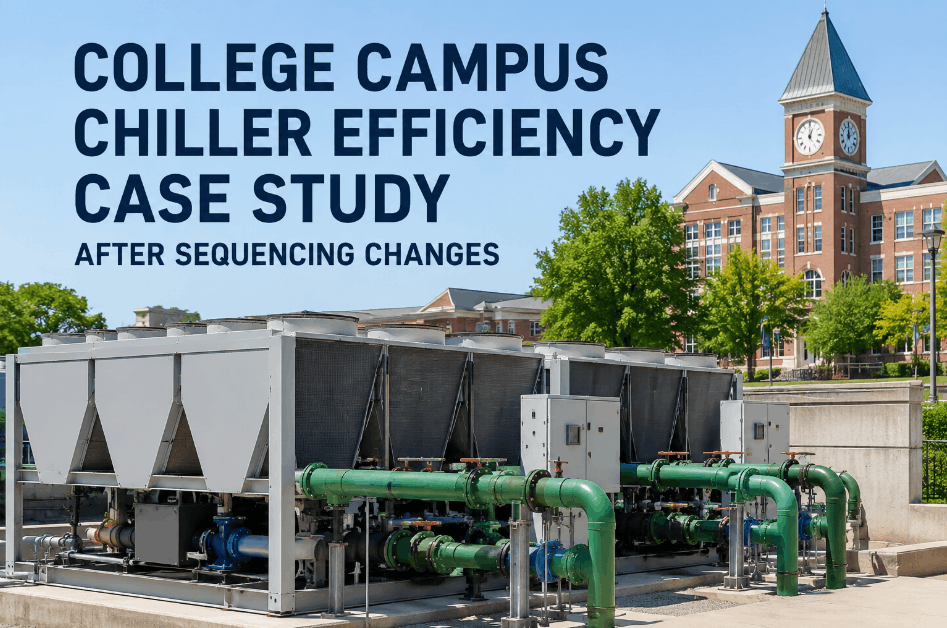
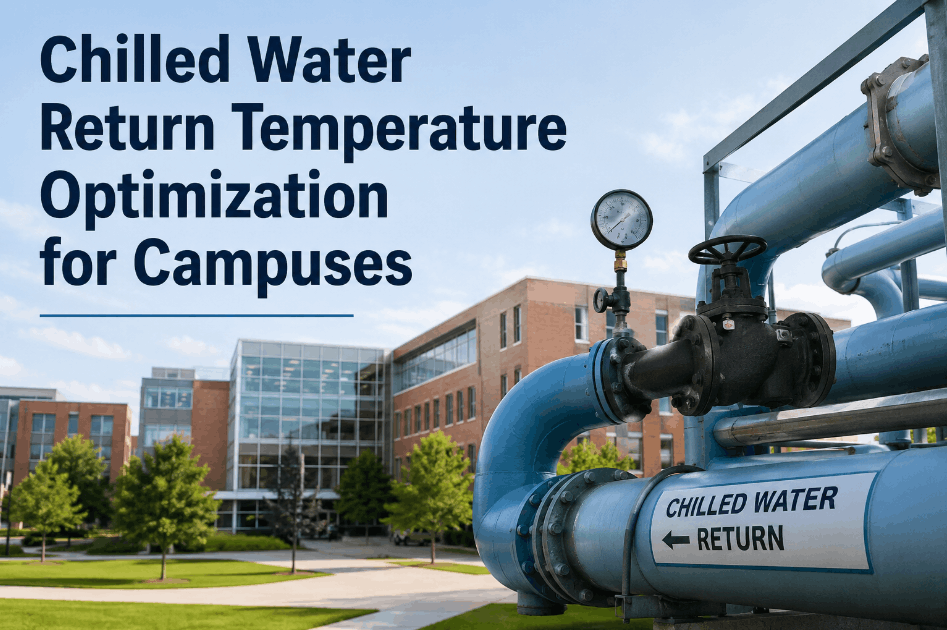
A mid-size university campus in the mid-Atlantic United States operating a central chilled water plant serving 38 academic and residential buildings was running its chiller fleet on fixed staging logic that had not been revised since original plant commissioning. Chillers were energizing sequentially by age rather than efficiency, running at partial load during low-demand periods, and cycling unnecessarily during shoulder seasons when a single optimized unit could serve the entire campus. Without structured sequencing oversight, preventive maintenance scheduling aligned to actual runtime, or digital inspection records connected to chiller asset profiles — Sign Up Free to explore the platform — the plant was consuming 23% more energy than load-optimized sequencing would require. After deploying Oxmaint's CMMS with chiller asset tracking, runtime-based maintenance scheduling, and digital inspection workflows, the campus reduced chiller plant energy consumption by 19%, cut unnecessary chiller runtime by 31%, and eliminated unplanned chiller shutdowns during the critical final exam cooling period.
Optimize Chiller Sequencing Before Peak Cooling Demand Returns
See how Oxmaint's CMMS delivers chiller asset tracking, runtime-based maintenance scheduling, and digital inspection trails — deployed without IT complexity or extended onboarding.
01 / The Facility
Central Chilled Water Plant. 38 Buildings. Load Matching That Didn't Match Anything.
Facility Type
University campus central chilled water plant serving academic buildings, residence halls, dining facilities, and a campus recreation center. Plant operates year-round with distinct seasonal load profiles driven by academic calendar, occupancy cycles, and outdoor design conditions.
Scale
Four centrifugal chillers with combined capacity of 4,200 tons. 38 buildings connected to the chilled water distribution loop. Supporting equipment includes 6 cooling towers, 12 primary and secondary pumps, and 14 air handling units serving central zones.
Maintenance Team
7-person central plant operations team — two licensed chiller technicians, three general facilities staff, and two operations coordinators managing work order dispatch and vendor scheduling for plant and building-level mechanical systems.
Sequencing Challenge
Original chiller sequencing logic staged units by installation number — not by current efficiency rating, runtime hours, or real-time load demand. Chiller 1 (oldest, lowest efficiency) was the default lead unit. Chillers 2 and 3 energized at fixed load thresholds regardless of seasonal demand profile or current equipment condition.
Prior System
Plant BAS provided operational data but had no CMMS integration. Maintenance scheduling was manual, calendar-based, and disconnected from actual chiller runtime. No digital inspection records, no runtime-weighted maintenance triggers, and no structured process for evaluating or updating sequencing logic based on equipment condition data.
Annual Cost Exposure
Estimated excess energy consumption from unoptimized sequencing represented $94,000 in annual utility overspend. Emergency chiller repair events during peak academic periods averaged $61,000 annually in unplanned maintenance costs and rental chiller expenses.
02 / The Challenge
Fixed Staging in a Variable Load Environment Creates Compounding Inefficiency
Campus chilled water plants are not static systems — they serve wildly varying loads across academic calendars, event schedules, and weather conditions. A sequencing strategy set at plant commissioning decades earlier reflects none of those realities. This plant's lead chiller was its oldest and least efficient unit. Its staging thresholds were fixed percentages that bore no relationship to current load profiles. Maintenance scheduling was calendar-based rather than runtime-weighted, meaning the highest-hour units received the same maintenance intervals as near-idle standby units. Book a Demo to see how Oxmaint closes these operational gaps in campus central plant environments.
23%
Excess energy from sequencing gaps
Engineering analysis determined that unoptimized chiller staging — leading with the least efficient unit and using fixed load thresholds — was responsible for approximately 23% excess energy consumption relative to a load-matched sequencing strategy.
4,100 hrs
Unnecessary chiller runtime annually
Shoulder season operation analysis showed chillers 2 and 3 accumulating over 4,100 combined hours of unnecessary runtime annually — energizing at fixed thresholds during periods when a single optimized unit could serve total campus load.
0
Runtime-linked maintenance triggers
All four chillers were maintained on identical 90-day calendar intervals — regardless of actual accumulated runtime hours. The lead chiller (Chiller 1) was running 3.4x more hours annually than standby units while receiving the same maintenance frequency.
3 events
Unplanned shutdowns in 2 years
Three unplanned chiller shutdowns occurred in the prior two academic years — two during final exam periods when campus cooling demand was at its seasonal peak — requiring emergency rental chiller deployment at significant cost and operational disruption.
"The plant was commissioned in a different era. The sequencing logic made sense when all four chillers were the same age and the campus was half its current size. By the time we addressed it, we were just burning energy and hoping the oldest unit would hold."
03 / The Solution
Oxmaint CMMS: Chiller Asset Tracking, Runtime-Based Maintenance Scheduling, and Sequencing-Aligned Inspection Workflows for Campus Central Plants
After evaluating CMMS platforms for campus central plant suitability, the facilities operations team selected Oxmaint for its combination of asset-level runtime tracking, flexible maintenance trigger configuration, and structured digital inspection workflows that could be aligned to sequencing logic changes without requiring BAS reprogramming. The platform gave the plant operations team the maintenance data foundation needed to defend and implement sequencing changes based on current equipment condition — replacing assumption-based staging with data-supported decisions. Sign Up Free and configure your chiller asset registry in under a week.
TRACK
All four chillers, six cooling towers, twelve pumps, and supporting plant assets registered in Oxmaint's asset registry — capturing runtime hours, maintenance histories, efficiency ratings, and current condition status in a single asset profile accessible to the full operations team.
SCHEDULE
Maintenance triggers reconfigured from fixed calendar intervals to runtime-hour thresholds — ensuring the lead chiller received proportionally more frequent maintenance than standby units in direct proportion to its actual operating hours, reducing failure risk during peak demand periods.
INSPECT
Structured digital inspection checklists deployed for each chiller unit — including efficiency metric verification, oil analysis scheduling, vibration check sequences, and condenser tube inspection steps. Every inspection timestamped, technician-attributed, and linked to auto-generated corrective work orders for identified findings.
OPTIMIZE
Oxmaint's asset condition data provided the maintenance evidence base supporting sequencing logic changes — enabling the plant team to justify reassigning lead chiller designation to the highest-efficiency unit and revising staging thresholds to reflect actual seasonal load profiles.
04 / Implementation
Fully Operational in 31 Days. First Runtime-Triggered Maintenance Cycle Complete Before Summer Peak.
Days 1–7
Chiller Asset Registry and Plant Equipment Catalogue
All 4 chillers and supporting plant equipment catalogued into Oxmaint's asset registry. Accumulated runtime hours manually entered from BAS historian exports and paper service logs. Manufacturer service intervals, oil analysis schedules, and efficiency benchmarks linked to individual asset profiles. QR tags installed on all primary plant equipment.
Days 8–16
Runtime-Based Maintenance Trigger Configuration and Inspection Workflow Build
Maintenance scheduling reconfigured for each chiller from 90-day calendar intervals to runtime-hour triggers — Chiller 1 at 750-hour intervals, Chillers 2 and 3 at 1,200-hour intervals, Chiller 4 (standby) at 1,800-hour intervals. Digital inspection checklists built for full chiller inspection, seasonal startup, and mid-season condition check sequences. First runtime-triggered work order generated on day 13 for Chiller 1, which had accumulated 890 hours since last service — flagged immediately under the new threshold logic.
Days 17–26
Team Training, Sequencing Change Documentation, and Parallel Operations
Plant operations team of 7 completed Oxmaint platform training — chiller technicians in 3 hours, general staff in 1.5 hours, coordinators in 2.5 hours including work order routing configuration. 10-day parallel period running digital and manual systems concurrently. Sequencing change proposal documented using Oxmaint asset condition data — supporting the shift from Chiller 1 to Chiller 3 as the new lead unit based on efficiency rating and current maintenance status.
Days 27–31
Full Digital Cutover, Sequencing Change Implementation, and Summer Readiness Campaign
Full paper elimination across all plant maintenance workflows. Sequencing changes implemented in BAS — Chiller 3 designated lead unit, revised staging thresholds aligned to seasonal load profiles documented in Oxmaint. Pre-summer inspection campaign launched, completing all four chiller seasonal startups in 4 days. Chiller 1's deferred service addressed before summer cooling demand peak.
05 / Results
19% Energy Reduction. Zero Unplanned Shutdowns. First Sequencing-Optimized Academic Year in Plant History.
Deploying Oxmaint's CMMS platform and implementing data-supported sequencing changes produced measurable outcomes that exceeded both the facilities team and university administration's targets. Runtime-based maintenance triggers resolved Chiller 1's deferred service before summer peak. Sequencing changes reduced unnecessary chiller runtime by 31% during shoulder seasons. The result was the plant's first academic year without an unplanned chiller shutdown and a 19% reduction in chilled water plant energy consumption. Book a Demo to map your campus plant's sequencing and maintenance outcomes.
| Metric |
Before Oxmaint |
After Oxmaint |
Change |
| Chiller plant energy consumption |
Baseline (unoptimized) |
−19% vs baseline |
19% energy reduction |
| Unnecessary chiller runtime (shoulder season) |
~4,100 hrs/year |
~2,830 hrs/year |
−31% wasted runtime |
| Unplanned chiller shutdowns (academic year) |
1.5 avg/year |
0 events |
100% eliminated |
| Lead chiller maintenance interval compliance |
Calendar-based, inconsistent |
Runtime-triggered, 100% |
Full compliance |
| Chiller inspection record completeness |
61% |
100% |
100% complete records |
| Reactive vs planned maintenance ratio (plant) |
58% reactive |
21% reactive |
−64% reactive ratio |
| Emergency repair and rental chiller spend |
$61,000/year avg |
$0 (current year) |
Full elimination |
| Estimated utility savings from sequencing |
$0 (no optimization) |
~$79,000/year |
New annual savings |
| Work orders issued (pre-summer campaign) |
0 structured |
29 plant work orders |
Structured first time |
| Asset maintenance cost visibility |
Sign Up Free to see how runtime-based scheduling works for your plant.
|
03
Shoulder season load matching delivered the majority of energy savings. The 19% total energy reduction was not evenly distributed across the year — approximately 70% of the savings occurred during spring and fall shoulder seasons, when the prior sequencing logic was energizing additional chillers at fixed thresholds while a single optimized unit could have served total campus load. Revised staging thresholds, documented and maintained in Oxmaint, captured savings that the original plant logic structurally prevented. Book a Demo to see how Oxmaint supports load-matched scheduling for campus plants.
04
Digital inspection records created a defensible equipment lifecycle documentation trail. With structured inspection records per chiller linked to Oxmaint asset profiles, the plant team built a continuous condition documentation history supporting both capital planning and warranty claim management. For a plant operating equipment with 15–20 year service lives, this maintenance record continuity represents long-term institutional value beyond any single-season efficiency outcome.
Energy Cost Recovery
A 19% reduction in chiller plant energy consumption delivered approximately $79,000 in annual utility savings — from sequencing changes supported by Oxmaint asset condition data and implemented without major capital investment.
Academic Continuity Protection
Eliminating unplanned chiller shutdowns during the academic year protected student, faculty, and exam-period operations — removing the $61,000 average annual emergency repair and rental chiller cost from the plant's operating budget.
Operations Team Efficiency
Shifting from 58% reactive to 21% reactive maintenance freed chiller technician capacity for planned work — reducing after-hours emergency response patterns and giving the team predictable maintenance windows that aligned to academic calendar low-demand periods.
Financial Recovery
Reduced emergency spend ($61,000 recovered), energy savings ($79,000 annually), and eliminated excess runtime costs combined to deliver an estimated $157,000 in annual financial benefit within the first full academic year post-deployment.
$157K
Annual savings recovered
Ready to Match Chiller Load to Real Campus Demand?
Oxmaint's CMMS delivers chiller asset tracking, runtime-based maintenance scheduling, and digital inspection workflows — without extended onboarding or IT-heavy deployment.
07 / FAQ
Frequently Asked Questions
How does a CMMS support chiller sequencing optimization on a college campus?
A campus CMMS provides the asset condition data, runtime histories, and maintenance records needed to justify and support sequencing changes — converting operational observations into data-supported decisions that administration can approve and plant teams can implement with confidence.
Can Oxmaint trigger chiller maintenance based on runtime hours rather than calendar dates?
Yes. Oxmaint's scheduling engine supports runtime-hour maintenance triggers configured per asset — ensuring lead chillers with high annual runtime receive more frequent service than standby units, directly proportional to actual equipment stress.
Does Oxmaint require BAS integration to track chiller runtime and condition?
No. Oxmaint operates independently of BAS systems. Runtime hours and condition data are entered manually or imported from BAS exports — giving facilities teams full CMMS functionality without requiring direct BAS integration or IT coordination.
How quickly can Oxmaint be deployed for a campus central chilled water plant?
Campus central plants typically reach full digital operation in 28–35 days. This 4-chiller, 38-building campus plant was fully deployed in 31 days with runtime-based maintenance scheduling active before the summer peak.
Can Oxmaint help document the maintenance case for chiller replacement decisions?
Yes. Full maintenance cost and runtime histories tracked per chiller surface units whose cumulative service spend or condition degradation supports replacement — providing the financial and operational documentation needed for capital project justification.
What is the energy savings potential from chiller sequencing changes supported by a CMMS?
Savings vary by plant configuration and prior sequencing logic, but facilities shifting from fixed staging to load-matched sequencing typically achieve 15–25% energy reductions in chiller plant operation — with most savings occurring during shoulder season operation.
What is the ROI timeline for a campus CMMS investment focused on chiller efficiency?
Campus central plants with reactive maintenance patterns and unoptimized sequencing typically recover platform costs within one academic year through combined energy savings, eliminated emergency repair costs, and reduced rental chiller exposure.
19% Less Energy. Zero Unplanned Shutdowns. Deployed in 31 Days.
4 chillers. 38 buildings. Runtime-based maintenance scheduling. Digital inspection trails from day one. See what Oxmaint delivers for your campus chilled water plant.