Ventilation systems represent one of the largest addressable carbon reduction opportunities in commercial buildings — and one of the least systematically managed. Fan energy, outdoor air conditioning loads, and reheat consumption collectively account for 30–45% of HVAC-related carbon in commercial facilities, yet most decarbonization roadmaps start with chiller plant upgrades and leave ventilation optimization as a later-phase activity. Sign Up Free to log ventilation PM work orders, fan runtime data, and control change documentation in OxMaint's CMMS — building the operational record that supports decarbonization project justification, verification, and reporting. The buildings that achieve durable ventilation carbon reductions are those that sequence their upgrades intentionally, protect occupant comfort at every stage, and document performance before and after each change.
Document Every Ventilation Change with a Traceable Work Order
OxMaint gives commercial building teams PM scheduling, control change documentation, equipment performance history, and compliance inspection checklists — built for facility operations teams executing ventilation decarbonization roadmaps in 2026.
Why Ventilation Decarbonization Requires a Phased Roadmap
Ventilation decarbonization cannot be treated as a single project — it is a sequence of interdependent control changes, equipment upgrades, and operational adjustments that must be implemented in priority order to avoid comfort failures and regulatory compliance gaps. Book a Demo to see how OxMaint's work order and PM modules help facility teams track the execution status of multi-phase ventilation roadmaps across buildings and equipment classes. Each phase must be verified before the next begins — demand-controlled ventilation cannot be tuned correctly until duct leakage is addressed, and VFD pressure optimization cannot hold without first correcting duct static pressure sensor placement. The roadmap structure is not bureaucracy; it is the mechanism that prevents a carbon reduction initiative from becoming an occupant comfort crisis.
Ventilation Decarbonization Roadmap: Phase by Phase
Baseline Audit and System Inventory
Commission airflow measurements, fan runtime data pulls, and duct leakage testing across all AHUs, MAUs, and exhaust systems. Build an OxMaint asset record for every ventilation unit with current CFM, design CFM, filter condition, and control sequence documentation. Baseline data is the only valid starting point for emissions reduction claims. Sign Up Free to begin building your ventilation asset inventory.
Duct Integrity and Leakage Remediation
Duct leakage of 15–25% is common in commercial buildings and directly undermines every downstream control optimization. Sealing supply and return duct leakage before implementing DCV or pressure reset strategies ensures that control changes produce the carbon reductions the model predicts — not the diluted results that leaking systems deliver.
Demand-Controlled Ventilation Implementation
DCV — modulating outdoor air delivery based on CO2 or occupancy sensor inputs — is the highest-ROI ventilation control change in spaces with variable occupancy. Properly tuned DCV reduces outdoor air conditioning energy by 20–40% in conference rooms, classrooms, and open-plan offices without compromising ASHRAE 62.1 compliance. Book a Demo to see how OxMaint documents control change work orders with pre- and post-verification readings.
VFD Retrofits and Static Pressure Optimization
Variable frequency drives on supply and return fans combined with static pressure reset strategies reduce fan energy by 30–50% versus constant-speed operation. VFD retrofit ROI is typically 2–4 years in systems that previously operated at constant static pressure setpoints — one of the strongest financial cases in commercial building decarbonization.
Heat Recovery Integration
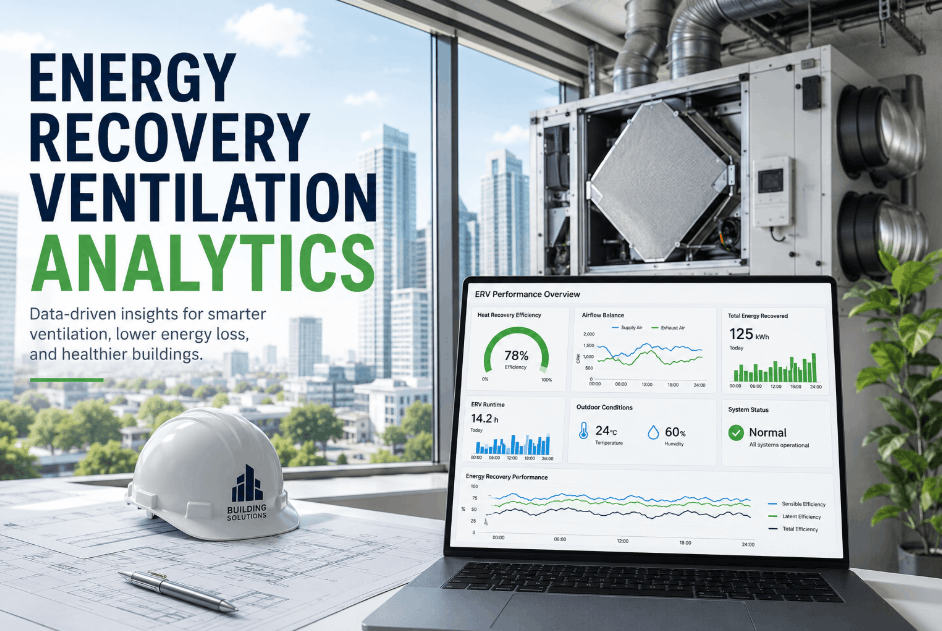
Energy recovery ventilators and heat wheels capture 60–80% of the heating and cooling energy from exhaust air before it is discharged — reducing the conditioning load on outdoor air by a factor that makes mechanical cooling and heating capacity more available for peak demand management. Heat recovery is most economical in climates with large outdoor-to-indoor temperature differentials.
Electrification and Low-Carbon Source Integration
After reducing ventilation load through efficiency measures, remaining conditioning can be shifted to electrified heat pump systems or low-carbon district energy sources. Load reduction from Phases 1–5 directly reduces the capital cost of electrification — making the sequencing of efficiency-before-electrification the economically correct decarbonization order.
Ventilation Decarbonization Metrics: What to Track at Every Phase
| Metric | What It Measures | Target | Intervention Threshold |
|---|---|---|---|
| Outdoor Air CFM/Person | Ventilation rate vs. ASHRAE 62.1 | Per occupancy category minimum | Overcooling or excess OA — DCV review |
| Fan kW/CFM | Fan system efficiency | <0.5 W/CFM (supply + return) | >0.8 W/CFM — VFD or duct audit |
| Duct Leakage (%) | System delivery efficiency | <5% total leakage class A | >15% — sealing before optimization |
| CO2 Setpoint Compliance | DCV control accuracy | 700–900 ppm occupied setpoint | >1,000 ppm — DCV tuning required |
| Reheat Energy (kBtu/ft²) | Overcooling and reheat waste | Minimize vs. prior year baseline | >10% increase — VAV or SAT audit |
| Carbon Intensity (kg CO2/ft²) | Emissions per unit of conditioned area | Roadmap milestone target | Missed milestone — phase review |
Reactive HVAC Operations vs. Decarbonization Roadmap Execution
Execute Your Ventilation Decarbonization Roadmap with Full Documentation
OxMaint gives commercial building teams the work order management, PM scheduling, asset history tracking, and inspection checklists to implement ventilation decarbonization phases with documented evidence at every step — from baseline audit through post-upgrade verification.
Frequently Asked Questions: Ventilation Decarbonization
What is the highest-ROI first step in ventilation decarbonization?
Demand-controlled ventilation is typically the highest-ROI first step in variable-occupancy commercial spaces, often delivering 2–3 year payback. Duct leakage remediation must precede DCV implementation to ensure control changes deliver predicted results.
How do VFDs reduce ventilation carbon emissions?
VFDs reduce fan speed in proportion to airflow demand — and since fan power scales with the cube of speed, a 20% speed reduction delivers nearly 50% power reduction. This makes VFD retrofits one of the strongest energy and carbon reduction measures in commercial HVAC.
Can ventilation decarbonization upgrades harm indoor air quality?
Yes, if implemented without occupancy verification and CO2 monitoring. DCV and airflow reductions must be validated against ASHRAE 62.1 minimum ventilation rates under actual occupied conditions — OxMaint's inspection checklists capture this verification at each phase.
How does a CMMS support decarbonization roadmap execution?
A CMMS like OxMaint documents each control change, baseline measurement, and post-upgrade verification in a timestamped asset record — creating the audit trail needed for emissions reporting, energy incentive applications, and building certification programs.
How long does a full ventilation decarbonization roadmap take to implement?
Typically 3–5 years for a comprehensive six-phase roadmap across a commercial campus. Early phases (DCV, VFDs) deliver carbon and cost savings that fund later phases — making the roadmap self-financing with proper sequencing and documentation.
Ready to Build a Ventilation Decarbonization Roadmap That Holds Up?
OxMaint gives facility teams the PM scheduling, control change documentation, IAQ inspection workflows, and asset performance history to execute ventilation decarbonization phases with the evidence base that building owners, regulators, and tenants require.