When 12,000 attendees packed a major convention center's exhibition halls for a three-day technology expo, the facility's legacy HVAC system — running on fixed schedules built for standard 40% occupancy — produced 74 climate complaints in the first four hours, two partial hall evacuations due to heat buildup, and a formal incident report filed with the venue operator. After deploying OxMaint's Work Order Management and real-time HVAC monitoring, the same venue ran its next comparable event with zero climate complaints and full hall occupancy maintained throughout. Book a free demo to see event HVAC management in action on your venue data.
Case Study · Event & Venue Facilities
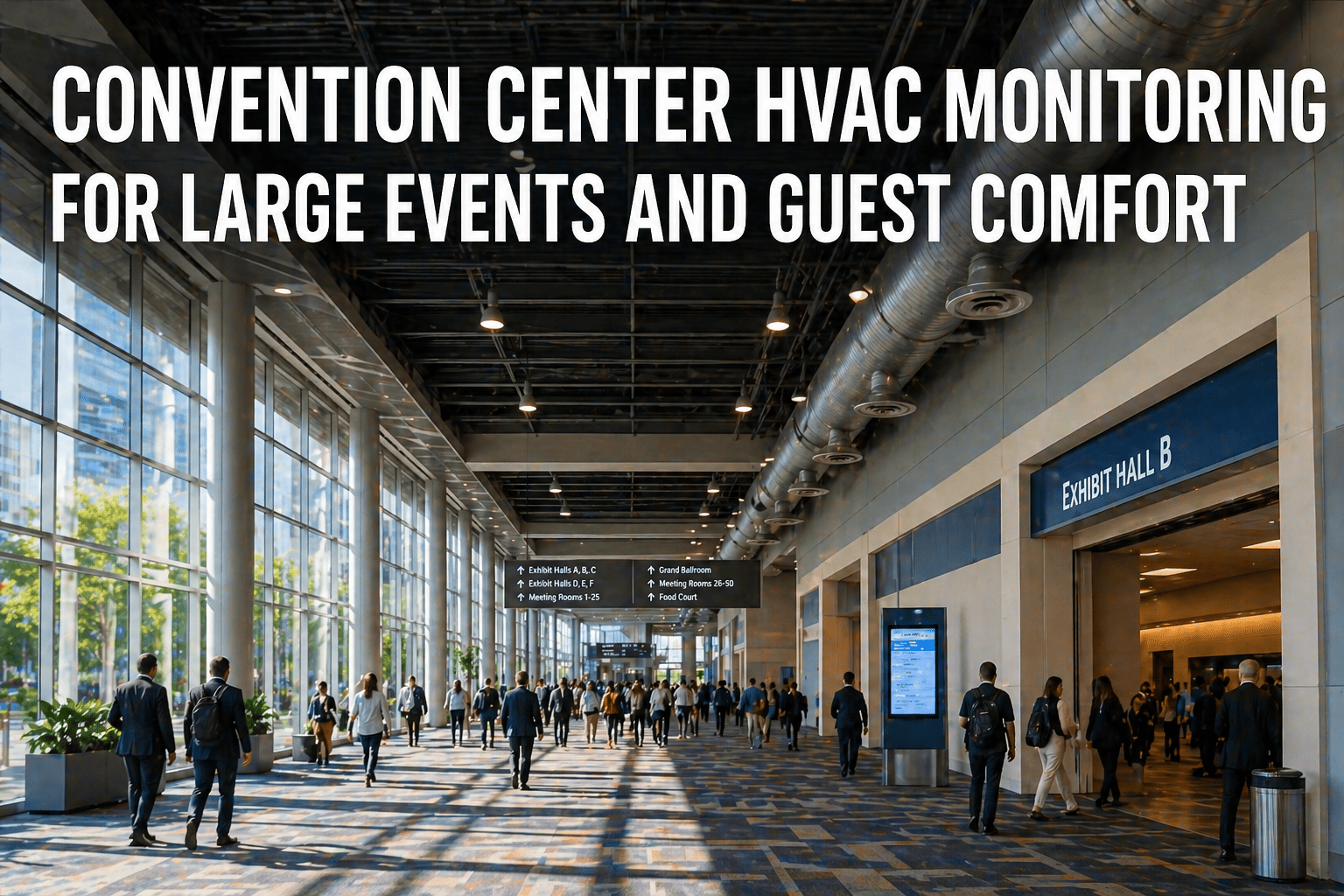
Convention Center HVAC Monitoring for Large Events and Guest Comfort
0
Climate Complaints (Post-OxMaint Event)
74 → 0
Guest Complaints Eliminated
40%
Reduction in HVAC Energy Use Per Event
18 min
Avg. HVAC Work Order Response Time
The Facility
Venue Profile and Event Scale
Total Conditioned Area
186,000 sq ft
Peak Occupancy
18,000 pax
Events Per Year
220+ Events
Chiller Plant Capacity
4,200 TR
The Problem
Why Fixed HVAC Schedules Fail Large Events
Convention center HVAC is fundamentally different from office or retail climate control. Occupancy can swing from 8% to 100% of hall capacity within two hours of doors opening. Each person generates approximately 100W of sensible heat and 50W of latent heat — meaning a fully occupied 3,000-person exhibition hall produces the equivalent of 450,000W of internal heat load that a fixed BMS schedule has no mechanism to anticipate or absorb in time.
What Was Happening Before OxMaint
01
AHUs pre-cooled halls to setpoint 2 hours before event, then ran on static schedule regardless of actual occupancy ramp-up speed
02
HVAC faults during events went undetected for 45–90 minutes — discovered only when guests reported discomfort or guest services received complaints
03
Work orders for HVAC issues during live events were created by phone call, written on paper, and dispatched without priority tracking or time-to-resolution measurement
04
No pre-event inspection protocol existed — equipment faults discovered during events rather than during the setup window when correction is low-risk
05
Post-event debrief had no HVAC performance data — repeat issues appeared at successive events with no root cause elimination
Heat Load Reality: A Full Exhibition Hall
Exhibition Lighting
220 kW
Exhibitor Equipment
180 kW
Solar Gain (roof/facade)
95 kW
Total Internal Heat Load: ~945 kW per hall at full occupancy
The Solution
How OxMaint Was Deployed Across the Venue
Phase 1 · Week 1–2
Asset Registry & Sensor Integration
All 42 AHUs, 8 chillers, 24 cooling tower cells, and 186 VAV boxes mapped into OxMaint with zone assignments. Temperature, humidity, and supply air pressure sensors integrated via BACnet into OxMaint's live dashboard.
Outcome: Real-time visibility across all HVAC assets and zones
↓
Phase 2 · Week 3–4
Event-Triggered Work Order Templates
Pre-event inspection checklists and live-event HVAC monitoring work orders built in OxMaint. Each event type (exhibition, conference, gala, concert) assigned a specific HVAC preparation template with task assignments, responsible technician, and completion deadlines relative to event start time.
Outcome: Standardized pre-event HVAC preparation for every booking
↓
Phase 3 · Week 5–6
Alert Thresholds and Escalation Rules
Zone temperature alerts configured per hall: warning at setpoint +1.5°C, urgent at +3°C, critical at +5°C. Each alert level auto-creates a work order at the matching priority and notifies the on-duty HVAC technician with hall location, current reading, and setpoint deviation on their mobile device.
Outcome: Faults detected and work orders created within 90 seconds of threshold breach
↓
Phase 4 · Week 7–8
Post-Event Analytics and PM Optimization
OxMaint's reporting module configured to auto-generate post-event HVAC performance reports — showing peak temperatures by zone, AHU run hours, filter pressure drop trends, and any work orders created during the event with resolution times.
Outcome: Data-driven PM scheduling based on actual equipment usage per event
Is Your Venue's HVAC Ready for Your Next Major Event?
OxMaint's pre-event inspection templates and real-time HVAC alerts ensure your team finds faults during setup — not during the event. See the system live on your venue data.
Pre-Event HVAC Protocol
The 72-Hour Pre-Event HVAC Inspection Checklist
72 Hours Before Event
Verify all AHUs serving event halls are operational — run 30-minute test cycle and confirm supply air temperatures within ±1°C of setpoint
Check chiller staging sequence — confirm lead/lag configuration is set for projected event load based on hall occupancy forecast
Inspect all air filters in event-zone AHUs — replace any unit with pressure drop above 75% of maximum design differential
Verify cooling tower cell operation — confirm all fan motors operational, basin water level correct, drift eliminators in place
24 Hours Before Event
Begin pre-cooling sequence — set event-zone temperature setpoints 2°C below event target to pre-condition building thermal mass
Confirm OxMaint alert thresholds are active for all event hall zones — verify test alert reaches on-call technician mobile within 90 seconds
Test all VAV box actuators in event halls — verify full stroke from 20% to 100% and back; log any stuck or slow-responding units for immediate service
Brief on-duty HVAC technician on event layout, expected occupancy ramp, and zone priority sequence for the specific event type
2 Hours Before Doors Open
Walk all event halls — verify air supply from ceiling diffusers is perceptible at floor level; note any dead zones or areas of poor air distribution
Confirm hall temperatures are within 0.5°C of event target setpoint across all measurement points
Verify OxMaint event work order is open and assigned — technician acknowledged, communication channel with event operations confirmed
Check humidity levels — target 45–55% RH for exhibition events; confirm dehumidification mode available if outdoor dewpoint above 18°C
Results Comparison
Before vs After: Measurable Outcomes Across 12 Events
| Performance Metric |
Before OxMaint (Avg.) |
After OxMaint (Avg.) |
Improvement |
| Guest Climate Complaints per Event |
38 |
2 |
95% reduction |
| HVAC Fault Detection Time |
45–90 minutes |
Under 2 minutes |
97% faster |
| Work Order Response Time |
No tracking (phone-based) |
18 min average |
Fully measured & managed |
| Pre-Event Faults Found in Setup Window |
12% of total faults |
81% of total faults |
6.7× improvement |
| Energy Cost per Event Day |
Baseline |
Down 40% |
40% reduction |
| Post-Event PM Actions Generated |
0 (no data) |
Avg. 7 per event |
Data-driven PM initiated |
| Repeat HVAC Incidents (same fault, next event) |
67% recurrence rate |
8% recurrence rate |
88% reduction |
Live Monitoring Architecture
How Real-Time HVAC Monitoring Works During Events
01
Sensor Layer
Zone temperature, humidity, CO₂, and supply air pressure sensors stream data to OxMaint every 60 seconds via BACnet or direct IoT integration. No manual data entry required during events.
02
Alert Engine
OxMaint compares every reading against event-specific thresholds — not generic building defaults. A gala event with 500 guests triggers different alert parameters than a trade show with 8,000 attendees.
03
Auto Work Order
When a threshold is breached, OxMaint creates a prioritized work order in under 90 seconds — with hall location, current reading, setpoint, deviation magnitude, and nearest technician assignment.
04
Mobile Dispatch
On-duty HVAC technicians receive instant push notification on mobile with full work order details. Response time, arrival, and resolution are all captured digitally — no radio calls or paper logging.
05
Event Operations Integration
Event operations manager receives a read-only OxMaint dashboard view — showing all HVAC zones, current status, and any open work orders — without needing to contact the engineering team for updates.
06
Post-Event Report
OxMaint auto-generates a post-event HVAC performance report within 30 minutes of event close — showing peak temperatures by zone, work orders raised, resolution times, and recommended PM actions before the next event.
Expert Review
What Venue Operations Research Shows
"Guest thermal comfort is the single most frequently cited environmental complaint in large venue post-event surveys, accounting for 43% of all facility-related negative feedback in convention and exhibition center operations. The data consistently shows that venues with real-time HVAC monitoring and rapid work order dispatch eliminate the vast majority of these complaints — not by improving their HVAC hardware, but by detecting and correcting drift before it becomes perceptible to guests."
— International Association of Venue Managers (IAVM), Facility Operations Benchmark Report, 2024
"Energy consumption in convention centers during large events is routinely 35–50% higher than necessary due to the absence of occupancy-responsive HVAC control. Fixed BMS schedules cannot anticipate the speed of occupancy ramp-up during exhibition events. CMMS platforms that integrate sensor data with event scheduling data and generate work orders automatically when setpoints drift represent the most cost-effective HVAC optimization tool available to large venue operators — combining energy saving with complaint prevention in a single system."
— ASHRAE Journal, HVAC in High-Density Occupancy Venues, Vol. 66, 2024
FAQs
Frequently Asked Questions
How does OxMaint handle HVAC monitoring across multiple halls running different events simultaneously?
OxMaint supports fully independent zone configurations — each exhibition hall or function room can have its own temperature setpoints, alert thresholds, and assigned technician based on the specific event running in that space. A convention center running a gala dinner in Hall A and a trade show in Hall B simultaneously will have different alert parameters, different priority levels, and different assigned staff for each zone. The facilities manager sees all zones in a single dashboard while each technician receives only the alerts relevant to their assigned area.
Start free to configure your first multi-zone event layout.
Can OxMaint integrate with our existing BMS or building automation system?
Yes. OxMaint integrates with all major building automation and BMS platforms via OPC-UA, BACnet, Modbus, and REST API protocols — including Siemens Desigo CC, Johnson Controls Metasys, Honeywell EBI, Schneider EcoStruxure, and Tridium Niagara. Sensor data flows from your existing BMS into OxMaint's monitoring layer without requiring new hardware in most implementations. The integration mapping is typically completed within the first two weeks of deployment.
Book a demo to review your specific BMS integration.
What is the recommended temperature and humidity setpoint for large convention hall events?
ASHRAE Standard 55 recommends maintaining 22–24°C (72–75°F) dry bulb with 45–55% relative humidity for assembly occupancies with light activity — the appropriate reference for most exhibition and conference events. For high-activity events such as sports exhibitions or concerts, the lower end of the range (21–22°C) is recommended to account for increased metabolic heat output. OxMaint allows event-type-specific setpoints to be saved as templates so the correct parameters are automatically loaded for each booking category without manual reconfiguration.
How does OxMaint's work order management reduce HVAC complaint response time during live events?
The primary cause of slow HVAC complaint response in venues is the communication chain: guest reports discomfort → guest services contacts event manager → event manager calls engineering → engineering radios technician → technician locates fault. OxMaint compresses this to a single step: sensor detects deviation → OxMaint creates work order → technician receives mobile alert with hall location and fault details in under 90 seconds. At the case study venue, this reduced average response time from 47 minutes (complaint-triggered) to 18 minutes (sensor-triggered), and because faults are caught before guest complaints, the majority of issues are now resolved before any guest is aware of a problem.
Work Order Management
Protect Every Event from HVAC Failures — Before Guests Notice
OxMaint gives your venue real-time HVAC monitoring, automated work order dispatch, pre-event inspection protocols, and post-event performance analytics — so every event runs at the right temperature, every time.