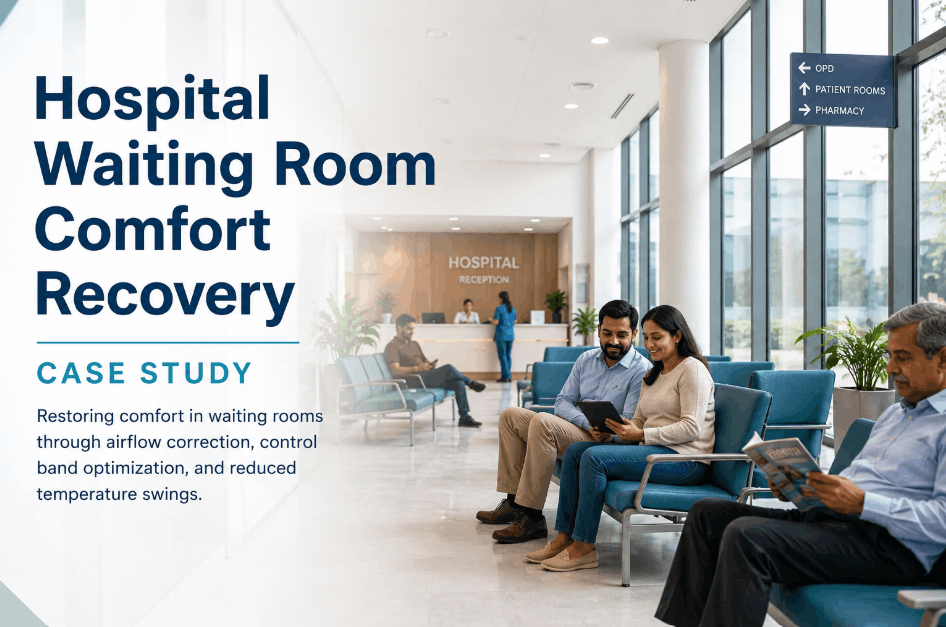
Hospitals rarely lose air quality compliance to one dramatic equipment failure — they lose it to a pressure relationship in an isolation room drifting out of spec for days while filter changes run on a fixed calendar instead of actual usage. Patient areas depend on precise pressure differentials and air change rates, and when those parameters drift quietly, infection control risk rises long before a routine inspection would catch it. A multi-wing hospital ran into exactly this pattern: negative-pressure isolation rooms occasionally drifted toward neutral without triggering any alert, filter changes followed a generic calendar regardless of actual air handling unit loading, and compliance documentation for accreditation reviews was scattered across paper logs and spreadsheets. If your facility is managing patient area air quality without real-time pressure monitoring or usage-based filter scheduling, Sign Up Free to see how Oxmaint structures environmental compliance for healthcare facilities — or Book a Demo with a healthcare facilities specialist.
Pressure Monitoring · Usage-Based Filter PM · Accreditation-Ready Records
Stop Checking Patient Area Air Quality on a Calendar and Start Monitoring It in Real Time
Real-time pressure and air change monitoring, usage-driven filter PM, automated drift escalation, and digital compliance trails — Oxmaint helps healthcare facilities teams protect patient areas before an audit ever finds the gap.
Facility Profile
The Operation: A Multi-Wing Hospital Checking Patient Area Air Quality on a Calendar Instead of in Real Time
Facility Overview
IndustryHealthcare — multi-wing acute care hospital
Scope1 hospital campus, 3 patient wings, 48 monitored air handling units and 22 isolation/negative-pressure rooms
Team6 facilities/biomed engineers, 1 infection control liaison, 1 compliance officer
Prior SystemPaper-based pressure checks and a fixed-calendar filter change schedule with no real-time room-level monitoring
Oxmaint FeaturesPLC & Sensor Integration · Inspection Management · Safety & Compliance · Preventive Maintenance · EHS Management · Analytics & Reporting
Baseline Air Quality Issues
14%
Of isolation room pressure checks found a differential outside spec at time of inspection
6 days
Average time a pressure or air change rate drift could persist before being caught
3 days
Average time spent compiling compliance documentation ahead of an accreditation review
Root Cause Analysis
Why Pressure and Filtration Drift Went Unnoticed Between Manual Checks
A review of pressure check logs, filter replacement records, and accreditation prep history revealed four compounding gaps in how environmental conditions were monitored. None of the gaps traced to the engineering team's diligence — the failure was in checking conditions periodically instead of continuously. Sign Up Free to bring real-time air quality monitoring to your patient areas — or Book a Demo to see drift escalation on a live system.
35%
No Real-Time Monitoring of Room Pressure Differentials Tied to an Asset Record
Isolation room pressure was checked manually on a periodic schedule, so a differential drifting toward neutral between checks could go unnoticed for days in a patient care area.
30%
Filter Changes Followed a Fixed Calendar Instead of Actual Air Handling Unit Loading
Every air handling unit followed the same generic filter replacement interval regardless of how hard it was actually running, so some units operated with degraded filtration before their next scheduled change.
22%
Inspection Records for Isolation Rooms Lived on Paper, Hard to Retrieve for Audits
Pressure checks, filter logs, and corrective actions were recorded across separate paper forms with no shared asset reference, turning every accreditation review into a manual document search.
13%
No Escalation When Pressure or Air Change Rate Drifted Out of Spec
A room reading outside its required pressure differential or air change rate triggered no automatic alert, leaving detection dependent on the next scheduled manual check.
The Solution
How Oxmaint Brought Real-Time Monitoring to Patient Area Pressure and Filtration
The hospital deployed Oxmaint to connect live pressure and air change data to a single asset register, schedule filter PM by real loading, and escalate drift automatically. Sign Up Free to see real-time room monitoring on your own facility — or Book a Demo to walk through compliance reporting live.
01
Sensor Integration Brought Real-Time Pressure and Air Change Data Into Oxmaint
PLC and sensor integration connects each isolation room and air handling unit to a live data feed tied to its own asset record, replacing periodic manual pressure checks with continuous monitoring.
02
Filter Change PM Schedules Now Follow Actual Unit Loading, Not a Fixed Calendar
Preventive maintenance for filter replacement is generated from each air handling unit's real running hours and loading trend instead of a generic interval applied across every unit.
03
Automatic Escalation When Pressure or Air Change Rate Drifts Out of Spec
When a monitored room's pressure differential or air change rate moves outside its required range, Oxmaint automatically opens a prioritized work order for facilities and notifies the infection control liaison.
04
Digital Inspection Checklists Build an Audit-Ready Compliance Trail
Pressure checks, filter records, and corrective actions are now captured through digital checklists with a complete, timestamped history ready for any Joint Commission or CMS review.
Results at 90 Days
Pressure Compliance, Drift Detection, and Audit Readiness Three Months After Deployment
89%
Reduction in isolation room pressure differentials found out of spec at inspection
4 hrs
Average time to detect a pressure or air change rate drift — down from roughly 6 days
100%
Of isolation rooms and air handling units now on real-time monitored asset records
58%
Of filter PM tasks rescheduled based on actual unit loading rather than fixed calendar
74%
Reduction in time spent compiling documentation for accreditation reviews
3.1×
ROI on Oxmaint platform cost within 90 days from reduced compliance risk and engineering hours
| Metric |
Before Oxmaint |
90 Days After |
Change |
| Isolation room pressure out of spec at inspection |
14% of checks |
89% reduction measured |
-89% |
| Time to detect a pressure/ACH drift |
~6 days average |
4 hours average |
-97% |
| Rooms and AHUs on real-time monitoring |
0% monitored continuously |
100% monitored continuously |
+100% |
| Filter PM tied to actual loading |
Fixed calendar only |
58% of tasks usage-based |
+58% |
| Accreditation documentation prep time |
~3 days per review |
74% faster compilation |
-74% |
| Platform ROI |
Not measured |
3.1× within 90 days |
3.1× |
Key Business Impact
What Real-Time Monitoring Means for Healthcare Air Quality Compliance
Patient area air quality rarely fails because one air handling unit breaks down completely — it fails because a pressure relationship drifts quietly for days between manual checks, or a filter keeps running past the point it's actually still protective. A calendar-based schedule treats every room and every unit the same regardless of how it's actually performing, which leaves real risk sitting undetected. Once pressure and loading data flow in continuously and drift triggers an automatic alert, infection control stops depending on catching it during the next scheduled walk-through. Oxmaint gives healthcare facilities teams that visibility without disrupting existing clinical workflows.
Renata Cole, Healthcare Facilities Engineering & Environmental Compliance Specialist
17 years hospital facilities operations · Former director of plant operations, multi-wing acute care hospital · Specialist in patient area pressure monitoring, filter loading analysis, and accreditation-ready compliance reporting for healthcare facilities
Continuous Monitoring · Usage-Based PM · One Compliance Trail
Give Your Infection Control Team Visibility Before the Next Audit Finds the Gap
Real-time pressure and air change monitoring, usage-driven filter PM, automated drift escalation, and digital compliance trails — Oxmaint helps healthcare facilities teams protect patient areas continuously.
FAQs
Frequently Asked Questions
How does Oxmaint monitor isolation room pressure differentials in real time?
Through sensor integration that ties each room's pressure and air change rate to a live data feed connected to its own asset record.
Can Oxmaint adjust filter change schedules based on actual air handling unit usage?
Yes. Filter PM tasks are generated from each unit's real running hours and loading trend rather than a fixed calendar interval.
Does Oxmaint help hospitals prepare for Joint Commission or CMS accreditation reviews?
Yes. Digital inspection checklists and pressure/filter records create one timestamped compliance trail ready for any review.
How does Oxmaint escalate a pressure or air change rate drift in a patient area?
Readings outside the required range automatically open a prioritized work order and notify the infection control liaison.
How long does it take to set up real-time air quality monitoring with Oxmaint?
Most healthcare facilities teams connect priority rooms and air handling units within the first two to three weeks.
Every Patient Area, One Compliance Standard
Bring Real-Time Pressure Monitoring and Usage-Based Filter PM to Your Hospital
Oxmaint brings continuous pressure and air change monitoring, usage-driven filter PM, automated drift escalation, and audit-ready compliance trails to healthcare facilities teams.