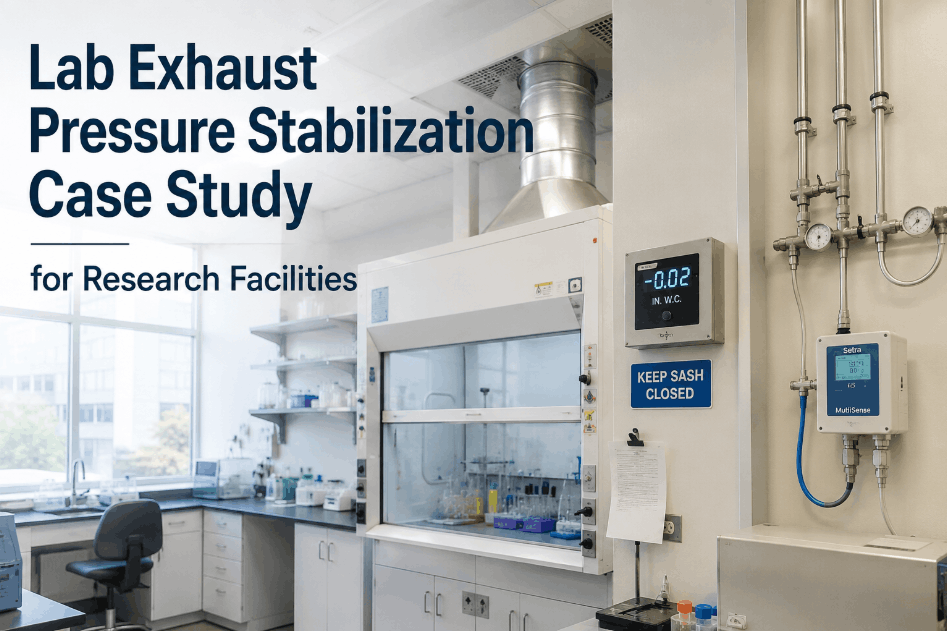
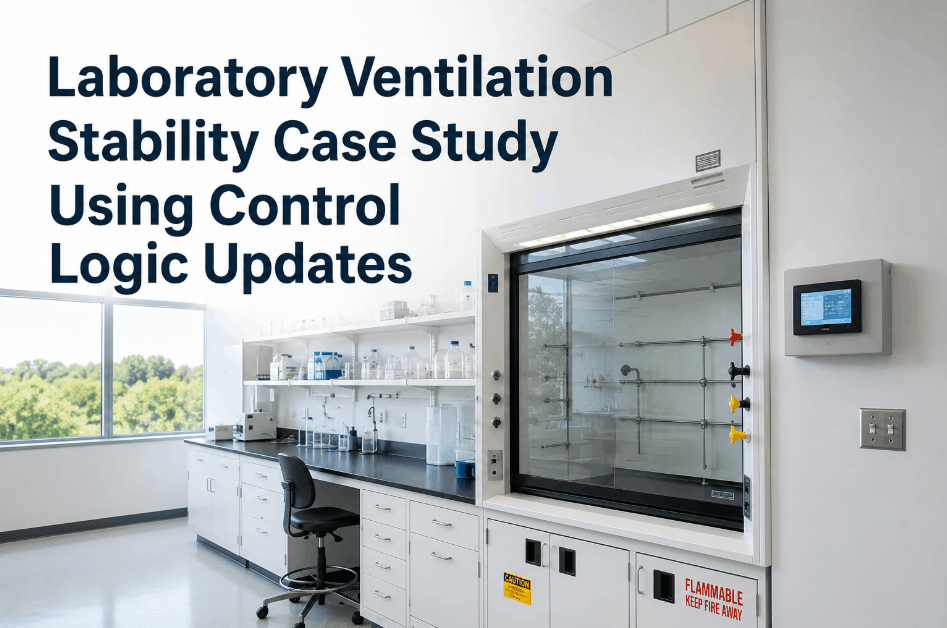
Laboratory exhaust pressure is one of the most safety-critical variables in research facility operations — and one of the most difficult to stabilize when controls, sensors, and exhaust rebalancing are managed through disconnected maintenance workflows. A university-affiliated research facility operating six laboratory wings found that pressure instability had become a recurring problem: containment zones were experiencing pressure differentials outside safe operating ranges, sensor readings were being trusted without calibration verification, and exhaust rebalancing was performed reactively after complaints rather than proactively against performance baselines. If your research facility is managing lab pressure stability without a connected maintenance and verification system, Sign Up Free to see how Oxmaint structures critical environment maintenance for research operations — or Book a Demo with a facility engineering specialist.
Pressure Control · Sensor Verification · Lab Safety
Stabilize Lab Exhaust Pressure Before It Becomes a Safety Event
Exhaust rebalancing workflows, sensor calibration tracking, controls verification, and pressure performance monitoring — OxMaint gives research facility teams the maintenance structure to keep critical environments within specification.
Facility Profile
The Operation: Six Laboratory Wings, Unverified Sensors, and Reactive Pressure Management
Facility Overview
IndustryResearch and laboratory operations — six wings, mixed biosafety and chemical containment classifications
Team12 facility engineers, 2 environmental health and safety coordinators, 1 controls systems technician
Asset Scope64 exhaust fan units, 148 pressure sensors, 31 VAV control zones across six wings
Prior SystemBAS alarm response, manual pressure logs, sensor calibration tracked in spreadsheets
Oxmaint FeaturesPreventive Maintenance Scheduling · Sensor Calibration Tracking · Controls Verification Workflows · Pressure Performance Logging · Work Order Management · Compliance Record Closure
Baseline Risk Indicators
47%
Of pressure sensors had not been calibration-verified within the required 12-month cycle at time of assessment
3.4×
Increase in pressure deviation events in the 18 months following last full exhaust rebalancing campaign
38%
Of VAV controls zones had documented tuning deviations not yet addressed through a corrective work order
Root Cause Analysis
Why Lab Pressure Kept Drifting — And Why Sensor and Controls Gaps Went Undetected
A structured review of 18 months of BAS alarm logs, sensor calibration records, and exhaust service history identified four compounding failure patterns. The facility engineering team was not underperforming on routine maintenance — scheduled PM cycles were being completed on time. The problem was that pressure stability depended on three interdependent systems — exhaust fans, pressure sensors, and VAV controls — each maintained through separate workflows with no shared performance baseline or verification closure chain. Deviations in any one system cascaded into pressure instability, but the maintenance record structure could not surface the connection. Sign Up Free to map your facility's pressure control maintenance gaps — or Book a Demo to see how Oxmaint connects exhaust, sensor, and controls maintenance for research environments.
36%
Sensor Calibration Cycles Not Enforced or Tracked to Closure
Calibration schedules existed on paper, but no system verified completion or flagged overdue sensors. Out-of-specification sensors continued generating readings used by BAS controls — causing the control system to respond to false data while actual pressure drifted.
29%
Exhaust Rebalancing Performed Reactively, Not on Defined Intervals
Rebalancing was triggered by sustained complaints or safety flags rather than scheduled against load change events. Seasonal occupancy shifts, new equipment installations, and zone reclassifications accumulated unaddressed between reactive service campaigns.
24%
VAV Controls Tuning Deviations Not Linked to Corrective Workflows
Controls faults identified during BAS alarm reviews were logged but not automatically converted to work orders. Documented deviations sat in alarm history without triggering corrective action, allowing controls drift to compound across multiple zones simultaneously.
11%
No Cross-System Pressure Performance Baseline for Deviation Detection
Each system — exhaust fans, sensors, VAV zones — had separate performance records. Without a unified pressure stability baseline, the engineering team could not distinguish sensor drift from actual pressure changes or controls faults from exhaust load imbalance.
The Solution
How Oxmaint Rebuilt Pressure Stability Across All Six Laboratory Wings
The research facility deployed Oxmaint to create a connected maintenance structure across all three pressure-critical system types — exhaust fans, pressure sensors, and VAV controls zones. Sensor calibration was scheduled with auto-closure verification, ensuring no sensor remained unverified beyond its required cycle. Exhaust rebalancing was placed on a defined interval schedule tied to occupancy change events, eliminating the reactive-only trigger model. Controls fault detection from BAS alarm data was linked directly to corrective work order generation, removing the manual gap between deviation identification and corrective response. A unified pressure performance log connected maintenance activity across all three systems to actual zone pressure readings — giving engineers a cross-system view of stability trends for the first time. Book a Demo to see how Oxmaint builds connected maintenance workflows for critical laboratory environments.
01
Sensor Calibration Scheduling With Verified Closure and Overdue Flagging
All 148 pressure sensors were enrolled in a calibration PM schedule within Oxmaint, with required closure verification at each cycle. Overdue sensors were automatically flagged in the work order queue — ensuring no sensor operated beyond its calibration window without engineering visibility.
02
Scheduled Exhaust Rebalancing Tied to Load Change Triggers
Exhaust rebalancing work orders were scheduled on defined intervals and linked to occupancy change events, equipment additions, and seasonal load transitions. Rebalancing no longer required a safety complaint to initiate — the maintenance schedule drove the activity before pressure drift accumulated.
03
BAS Controls Faults Auto-Converted to Corrective Work Orders
VAV controls deviations flagged in BAS alarm logs were integrated with Oxmaint's work order system, generating corrective maintenance tasks automatically at fault detection. Controls drift was addressed within the next maintenance cycle — not accumulated in alarm history waiting for manual review.
04
Unified Pressure Performance Log Across All Three System Types
Maintenance completion data from exhaust fans, sensors, and VAV zones was linked to zone-level pressure performance logs. Engineers could correlate system maintenance events with pressure stability trends — distinguishing sensor drift from load imbalance and isolating root causes without cross-referencing three separate record systems.
Results at 90 Days
What Pressure Stability Looked Like Three Months After Deploying Oxmaint
79%
Reduction in pressure deviation events across all six laboratory wings versus the prior 90-day baseline
100%
Sensor calibration compliance — all 148 pressure sensors verified within required cycle windows
86%
Reduction in unaddressed VAV controls deviations — from 38% of zones open at baseline to under 6%
+61%
Faster corrective response to controls faults — auto work order generation eliminated manual review delay
0
Safety-triggered pressure escalations in the 90 days post-deployment, versus 4 in the prior equivalent period
4.3×
ROI on platform cost within 90 days from avoided regulatory review events, reduced reactive service, and compliance record efficiency
| Metric |
Before Oxmaint |
90 Days After |
Change |
| Pressure deviation events (90-day period) |
Avg 19 events |
Avg 4 events |
-79% |
| Sensor calibration compliance rate |
53% of sensors |
100% of sensors |
Full compliance |
| Open VAV controls deviations |
38% of zones |
6% of zones |
-86% |
| Reactive exhaust rebalancing calls |
Avg 6/quarter |
Avg 1/quarter |
-83% |
| Safety-triggered pressure escalations |
4 per period |
0 per period |
Eliminated |
| Compliance record preparation (audit) |
16 hrs avg |
5 hrs avg |
-69% |
Key Business Impact
What Stable Lab Exhaust Pressure Means for Research Facility Safety and Compliance
"Lab pressure failures almost never come from a single system — they come from three systems that each look fine in isolation but interact badly when one drifts. A sensor that's out of calibration tells the controls system a zone is stable when it isn't. A VAV zone that's been tuned wrong for six months slowly pulls the exhaust balance off. A rebalancing that hasn't happened since a wing was reconfigured leaves load distribution mismatched to the actual space. The challenge is that maintaining these systems through separate workflows means you're always one step behind the interaction. When exhaust, sensors, and controls are maintained as a connected system with shared performance visibility, pressure stability becomes a manageable engineering problem — not a recurring safety risk."
Dr. Priya Nambiar, Research Facility Engineering and Critical Environment Systems Advisor
18 years laboratory and research facility operations · Former chief facilities engineer, multi-campus research institution · Specialist in critical environment pressure management, biosafety systems compliance, and integrated building controls maintenance
Exhaust Rebalancing · Sensor Calibration · Controls Verification
Connect the Maintenance Workflows That Keep Lab Pressure Stable
Scheduled exhaust maintenance, sensor calibration enforcement, BAS-linked controls work orders, and unified pressure performance tracking — OxMaint gives research facility engineers a connected maintenance structure for critical environment stability.
FAQs
Frequently Asked Questions
How does Oxmaint help research facilities stabilize lab exhaust pressure?
Oxmaint connects exhaust fan maintenance, sensor calibration cycles, and VAV controls verification in a unified workflow — ensuring all three pressure-critical systems are maintained in sync rather than through isolated tracks.
Can Oxmaint enforce pressure sensor calibration schedules for laboratory environments?
Yes. Calibration PMs are scheduled per sensor with closure verification required. Overdue sensors are automatically flagged in the work order queue so no sensor operates beyond its required calibration window.
Does Oxmaint integrate with BAS alarm data to trigger corrective work orders?
Yes. Controls deviations from BAS systems can be linked to automatic corrective work order generation in Oxmaint — eliminating the manual step between fault detection and maintenance response.
How does Oxmaint support compliance record closure for lab safety audits?
Maintenance completion records, sensor calibration certificates, and corrective action closures are stored in a unified audit trail — reducing compliance record reconstruction time and providing defensible documentation for regulatory review.
How quickly does lab pressure stability improve after deploying Oxmaint?
Most facilities see measurable reduction in pressure deviation events within the first two PM cycles after sensor calibration compliance is restored — typically within 30–60 days of deployment.
Every Verified Sensor Is a Containment Risk Reduced
Give Your Lab Environment the Maintenance Structure It Requires
Oxmaint brings sensor calibration enforcement, scheduled exhaust rebalancing, controls fault-to-work-order automation, and unified pressure performance logging to research facility maintenance programs — without adding engineering headcount.