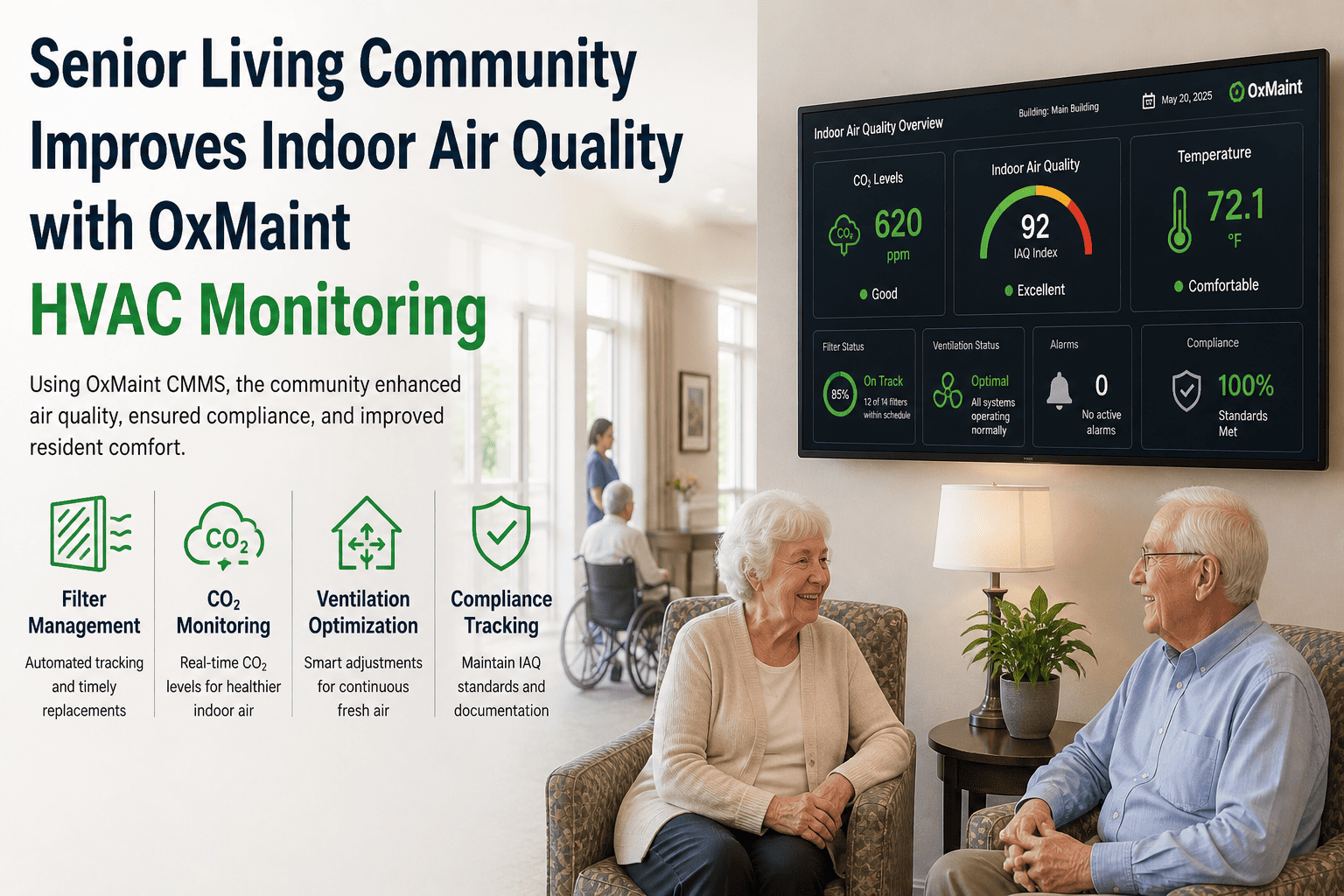
A senior living facility HVAC failure is not a maintenance inconvenience — it is a resident safety emergency. Elderly residents and those with chronic conditions cannot thermoregulate the way younger adults can. A 4°F temperature deviation that an office worker tolerates without noticing can trigger a serious health event in a resident with cardiovascular disease, diabetes, or dementia. The Centers for Medicare and Medicaid Services survey findings consistently cite environment of care deficiencies — including temperature and ventilation non-compliance — among the top five citations that threaten facility certification and reimbursement. The senior living and long-term care operators maintaining the highest resident satisfaction scores and the fewest CMS citations share one operational advantage: a structured, documented 24/7 HVAC maintenance programme built around resident vulnerability, not building convenience. Book a demo to see how Oxmaint keeps your facility HVAC compliant, documented, and always resident-ready.
4°F
Temperature deviation that can trigger serious health events in elderly residents with cardiovascular or metabolic conditions
CMS
Environment of care temperature and ventilation deficiencies consistently rank in the top 5 CMS survey citations nationally
24/7
Required HVAC operational continuity — senior living facilities have no unoccupied hours, no off-season, and no acceptable downtime window
30%+
Higher resident complaint rate in senior facilities with reactive HVAC management versus structured preventive maintenance programmes
Why Senior Living HVAC Is a Resident Safety System
Senior living and long-term care HVAC is not comfort-level infrastructure. It is a medical environment control system that operates continuously for residents who have no tolerance for failure.
TEMP
Temperature Stability
CMS requires nursing home room temperatures between 71°F and 81°F. Residents with diabetes, heart disease, or dementia are especially sensitive to thermal variation. HVAC systems must maintain these ranges without gaps — not when convenient.
IAQ
Indoor Air Quality
Elderly immune systems are compromised. Airborne pathogen control, dust and particulate management, and adequate ventilation directly affect infection rates across the resident population. IAQ failures spread respiratory illness faster in senior facilities than in any other building type.
HUM
Humidity Control
Relative humidity between 30–60% is required in resident care areas. Below 30%, mucous membranes dry and infection vulnerability increases. Above 60%, mold growth begins in duct liners and ceiling tiles within days — creating direct respiratory hazard for immunocompromised residents.
REG
Regulatory Compliance
CMS Conditions of Participation, state health department surveys, and accreditation bodies all require documented HVAC maintenance records. Missing records — even when equipment is functioning — constitute survey deficiencies that can trigger correction plans, civil monetary penalties, and in severe cases, decertification.
HVAC Systems in Senior Living: Maintenance by Area Type
Each area of a senior living campus has distinct HVAC requirements driven by resident acuity, regulatory classification, and risk profile. A single PM programme must address all of them — by zone, not by building. See how Oxmaint maps zone-specific PM schedules across your full campus.
| Facility Zone |
Temp Requirement |
Key PM Frequency |
Regulatory Basis |
Risk if Failed |
| Resident Rooms |
71–81°F year-round |
Filter monthly, coil bi-annual, FCU quarterly |
CMS 42 CFR 483.15, state licensing |
Resident health event, CMS survey deficiency, family complaint escalation |
| Memory Care Unit |
71–78°F with tight control |
Filter monthly, thermostat calibration quarterly |
CMS Conditions of Participation, state dementia care regs |
Behavioural escalation in dementia residents, regulatory citation |
| Dining and Activity Areas |
70–76°F during occupancy |
Filter bi-monthly, coil semi-annual |
CMS dining environment standards |
Resident comfort complaints, food safety temperature management issues |
| Therapy and Rehab |
72–76°F with low humidity |
Filter monthly, humidity sensor calibration bi-annual |
Joint Commission Environment of Care |
Therapy disruption, accreditation finding if documentation absent |
| Skilled Nursing / Clinical |
70–75°F, 30–60% RH |
Filter monthly, HEPA semi-annual, pressure quarterly |
CMS SNF conditions, ASHRAE 170 |
Infection risk, CMS survey deficiency, potential reimbursement impact |
Four HVAC Failures That Trigger CMS Citations and Resident Events
These four patterns are the consistent root causes of senior living HVAC regulatory citations and resident safety events. All are preventable with a structured maintenance programme.
01
Temperature Exceedances in Resident Rooms
FCUs and room HVAC units with clogged filters, dirty coils, or failed thermostats lose the ability to maintain the CMS-required temperature band. Summer heat events in rooms without functioning cooling are high-severity CMS deficiencies. Documentation of PM tasks — or the absence of it — is the first thing a surveyor examines when a temperature complaint is filed.
02
Humidity Exceedances and Mold Events
Humidity above 60% in resident areas creates mold growth in duct liners and ceiling tiles within 72 hours. A single mold event in a memory care unit or skilled nursing wing triggers immediate survey investigation, resident relocation, environmental remediation costs, and typically a CMS deficiency that requires a corrective plan of action — disrupting operations for weeks.
03
Missing or Incomplete Maintenance Documentation
A CMS surveyor who finds a functioning HVAC system but no maintenance records will cite the facility just as they would for a malfunctioning system. Documentation gaps — missing filter change logs, unrecorded thermostat checks, absent contractor sign-offs — are treated as evidence of a deficient maintenance programme regardless of actual equipment condition.
04
Overnight and Weekend Equipment Failures
Senior living facilities operate at full occupancy every hour of every day. HVAC failures during overnight shifts or weekend periods — when maintenance staff is reduced — expose residents to extended periods of temperature or humidity non-compliance. Without a structured PM programme that reduces failure rates, facilities accept this risk permanently.
A CMS Surveyor Does Not Call Ahead. Your HVAC Records Must Always Be Ready.
Oxmaint auto-schedules every filter change, coil cleaning, thermostat calibration, and humidity check across every resident zone — and retains the complete maintenance record that satisfies CMS surveyors, state inspectors, and accreditation reviewers at any moment.
Reactive vs. Structured Senior Living HVAC Maintenance
In senior living, reactive HVAC management is not just a cost problem — it is a resident safety risk and a regulatory compliance gap that surveyors are specifically trained to identify.
Temperature Management in Resident Rooms
Reactive Management
FCU and room thermostat issues addressed when residents or family complain. Filter loading and coil degradation reduce heating and cooling capacity gradually — invisible until a temperature exceedance event. CMS survey finds no maintenance records and cites the programme.
With Oxmaint PM Schedule
Monthly filter changes and quarterly FCU inspections maintain rated heating and cooling capacity. Thermostat calibration verified bi-annually per zone. Temperature compliance documentation always current. Survey-ready at any time without advance preparation.
Humidity and IAQ Control
Reactive Management
Humidity sensors not calibrated. No scheduled monitoring of RH levels in resident areas. Mold event discovered during a routine inspection or after resident complaints — triggering emergency remediation, resident relocation, and CMS investigation.
With Oxmaint PM Schedule
Humidity sensor calibration scheduled bi-annually. Humidifier and dehumidifier PM tasks generated automatically by season. RH readings logged per zone. Any exceedance triggers a corrective work order before conditions reach mold growth threshold.
CMS Survey and Documentation Readiness
Reactive Management
Maintenance records scattered across paper logs, contractor invoices, and email chains. Survey preparation takes days of record compilation. Gaps discovered during preparation or — worse — during the survey itself, triggering immediate deficiency citations.
With Oxmaint PM Schedule
Complete HVAC maintenance history per zone, per asset, and per work order exportable in under 2 minutes. Facility is survey-ready every day — not just in the weeks before a scheduled inspection. No gap discovery risk during an unannounced survey.
How Oxmaint Manages Senior Living HVAC Compliance
Senior living HVAC maintenance requires a system built for regulatory accountability, 24/7 operational continuity, and the documentation standards that CMS and accreditation bodies require. Book a demo to see Oxmaint running on a live senior living campus asset register.
01
Zone-Specific Asset Registry by Resident Care Area
Every FCU, AHU, thermostat, humidity sensor, and ventilation unit registered by resident zone — memory care, skilled nursing, assisted living, and common areas. CMS temperature requirements and PM intervals assigned per zone type. Installation date, warranty status, and condition score tracked centrally. Maintenance history always linked to the specific zone and room, not just the building.
02
Automated PM Scheduling Aligned to CMS Requirements
PM schedules are built around CMS Conditions of Participation and state licensing requirements — not generic commercial building intervals. Monthly filter changes, quarterly FCU inspections, semi-annual coil cleaning, and annual AHU overhauls generate automatically. Seasonal maintenance tasks for humidity management activate before summer and winter occupancy peaks. No manual calendar management for facilities staff.
03
Resident Complaint to Work Order in One Step
When a resident, family member, or care staff logs a temperature or comfort complaint, a reactive work order is created immediately — assigned, prioritised, tracked, and linked to the room and zone asset record. The complete complaint-to-resolution timeline is always documented, providing the evidence trail CMS surveyors require when investigating resident rights concerns related to environment of care.
04
CMS-Ready Compliance Reports Exportable in 2 Minutes
When a surveyor arrives — announced or unannounced — a complete HVAC maintenance record for the facility exports in under 2 minutes: PM completion rates by zone, filter change logs with dates and technician sign-offs, thermostat calibration records, corrective actions for any out-of-range conditions, and contractor service certificates. The facility is always prepared — because Oxmaint keeps the records current every day.
Every Resident Room Comfortable. Every Zone Compliant. Every Record Audit-Ready.
Oxmaint gives senior living facilities zone-specific PM scheduling, CMS-aligned maintenance intervals, humidity and temperature compliance tracking, and instant survey-ready documentation — all in one platform, live in 60 days, with no implementation fees.
71–81°F
CMS-required temperature range maintained by structured zone-specific PM schedules
2 Min
To export complete CMS-ready HVAC maintenance records for any unannounced survey
30%+
Lower resident HVAC complaint rate in facilities with structured PM vs. reactive management
60 Days
To active PM schedules across your full campus — no implementation fees, no long onboarding
Regulatory Frameworks Governing Senior Living HVAC
Senior living and long-term care HVAC maintenance is governed by multiple overlapping frameworks — federal CMS standards, state licensing requirements, and accreditation bodies — each requiring documented evidence of compliance.
| Framework |
Requirement |
HVAC Implication |
Oxmaint Coverage |
| CMS 42 CFR 483 |
Nursing home Conditions of Participation — temperature 71–81°F in resident areas, documented maintenance programme |
PM records, temperature logs, corrective actions, contractor sign-offs all required for survey response |
CMS-aligned PM scheduling, temperature range tracking, survey-ready export in 2 minutes |
| Joint Commission |
Environment of Care (EC) standards — HVAC equipment maintenance, temperature and humidity monitoring, documentation |
Documented PM programme with intervals, completion rates, and corrective action records required for accreditation |
EC-aligned maintenance intervals, PM compliance dashboard, corrective work order tracking |
| ASHRAE 170 |
Ventilation for healthcare facilities — ACH rates, temperature, humidity by space type |
Skilled nursing and clinical areas require ASHRAE 170-compliant ventilation verification and PM documentation |
ASHRAE 170 zone-specific intervals, ventilation verification PM tasks, calibration records |
| State Licensing |
Varies by state — most require annual or biennial facility inspections with HVAC maintenance record review |
State inspectors review maintenance logs, contractor records, and temperature monitoring documentation |
State-specific compliance calendars, deadline alerts, complete maintenance history export |
| CARF / NCQA |
Rehabilitation and managed care accreditation — facility safety and environment of care standards |
HVAC maintenance documentation supports environment of care accreditation requirements |
Accreditation-aligned record structure, PM completion rates, compliance export per building |
The ROI of Structured Senior Living HVAC Maintenance
40%
Fewer CMS environment of care HVAC citations in facilities with structured, documented preventive maintenance programmes
$12K+
Average civil monetary penalty per CMS environment of care deficiency in nursing facilities — per citation, not per survey
5 Yrs
Additional HVAC equipment service life in senior living facilities with structured quarterly PM versus reactive management
2 Min
To generate complete CMS-ready HVAC maintenance documentation for any unannounced survey with Oxmaint
Frequently Asked Questions: Senior Living HVAC Maintenance
What temperature does CMS require in nursing home resident rooms?
CMS 42 CFR 483.15 requires that nursing facilities maintain resident room temperatures between 71°F and 81°F at all times. This is not a target range — it is a regulatory requirement that applies year-round, including during overnight hours and weekend periods when maintenance staffing is reduced. Facilities must have documented evidence that HVAC systems are maintained to sustain this temperature band, including PM records, corrective action documentation for any exceedances, and contractor service sign-offs.
What HVAC documentation does a CMS surveyor look for?
CMS surveyors examining environment of care typically request written preventive maintenance policies and schedules, evidence of PM task completion with dates and technician identification, contractor service records for HVAC inspections and repairs, corrective action documentation for any temperature or humidity exceedances, and evidence that the facility has a system for tracking maintenance compliance. Missing records — even when equipment is physically functional — constitute survey findings under the maintenance and safe environment standards.
How often should FCUs in resident rooms be serviced?
Fan coil units in resident rooms should have monthly filter inspection and cleaning, quarterly comprehensive inspection including coil condition, drain pan, and controls, semi-annual deep coil cleaning, and annual thermostat calibration verification. Memory care and skilled nursing units typically warrant more frequent inspection due to higher-acuity resident populations and tighter temperature requirements. Oxmaint schedules all these intervals by zone type automatically — no manual calendar management required.
What humidity range is required in senior living facilities?
CMS and ASHRAE 170 for healthcare spaces require relative humidity between 30% and 60% in resident care areas. Below 30%, mucous membrane irritation increases infection vulnerability. Above 60%, mold growth becomes active within 72 hours in duct liners, ceiling tiles, and wall materials — particularly in memory care and skilled nursing units where ventilation is lower and occupancy is continuous. Humidity sensors require calibration at defined intervals and continuous monitoring in high-acuity zones to detect exceedances before they reach remediation threshold.
How can Oxmaint help prepare for a CMS survey?
Oxmaint keeps your facility survey-ready every day — not just before scheduled inspections. All HVAC PM records, contractor sign-offs, corrective actions, and temperature and humidity compliance documentation are retained per asset and per zone. When a surveyor arrives, a complete environment of care HVAC compliance report for the entire facility exports in under 2 minutes. There is no preparation time required and no risk of record gaps — because the documentation is built continuously through every completed work order.
Your Residents Cannot Wait. Neither Can Your HVAC Programme.
Oxmaint gives senior living and long-term care facilities zone-specific HVAC scheduling, CMS-aligned maintenance intervals, temperature and humidity compliance tracking, resident complaint to work order management, and survey-ready documentation — all in one platform, live in 60 days, with no implementation fees.
CMS-aligned PM scheduling by zone
Temperature and humidity compliance tracking
Resident complaint work order management
Survey-ready documentation in 2 minutes