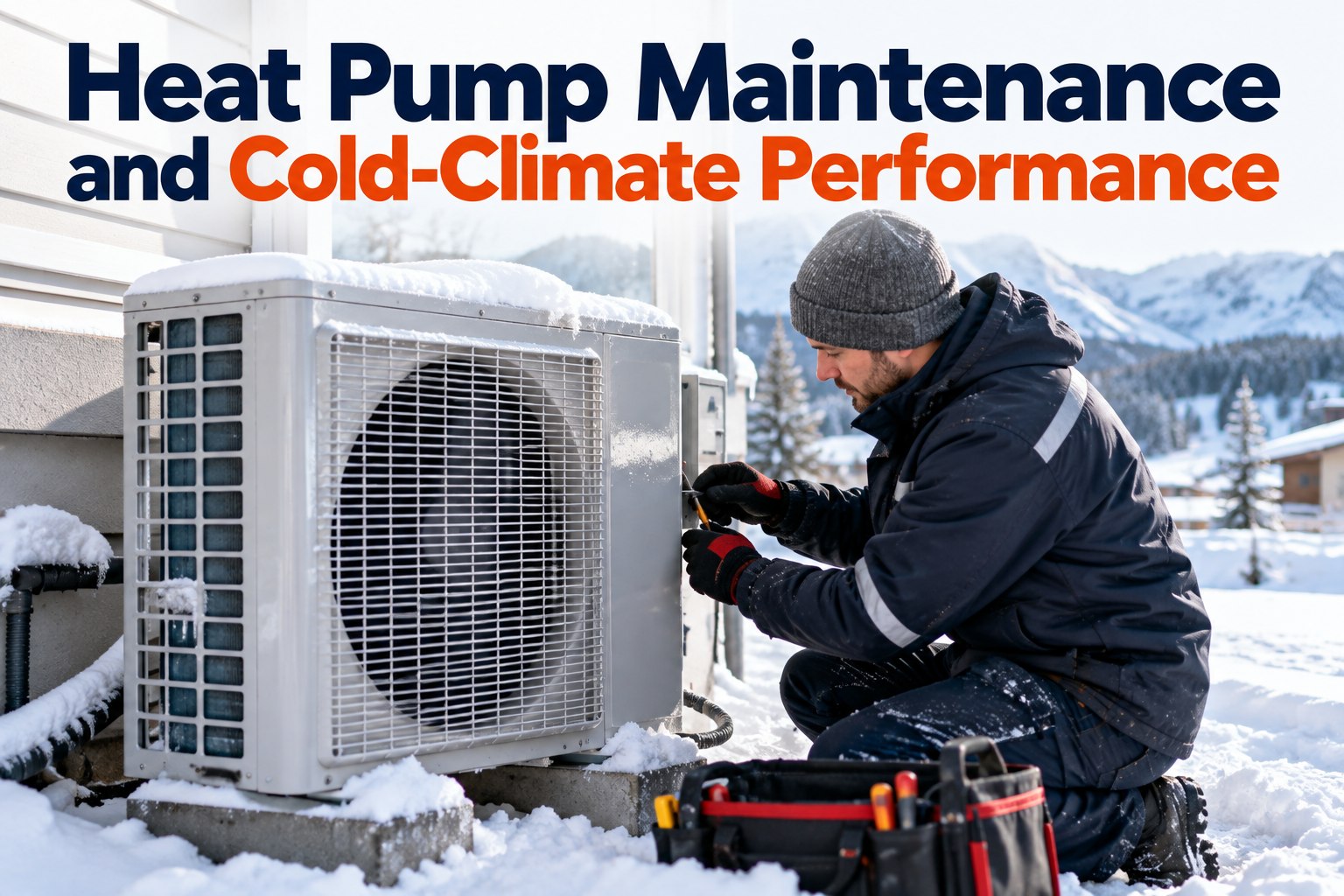
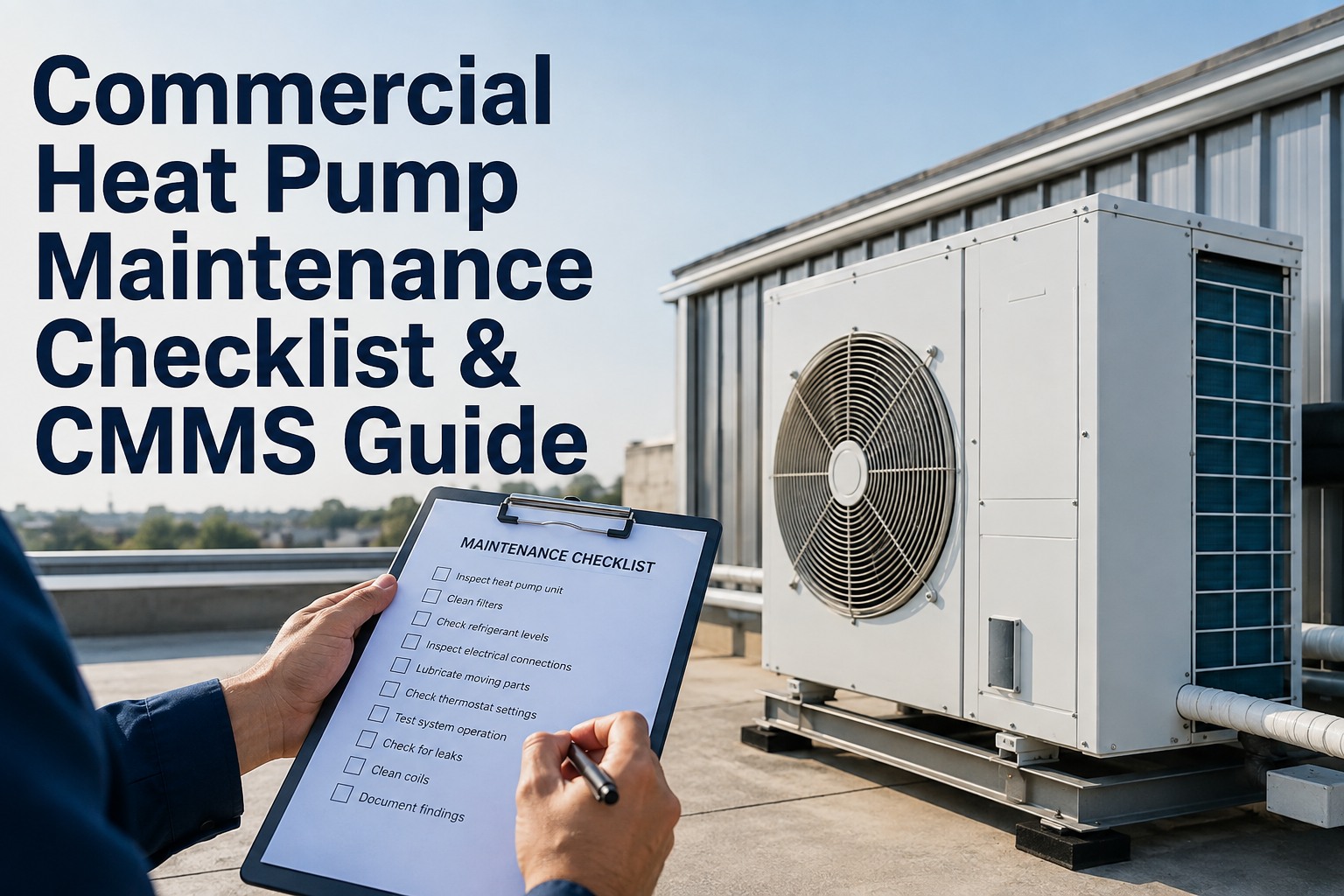
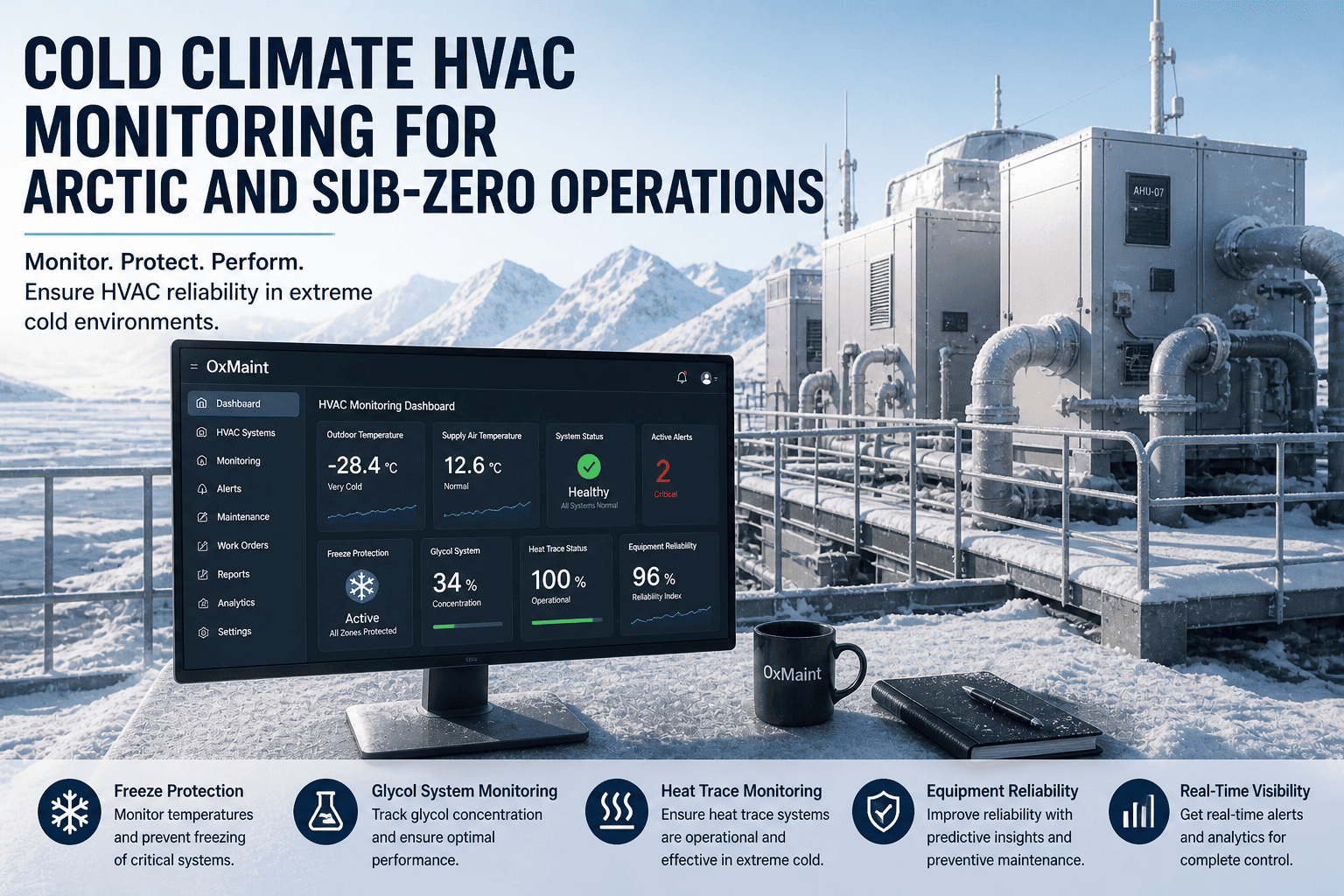
A heat pump that hums along all summer becomes a different machine at 5°F. It has to pull heat from air that barely has any, frost keeps forming on the coil it's trying to draw from, and a backup heat source has to know exactly when to step in — none of which a cooling-only unit ever deals with. As electrification pushes heat pumps into buildings across cold regions, facility teams are inheriting equipment whose hardest season is the one it's now expected to carry. The difference between a heat pump that delivers comfort through winter and one that runs up a shocking electric bill on emergency heat comes down to maintenance built for the cold. OxMaint AI maintenance management software schedules those cold-weather tasks and logs the readings that prove the system is ready before the first freeze.
Facility Management · HVAC · Heat Pump · Cold-Climate Maintenance · 2026
Keep the Heat Pump Delivering When the Temperature Drops Below Its Comfort Zone
In the cold, a heat pump fights physics — thinner heat in the air, frost on the coil, and a backup source that must engage at exactly the right moment. Maintenance built for mild weather misses all of it, and the cost shows up as emergency heat running all winter. OxMaint AI schedules defrost verification, low-ambient charge checks, and backup-heat coordination as seasonal tasks, and logs the readings so a struggling unit is caught before the cold exposes it.
1Pre-winter inspection
→
2Verify defrost & charge
→
3Coordinate backup heat
→
4Log & monitor through winter
3–5 / day
normal defrost cycles in frost conditions, 3–5 min each
0–10°F
typical backup-heat lockout for a sized cold-climate unit
20–40°F
the frost-prone band where defrost runs most
18–24 in
clearance to keep the outdoor unit above snow
What the Cold Does to a Heat Pump
Four challenges appear only when it's cold — and each one is a maintenance task waiting to happen. Miss them and the unit leans on expensive backup heat. Start free and put each cold-weather task on a schedule in OxMaint AI.
Defrost Cycles
Frost forms on the outdoor coil and the unit must reverse to melt it — 3–5 times a day in frost weather. A stuck or too-frequent cycle wastes heat and signals a fault.
Falling Capacity
The colder the air, the less heat there is to pull. Capacity and COP both drop with temperature, so the unit works harder for less output.
Refrigerant Behaviour
Charge matters far more in the cold; even a slightly low charge shows up as excessive defrost and lost capacity when it's needed most.
Backup Heat Timing
Below the balance point, supplemental heat must engage — but if it locks in too early or stays on, the electric bill climbs for no reason.
The Capacity Curve: Why Winter Needs Its Own Plan
A heat pump's rated performance is measured at mild temperature — it isn't what you get at 5°F. This is roughly how capacity and efficiency fall as the air cools. Book a demo to trend cold-weather performance in OxMaint AI.
| Outdoor temp | Heating capacity | COP (efficiency) |
|---|
| 47°F | 100% | 4.0–4.5 |
| 30°F | 92–96% | 3.2–3.8 |
| 17°F | 85–90% | 2.8–3.2 |
| 5°F | 75–85% | 2.0–2.5 |
| 0°F | 70–80% | 1.8–2.2 |
| −13°F | 60–70% | 1.5–1.8 |
Even at their coldest a good unit still moves more heat than resistance alone — but only if it's maintained. A fouled coil or low charge drops it below this curve fast. Start free and keep every unit on its curve in OxMaint AI.
The Emergency-Heat Bill Is the Sound of Maintenance Skipped.
When a heat pump can't keep up, backup resistance heat carries the load — at a fraction of the efficiency. Most of that fallback isn't the cold's fault; it's a dirty coil, a low charge, or backup heat locking in too early. OxMaint AI catches all three on a schedule, before the meter does.
The Cold-Climate Maintenance Tasks
Ordinary HVAC PM doesn't cover what a heat pump needs for winter. These are the tasks that keep it delivering heat instead of leaning on backup. Start free and schedule each as a recurring task in OxMaint AI.
Defrost Cycle Verification
Confirm the unit defrosts and returns to heating cleanly. Watch for the fault signature: defrosting every 20–30 minutes, or a cycle lasting 15+ minutes.
Low-Ambient Charge Check
Verify refrigerant charge to spec before the cold hits — an undercharge that's invisible in mild weather cripples capacity at low ambient.
Backup Heat Coordination
Check the balance point and set the backup-heat lockout near it (typically 0–10°F) so resistance heat carries only the load the pump truly can't.
Coil & Airflow
Clean the outdoor coil and check airflow — a fouled coil frosts faster, defrosts more, and drops the unit below its capacity curve.
Outdoor Unit Placement
Keep the unit elevated 18–24 inches above expected snow with clearance all around, so drifts and meltwater don't block or ice the coil.
Sensors & Controls
Verify the defrost sensor and thermostat staging — a faulty sensor is a top cause of abnormal defrost and wasted backup heat.
Normal vs. Trouble: Reading the Defrost Cycle
Defrost is supposed to happen — the skill is telling routine from a fault. Steam off the outdoor unit is normal; the pattern below is not. Book a demo to log defrost behaviour per unit in OxMaint AI.
NORMAL
3–5 defrost cycles per day in frost weather
Each cycle lasts about 3–5 minutes
Steam rising from the outdoor unit
Briefly cooler air, then heat resumes
Rare defrost below 20°F (drier air)
TROUBLE
Defrosting every 20–30 minutes
A cycle lasting 15+ minutes
Ice building on the coil, not clearing
Backup heat running constantly
Likely cause: low charge or faulty sensor
How OxMaint AI Runs Cold-Climate Heat Pump Maintenance
The tasks are seasonal and the failures are gradual — exactly what a scheduled, tracked program is built for. OxMaint AI makes winter readiness routine. Start free and turn cold-weather PM into a running program.
Seasonal PM Scheduling
Pre-winter inspection, defrost check, and charge verification raised on the calendar before the first freeze — not after a complaint.
Defrost & Reading Logs
Defrost behaviour, charge, and staging logged per unit, so an abnormal pattern is a record, not a guess.
Backup-Heat Tracking
Balance point and lockout settings recorded, so runaway resistance heat gets caught and corrected.
Fault-to-Work-Order
An abnormal defrost or a low charge becomes a corrective work order the moment it's logged.
Performance Trend
Unit output trended against the capacity curve, so a slow decline shows before winter exposes it.
Full Unit History
Every seasonal check and repair on one timeline — the record behind reliable winter heat.
Frequently Asked Questions
How often should a heat pump defrost in winter?
What is the balance point?
The outdoor temperature where the heat pump's output exactly matches the building's heat loss. Below it, backup heat is needed — for a sized cold-climate unit that's often around 0–10°F.
Book a demo of backup-heat coordination.
Why does my heat pump lose capacity in the cold?
Colder air holds less heat to extract, so both capacity and COP fall as temperature drops — from full output near 47°F to roughly 60–70% at −13°F for a cold-climate unit.
Sign up free and trend each unit's curve.
Why is my backup heat running so much?
Often a maintenance issue, not the cold — a dirty coil, low charge, or a backup lockout set too warm makes resistance heat carry load the pump could handle.
Book a demo of backup-heat tracking.
How does a CMMS help with cold-climate heat pumps?
OxMaint AI schedules the seasonal tasks, logs defrost and charge readings per unit, tracks backup-heat settings, and turns faults into work orders — so the unit is ready before winter.
Start free and see it work.
Make Winter Readiness a Task, Not a Gamble.
A heat pump's hardest work happens on the coldest day, and that's the worst time to discover a low charge or a stuck defrost. Cold-climate maintenance — defrost verified, charge checked, backup heat tuned, coil clean — is what keeps the unit delivering comfort instead of falling back on the meter. OxMaint AI schedules every cold-weather task, logs the readings, and flags the faults, so the heat pump meets winter ready and the emergency-heat bill never arrives.