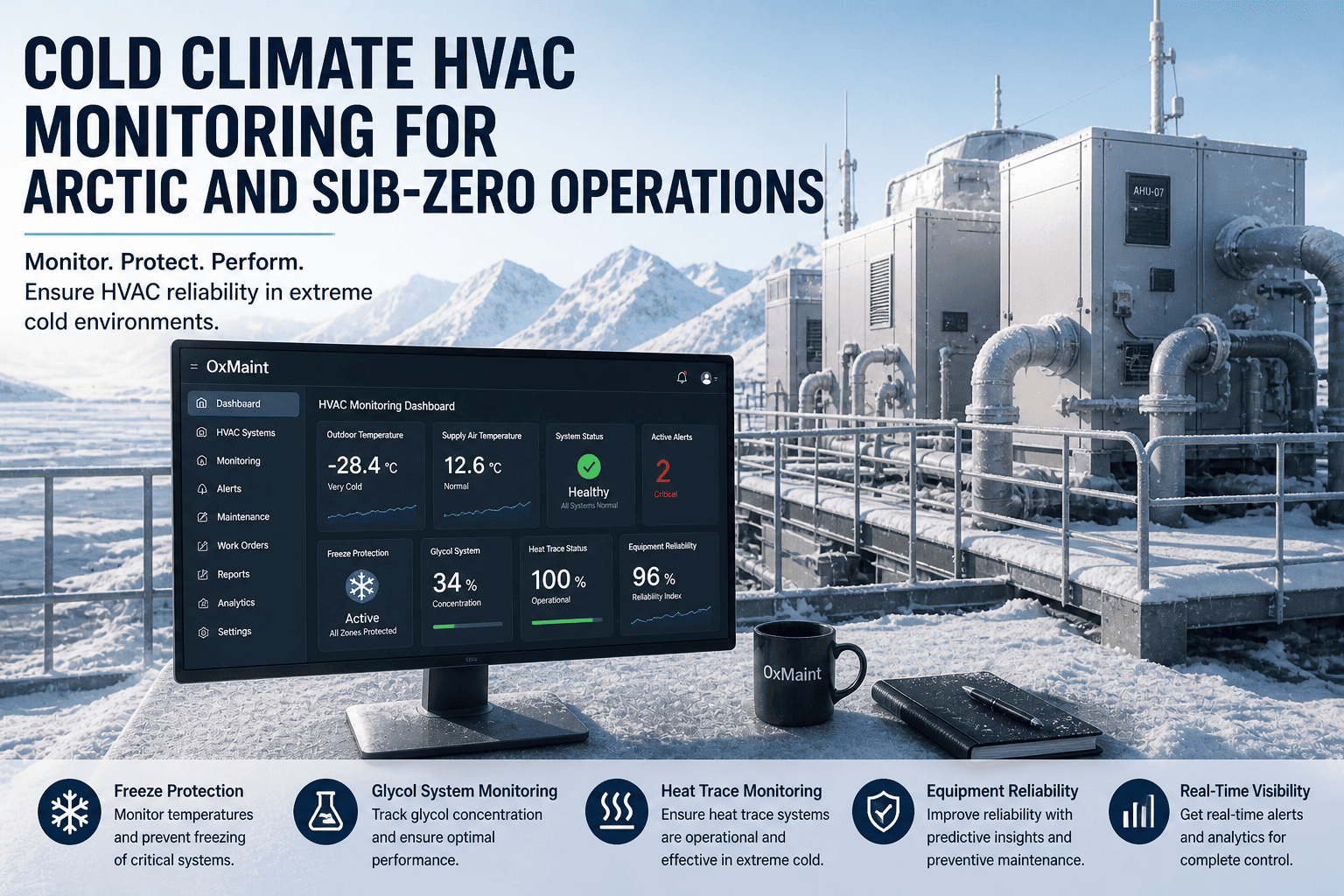
At minus 40°C, an HVAC system failure is not an inconvenience — it is a life-safety event. Arctic and sub-zero facilities — mining camps, remote industrial sites, northern data centres, and cold-region municipal buildings — operate HVAC equipment under thermal stress conditions that have no equivalent in temperate climates. Freeze protection failures, glycol degradation, and heat trace outages can progress from undetected fault to burst pipe in under six hours when ambient temperatures are extreme. OxMaint's CMMS preventive maintenance platform is configured for extreme cold operations — tracking glycol concentration schedules, heat trace circuit status, freeze stat calibration, and equipment start reliability across every asset exposed to sub-zero risk.
Article · Extreme Climate HVAC · Preventive Maintenance
Cold Climate HVAC Monitoring for Arctic and Sub-Zero Operations
Freeze Protection · Glycol Systems · Heat Trace Monitoring · Equipment Reliability at −40°C and Below
Ambient
−42°C
Extreme Cold Protocol Active
Glycol Supply
−52°C FP
Protection Adequate
Heat Trace Circuits
14 / 16
2 Circuits — PM Overdue
AHU Start Reliability
97.4%
Within Target
Cold climate HVAC failures escalate 3× faster than temperate-climate failures — freeze damage progresses from pipe frost to burst in under 6 hours at −40°C
−60°C
Lowest ambient temperature OxMaint-monitored HVAC systems operate in
6 hrs
Maximum window from undetected freeze fault to structural pipe damage
30%
Glycol concentration loss over 12 months without scheduled testing
4×
Higher equipment failure rate in unmonitored cold-climate HVAC vs monitored
The 5 Critical Failure Modes in Arctic and Sub-Zero HVAC
01
Glycol Concentration Degradation
Propylene and ethylene glycol solutions degrade through oxidation, pH shift, and additive depletion over 12–24 months of operation. A glycol mix that tested at −50°C freeze protection at installation may provide only −35°C protection two years later without scheduled concentration testing and replenishment. OxMaint schedules glycol testing work orders at configurable intervals — default every 6 months for extreme cold environments — and flags when test results fall below the freeze protection threshold for the recorded ambient low at that site.
02
Heat Trace Circuit Failure
Electric heat trace circuits protect exposed pipe runs, valve bodies, and instrument lines from freeze-up. A failed heat trace circuit is invisible until the pipe it protects reaches its freeze temperature — at which point the damage is already done. Annual continuity testing, amperage verification, and thermostat calibration checks are the PM tasks that prevent heat trace failures, and OxMaint auto-schedules these before each cold season entry.
03
Freeze Stat Miscalibration
Freeze protection thermostats that trip AHUs and close dampers when coil temperatures approach freezing must be calibrated to within ±1°C of their set point. A freeze stat calibrated 3°C high will allow coil temperatures to approach freeze conditions before tripping — potentially causing coil damage. OxMaint schedules annual freeze stat calibration checks before the cold season with a work order that requires a calibration certificate upload before closure.
04
Cold-Start Equipment Failure
Lubricants thicken at extreme temperatures, belt drives stiffen, and bearing clearances tighten — making cold-start reliability a measurable maintenance KPI in sub-zero operations. Tracking first-attempt start success rate per AHU and fan unit reveals which assets are developing cold-start problems weeks before they become start failures. OxMaint records cold-start outcomes in work order data and calculates first-attempt start reliability by asset.
05
Ductwork and Damper Seal Failure
Outdoor air damper seals harden and crack below −30°C, allowing infiltration of sub-zero air into supply air streams that overwhelm coil freeze protection. Annual damper seal inspection and replacement before cold season entry — tracked in OxMaint as a recurring PM — prevents the progressive air seal degradation that accelerates freeze risk throughout the heating season.
Cold Climate PM Schedule — OxMaint Configuration
| PM Task |
Trigger Basis |
Cold Climate Interval |
Failure Risk if Missed |
| Glycol concentration & pH test |
Calendar |
Every 6 months |
Freeze protection loss — pipe burst |
| Heat trace continuity & amperage check |
Pre-season |
Annual (Oct–Nov) |
Undetected circuit failure — freeze event |
| Freeze stat calibration verification |
Pre-season |
Annual (Oct–Nov) |
Coil freeze — AHU out of service |
| Outdoor damper seal inspection |
Pre-season |
Annual (Sep–Oct) |
Cold air infiltration — freeze risk elevated |
| Lubricant specification winter changeover |
Temperature trigger |
When ambient forecast below −20°C |
Cold-start bearing failure |
| Belt pre-tension check |
Pre-season |
Annual |
Belt snap on first cold-season start |
| Drain line heat trace verification |
Calendar |
Every 3 months |
Blocked drain — coil water retention — freeze |
"
Cold climate HVAC is a different discipline from temperate HVAC. The tolerance for missed maintenance is near zero because the consequences of a freeze event at a remote Arctic site are not a call to a local contractor — they are a multi-day response, potential building shutdown, and pipe damage that can cost $50,000 to $200,000 to remediate depending on the site. Every PM task I configure in OxMaint for cold climate installations is scheduled before it matters — glycol testing in October, heat trace checks in November, freeze stat calibration before the first hard frost. When OxMaint flags a missed heat trace circuit test on my dashboard in October, I have time to act. If I discover it in January when the circuit fails, I do not. That lead time is the entire value of a monitored maintenance programme in extreme cold environments.
Erik Sundqvist, P.Eng
Mechanical Engineering Lead — Arctic and Northern Industrial Facilities · 17 Years HVAC Design and Maintenance in Subarctic and Arctic Environments · Professional Engineer (APEGA) · Specialising in freeze protection systems, cold climate CMMS deployment, and remote facility mechanical reliability for mining, oil & gas, and infrastructure clients
Sub-Zero HVAC Failures Don't Give Warning. Your PM Schedule Has To.
OxMaint schedules glycol testing, heat trace checks, and freeze stat calibration automatically before every cold season — so your team acts before the temperature drops, not after the pipe bursts.
Glycol Freeze Protection Reference — Concentration vs Temperature
Frequently Asked Questions
How does OxMaint handle PM scheduling for sites with seasonal temperature extremes?
OxMaint supports both calendar-triggered and temperature-triggered PM scheduling. Pre-season PM tasks — heat trace checks, freeze stat calibration, glycol testing — are configured as annual recurring work orders set to generate in September or October depending on site latitude and historical cold season onset. Temperature-triggered PMs can be configured to generate when ambient temperature forecast data crosses a defined threshold, such as scheduling lubricant winterisation work orders when ambient temperatures are projected to drop below −20°C. Remote site managers receive the work order on their mobile device regardless of location, with all relevant procedures and parts lists attached.
Start a free trial to configure your cold climate PM schedule.
Can OxMaint track glycol test results and freeze protection levels across multiple remote sites?
Yes. Glycol test results — concentration percentage, pH, freeze point, and inhibitor package condition — are entered as structured inspection readings in OxMaint's work order closure form. Results are stored against the specific system and asset, trend-tracked over time, and compared against site-configured freeze protection minimums. When a glycol test result shows concentration below the minimum for the recorded ambient low at that site, OxMaint automatically generates a glycol replenishment work order with the required top-up quantity calculated from the system volume record. Multi-site portfolio managers see all site glycol compliance statuses on a single dashboard.
Book a demo to see OxMaint's multi-site freeze protection dashboard.
What is the recommended monitoring interval for heat trace circuits in sub-zero environments?
For facilities operating below −30°C, heat trace circuit testing should be completed in full before the cold season — ideally in October for northern hemisphere sites — with a mid-season continuity spot check in January on circuits protecting the highest-risk pipe runs (domestic water, condensate, and drain lines). OxMaint's PM schedule for extreme cold sites typically includes: pre-season full circuit test (October), mid-season spot check on critical circuits (January), and a post-season inspection (April) to identify circuit damage from the heating season for summer remediation. All three are configured as auto-generating recurring PMs with the relevant checklist and pass/fail criteria embedded in the work order.
Explore OxMaint's heat trace PM configuration with a free trial.
OxMaint · Cold Climate HVAC Monitoring
At −40°C, Missed Maintenance Doesn't Wait for the Next Inspection. Neither Should Your PM System.
OxMaint's preventive maintenance platform schedules every cold-climate HVAC task — glycol testing, heat trace checks, freeze stat calibration, and cold-start reliability tracking — before the season demands them.