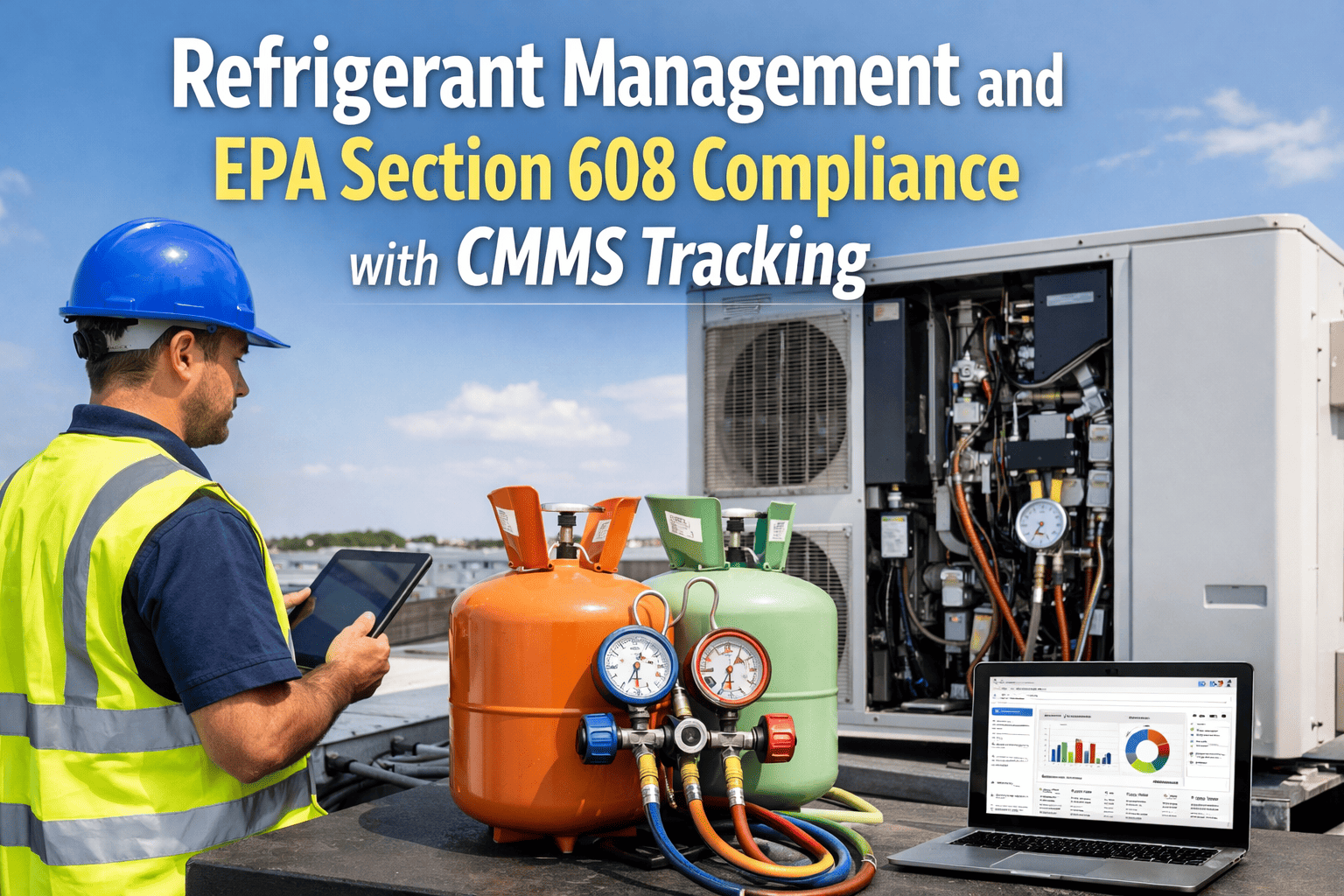
EPA refrigerant compliance isn't a once-a-year reporting exercise—it's a continuous obligation embedded in every HVAC service event your team or contractors perform. Every time someone opens a refrigerant circuit, adds a pound of R-410A, recovers refrigerant from a decommissioned system, or repairs a leak on a commercial chiller, there's a compliance record that must be created, linked to the right equipment, and retained for a minimum of three years. Miss any of these touchpoints and you've created an enforcement gap that carries penalties up to $44,539 per day per violation. The problem isn't that facility managers don't care about compliance. It's that the compliance data has to come from the same people doing the maintenance work—technicians in the field with wrenches in their hands, not clipboards. Paper-based tracking systems, standalone spreadsheets, and after-the-fact record reconstruction create exactly the documentation gaps that EPA inspectors are trained to find. A Computerized Maintenance Management System built for refrigerant compliance changes this equation entirely. When compliance data capture is embedded in the work order workflow—when technicians can't close a service event without logging the refrigerant type, quantity, and equipment ID—the compliance record becomes an automatic byproduct of doing the work, not an additional administrative burden that depends on someone remembering to fill out a form after the fact. That's the difference between a compliance program that works and one that looks good on paper until the inspector arrives.
The Compliance Reality
78% of Facilities Have Refrigerant Compliance Gaps They Don't Know About
EPA enforcement actions consistently reveal the same pattern: facilities believe they're compliant because work is being done—but the documentation trail has holes that turn routine inspections into violations.
$44,539
Per day, per violation — maximum EPA civil penalty
3 years
Minimum record retention — available for inspection without notice
30 days
Maximum time to repair leaks exceeding EPA threshold rates
The Seven EPA Compliance Requirements a CMMS Must Address
EPA Section 608 defines specific obligations for anyone who owns or operates equipment containing refrigerant. A CMMS built for refrigerant compliance must capture, calculate, track, and report against all seven requirements—not as a bolt-on module, but as an integral part of the standard maintenance workflow. Facilities that sign up to manage their HVAC maintenance on a compliance-ready platform close the documentation gaps that manual systems inevitably create.
Equipment Registration & Refrigerant Inventory
EPA requires: Identification of all appliances containing 50+ lbs of refrigerant
CMMS solution: Asset registry with refrigerant type, design charge, location, installation date, and current charge level linked to every work order. Every system with 50+ lbs is flagged for Section 608 compliance tracking automatically.
Refrigerant Transaction Logging
EPA requires: Records of all refrigerant added to and recovered from each system
CMMS solution: Mandatory data fields on HVAC work orders capture refrigerant type, quantity added or recovered, date, and technician for every service event. Work orders cannot be completed without these fields—eliminating incomplete records.
Leak Rate Calculation & Monitoring
EPA requires: Annualized leak rates tracked; action required when thresholds exceeded (15% commercial refrigeration, 30% comfort cooling)
CMMS solution: Automatic 12-month rolling leak rate calculation after every refrigerant addition. Real-time threshold monitoring with instant alerts when systems exceed applicable rates. Dashboard visibility of all system leak rates across the portfolio.
Leak Repair & Verification Tracking
EPA requires: Leak repairs completed within 30 days of exceeding threshold; verification test confirming successful repair
CMMS solution: Auto-generated leak repair work orders with 30-day compliance countdown. Follow-up verification work orders scheduled automatically. Escalation alerts if deadlines approach without completed repair documentation.
Technician Certification Management
EPA requires: Only EPA Section 608 certified technicians handle refrigerant
CMMS solution: Technician profile database storing certification type, number, and expiration date. Work order assignment validation ensures only certified technicians are assigned refrigerant work. Automatic renewal alerts 60 days before expiration.
Recovery & Disposal Documentation
EPA requires: Records of refrigerant recovered during service and decommissioning, with certified recovery equipment
CMMS solution: Recovery tracking fields on every service and decommissioning work order. Recovery equipment certification records linked to service events. Disposal documentation chain-of-custody from recovery through reclamation or destruction.
Record Retention & Audit Readiness
EPA requires: All records retained for minimum 3 years and available for inspection on demand
CMMS solution: Permanent digital record storage with automatic retention policies. Complete audit package—every service record, transaction, leak rate, certification, and disposal record—exportable on demand in minutes.
Manual Tracking vs. CMMS: Where Compliance Breaks Down
The gap between manual and CMMS-based compliance isn't about effort—it's about reliability. Spreadsheets and paper systems depend on human consistency under field conditions. A CMMS enforces consistency by design, capturing compliance data as a required part of completing maintenance work.
Replace Compliance Gaps with Compliance Certainty
OxMaint embeds EPA refrigerant compliance directly into the HVAC maintenance workflow — every service event captures the data, calculates the rates, tracks the deadlines, and builds the audit trail automatically.
CMMS Compliance Workflow: Step by Step
The power of CMMS-based compliance is that the workflow is the compliance program. Technicians perform their normal maintenance work; the system captures the compliance data as a natural byproduct. No extra forms, no separate processes, no remembering to log something later.
Work Order Created
HVAC service request triggers work order linked to equipment asset record. System pre-populates refrigerant type, current charge, last service date, and current leak rate from equipment history.
Technician Validated
System confirms assigned technician holds valid EPA Section 608 certification for the refrigerant class. Blocks assignment if certification is expired or missing.
Refrigerant Data Captured
Technician logs refrigerant activity on mobile device: pounds added, pounds recovered, cylinder ID, service performed. Required fields enforce completeness — work order stays open until all data is entered.
Leak Rate Auto-Calculated
System instantly recalculates 12-month rolling leak rate for the serviced equipment. If the updated rate exceeds the applicable EPA threshold, the system flags it immediately — not weeks or months later.
Compliance Actions Triggered
If leak rate exceeds threshold: auto-generated repair work order with 30-day deadline, manager notification, and compliance countdown timer. If threshold not exceeded: clean record, updated equipment history, audit trail complete.
Verification & Record Finalized
After leak repair: system schedules verification test work order. After verification passes: compliance record closes. If verification fails: re-escalation for additional repair. Complete chain documented end-to-end.
The Five CMMS Features That Make or Break Refrigerant Compliance
Not every CMMS handles refrigerant compliance well. The features that separate a compliance-ready platform from a generic work order system are specific to the regulatory requirements of EPA Section 608 and the operational realities of HVAC service delivery.
Mandatory Refrigerant Data Fields
Work orders for HVAC systems must require refrigerant type, quantity, and equipment ID as mandatory fields that cannot be bypassed. Optional fields get skipped 40–60% of the time under field conditions. Mandatory fields get completed 100% of the time because the work order won't close without them.
Why it matters: Every incomplete record is a potential compliance gap. Mandatory fields eliminate incomplete records by design.
Automatic Leak Rate Calculation
The system must calculate annualized leak rates automatically after every refrigerant addition—using the EPA formula (total additions over 12 months ÷ full charge × 100). Manual calculation introduces errors and delays that allow threshold exceedances to go undetected for months.
Why it matters: EPA counts from the date the threshold was exceeded, not the date you discovered it. Real-time calculation prevents unknowing non-compliance.
Automated Compliance Work Order Generation
When a system exceeds the leak rate threshold, the CMMS must automatically generate a repair work order with the 30-day deadline, schedule verification follow-up after repair, and escalate to management if deadlines approach without completion. Manual triggering introduces delays that consume the compliance window.
Why it matters: The 30-day clock starts ticking automatically—your response system must also start automatically.
Technician Certification Tracking
The system must store EPA Section 608 certification records for every technician—internal and contractor—and validate certification status before allowing refrigerant work order assignment. Expiration alerts must trigger renewal reminders well before certificates lapse.
Why it matters: Using uncertified technicians is a separate violation from any refrigerant handling issue—and the facility owner bears responsibility regardless of contractor claims.
On-Demand Audit Report Generation
Complete compliance audit packages—covering all service records, refrigerant transactions, leak rates, repair timelines, technician certifications, and recovery documentation—must be exportable in minutes, not days. When an inspector asks for records, the answer should be "give me five minutes," not "give me five days."
Why it matters: Slow record production during EPA inspection triggers deeper investigation. Instant production demonstrates a mature compliance program.
Implementation Roadmap: From Paper-Based to CMMS Compliance
Transitioning from manual refrigerant tracking to CMMS-based compliance doesn't require a multi-year IT project. Most facilities can be fully operational within 60–90 days using a structured implementation approach that delivers compliance value from the first week.
Week 1–2
Equipment Inventory & Baseline
Register every refrigerant-containing system in the CMMS: equipment type, location, refrigerant type, design charge, installation date, and current condition. Flag all systems with 50+ lbs for Section 608 compliance tracking. Import any existing service history and refrigerant records.
Outcome: Complete refrigerant asset registry — the foundation for all compliance tracking
Week 3–4
Workflow Configuration & Technician Setup
Configure HVAC work order templates with mandatory refrigerant data fields. Set leak rate threshold alerts for applicable system categories. Enter technician certification records for all internal and contractor personnel. Establish escalation chains for compliance deadline alerts.
Outcome: Compliance workflows active — every new service event captured correctly from day one
Week 5–8
Training & Field Deployment
Train technicians and contractors on mobile CMMS work order completion with refrigerant data entry. Run parallel operations (paper + CMMS) for 2 weeks to validate data capture. Resolve any field workflow issues and optimize mobile entry experience for service conditions.
Outcome: All HVAC service events flowing through CMMS with complete refrigerant compliance data
Week 9–12
Reporting Validation & Full Compliance Operation
Generate first compliance reports and verify accuracy. Test audit package export. Review leak rate dashboard for any systems exceeding thresholds. Confirm all automated work order triggers and escalations are functioning. Transition to full CMMS-based compliance operations.
Outcome: Audit-ready compliance program operating continuously with zero manual record-keeping
The 60–90 day implementation timeline means facilities can be fully compliant before their next EPA inspection cycle—and the compliance improvements begin from the very first work order processed through the system. Facilities that sign up to start their compliance implementation receive guided setup support to ensure the transition from manual tracking is smooth and complete.
ROI: CMMS-Based Compliance vs. Manual Tracking
$85K
Avoided EPA Penalty Exposure
Documented, automated compliance eliminates the recordkeeping gaps that drive enforcement actions
$55K
Refrigerant Cost Reduction
Leak rate visibility and timely repair reduce portfolio refrigerant consumption by 30–50%
$35K
Administrative Time Savings
Eliminates 150–300 hours annually of manual recordkeeping, spreadsheet reconciliation, and report preparation
$20K
Avoided Audit Remediation Costs
Always audit-ready eliminates $20K–$100K retroactive record reconstruction and emergency compliance projects
Expert Perspective: Why CMMS Is the Foundation for Refrigerant Compliance
"
I've investigated refrigerant compliance programs at over 200 facilities, and the single biggest predictor of compliance success is whether the refrigerant data capture is part of the maintenance workflow or separate from it. When it's separate—a standalone spreadsheet, a paper log, a quarterly report that someone assembles after the fact—compliance rates hover around 40–60%. When it's embedded in the CMMS work order—where the technician enters refrigerant data as part of closing the work order, and the system calculates leak rates and triggers repair deadlines automatically—compliance rates exceed 95%. The reason is simple: separate systems depend on discipline and memory. Integrated systems depend on process design. In the field, under time pressure, process design wins every time. The CMMS doesn't just store compliance data—it enforces the workflow that creates compliance data. That's the difference between a compliance program that works and one that falls apart the moment someone forgets to fill out a form.
Make refrigerant fields mandatory on work orders—optional fields create compliance gaps
Automate leak rate calculations—manual math introduces errors and delays
Include contractors in the CMMS workflow—their compliance gaps are your compliance gaps
Test your audit readiness quarterly—export a full compliance package and review for gaps
Whether you're starting from scratch with paper-based tracking or upgrading from a CMMS that doesn't handle refrigerant compliance natively, the transition to an integrated compliance workflow pays for itself within weeks—and eliminates the audit anxiety that comes with knowing your records have gaps. If you're ready to build a compliance program that works, book a free demo to see how CMMS-based refrigerant compliance works in practice.
Compliance Isn't Paperwork. It's Workflow. Build It Right.
OxMaint is the CMMS built for refrigerant compliance—mandatory data fields, automatic leak rate calculations, 30-day repair tracking, technician certification management, and audit-ready reporting. Every service event builds your compliance record automatically.
Frequently Asked Questions
What specific EPA regulations does a CMMS help comply with?
A compliance-ready CMMS addresses the core requirements of EPA Section 608 of the Clean Air Act, which governs the management of refrigerants in stationary equipment. Specific regulations covered include the prohibition on venting refrigerants (enforced through proper recovery documentation), requirements for leak repair within 30 days of exceeding applicable thresholds (15% for commercial refrigeration, 30% for comfort cooling), mandatory use of EPA Section 608 certified technicians for all refrigerant handling, requirements for certified recovery equipment, recordkeeping obligations for all systems containing 50 or more pounds of refrigerant, and three-year record retention with availability for EPA inspection. Additionally, a CMMS supports compliance with the AIM Act phase-down requirements by tracking refrigerant consumption in GWP-weighted quantities and supporting transition planning away from high-GWP HFCs. For facilities in states with additional requirements like California's CARB program, the CMMS can be configured to track state-specific obligations including stricter leak rate thresholds and automatic leak detection requirements.
How does a CMMS handle contractor-performed HVAC service?
Contractor integration is critical because the facility owner bears compliance responsibility regardless of who performs the work. A compliance-ready CMMS handles contractor service through several mechanisms. First, contractor technicians are registered in the system with their EPA Section 608 certification records, ensuring only certified personnel are assigned to refrigerant work orders. Second, contractors use mobile access to the CMMS to log refrigerant data directly during service events—the same mandatory fields apply whether the technician is internal or external. Third, contractor work orders are subject to the same automatic leak rate calculations and threshold alerts as internal work. Fourth, the system maintains a complete audit trail linking every service event to the specific contractor and technician who performed the work, their certification status at the time of service, and the refrigerant quantities handled. This eliminates the common compliance gap where facilities assume contractors handle their own compliance documentation—a dangerous assumption that EPA does not recognize as a defense.
How long does it take to implement a CMMS for refrigerant compliance?
Most facilities achieve full CMMS-based compliance operations within 60–90 days using a structured implementation approach. The timeline breaks down as follows: weeks 1–2 for equipment inventory and baseline data entry (registering all refrigerant-containing systems, importing historical service records), weeks 3–4 for workflow configuration (setting up mandatory data fields, leak rate thresholds, alert escalations, and technician certification records), weeks 5–8 for training and field deployment (technician training on mobile data entry, parallel operations to validate data capture, workflow optimization), and weeks 9–12 for reporting validation and full operation (verifying compliance reports, testing audit package export, confirming all automated triggers). Cloud-based CMMS platforms like OxMaint can be significantly faster because there is no on-premise infrastructure to deploy—the system is ready for configuration from day one. The most time-consuming step is typically the initial equipment inventory if no digital records exist, but even this can be completed in 1–2 weeks for portfolios of 50–200 systems.
What happens if we already have a CMMS that doesn't track refrigerant data?
Many facilities use a general-purpose CMMS for work order management but lack the refrigerant-specific features needed for EPA compliance. In this situation, you have three options. First, check whether your current CMMS can be configured with custom fields for refrigerant tracking—some platforms allow adding mandatory data fields to work order templates. However, this approach typically lacks the automatic leak rate calculation, threshold alerting, and compliance workflow automation that purpose-built solutions provide. Second, supplement your existing CMMS with a dedicated refrigerant tracking module that integrates through API connections—this preserves your investment in the current system while adding compliance-specific capability. Third, transition to a CMMS that includes native refrigerant compliance features as part of the standard HVAC maintenance workflow—this provides the most seamless integration between maintenance operations and compliance documentation. The key evaluation criterion is whether refrigerant data capture is truly embedded in the work order completion workflow with mandatory fields, or whether it exists as a separate, optional process that technicians can skip.
Can a CMMS help us prepare for an EPA inspection?
A compliance-ready CMMS transforms EPA inspection preparation from a weeks-long scramble into a five-minute report export. The system maintains a continuously updated audit package that includes a complete equipment inventory with refrigerant types and charge levels, all refrigerant transaction records (additions, recoveries, disposals) linked to specific equipment and technicians, calculated leak rates for every system with a complete history of threshold exceedances and repair documentation, technician certification records with validation timestamps proving certification was current at the time of each service event, recovery equipment certification records, and chronological service histories for every system. When an inspector requests records—often with little or no advance notice—you can produce the complete package immediately from a single system rather than spending days reconstructing it from contractor invoices, purchase orders, and filing cabinets. This immediate response capability itself demonstrates compliance maturity and typically results in shorter, less invasive inspections. Facilities should conduct quarterly internal audits by exporting and reviewing their own compliance package to identify and correct any gaps before EPA does.