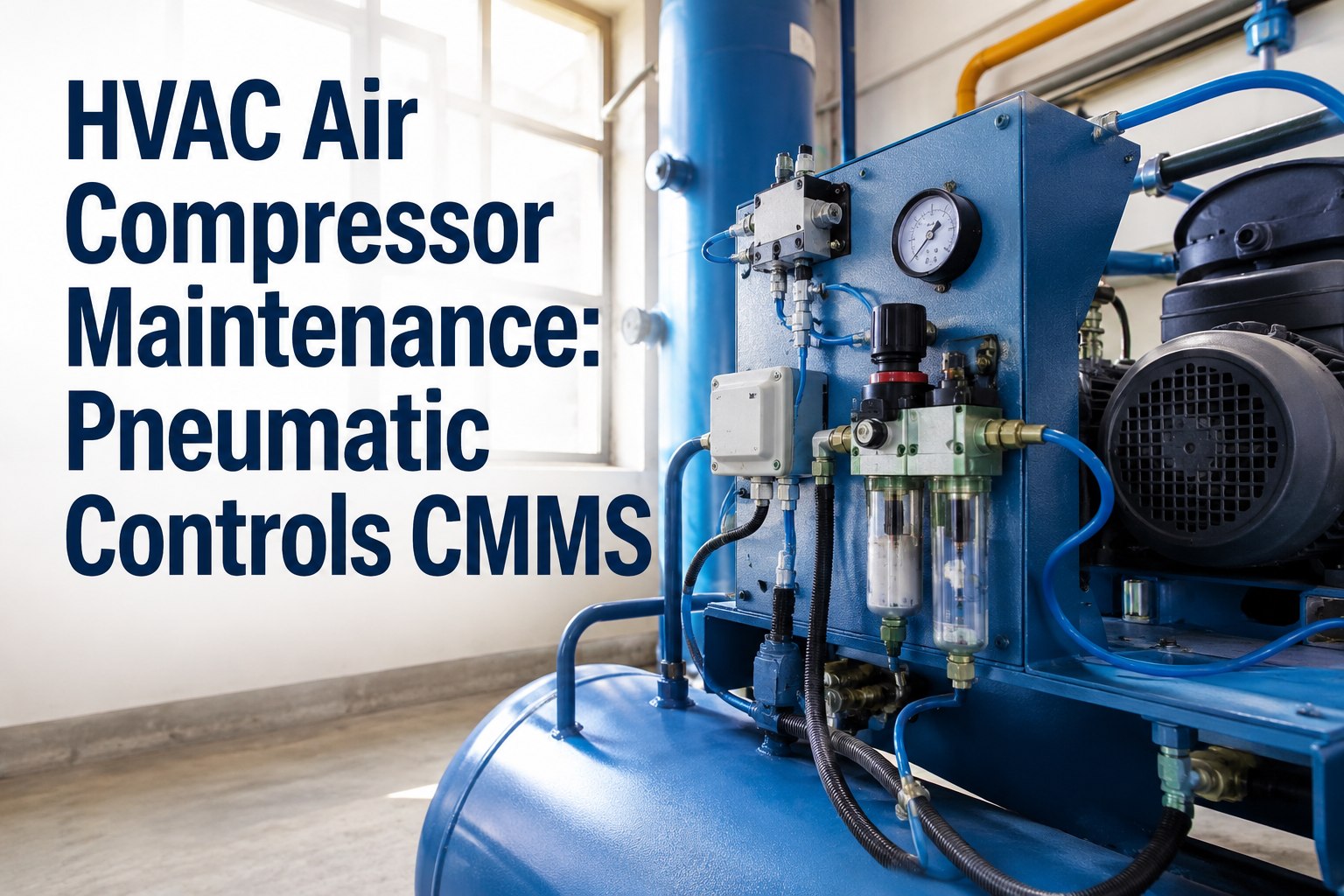
Proper HVAC air compressor maintenance is the backbone of reliable pneumatic control systems, ensuring that building automation components like valves and actuators receive clean, dry, and consistent instrument air. Failing to maintain compressor dryers, replace coalescing filters, and calibrate pressure switches leads to moisture ingress, frozen control lines, and costly system downtime. This HVAC pneumatic guide covers everything from daily air compressor checklists to advanced CMMS-based compressed air management. Ready to modernize your maintenance program? You can Start Free Trial today and digitize your entire preventive maintenance workflow.
HVAC Pneumatic Control Compressor Guide
Is moisture and pressure drop silently killing your HVAC pneumatic controls?
A single failed compressor pressure switch or clogged filter can starve pneumatic actuators, freezing dampers and shutting down air handling units across an entire facility. Take control with a structured, CMMS-driven air compressor maintenance program.
are linked to poor moisture control and neglected filter maintenance in HVAC applications.
The Real Cost of Neglect
Why HVAC pneumatic control air compressors fail prematurely
Pneumatic HVAC controls rely on a pristine supply of instrument air. When maintenance teams operate without a structured air compressor checklist, contaminants bypass the intake, desiccant dryers saturate, and pressure switches fall out of calibration. The result is a cascading failure: moisture rusts internal actuator springs, scale blocks restrictor orifices, and dampers seize in the closed position—forcing air handlers to work harder and driving up energy costs by 15-30%.
Preventive Maintenance
The complete HVAC air compressor maintenance checklist
Use this tiered air compressor checklist to structure your preventive maintenance program. Each tier corresponds to a specific interval, ensuring that both routine wear items and critical calibration targets are hit on schedule.
Operational Checks
- Drain receiver tank of condensate manually or verify auto-drain operation
- Inspect compressor oil level and top up if below sight glass
- Check discharge pressure against setpoint (typically 80-100 PSIG)
- Listen for abnormal vibration, knocking, or leaking solenoid valves
- Verify pneumatic thermostat supply lines for steady airflow
Filtration & Dryer
- Replace coalescing filter elements (5-micron primary, 0.01-micron secondary)
- Inspect refrigerated air dryer condenser coils and clean cooling fins
- Test desiccant beads in twin-tower dryers for saturation (color change)
- Clean compressor intake filter element and assess element housing
- Verify dryer dew point is holding at or below 35°F (1.6°C)
Calibration & Overhaul
- Calibrate compressor pressure switch cut-in and cut-out thresholds
- Change compressor lubricating oil and spin-on oil filter
- Conduct ultrasonic leak detection across all pneumatic control lines
- Test safety relief valve (SRV) lift pressure and reseat function
- Inspect drive belts for tension, wear, and alignment
Worked Example
The math behind proactive compressor dryer maintenance
Consider a 180-asset commercial facility running a 15 HP pneumatic control compressor 24/7. Without a CMMS to enforce an air compressor maintenance program, they only change dryer filters reactively. They average 3 major actuator failures per year at $4,000 each and waste 20% extra energy.
By shifting from reactive to preventive maintenance using an HVAC compressor CMMS, this facility eliminates 80% of downtime, reduces energy waste, and pays for the software subscription in under two months.
Software Solution
How an HVAC compressor CMMS transforms your maintenance program
OxMaint digitizes your entire HVAC air system guide, turning paper logs and tribal knowledge into a data-driven, automated maintenance engine. Stop relying on calendar reminders that get ignored—OxMaint triggers work orders based on runtime hours and actual equipment condition.
Automated Preventive Triggers
Schedule compressor dryer maintenance and filter replacements based on runtime hours or calendar intervals—eliminating missed PMs and cutting unplanned downtime by 30-50%.
Predictive Pressure Analytics
Track pressure switch cycles and discharge trends. OxMaint's AI flags anomalies in compressed air consumption before they lead to seized pneumatic HVAC controls.
Spare Parts & Inventory
Auto-decrement coalescing filters, desiccant, and compressor oil from inventory. Ensure critical spares are always in stock to keep your air compressor program running.
Mobile Audit Readiness
Technicians complete digital air compressor checklists on mobile devices with photo attachments, generating timestamped compliance logs for ISO 55000 and internal audits.
See OxMaint on your assets — book a 30-min demo
Discover how maintenance teams use OxMaint to automate HVAC air compressor maintenance, predict control failures, and eliminate paper work orders for good.
Implementation Timeline
Deploying your CMMS-based air compressor program in 90 days
Transitioning from spreadsheets to a fully automated pneumatic control maintenance program does not require a multi-year IT project. OxMaint is built for rapid deployment.
Asset & Data Onboarding
Import your HVAC compressor assets, pressure switch specs, and existing PM checklists into OxMaint. Map out pneumatic control zones and criticality rankings.
Automate & Dispatch
Configure automated work order triggers for filter replacements and dryer maintenance. Technicians begin using the mobile app to execute digital checklists with photo verification.
Analyze & Optimize
Leverage OxMaint analytics to review mean time between failures (MTBF) and energy consumption trends. Adjust PM intervals based on real-world data rather than guesswork.
Frequently Asked Questions
HVAC air compressor maintenance FAQs
How often should HVAC pneumatic control air compressor filters be replaced?
Coalescing filter elements should be replaced every 3 to 6 months, depending on the ambient air quality and compressor runtime. Intake filters should be inspected monthly and cleaned or replaced quarterly. Using a CMMS like OxMaint ensures these replacements are automatically triggered via work orders so they are never missed. Start Free Trial to automate these intervals today.
What is the correct pressure switch setting for a pneumatic HVAC control system?
Most pneumatic HVAC controls require a supply pressure of 80 to 100 PSIG. The compressor pressure switch should typically be set to cut in at 80 PSIG and cut out at 100-105 PSIG. It is critical to calibrate these switches annually, as drift can cause short-cycling, wasted energy, and premature valve wear.
Why is moisture in my HVAC pneumatic control lines, and how do I stop it?
Moisture occurs when the compressor's air dryer fails or is undersized, allowing humid ambient air to condense in cool control lines. To stop it, ensure your refrigerated or desiccant dryer is sized correctly, maintain a dew point below 35°F, and drain the receiver tank daily. Regular dryer maintenance scheduled through an HVAC compressor CMMS prevents moisture breaches.
Can a CMMS actually reduce compressed air energy costs in HVAC systems?
Yes. A CMMS reduces energy costs by ensuring intake filters are clean (clogged filters force the compressor to work harder) and by tracking air leaks through scheduled ultrasonic inspection work orders. Facilities using OxMaint typically see a 15-25% reduction in compressed air energy consumption within the first year.
What is the ROI of switching from paper checklists to a CMMS for compressor maintenance?
The ROI is usually achieved in under 90 days. By preventing just one major pneumatic actuator failure ($4,000+ cost) and reducing energy waste, the software pays for itself. You can Book a Demo to see a custom ROI breakdown for your facility.
Stop reacting to compressor failures. Start preventing them.
Join the maintenance teams using OxMaint to automate their HVAC air compressor maintenance, track pneumatic control health, and eliminate costly downtime.
Free 14-day trial · No credit card